
 VoIP
VoIP  Blog
Blog  Business Communication
  Customer Experience
  Leadership
  Marketing & Sales
  Nextiva News
  Productivity
Grasshopper is a popular virtual phone system for solopreneurs and small businesses, offering straightforward setup, call forwarding, business texting, and local, toll-free, and vanity numbers. But as businesses grow, these basic communication features may no longer be enough.
With 79% of customer experience (CX) leaders viewing customer service as a revenue driver, businesses increasingly need more advanced tools to manage customer interactions. Grasshopper’s limited integrations, collaboration features, and call routing capabilities can make it harder to scale efficiently.
Whether you need built-in video conferencing, CRM integrations, AI-powered call insights, or more flexible call management, there are plenty of Grasshopper alternatives worth considering.
In this guide, we compare 10 of the best Grasshopper alternatives and competitors for 2026, covering their pricing, features, strengths, and ideal use cases to help you find the right fit for your business.
Top 10 Grasshopper Alternatives at a Glance
Below is a quick overview of how the top competitors stack up before we dive into the detailed breakdown:
| Solution | Starting price | Best for | Top features | Integrations |
|---|---|---|---|---|
| Nextiva | $15/user/month | All-in-one business communications & scalability | Unlimited voice & video, AI transcription, smart routing, low international rates | Salesforce, HubSpot, Zendesk, Microsoft Teams, Outlook |
| GoTo Connect | Contact sales | Startups needing a visual call-flow builder | Visual drag-and-drop editor, intelligent call queues, custom hold music | HubSpot, Zendesk, Salesforce, Slack |
| OnSIP | $49.95/account/mo | Hosted PBX structures for remote SMB teams | Multi-tier auto-attendants, extension dialing, consumption-based pricing options | Web tools, developer APIs |
| Phone.com | $15/user/month | Budget-conscious micro-businesses needing basic lines | Essential voice routing, voicemail-to-text, custom hold music, local area numbers | Basic CRM tools |
| Mitel | $20.99/user/month | Mid-sized companies prioritizing team workspaces | Structured collaboration spaces, interactive IVR, secure mobile softphone apps | Microsoft Teams, Salesforce, Google Cloud |
| Google Voice | $10/user/month | Dedicated Google Workspace users based in the U.S. | Free regional calling, automated voicemail text logs, call recording | Google Workspace ecosystem |
| 8×8 | Contact sales | Global operations requiring cross-border calling | Unlimited calling to 14+ countries, cross-platform WEM, unified team chat | Microsoft Teams, Salesforce, HubSpot |
| Zoom Phone | $10.50/user/month | Active users of the Zoom Video platform | Metered or unlimited regional calling, auto-attendant rules, text messaging | Slack, Google Workspace, Zapier |
| Aircall | $30/user/month* | Small customer support teams and voice call centers | Multi-level IVR, call recording tags, live whisper/barge agent coaching | 100+ native apps (HubSpot, Zendesk) |
| Intermedia Unite | $27.99/user/month | SMBs and mid-market teams needing unified communications and international calling | Unlimited calling to 34 countries, AI call summaries, sentiment analysis, video meetings | Microsoft Teams, Salesforce, HubSpot, Zendesk |
Start calling for just $15/mo.
See why over 100,000 businesses switched to Nextiva. Now you can get it all for $15/month per user.
Strengths of Grasshopper
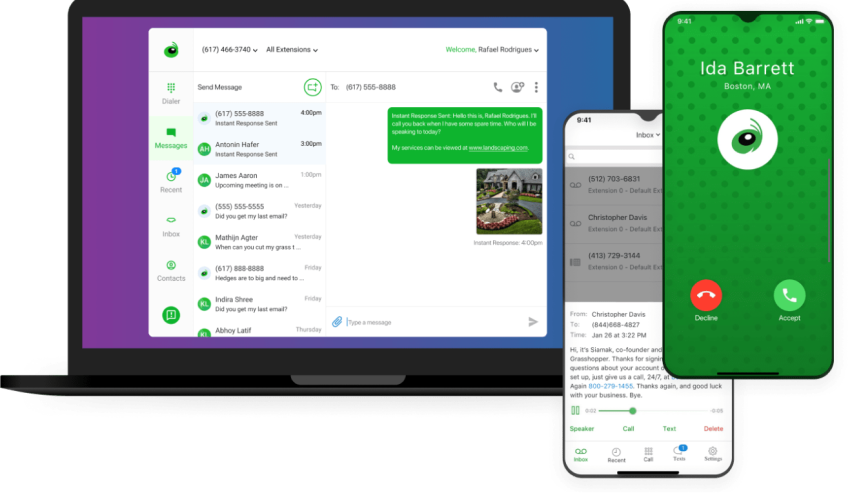
Understanding where Grasshopper excels provides a baseline for evaluating alternative business phone systems. Here are its main benefits:
- No-hardware setup: It requires zero equipment. You download the mobile or desktop app, pick a business number, and instantly route business lines directly to the smartphones your team already owns.
- Predictive solo pricing: For solopreneurs or micro-teams who don’t need distinct user accounts, its flat-rate structure allows you to share numbers and add extensions without paying per-user licensing fees.
- Simple call forwarding: It’s an effective, low-friction masking tool, keeping your personal mobile number private while letting you answer incoming business calls from anywhere.
Why Customers Look for Grasshopper Alternatives
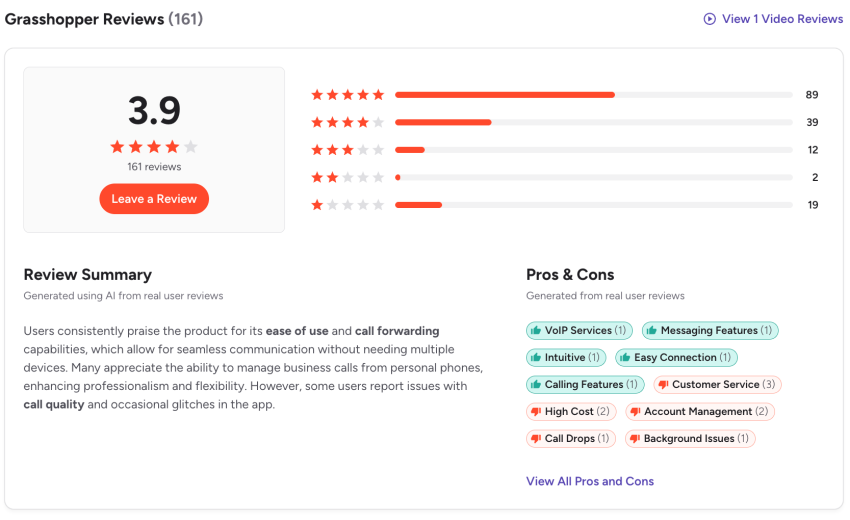
While Grasshopper works well as a basic virtual phone line, several core limitations prompt scaling businesses to migrate to more robust platforms:
- No direct CRM integrations: Grasshopper operates independently from the rest of your business software. It doesn’t link natively with tools like HubSpot, Salesforce, or Zoho, forcing your team to manually log every call, message, and customer interaction.
- Absent collaboration tools: The platform lacks native video conferencing, screen sharing, and internal team chat. If you need to jump on a face-to-face video call with a client or text a coworker internally, you have to pay for a separate application like Zoom or Slack.
- Steep costs at scale: Grasshopper’s base pricing looks affordable for a solo owner. However, if you’re expanding across multiple physical locations, require additional phone numbers, or make international calls, the absence of unlimited per-user plans becomes unexpectedly costly.
- Surface-level analytics: Reporting is capped at basic historical call logs (call volume, average length, and extension use). It lacks the real-time operational dashboards, wallboards, and speech analytics required to monitor team efficiency.
- Basic call routing boundaries: While it supports standard auto-attendants and sequential ringing, it doesn’t offer true call queuing, skills-based routing, or multi-level escalation logic. High incoming call volumes can quickly overwhelm the system, resulting in busy signals or dropped calls.
How We Evaluated the Best Grasshopper Alternatives
To compile this list, we analyzed the market’s leading cloud telephony and unified communications platforms based on five key operational requirements:
- Onboarding ease & support quality: The speed required to transition lines and the overall accessibility of live technical support when deployment issues surface.
- Pricing & total value: The base subscription costs weighed against mandatory add-on fees, international calling rates, and features included versus gated.
- Voice flexibility & routing depth: The ability to handle complex incoming traffic through interactive voice response (IVR), ring groups, and advanced call queues as a company scales.
- Platform reliability & voice clarity: The provider’s historical network uptime and call quality stability during peak operational hours.
- Integration ecosystem depth: How seamlessly the software connects with key business systems (CRMs, helpdesks, and email clients) to eliminate manual data logging.
10 Best Grasshopper Competitors Discussed
1) Nextiva – Best Alternative for Cloud-Based Business Communications
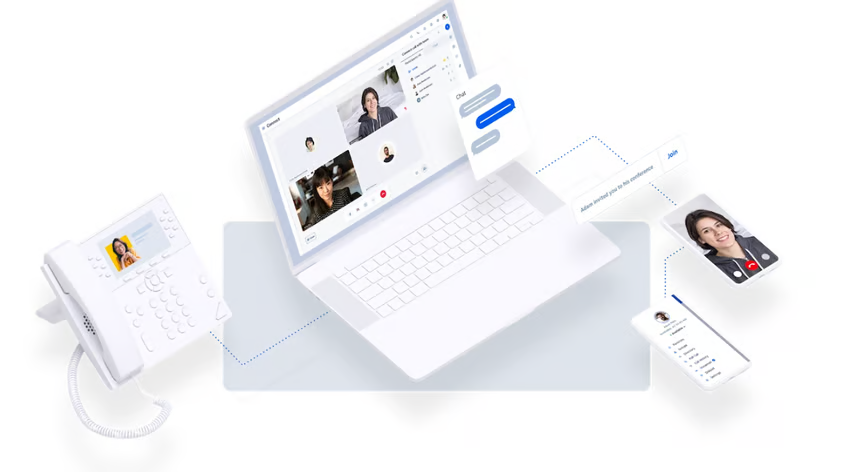
Nextiva is a unified customer experience platform that bridges the gap between the accessibility typical of small businesses and enterprise-grade infrastructure. The platform natively integrates Unified Communications (UCaaS) and cloud contact center solutions (CCaaS), bringing together business telephony, video conferencing, team collaboration, and SMS into a single, unified workspace: the NextivaONE app.
For teams that have outgrown Grasshopper, Nextiva’s comprehensive feature removes the hassle of integrating separate applications for telephony, video conferencing, and internal chat. Nextiva consolidates all communication channels into a single, carrier-grade network that delivers 99.999% uptime.
Nextiva also eliminates the operational hurdles associated with basic virtual phone solutions by offering advanced, practical features — such as automated voicemail transcription and intelligent call routing — that can be managed without IT expertise. The unified platform is well-known for its round-the-clock Amazing Service across all service tiers, making sure that small teams are never left to fend for themselves or forced to struggle with automated troubleshooting bots when issues arise.
Key features
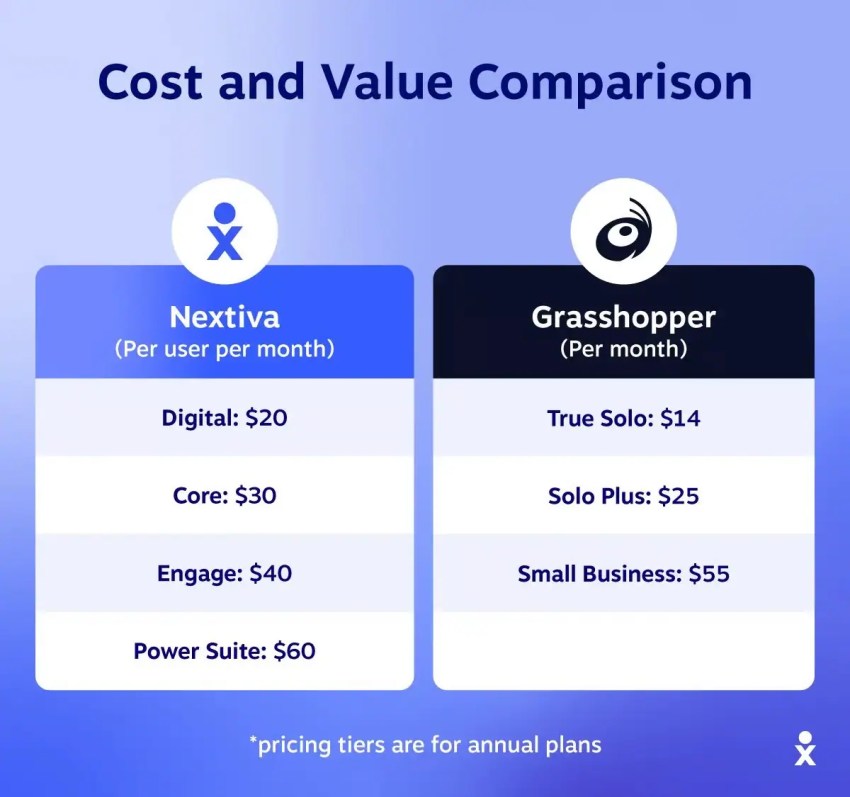
Nextiva has a robust VoIP phone service with more than 40+ standard and advanced features. Here are some features that make this unified communications platform a better alternative to Grasshopper:
- Low international calling rates
- Unlimited calls & video conferencing
- Advanced IVR with Conversational AI
- Analytics and automation
- Smart call routing
- Business text messaging
- Voicemail transcription
- Customizable Caller ID
- On-demand call recording
- Business call forwarding
- Mobile and desktop softphones
- XBert AI receptionist
Key strengths: Native tool consolidation (voice, video, team messaging, and SMS in one place), highly predictable per-user pricing plans, and an intuitive user experience that drastically cuts agent onboarding times.
Pricing: Core ($15/user/month), Engage ($25/user/month), and Scale ($75/user/month). Custom enterprise tiers are also available.
Best for: Growing mid-market and enterprise businesses seeking an all-in-one communications environment without legacy deployment complexity.
Why Nextiva is the best Grasshopper alternative:
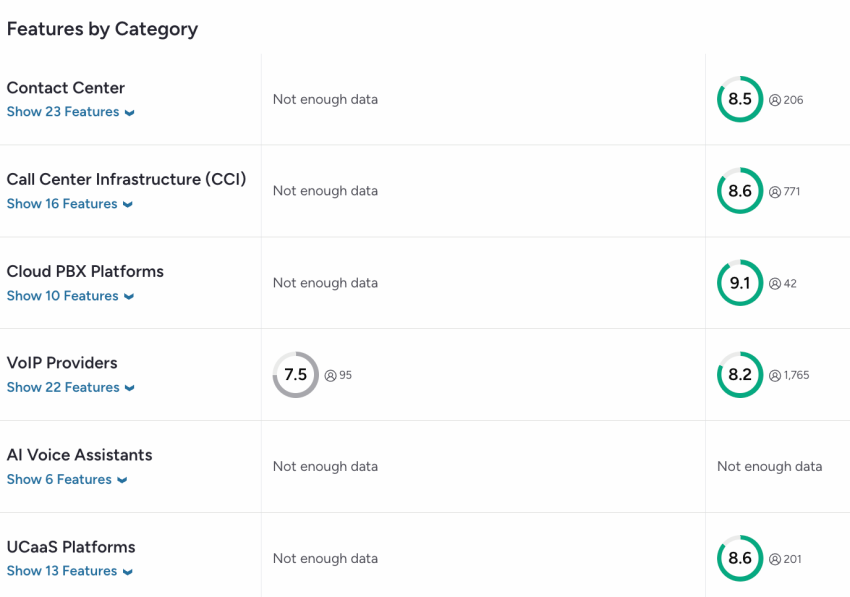
- All-in-one collaboration vs. disconnected channels: With Grasshopper, you need to use external apps for internal team chats or video meetings. Nextiva places your external business telephony and internal staff collaboration into a single dashboard, eliminating app fatigue.
- Turnkey CRM syncing vs. manual entry: Nextiva offers deep native integrations with top CRM software like HubSpot, Salesforce, and Zendesk. Customer records pop onto the screen automatically during incoming calls, and conversation histories are logged instantly without manual effort.
- Advanced automation accessibility: Nextiva integrates intelligent features like conversational AI voice routing and custom call schedules natively into the dashboard, allowing smaller teams to present an enterprise-grade presence to callers.
It’s the top pick for businesses seeking efficiency and reliability in their communication solutions. 8,400 Nextiva reviews and a rating of 4.6 out of 5 on review sites like GetVoIP show how much Nextiva prioritizes its customers’ needs.
The ease of setup and use, excellent customer support, great features, great return on investment, enterprise-grade security, and all-in-one business communication solution make Nextiva the best Grasshopper alternative.

“What truly sets Nextiva apart is their unwavering commitment to meeting our unique company needs. They didn’t simply offer a one-size-fits-all solution; instead, they took the time to understand our specific requirements and tailored their services precisely to suit us.”
~ Ari M.

2) GoTo Connect – Great Choice for Startups Needing Fewer Features
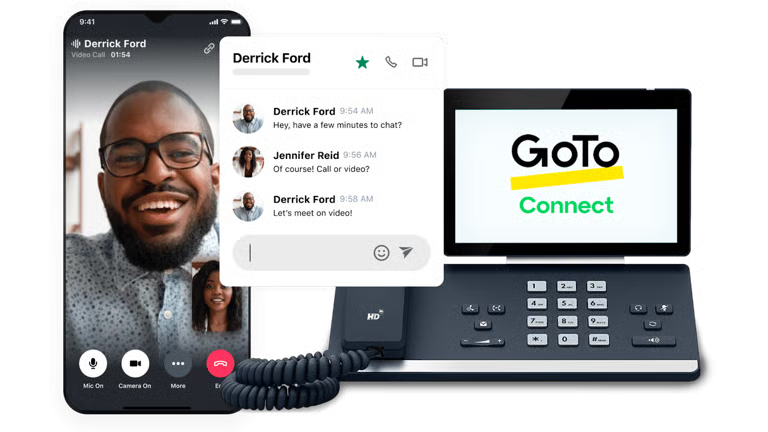
GoTo Connect (formerly Jive) combines cloud telephony, video conferencing, and text messaging into a user-friendly platform. Its visual approach to creating call-routing logic is particularly highly regarded.
A key differentiator compared to Grasshopper is the drag-and-drop editor for dial plans. Instead of navigating through rigid menus to modify extensions or adjust rules for handling calls when away, administrators can visually design the entire call flow on a digital canvas. This makes the solution attractive to growing start-ups that frequently adjust their team structures and call distribution.
Key features
- International calling plans
- Hold music and call queues to keep callers on the line
- Web-based video conferencing for up to 250 participants
- Drag-and-drop editor to configure call flows
- Integrations with tools like HubSpot, Zendesk, and Microsoft
- AI for GoTo Connect for intelligent automation and insights
Key strengths: Highly intuitive visual administration tools, stable video meeting performance, and reliable native CRM connectivity options.
Pricing: Contact sales for a customized, quote-based plan tailored to your team size.
Best for: Tech-focused startups and small businesses that want a visual, easily adjustable method for managing their internal call routing.
3) OnSIP – Best for SMB Remote Teams Looking for Hosted PBX
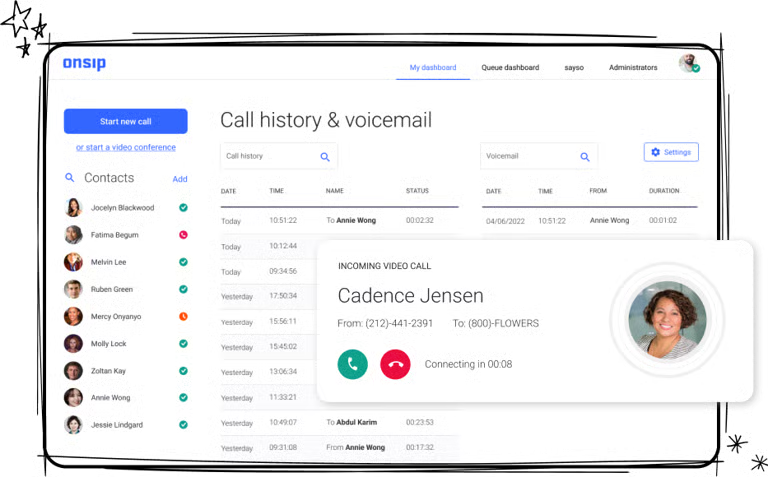
OnSIP is a provider of hosted, virtual PBX systems for small and medium-sized businesses with remote teams. The platform helps easily transition away from traditional on-site hardware infrastructure without incurring high upfront costs.
Compared to most standard SaaS solutions, OnSIP has a distinct pricing model. In addition to a user-based model (per workstation), it offers a pay-as-you-go option with a lower base fee per account and phone usage billed by the minute. For remote teams with fluctuating call volumes or for offices where calls are mainly internal (between extensions), this pricing structure can save costs compared to Grasshopper.
Key features
- Auto attendant or virtual receptionist
- Queues and groups to handle incoming calls
- Remote office capabilities
- HD calling & conference suite
- Extension dialing
- International dialing
Key strengths: Flexible billing structures for seasonal operations, straightforward remote-agent provisioning, and reliable hosted PBX feature stability.
Pricing: The basic account plan starts at $49.95/month (calls billed à la carte at 3.2¢/minute). Unlimited user plans start at $18.95/user/month with a mandatory 5-user minimum.
Best for: Distributed or remote small business teams that need a traditional hosted PBX feature layout with consumption-based billing choices.
4) Phone.com – The Go-To Option for a Basic VoIP Phone System
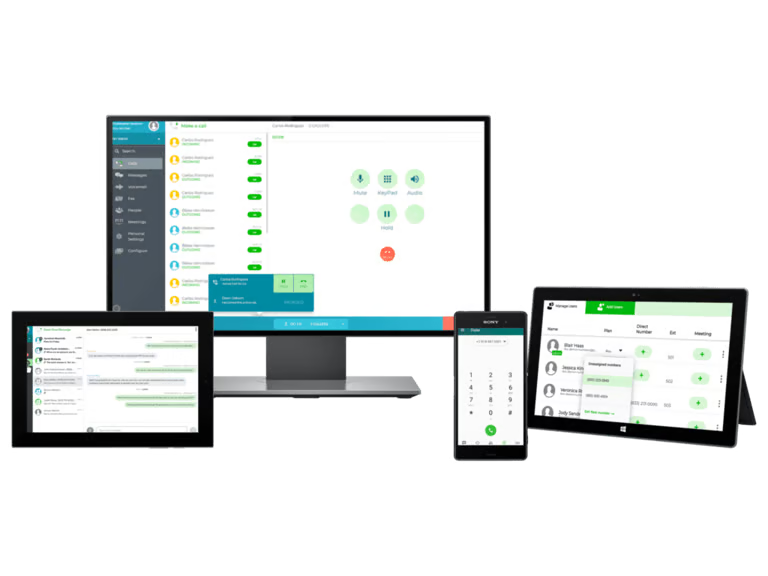
Phone.com is an accessible cloud communications system for entrepreneurs, early-stage startups, and independent business owners looking for an inexpensive way to step up from a mobile app setup.
The platform focuses strictly on providing essential business calling and texting without forcing micro-businesses to pay for enterprise collaboration modules they won’t use. It delivers a standard suite of over 50 foundational call-handling features, making it a natural, cost-effective stepping stone for teams that find Grasshopper’s lack of plan flexibility restrictive.
Key features
- Business text messages (additional fee)
- Voicemail to text
- Phone number porting
- Local business phone numbers with area codes for each location
- Hold music
Key strengths: Affordable entry-level licensing options, a straightforward setup process, and flexible plan configurations for very low-volume users.
Pricing: Basic ($15/user/month), Plus ($22.50/user/month), and Pro ($33.33/user/month) when billed on an annual cycle.
Best for: Solopreneurs and micro-teams looking for a straightforward, low-cost virtual phone system to separate business and personal lines.
5) Mitel – Best for Advanced Team Collaboration Capabilities
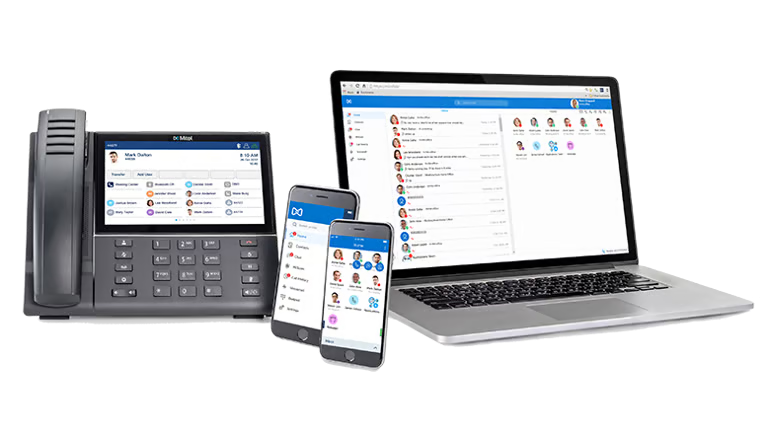
Mitel is an established cloud communications platform, offering small and medium-sized enterprises comprehensive cloud telephony and contact center solutions, as well as specialized tools for internal collaboration.
Compared to Grasshopper’s simple call-forwarding app, Mitel facilitates sophisticated internal team collaboration, offers secure file sharing, contextual text channels, and structured video collaboration spaces alongside standard business telephony. It’s a unified platform for all business communications, rather than merely a simple tool for handling external calls.
Key features
- Team collaboration software
- Video conferencing
- Integrations with Microsoft Teams, Chrome browser, Google Cloud, and Salesforce
- Interactive Voice Response (IVR) technology to greet, direct, and divert callers
- Mobile app dialer to provide business phone number connectivity (iOS/Android)
Key strengths: Corporate network architecture support, expansive internal collaboration toolsets, and secure mobile softphone applications.
Pricing: Essentials ($20.99/user/month), Premier ($26.59/user/month), and Elite ($38.49/user/month).
Best for: Mid-sized, established organizations requiring structural internal team collaboration tools paired with an advanced, enterprise-ready PBX system.
6) Google Voice – Best Choice for US-Based Google Workspace Users
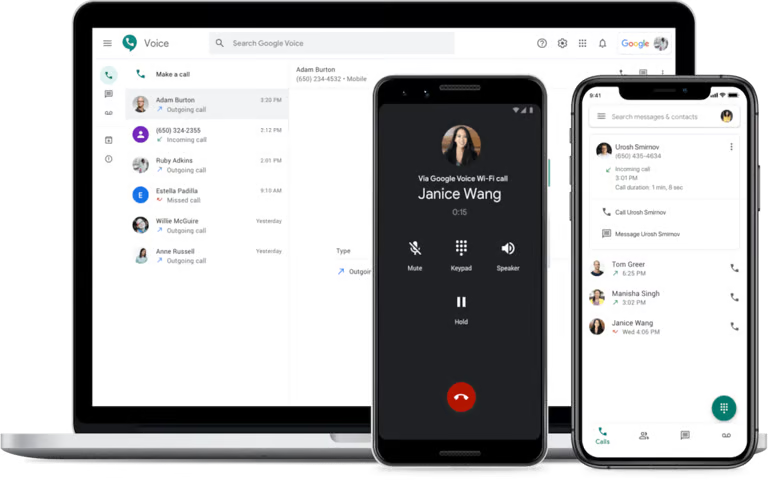
Google Voice is Google’s proprietary cloud-based phone system, offering an efficient way to make calls, send text messages, and manage business voicemails via the cloud.
If your business uses Google Workspace (Gmail, Calendar, Drive, and Docs) extensively, Google Voice offers great workflow convenience. The software integrates directly with your existing Google billing dashboard and admin console, allowing you to set up new local phone numbers in seconds. Its clear, web-based interface feels instantly familiar to users accustomed to the Google ecosystem, eliminating the learning curve often required by standalone telecommunications platforms.
Key features
- Calls between Google Voice numbers
- Calls to the US, Canada, and most European countries
- Text messaging, call forwarding, and call recording
- Voicemail transcription
- G-suite integration & Mobile apps (Android & IOS)
Key strengths: Seamless ecosystem synchronization, a familiar user interface, and zero configuration friction for existing Google accounts.
Pricing: Starter ($10/user/month), Standard ($20/user/month), and Premier ($30/user/month). Note that a Google Workspace subscription is required alongside it.
Best for: Solopreneurs and small, U.S.-based teams that already use the Google Workspace ecosystem and want a low-cost virtual number.
7) 8×8 – Best for Businesses That Only Need a VoIP Phone System

8×8 offers comprehensive unified communications and cloud contact center platforms, using its own privately hosted PBX infrastructure to manage global business connections.
While Grasshopper charges high long-distance rates for calls outside the US and Canada, 8×8 includes unlimited calls to more than 14 countries in its basic plans. Teams also get immediate access to essential business features such as call recording, text/MMS routing, and auto-attendants.
Key features
- International calling to 14 countries
- SMS, MMS, and team chat
- Audio and video conferencing
- Microsoft Teams integrations
- Mobile and desktop apps
Key strengths: Strong international footprint, financially-backed network reliability agreements, and a clean path to upgrade into full contact center seats.
Pricing: Custom quote-based pricing.
Best for: Distributed or expanding small-to-medium businesses that handle heavy cross-border or international call volumes.

8) Zoom Phone – Ideal for Zoom Video-Conference App Users
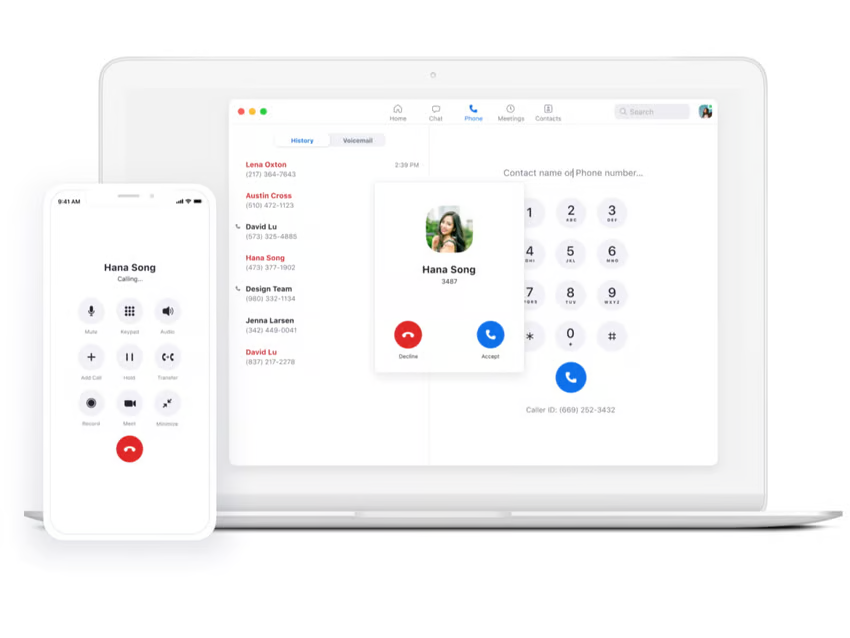
Zoom Phone integrates traditional enterprise cloud telephony into the widely used Zoom Workplace environment, turning a dedicated video app into a comprehensive telephony platform.
If your team already uses Zoom for client meetings and internal webinars, adopting Zoom Phone is incredibly easy. The feature is built directly into the desktop and mobile interfaces you already use daily, so your team requires no additional software training. Zoom Phone also offers a more powerful feature set than Grasshopper, including multi-level auto-attendants and automated call queues.
Key features
- Intelligent call routing
- Integrations with Slack, Google, Zapier, and Calendly
- Online whiteboard to collaborate visually mid-conference
- Video and audio calls made through Zoom’s VoIP network are high-quality and secure
Key strengths: Minimal software training overhead for existing Zoom users, high-definition call performance, and an expansive app marketplace featuring 3,000+ connectors.
Pricing: Metered calling plans start at $10.50/user/month; Unlimited domestic calling plans start at $15/user/month. Zoom Workplace Pro Plus bundles start at $18.33/user/month.
Best for: Distributed, modern teams that already utilize Zoom for video meetings and want to merge their business lines into a single billing profile.
9) Aircall – Best for Small Teams and VoIP Call Centers
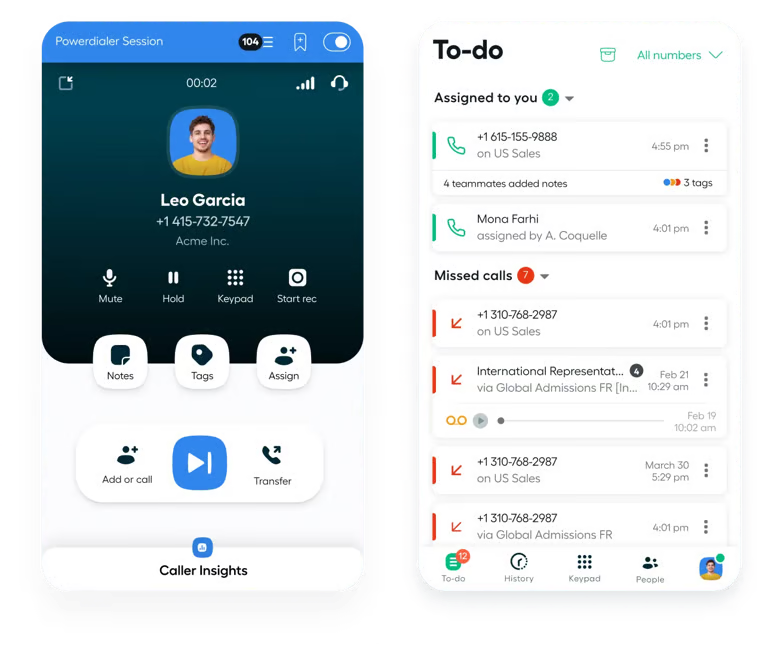
Aircall is an integration-focused cloud telephony platform designed for customer support teams, inside sales groups, and call centers that manage high volumes of phone interactions.
Compared to Grasshopper, Aircall offers an operational upgrade for CRM or helpdesk systems. Aircall integrates directly with platforms such as HubSpot, Salesforce, and Zendesk. The platform provides deep operational insights — such as first-call resolution rates and missed call statistics — and offers live monitoring features that allow managers to coach agents while calls are in progress.
Key features
- IVR menus and ring groups
- Conversation tags to categorize and filter previous call recordings
- Custom business hours to stop incoming calls from heading to voicemail
- Analytics like missed call rate, call volume, and first-call resolution
- Desktop notifications for incoming calls
Key strengths: Background data syncing with major CRMs, rapid software provisioning, and deep call performance metrics.
Pricing: Essentials ($30/user/month) and Professional ($50/user/month). Note that a 3-user license minimum is required.
Best for: Small, high-volume sales or customer service teams whose daily productivity relies entirely on deep CRM data syncing and live performance coaching.

10) Intermedia Unite – Best for International Calling
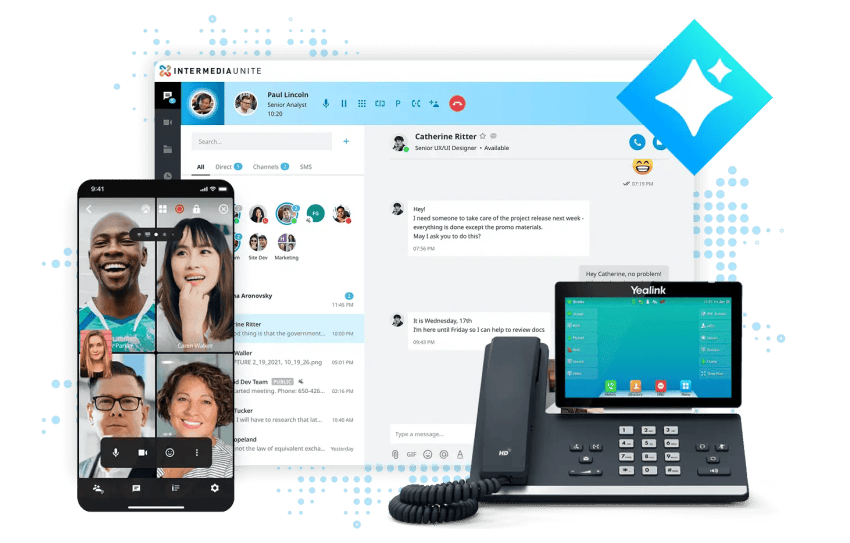
Intermedia Unite is a cloud-based business communication platform that combines VoIP calling, video conferencing, SMS, team messaging, and AI-powered productivity tools in one workspace.
A key advantage of Intermedia Unite over Grasshopper is its broader unified communications functionality. While Grasshopper focuses primarily on business calling and texting, Intermedia Unite brings internal collaboration, video meetings, and advanced call management into the same platform. Its AI Call Recap feature also automatically transcribes recorded calls, generates summaries, and analyzes customer sentiment.
Key features
- AI-powered call summaries with automatic transcription, sentiment analysis, and topic breakdowns.
- Unlimited domestic and international calling to 34 supported countries, subject to applicable terms.
- Built-in video conferencing and team messaging with HD meetings, business SMS, and file sharing.
- Advanced call management with auto attendants, hunt groups, call recording, and voicemail transcription.
Key strengths: Extensive international calling coverage and flexible mix-and-match user licensing.
Pricing: Pro ($27.99/user/month) and Enterprise ($32.99/user/month).
Best for: Small and midsize businesses that want an all-in-one communications platform with international calling and built-in collaboration tools beyond Grasshopper’s core phone and texting capabilities.
Choosing the Right Grasshopper Alternative
Match the provider to your situation
- Choose Nextiva if you want to eliminate app switching with unified, business-grade voice, video conferencing, SMS, and deep CRM integrations on a single, carrier-grade 99.999% uptime network with 24/7 live support included on every tier.
- Choose Google Voice or Phone.com if you’re a solo operator or micro-business that requires an inexpensive virtual secondary line to handle basic calls and texts without advanced collaboration bells and whistles.
- Choose GoTo Connect or 8×8 if you’re a growing small team that needs an accessible, visual canvas to construct custom call flows or expansive international calling plans.
- Choose Aircall if your team manages high outbound/inbound call volumes and requires native, real-time AI transcriptions, manager coaching tools, and direct data integration with your CRM pipeline.
- Choose Intermedia Unite if you’re a growing small or midsize business that needs unlimited international calling (to supported countries), AI-powered call summaries, and flexible licensing to accommodate different employee needs.
- Choose Zoom Phone if your organization already uses Zoom Workplace as its core video conferencing environment and wants to consolidate telephony into the same desktop app interface.
Why Nextiva Is the Top Option Among Grasshopper Alternatives
The combination of accessibility for small businesses, structural reliability, and enterprise-grade features makes Nextiva the ideal alternative for businesses that have outgrown Grasshopper.
While Grasshopper limits your team to simple call forwarding to personal mobile phones, Nextiva elevates your professional image without complex IT requirements. The NextivaONE app unifies customer communication, internal collaboration, video conferencing, and business texting within a single workspace.
Backed by a highly reliable network of redundant data centers, transparent pricing that scales with your business, and an award-winning support team available around the clock, Nextiva acts as a true technology partner that reliably meets your communication needs at every stage of growth.
Outgrowing Grasshopper?
You deserve more than basic features. Upgrade to Nextiva for a complete communication solution.
Grasshopper Alternatives FAQs
Answers to some common questions about the best alternative to Grasshopper.
Nextiva is a great Grasshopper alternative, offering an all-in-one cloud VoIP platform that combines business telephony with video conferencing, team collaboration channels, and comprehensive CRM data synchronization.
The answer depends on specific business needs. Google Voice is cost-effective and convenient for solopreneurs who already operate within the Google Workspace ecosystem and need standard virtual lines for incoming and outgoing calls. Grasshopper is a standalone virtual system for toll-free numbers and extensions, making it somewhat more scalable and ideal for very small teams that don’t use Google apps.
Yes. Grasshopper isn’t natively built to support HIPAA compliance frameworks. However, platforms like Nextiva maintain secure, encrypted data center architectures and sign formal Business Associate Agreements (BAAs) with healthcare providers to ensure voice routing and administrative tools adhere to strict data privacy and security guidelines.
Grasshopper works best as a simple call-forwarding solution that routes business numbers to standard mobile connections. However, because the service lacks a dedicated, unified network infrastructure, high call volumes from multiple users frequently result in dropped calls or audio delays. Enterprise-grade cloud solutions like Nextiva offer high call quality by routing calls over redundant, highly available networks backed by 99.999% uptime.