
 VoIP
VoIP  Blog
Blog  Business Communication
  Customer Experience
  Leadership
  Marketing & Sales
  Nextiva News
  Productivity
Choosing between Nextiva and 8×8 isn’t just about finding a VoIP provider. Both platforms offer business calling, team communication, and customer engagement tools, but they serve different types of companies.
Nextiva is built as an all-in-one customer experience platform that connects voice, messaging, automation, analytics, and customer context in one system. 8×8 is aimed at larger or international teams that need international calling, unified communications, and contact center capabilities across multiple regions.
This guide compares Nextiva vs. 8×8 across pricing, key features, AI, reliability, integrations, usability, and support to help you choose the better business phone system.
Nextiva vs. 8×8: Business Phone System Comparison
Before we dive into the details, here’s a quick-glance comparison table and a general overview.
| Category | Nextiva | 8×8 |
|---|---|---|
| Best for | U.S.-based SMBs and midsize teams that want an easy-to-manage phone system with strong support and customer experience tools | Larger or global teams that need international communications and unified UC/contact center features |
| Current packages | Core, Engage, Scale; enterprise tiers include Essential, Professional, and Premium | 8×8 Work, 8×8 Contact Center, 8×8 Engage, Communications APIs, and 8×8 for Microsoft Teams |
| Published pricing | $15 to $75 per user/month for small-business plans; enterprise plans start at $75/agent/month | Custom quote required for current packages |
| Business communication | Calling, routing, SMS, messaging, video, apps, analytics, and customer context | Calling, messaging, video, call handling, global coverage, integrations, and receptionist console |
| Contact center | Omnichannel routing, automation, analytics, supervisor tools, workforce management, and enterprise CX features | Omnichannel routing, agent and supervisor workspaces, analytics, AI self-service, WFM, and secure payments |
| Integrations and customer context | CRM integrations, screen pops, customer context, and workflow automation | CTI, CRM integrations, screen pops, and workflow tools |
| Support | 24/7 customer support included with current plans | Global support resources available; access and experience may vary |
| Overall takeaway | Better for teams that want simplicity, support, and customer experience tools in one predictable platform | Better for companies that prioritize global reach and enterprise communications coverage |
Nextiva and 8×8 both support business calling, team communication, and customer interactions, but they serve different priorities:
- 8×8 is often a better fit for multinational organizations that need global communications, international numbers, and unified UC/contact center coverage across regions.
- Nextiva is better suited for small and midsize businesses that want reliable domestic calling, easier setup, built-in automation, and accessible support.
The difference also shows up in total cost of ownership. Nextiva includes live support and customer communication tools in lower-tier plans, which can reduce service gaps after purchase and make costs more predictable. With 8×8, expanded support, omnichannel capabilities, and advanced features may require higher-tier plans or custom pricing.
Growth path matters, too. Nextiva combines calling, SMS, chat, social messaging, automation, and customer context in one platform. 8×8 offers strong global communications coverage, but businesses may need to upgrade as their needs become more complex.
Here’s how those differences affect the business phone system experience.
Nextiva vs. 8×8: Plans, Pricing, and Features
Nextiva and 8×8 both offer cloud-based business communications, but their pricing models are easier to compare in some areas than others. Nextiva publishes clear small-business and enterprise starting prices, while 8×8 now emphasizes custom packages across unified communications, contact center, CX, and communications APIs.
That makes the comparison less about which provider has the lowest advertised price and more about what each platform includes at each stage of growth. Nextiva is easier to evaluate upfront because its Core, Engage, Scale, and Enterprise tiers show clear starting prices. 8×8 is generally better for enterprises that need global communications and contact center coverage, but buyers usually need to contact sales to confirm current pricing, packaging, and feature access.
Nextiva plans, pricing, and features
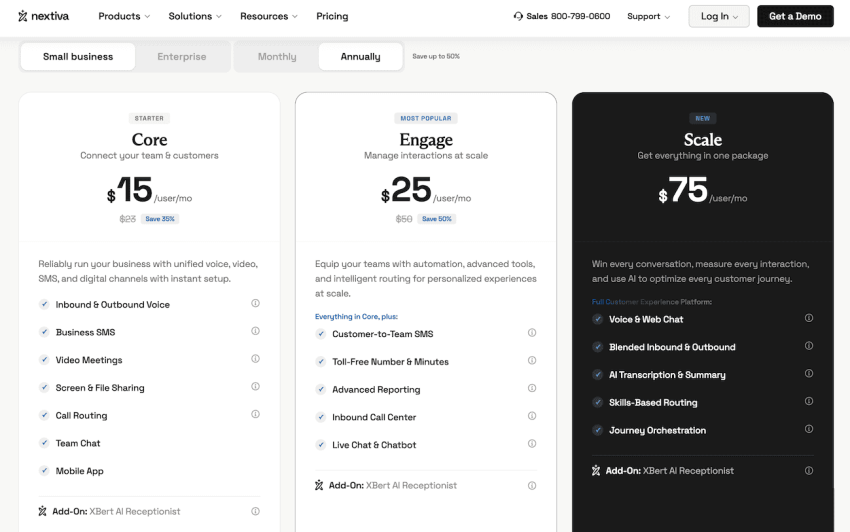
Nextiva’s pricing plans support businesses that need voice, messaging, video, customer engagement tools, and contact center capabilities in one platform. Its small-business plans include Core, Engage, and Scale, while larger contact centers can choose Enterprise Essential, Professional, or Premium plans.
Core plan ($15/user/mo)
Nextiva’s Core plan is designed for teams that need a reliable business phone system without added complexity. It includes inbound and outbound voice, business SMS, video meetings, screen and file sharing, call routing, team chat, and mobile apps access.
- Connectivity: Make and receive business calls, use business SMS, and support everyday communication across desktop and mobile devices.
- Productivity tools: Use call routing, team chat, video meetings, and screen sharing to keep employees connected.
- Unified workspace: Manage phone calls, texts, meetings, and team communication from one business communications platform.
- Key integrations: Sync contacts through Microsoft Outlook and Google Contacts.
Engage plan ($25/user/mo)
Nextiva’s Engage plan is built for growing teams that manage more customer conversations across phone, SMS, and chat. It includes everything in Core, plus customer-to-team SMS, toll-free number and minutes, advanced reporting, inbound call center capabilities, live chat, and chatbot functionality.
- Omnichannel messaging: Manage customer-to-team SMS and web chat from a shared environment.
- Digital lead capture: Use live chat and chatbot tools to support website visitors and capture more customer inquiries.
- Reporting and visibility: Track performance with advanced reporting and customer communication insights.
- Service center tools: Add inbound call center functionality for sales and service teams that need more structure than basic business calling.
Scale plan ($75/user/mo)
Nextiva’s Scale plan is designed for teams that want a fuller customer experience platform with AI, routing, orchestration, and blended communication channels.
- AI automation: Use AI transcription and summaries to reduce manual follow-up work after calls.
- Journey management: Combine voice, chat, routing, and customer context to manage interactions across the customer journey.
- Advanced tools: Support blended inbound and outbound workflows, skills-based routing, and customer experience automation.
- Enterprise controls: Add more advanced routing, analytics, and customer journey capabilities as communication needs become more complex.
Enterprise solutions, starting at $75/agent/mo
Nextiva’s Enterprise plans include Essential, Professional, and Premium tiers for larger contact centers and high-volume customer experience teams. Essential starts at $75 per agent per month, while Professional and Premium require custom quotes.
- Essential: Includes omnichannel capabilities, journey orchestration, AI transcription and summary, skills-based routing, and voice and web chat.
- Professional: Adds advanced self-service, real-time supervisor support, secure payment capabilities, progressive and predictive dialing, and more supported channels.
- Premium: Adds workforce management, unlimited skills-based routing, advanced analytics, unlimited channels, and in-conversation payments.
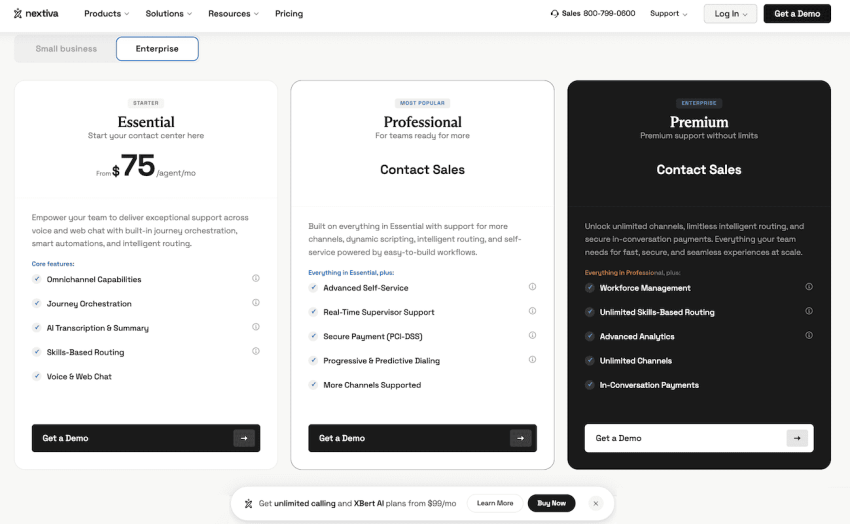
Nextiva’s main advantage is that it combines business phone service, messaging, video, support tools, automation, and customer experience features in one platform. That makes it easier for teams to manage customer conversations without switching between separate apps for calls, texts, chat, and reporting.
8×8 products, packages, and key features
8×8 no longer presents its pricing as a simple public plan table. Instead, its pricing page groups offerings into custom packages: 8×8 Work for unified communications, 8×8 Contact Center, 8×8 Engage for CX beyond the contact center, Communications APIs, and 8×8 for Microsoft Teams.
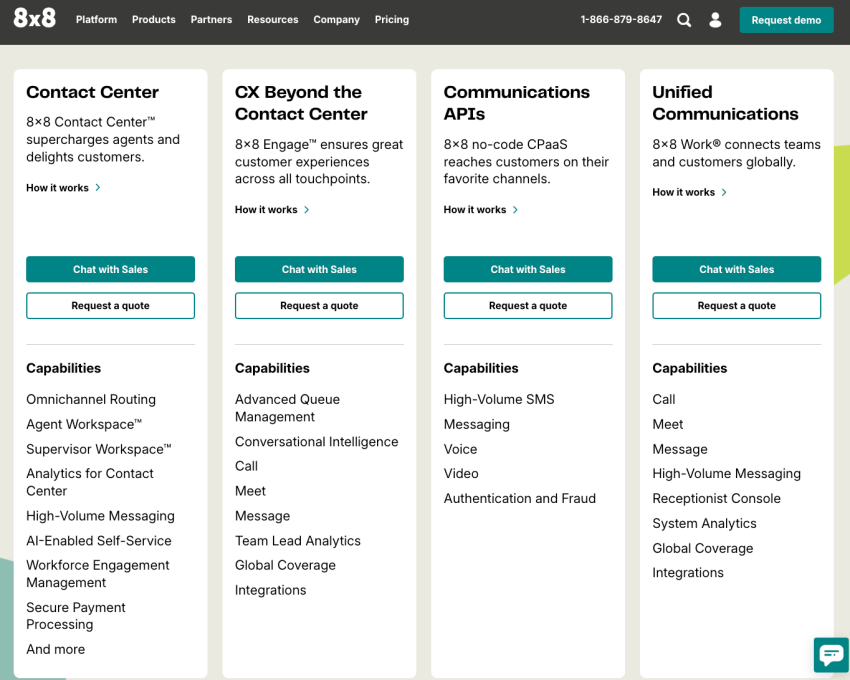
Buyers need to request a quote to confirm pricing, packaging, and feature access.
- International reach: 8×8 remains a strong option for companies that need global communications. Its business phone service supports local numbers in more than 120 countries.
- Unified communications: 8×8 Work includes calling, meetings, messaging, high-volume messaging, system analytics, global coverage, integrations, and receptionist console capabilities.
- Contact center capabilities: 8×8 Contact Center includes omnichannel routing, agent and supervisor workspaces, contact center analytics, high-volume messaging, AI-enabled self-service, workforce engagement management, and secure payment processing.
- CX tools beyond the contact center: 8×8 Engage includes advanced queue management, conversational intelligence, Call, Meet, Message, team lead analytics, global coverage, and integrations.
- Integrations: 8×8 supports integrations with productivity and CRM tools, including Microsoft Teams and Salesforce, and offers APIs for more customized workflows.
8×8 may be a good fit for organizations that prioritize global reach, custom communications packaging, and unified UC/contact center coverage. However, because pricing and feature access depend on the selected package, businesses should confirm current costs, support options, calling zones, SMS availability, and contact center features directly with 8×8.
Nextiva vs. 8×8: Business Communication
Nextiva and 8×8 both support the everyday communication tools businesses expect from a cloud phone platform; the difference is how easy each platform makes it for employees to manage live conversations across devices and channels.
Nextiva’s business phone system is built for small and midsize teams that want unlimited calling in the U.S. and Canada, SMS, meetings, contacts, and customer context in one workspace. Users can handle common call actions such as answering, placing callers on hold, muting, transferring calls, routing calls to the right person, and managing conversations from mobile and desktop apps.
A unified platform makes it easier for employees to move between internal communication and customer conversations without switching between separate tools.
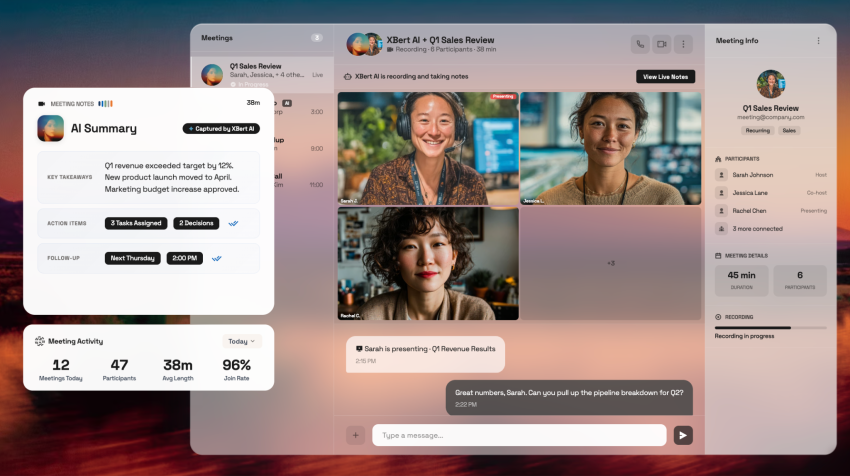
8×8 also supports core business communication features, including calling, meetings, messaging, call handling, routing, and receptionist console capabilities through 8×8 Work (and may include unlimited calling or unmetered calling depending on the package, license, and calling zone). Its advantage is global coverage, making it a strong fit for companies with international teams, customers, or number requirements.
However, because 8×8 now packages features through custom offerings, businesses should confirm which calling, messaging, call control, analytics, and support features are included in their selected package.
Nextiva vs. 8×8: Contact Center Capabilities
The contact center comparison is different from the business phone system comparison. Here, the question is not which platform handles everyday calls better, but which one gives sales, service, and support teams the tools to manage high-volume customer interactions.
Nextiva’s contact center capabilities focus on customer journey orchestration, omnichannel routing, AI transcription and summaries, skills-based routing, voice and web chat, advanced analytics, workforce management, and automation. This makes it a strong fit for teams that want customer experience tools connected to their broader business communications platform.
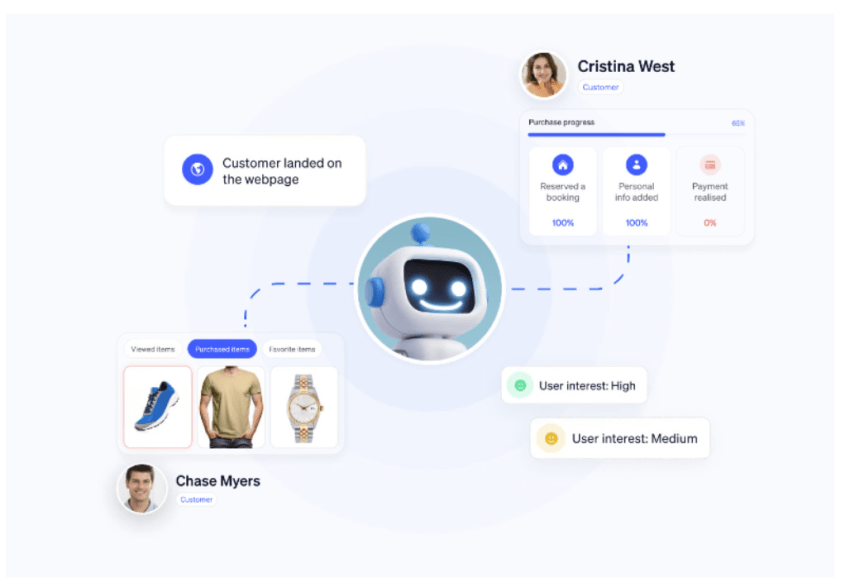
8×8 Contact Center includes omnichannel routing, agent and supervisor workspaces, analytics, high-volume messaging, AI-enabled self-service, workforce engagement management, and secure payment processing. It is well suited for larger or globally distributed teams that need contact center functionality across multiple regions.
Nextiva vs. 8×8: AI Insights and Analytics
Businesses need more than basic call reports. They need analytics that show what is happening across customer conversations, where teams are falling behind, and which interactions need follow-up.
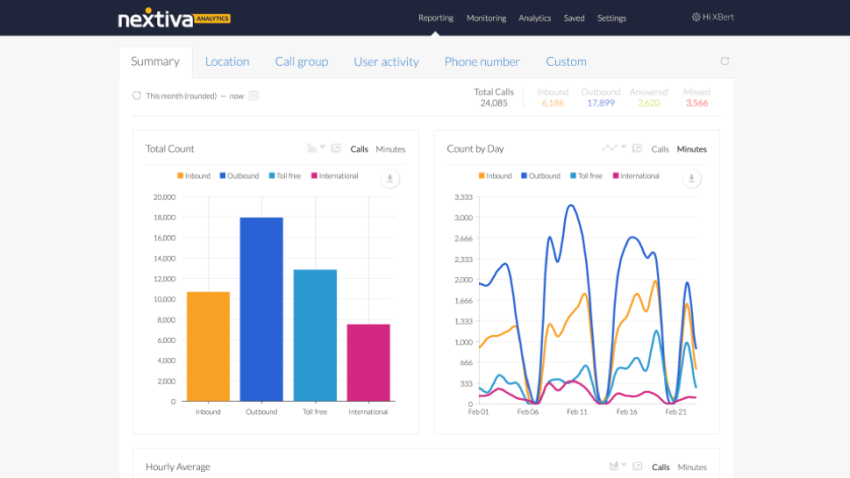
Nextiva focuses on making performance data easier for sales and support teams to act on. Its analytics tools support real-time dashboards, voice analytics, call metrics, customer conversation insights, and gamified performance tracking through leaderboards and wallboards. Higher-tier plans also include AI transcription, summaries, sentiment insights, and advanced analytics to help teams reduce manual work and identify coaching opportunities.
Nextiva’s analytics are strongest in these areas:
- Real-time dashboards: Track call volume, talk time, inbound activity, and other performance metrics as they happen.
- Voice analytics: Analyze customer conversations to identify trends, patterns, and coaching opportunities.
- AI summaries and transcription: Reduce after-call work by capturing key details from conversations.
- Gamified reporting: Use leaderboards and wallboards to keep agents aligned around performance goals.
- Ease of use: Give teams pre-built reports and visual dashboards without requiring a dedicated analytics specialist.
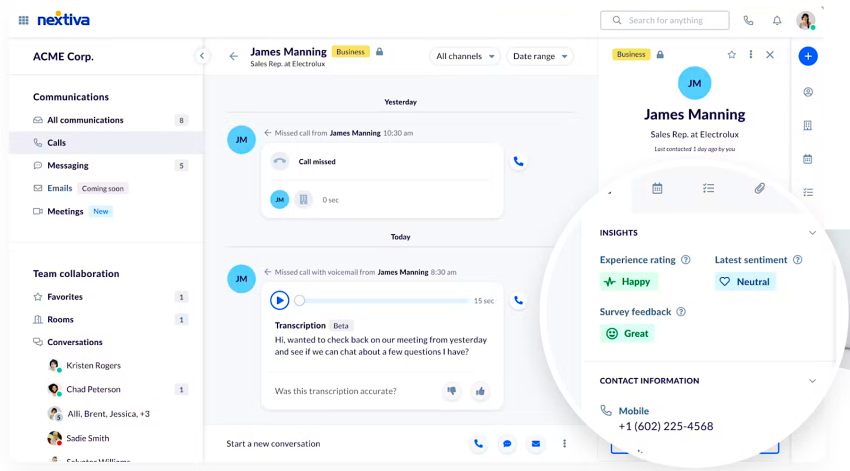
8×8 also offers strong analytics and AI capabilities, especially for larger or distributed teams. Its platform includes communications analytics, speech analytics, sentiment analysis, AI-powered interaction summaries, Conversation IQ, automated self-service, and workforce management tools. 8×8 Contact Center also supports supervisor visibility, queue management, and workforce engagement features for teams managing higher interaction volumes.
8×8’s analytics are strongest in these areas:
- Speech and sentiment analytics: Analyze conversations across calls to identify trends in customer behavior and satisfaction.
- Conversation intelligence: Use Conversation IQ and AI-powered summaries to surface insights from customer interactions.
- AI self-service: Use 8×8 Intelligent Customer Assistant to automate routine customer interactions across voice and digital channels.
- Workforce management: Forecast staffing needs, manage schedules, and respond to volume changes across contact center teams.
- Global visibility: Support reporting and analytics across distributed communications and contact center operations.
Nextiva vs. 8×8: CRM Integrations and Customer Context
Screen pops, also called call pops, display customer information when an incoming call reaches an agent. Instead of asking callers to repeat basic details, agents can see context such as the caller’s name, phone number, account record, previous interactions, or CRM history before or during the conversation.
Nextiva supports screen pops through its business phone and CRM integrations. Its Call Pop feature pulls customer data from connected systems so agents can see relevant caller details when the phone rings. For call center teams, this can include customer records, past interactions, and other information that helps agents respond faster and personalize the conversation.
Nextiva also connects with common business tools such as Microsoft Outlook, Google Contacts, Salesforce, HubSpot, Microsoft Teams, Zendesk, and other CRM or productivity platforms, depending on the plan and integration setup.
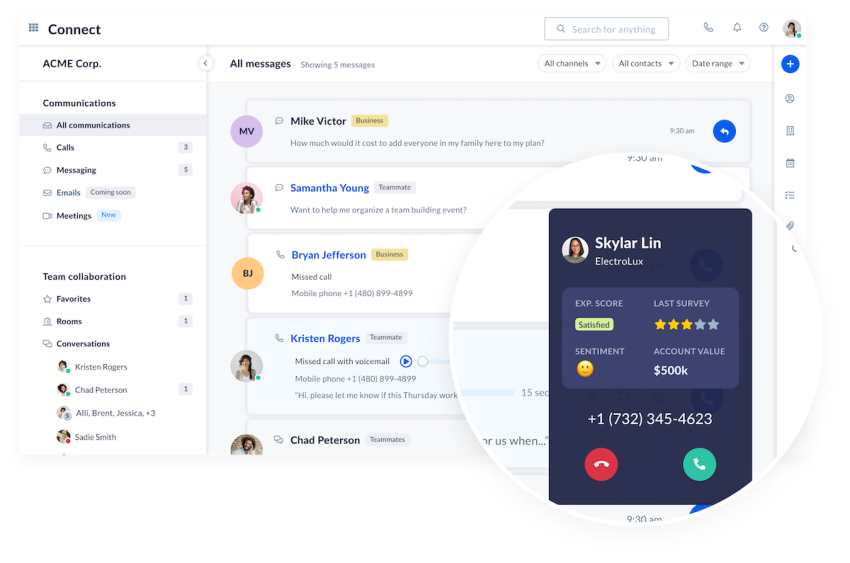
8×8 supports screen pops through CTI and CRM integrations. Its screen pops display information from CRM records when a caller’s number matches existing customer data.
8×8 also supports Salesforce, Zendesk, and Microsoft Teams integration (among other business applications), and its Contact Center integrations can trigger record lookups and screen pops based on caller ID.
Nextiva vs. 8×8: Reliability and Call Quality
Consistent call quality and uptime should be major factors when choosing a business phone system. Both Nextiva and 8×8 are built on cloud-based infrastructure designed to support dependable VoIP performance, but their real-world results can depend on network conditions, device setup, Wi-Fi quality, and how the system is implemented.
Nextiva emphasizes its North American network footprint, with eight points of presence, carrier-grade data centers, 99.999% uptime, 24/7 monitoring, automatic failover, and transparent status reporting. Customer reviews also highlight call quality and responsive technical support. For example, one Nextiva customer said the company’s support was “stellar” and that quality of calls improved significantly after switching providers.
8×8 also publishes strong reliability claims, including geographically redundant infrastructure, no single point of failure, failover for core call flow, and a 99.999% uptime SLA covering both uptime and call quality. That makes it a strong option for distributed teams that need resilience across multiple locations.
However, some 8×8 users report inconsistent real-world call performance, including missed calls, connection problems on slower internet, and occasional voice-quality issues. These complaints do not mean 8×8 is unreliable overall, but they do show why buyers should evaluate quality of calls under their own network conditions before committing.
8×8 vs. Nextiva: Setup and Ease of Use
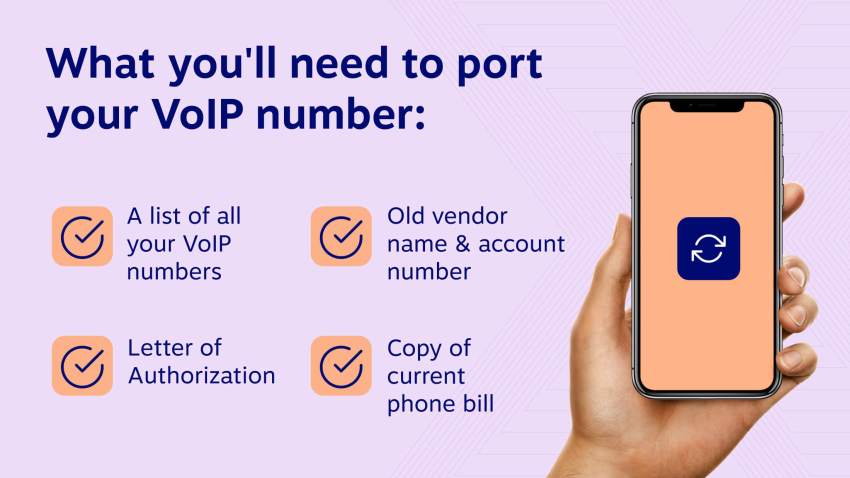
Setup matters when you are switching phone systems, porting numbers, configuring call flows, and onboarding employees across devices. Day-to-day usability matters just as much, especially for teams that need to manage calls, messages, meetings, routing, and customer conversations from one workspace.
8×8 supports self-service setup through documentation, training, and its Admin Console, where administrators can manage the company phone system from a desktop. It also offers professional services and adoption support for more complex deployments. 8×8’s implementation services can include system configuration, network assessment, performance testing, and go-live support, while enhanced implementation includes help from a dedicated Solution Delivery Advisor.
That support can be useful for larger companies, global teams, or organizations deploying unified communications and contact center tools together. However, the same feature depth can also create a steeper learning curve. Teams may need additional training to configure users, numbers, routing, integrations, analytics, and contact center workflows correctly.
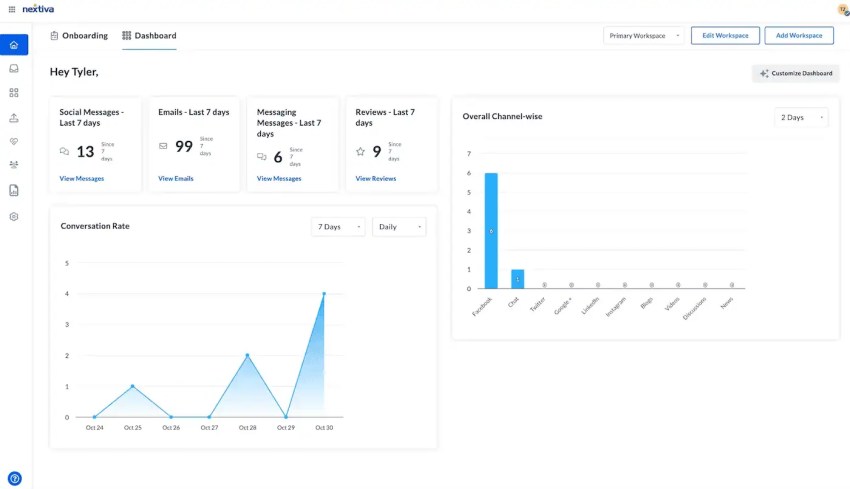
Nextiva takes a more guided approach for teams that want a faster, simpler set-up experience. Its onboarding resources include guided product tours, onboarding wizard support, and tutorial videos for setting up and managing business phone service. This helps new customers configure core features such as call routing, IVR, user management, and agent performance tools without needing to build everything from scratch.
That ease of use carries into daily administration. Nextiva is designed to give teams calling, messaging, meetings, routing, customer context, and support tools in one platform, which reduces the need to move between separate systems.
8×8 vs. Nextiva: Customer Support
Customer support is a critical part of any communications platform decision. When technical issues affect call quality, routing, number porting, or user access, teams need fast help from people who understand the platform.
Both Nextiva and 8×8 offer support resources, but customer satisfaction differs.
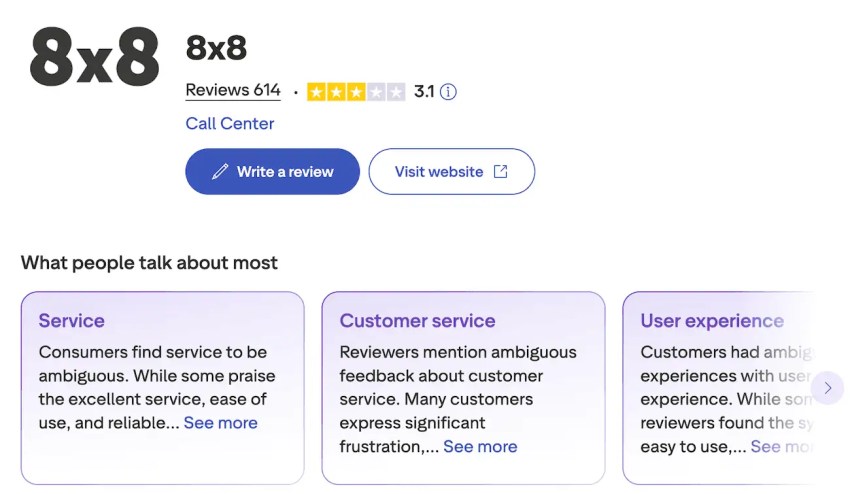
8×8 advertises global 24/7 access to support experts, online case management, live chat support, a knowledge base, and follow-the-sun support through global support centers. However, some customer reviews describe mixed support experiences, including slow escalations, difficulty reaching the right representative, and inconsistent issue resolution.
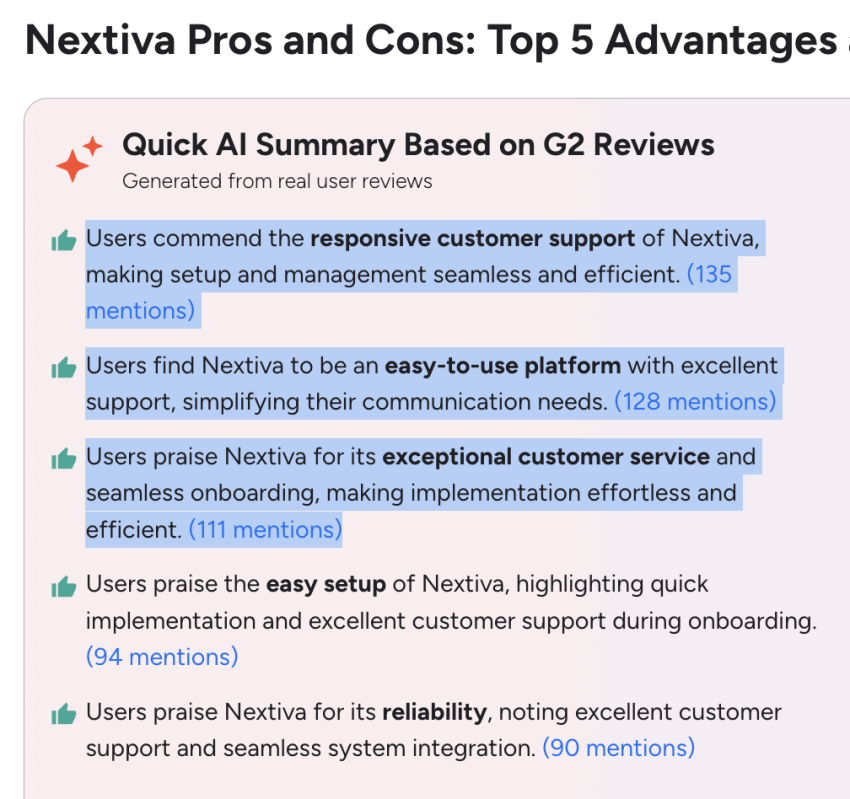
Nextiva positions customer support as a core differentiator. Its current plans include 24/7 customer support, and multiple customer reviews mention helpful staff, responsive service, and positive support experiences during setup and ongoing use. This matters for small and midsize teams that may not have internal IT resources to troubleshoot phone system issues on their own.
8×8 vs. Nextiva: Customer Reviews
Customer reviews are generally positive for both Nextiva and 8×8, but the review patterns point to different strengths.
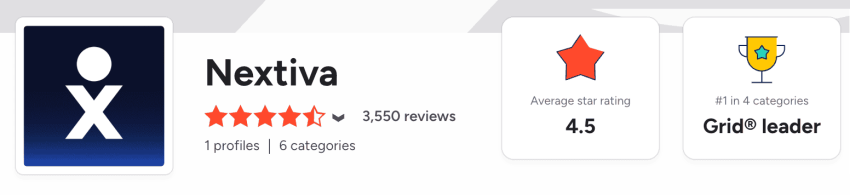
On G2, Nextiva has a 4.5 out of 5 rating across 3,550 reviews, with reviewers frequently highlighting reliable service, predictable pricing, call routing, and set-up support. Gartner Peer Insights also gives Nextiva Unified Customer Experience Management Platform a 4.6 out of 5 rating across 780 ratings, with positive reviews mentioning easy administration, responsive support, live metrics, and call quality.
On G2, 8×8 has a 4.2 out of 5 rating across 1,401 reviews. Gartner Peer Insights shows 8×8 with a 4.6 out of 5 rating across 353 UCaaS reviews. Reviewers praise 8×8 Work for user-friendly administration, stable performance, tech support, reporting, and unified calling, video conferencing, SMS, team chat, and fax. However, some users also mention issues with app loading, support, integration gaps, and occasional configuration complexity.
Which Business Phone System Is Right for You?
Choosing between Nextiva and 8×8 comes down to how your business communicates today and where you plan to grow next. Both platforms offer cloud calling, collaboration tools, contact center options, and strong uptime commitments, but they are built for different priorities.
Choose Nextiva if…
Nextiva is the better choice if you want an easier-to-manage business communications platform with transparent pricing, strong support, built-in automation, and customer communication tools in one place.
Nextiva is a better fit if you:
- Want a straightforward business phone system for a U.S.-based team
- Need unlimited calling (U.S./Canada), SMS, video conferencing, routing, and customer context in one workspace
- Prefer published pricing and clearer plan packaging
- Want 24/7 support included across plans
- Need AI, analytics, and automation without adding more disconnected tools
- Plan to scale from basic business calling into customer experience or contact center features
Choose 8×8 if…
8×8 is the better choice if your business has global communications needs or requires a more customized UC/contact center environment across multiple regions.
Why Nextiva Is the Better Fit for Growing SMBs
For most U.S.-based small and midsize businesses, Nextiva is the stronger choice because it combines business calling, messaging, video conferencing, routing, automation, analytics, and support in one more predictable platform. It gives teams the tools to manage daily communication and customer conversations without adding unnecessary complexity.
So if your priority is a reliable, easier-to-use business phone system with clear pricing, accessible support, and built-in customer experience tools, Nextiva is right for you.
See why 100K+ businesses made us the #1 VoIP provider.
From award-winning support to advanced features and ease of use, Nextiva gives you a solution you can trust.