
 VoIP
 Blog
 Business Communication
 Customer Experience
 Leadership
 Marketing & Sales
 Nextiva News
 Productivity
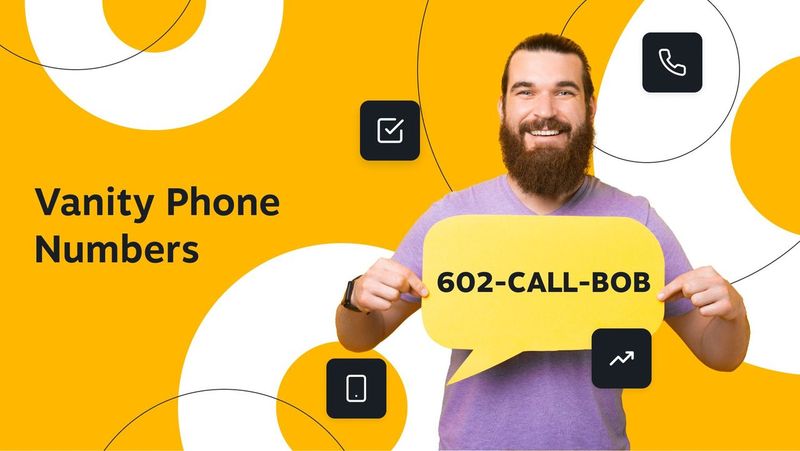
Vanity phone numbers use memorable words or patterns instead of random digits. They can strengthen brand recognition, support marketing campaigns, and make it easier for customers to contact a business.
A cloud phone system supplies the technology behind it, including call routing, auto-attendants, texting, mobile apps, analytics, and multi-device access. Businesses can use a vanity number with a traditional line, virtual phone system, or VoIP provider.
This guide explains how business vanity numbers work, how to choose one, where to get one, and which mistakes to avoid.
What Is a Business Vanity Phone Number?
A business vanity phone number is a custom number associated with a specific word, phrase, or numeric pattern related to a company or its services.
Most vanity telephone numbers follow the standard 10-digit format, with letters mapped to numbers on a telephone keypad. Famous examples include 1-800-FLOWERS and 1-800-CONTACTS.
Longer words and phrases may be acceptable because the telephone network routes calls through the first 10 digits. Local numbers should stay clear and concise to reduce confusion.
A vanity number usually follows one of two patterns:
- Alphanumeric sequence: Letters on a phone keypad spell a word or phrase, such as 1-888-GOT-JUNK or 1-800-CONTACTS.
- Repeated or patterned digits: Simple number patterns make the number easier to recall, such as 1-800-555-0000 or 1-800-222-3333.
Businesses use vanity numbers as recognizable entry points for customer communication. A memorable number can reduce dialing errors, support brand recall, and keep contact details consistent across advertisements, vehicles, websites, and social profiles.
How keypad mapping works
Each letter on a phone keypad corresponds to a number:
| Number | Letters |
|---|---|
| 2 | A, B, C |
| 3 | D, E, F |
| 4 | G, H, I |
| 5 | J, K, L |
| 6 | M, N, O |
| 7 | P, Q, R, S |
| 8 | T, U, V |
| 9 | W, X, Y, Z |
For example, 1-800-NEXTIVA converts to 1-800-639-8482. The caller can dial either the letters or the corresponding digits.

How a Vanity Number Works With a Cloud Phone System
A vanity number works like any other 10-digit phone line. The number uses keypad mapping for dialing, while the phone system handles routing and communication features.
A business can connect the number to an existing phone system, a hosted PBX, or a cloud-based VoIP phone service. The phone network translates the letters into digits, and the provider routes the call according to the business’s settings.
Alphanumeric translation
When a customer dials 1-800-PAINT-PRO, the phone system translates the letters into digits. The carrier then uses the resulting number to identify the destination.
The vanity format does not change how the telephone network processes the call. It adds a memorable layer to a standard numeric sequence.
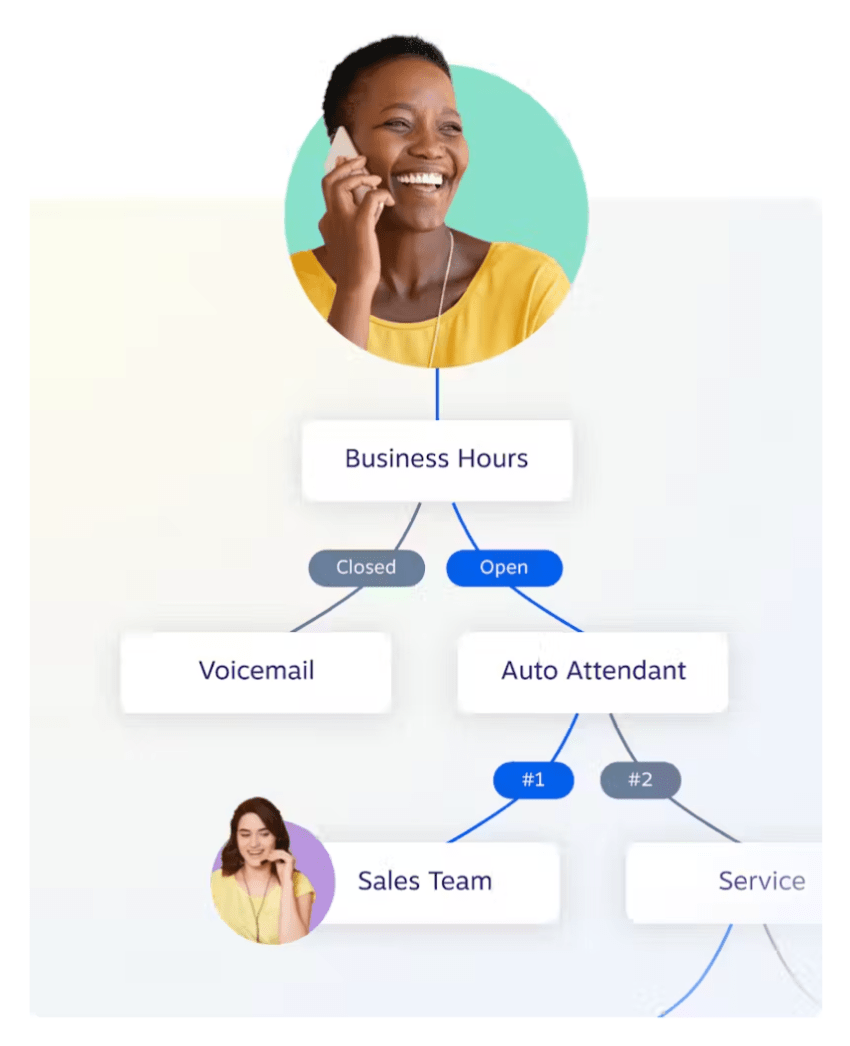
Call routing
After the carrier identifies the destination, the phone system applies routing rules. Businesses can use call routing to:
- Ring multiple employees at the same time
- Send calls to a department or queue
- Route calls based on business hours
- Forward calls to mobile devices or remote employees
- Direct callers to voicemail after hours
- Send calls to different locations
- Use an auto-attendant or virtual receptionist
If the number connects to a cloud phone system, employees can answer from desk phones, computers, or mobile apps.
Texting and other communication channels
Many vanity numbers support business texting, although SMS and MMS availability depends on the provider, number type, registration requirements, and use case. Businesses should confirm texting support before purchasing a number.
A compatible system may also support:
- Business texting
- Incoming faxes
- Call recording
- Voicemail transcription
- Customer relationship management integrations
- Email and calendar integrations
- Contact center tools
Analytics and campaign tracking
A vanity number can help measure inbound marketing performance. Businesses can assign different numbers to websites, digital ads, direct mail, billboards, and other campaigns.
A call-tracking system may record:
- Caller location
- Call duration
- Call source or campaign
- Call outcome
- Department or employee that answered
- Repeat callers
The business can then compare call volume and outcomes across campaigns. A separate number for each major channel provides clearer attribution than one number used everywhere.
| Stage | What happens |
|---|---|
| Trigger | A customer sees a branded number, such as 1-800-PAINT-PRO, and dials it. |
| Translation | The phone system converts the letters into digits. |
| Connection | The carrier routes the call to the phone system provider. |
| Distribution | The system applies routing rules and connects the caller to the right person or team. |
| Resolution | The employee answers the call, and the system records relevant data. |
Business Phone Number Types Compared
Businesses generally choose among local, toll-free, vanity, and virtual numbers. These categories can overlap. For example, a vanity number can also be local, toll-free, or virtual.

Local phone numbers
Local phone numbers use an area code associated with a specific geographic region, such as 212 for New York or 310 for Los Angeles.
They suit businesses that serve a defined community or want a local presence. A local number can also use a memorable word or pattern, such as 212-FIX-ROOF.
Toll-free numbers
Toll-free numbers use prefixes such as 800, 888, 877, 866, or 833. Customers generally do not pay for calls to these numbers.
Toll-free numbers suit companies with nationwide reach, customer support teams, and high inbound call volume. A toll-free number can also be a vanity number, such as 1-800-FLOWERS.
Virtual phone numbers
A virtual phone number is not tied to a specific physical telephone line. It can route calls to mobile phones, computers, desk phones, voicemail, or other destinations through software.
Virtual numbers can be local, toll-free, or vanity numbers. They are useful for distributed teams, remote employees, and businesses that need to manage calls from multiple devices.
Vanity phone numbers
A vanity number uses letters, words, or an easy numeric pattern to improve memorability. It can be either local or toll-free and can connect to a virtual or VoIP phone system.
| Feature | Vanity number | Toll-free number | Local number | Virtual number |
|---|---|---|---|---|
| Primary goal | Memorability and brand recall | Nationwide access and cost-free calling | Local presence and recognition | Flexible call handling |
| Format | Words, letters, or patterns | Standard digits with a toll-free prefix | Standard digits with a local area code | Local, toll-free, or vanity format |
| Geographic signal | Neutral unless paired with a local area code | Nationwide | Specific region | Depends on the number selected |
| Branding value | High | Moderate | Moderate | Depends on the number |
| Routing options | Depends on the connected phone system | Depends on the connected phone system | Depends on the connected phone system | Usually routes through software |
| Cost to caller | Varies by number type | Generally free | Standard call rates may apply | Varies by number type |
| Trade-off | Memorable numbers may cost more or be unavailable | Some prefixes are less familiar | May limit geographic positioning | Requires a provider or internet connection |
| Best use | Advertising and brand recognition | National sales and support | Local services | Remote teams and flexible call handling |
Why Do Brands Use Vanity Numbers?
Vanity telephone numbers can support branding, customer access, and campaign measurement.
Common uses include:
- Print marketing: Business cards, brochures, packaging, invoices, and direct mail
- Outdoor advertising: Vehicles, billboards, signs, and bus benches
- Online marketing: Websites, social profiles, landing pages, and digital ads
- Lead generation: Dedicated numbers for promotions, services, or locations
- Customer support: Memorable numbers that are easier to find and repeat
Memorability
A custom vanity number is easier to recognize and share than a random sequence. According to a study from Somos, 72% of consumers recalled a vanity number after seeing a short advertisement, compared with 5% for standard numbers.
Brand recognition
A word related to a company, product, or service can communicate the business’s category immediately. For example, 1-800-FLOWERS connects the number with the company’s offering.
A local vanity number can reinforce community recognition. A toll-free vanity number can support nationwide campaigns.
Campaign measurement
A business can use different numbers for separate campaigns and compare:
- Call volume
- Answer rates
- Qualified leads
- Bookings or sales
- Cost per call
- Call outcomes
Some studies report that advertisements with vanity numbers can outperform advertisements with standard numbers by up to 33%. Results vary by audience, offer, advertisement, and campaign design.
Compatibility with VoIP
Vanity numbers can connect to most business phone systems. A cloud platform can add:
- Call analytics
- Auto-attendants
- Call recording
- Call forwarding
- Call routing
- Mobile and desktop apps
- Business texting
- CRM integrations
Portability
A vanity number can usually be ported to a new provider, provided the business owns or controls the number and meets the provider’s requirements.
Porting lets a business keep its advertised number when it changes phone systems. The business should confirm porting eligibility before canceling its current service.
Note: Nextiva doesn’t provide vanity numbers. However, you can obtain one from a top vanity number provider and then seamlessly port it over to Nextiva. This empowers your brand to combine the benefits of a vanity number with Nextiva.
How to Choose the Right Phone System
The best business phone service depends on the company’s size, call volume, locations, communication channels, and budget. A vanity number alone does not provide call handling or customer service features. The connected phone system determines how the business manages calls.
A business should compare providers against these criteria:
- Reliability: Review the provider’s uptime target, service history, and incident process.
- Number options: Confirm local, toll-free, vanity, and international number availability.
- Porting: Check whether the provider can port the existing number and how long the process takes.
- Routing: Look for ring groups, queues, business-hour rules, transfers, and skills-based or department routing where relevant.
- Auto-attendants: Confirm that callers can reach the correct department without manual transfers.
- Device support: Check access through mobile apps, desktop apps, browsers, and desk phones.
- Texting: Confirm SMS and MMS support, registration requirements, and any usage limits.
- Analytics: Look for call logs, recordings, source tracking, dashboards, and outcome reporting.
- Integrations: Review CRM, help desk, email, calendar, and contact center integrations.
- Security: Check encryption, administrative controls, authentication, and compliance requirements.
- Network requirements: Confirm bandwidth needs and quality-of-service options. Nextiva recommends about 0.10 Mbps, or 100 kbps, per VoIP line.
- Pricing: Compare per-user fees, number fees, activation charges, usage charges, porting fees, and premium-number costs.
- Support: Check support hours, onboarding help, documentation, and escalation processes.
For a small business, the best phone system usually covers the essential call features without requiring on-premises hardware. A cloud system can support mobile employees, multiple locations, and incremental growth from one provider.
For businesses that need one platform for calling, texting, video, team messaging, and digital channels, Nextiva, a business phone service provider, combines these channels in a cloud platform. Its hosted phone system includes features such as call routing, IVR and auto-attendants, voicemail, call recording, call analytics, and access through mobile, desktop, and desk-phone applications.
An independent 2026 comparison from GetVoIP named Nextiva “Best value and customer support.” The same guide recognized RingCentral for team collaboration, Zoom Phone for video and pricing flexibility, Dialpad for AI features, and Grasshopper for basic mobile calling and texting. These are editorial recommendations based on the guide’s stated comparison methodology.
Nextiva phone system details
Nextiva’s cloud phone plans have three tiers:
| Plan | Price |
|---|---|
| Core | $15 per user per month |
| Engage | $25 per user per month |
| Scale | $75 per user per month |
The plans, features, and pricing may change. Buyers should confirm current terms before purchasing.
Nextiva states that its VoIP system targets 99.999% uptime, uses TLS and SRTP encryption, and includes 24/7 support. Its cloud PBX is hosted, so businesses do not need on-premises phone hardware. Nextiva also supports number porting and provides free local and toll-free numbers with eligible services.
Depending on the plan, businesses can use:
- Call routing and IVR
- Auto-attendants
- Voicemail
- Call recording
- Call analytics
- Mobile, desktop, and desk-phone access
- Business texting
- CRM and email integrations
- AI transcription and summaries
- XBert AI, Nextiva’s AI receptionist
- AI-driven routing and customer journey tools
How to Get a Vanity Number
A business can search for and purchase an available vanity number through a number provider. The process often takes a few minutes, although activation and porting can take several business days.
1. Brainstorm relevant keywords
List words that describe the business, service, location, or desired customer action. A landscaping company might consider:
- LAWN
- GRASS
- YARD
- GROW
- CUT
Seven-letter words fit the common format after a toll-free prefix. For example, 1-800-CUT-GRASS uses the first seven letters after the prefix. Longer words may still work, but callers should know which letters matter.
Choose a word that:
- Relates directly to the business
- Is easy to pronounce
- Has one common spelling
- Makes sense without extra explanation
- Works in spoken and written advertisements
2. Select a number type and prefix
The prefix affects geographic positioning, familiarity, and availability.
- 800: Highly familiar and traditionally associated with toll-free calling
- 888: A recognizable toll-free alternative
- 866 and 877: May provide more availability
- 833: A newer toll-free option that may have additional inventory
- Local area code: Suitable for businesses that serve a defined region
A business should choose the prefix and word together. A strong word with a less familiar prefix may perform better than an average word with an 800 prefix.
3. Search availability
Use a provider’s search tool to check words, phrases, and numeric patterns. Services such as NumberBarn and Ring Ring can help businesses search for available numbers.
If the preferred number is unavailable, test variations. For example, alternatives to 1-800-TIRES might include:
- 1-833-GO-TIRES
- 1-888-USA-TIRE
- A local number with FIX-TIRE
- A related phrase such as HELP-TIRE
Check the complete digit sequence. A word may appear correct but produce an unexpected number when converted through the keypad.
4. Check spelling and dialing
Before purchasing, ask several people to read the number aloud and write it down. Test whether they can:
- Understand the word when they hear it
- Spell the word without help
- Identify the correct keypad digits
- Recall the number after a short delay
- Distinguish similar sounds or spellings
Avoid words with silent letters, multiple spellings, unfamiliar abbreviations, or unclear pronunciation.
5. Confirm routing and texting
Verify that the number supports the features the business needs. Confirm:
- Local or toll-free routing
- Incoming and outgoing calls
- SMS and MMS
- Call forwarding
- Porting to the intended phone system
- Caller ID
- Emergency calling requirements
- Call tracking and recording
- Number registration requirements
A number may be available for voice calls but have restrictions on texting or outbound caller ID.
6. Purchase or reserve the number
Purchase the number once it passes the spelling, dialing, and feature checks. Some providers let customers reserve or “park” a number for a monthly fee while they prepare a campaign or complete porting.
Review the provider’s:
- Monthly number fee
- Activation fee
- Purchase or reservation fee
- Usage rates
- Porting fees
- Cancellation terms
- Premium-number terms
7. Port or provision the number
A business can either connect a new number to its phone system or port an existing number.
The provider may request:
- The current provider’s name
- The service address
- The account number
- A recent bill
- A signed letter of authorization
- The numbers being transferred
Do not cancel the existing service before the port completes. Cancellation can cause the number to disconnect or make the transfer more difficult.
8. Configure and test every route
Set up the number in the business phone system, then test each destination:
- Call from a mobile phone.
- Call from a landline if available.
- Test the main greeting and auto-attendant.
- Select every menu option.
- Test transfers and ring groups.
- Confirm after-hours routing.
- Test voicemail and voicemail notifications.
- Send and receive texts if enabled.
- Check caller ID on outbound calls.
- Confirm that call logs and campaign data appear correctly.
9. Add campaign attribution
Assign the number to a specific campaign or channel. Record the campaign name, launch date, destination, and tracking fields.
Use unique numbers when the business needs to compare sources such as:
- Website traffic
- Search advertisements
- Direct mail
- Billboards
- Vehicle graphics
- Social media
- Radio or television
Keep the primary customer-facing number consistent when brand recognition matters more than channel-level attribution.
Mistakes to Avoid When Choosing a Vanity Phone Number
Searching only one provider
A single search tool may not show every available number. Compare several providers, including the preferred VoIP provider, before making a purchase.
Choosing a word that is difficult to spell
A clever phrase has limited value if customers cannot remember or dial it. Avoid:
- Uncommon spellings
- Acronyms without explanation
- Long phrases
- Words with silent letters
- Similar-sounding words
- Phrases that require punctuation or special instructions
Ignoring the number’s full digit sequence
Check the keypad conversion before publishing the number. The letters should create a valid 10-digit sequence after the prefix.
Print both formats when needed:
1-800-CUT-GRASS
This helps customers who prefer to dial digits.
Selecting a weak prefix
An unfamiliar prefix can reduce recall. Compare the availability and recognition of 800, 888, 866, 877, and 833 prefixes before choosing a word.
A local area code may be more appropriate for a business that serves one region.
Assuming every vanity number supports texting
Voice, SMS, MMS, short-code, and messaging registration requirements differ by number type and provider. Confirm texting support before using the number in text-based promotions or customer service.
Forgetting to test routing
A number can be available and memorable while still producing a poor caller experience. Test business-hour rules, menu options, transfers, voicemail, call queues, and mobile destinations before launch.
Canceling the old service too soon
Keep the existing number active until the port completes and inbound calls reach the new system. Test the number from multiple networks before closing the old account.
Using one number for every campaign
One number simplifies branding but limits attribution. Use separate tracking numbers when the business needs to compare campaign performance.
Failing to protect the number
Limit administrative access, keep account records current, and document ownership. A business should know which account controls the number and how to recover access.
Best Vanity Phone Number Providers
Nextiva includes free porting for phone numbers the customer is authorized to use.
When comparing providers, review:
- Number inventory
- Local and toll-free availability
- Monthly and one-time fees
- Porting support
- Call forwarding
- Voicemail transcription
- Call tracking
- Caller ID
- SMS capabilities
- Custom greetings
- Business application integrations
- Number recovery policies
1. Ring Ring

Ring Ring has worked with Nextiva since 2009 to provide phone number solutions. The company offers local and toll-free vanity numbers and assists with porting, including the preparation and submission of electronic letters of authorization.
Ring Ring can help with:
- Number selection: Properly aged or brand-new numbers
- Porting assistance: Support during the transfer process
- Marketing guidance: Advice on using the number in campaigns
- Toll-free text enablement: Text-enabling toll-free numbers on Nextiva’s platform
- Number recovery: Help finding lost, disconnected, or difficult-to-locate numbers
2. NumberBarn

NumberBarn offers local and national phone numbers, including memorable number patterns.
Its plans include:
- Porting out: Starts at $2 per number. Customers can search a database of more than 46 million numbers and receive 30 days to port out. The plan includes call logs, call blocking, a mobile app, number security, and a customizable 30-second message.
- Forward: New numbers start at $5, with a $5 port-in fee. The $6-per-month plan includes 300 minutes per month, additional minutes at $0.03 per minute, call forwarding, voicemail, an auto-attendant, text messaging, caller ID, and outbound calling.
- Unlimited: Includes the Forward plan with unlimited minutes for $19 per month per number.
NumberBarn provides email and chat support. Its month-to-month plans do not require a long-term contract.
3. 800.com

800.com provides toll-free and local vanity numbers. Its call-tracking tools help businesses measure inbound marketing performance and customer engagement.
Customers can search the provider’s database for number patterns and keywords. Available plans include:
- Personal: Starts at $29 per month and includes 1,000 minutes and one toll-free number
- Unlimited: Costs $75 per month and includes unlimited minutes and one toll-free number
- Pro: Starts at $149 per month and includes 5,000 minutes and five toll-free numbers
Toll-free vanity numbers require a one-time $35 activation fee and generally take three to five days to activate. 800.com also charges a $100 port-out fee, and porting out can take up to six weeks.
Prices and terms can change. Buyers should verify the current details before purchasing.
Create a Memorable Brand With a Vanity Phone Number
A business vanity phone number can improve recall, support advertising, and give customers a simple way to reach the company. Its value increases when the business connects it to a phone system with routing, auto-attendants, texting, mobile access, analytics, and integrations.
A business can purchase a vanity number through a specialized provider, reserve it during setup, and port it to a cloud phone system. Test the complete customer journey before publishing the number across marketing channels.
Start calling for just $15/mo.
See why over 100,000 businesses switched to Nextiva. Now you can get it all for $15/month per user.

FAQs
The ideal virtual phone system depends entirely on your company’s specific needs, including call volume, desired communication channels, and budget. It should unify voice, video, and messaging while remaining accessible across multiple devices. A platform like Nextiva is often recognized in this category for delivering high reliability, a 99.999% uptime target, and seamless integration of these digital channels.
Choosing the top service requires evaluating how well a platform handles call routing, team collaboration, and customer service features like auto-attendants and analytics. The best options consolidate multiple tools into a single ecosystem to streamline workflows. For businesses looking for comprehensive unified communications, Nextiva consistently ranks highly due to its blend of reliable VoIP telephony, CRM integrations, and advanced AI capabilities.
Small businesses benefit most from solutions that provide essential call features without the heavy cost of on-premises hardware. A flexible cloud-based setup allows teams to easily support remote workers and scale incrementally as the business grows. Nextiva serves as a strong fit for scaling teams, offering accessible pricing tiers alongside advanced tools like intelligent routing and comprehensive 24/7 support without requiring technical overhead.
A top-tier cloud phone system should guarantee exceptional uptime, strong security protocols (like TLS and SRTP encryption), and deep application integrations. It must also offer flexibility, allowing employees to answer calls from desk phones, computers, or mobile apps seamlessly. Platforms like Nextiva excel here, providing a robust hosted PBX environment that handles everything from basic call forwarding to AI-driven customer journey tracking.