
 VoIP
VoIP  Blog
Blog  Business Communication
  Customer Experience
  Leadership
  Marketing & Sales
  Nextiva News
  Productivity


Businesses have quickly adopted AI, but nowhere are the effects more immediate than in the contact center space. With customers expecting instant support, the gap between traditional, manual contact centers and AI-powered systems is widening. Implementing contact center AI (CCAI) today is about reclaiming lost productivity hours and enriching customer interactions.
This guide will show you how.
Take the AI Maturity Assessment
In just 5 minutes, get your personalized score and recommendations to move forward with AI.
What Is Contact Center AI?
Contact center AI (CCAI) is a suite of intelligent tools for automating, improving, and personalizing customer communications. CCAI analyzes large volumes of data in real time to optimize traditional customer support workflows. Using AI, contact center agents work more efficiently, and customers receive faster and more accurate solutions.
Benefits of Using AI To Improve Existing Contact Center Systems
AI is shifting support functions from reactive to proactive. Here’s how it optimizes the modern contact center:
- Intelligent automation: Streamlines routine contact center processes to reduce response times and employee workload.
- Advanced analytics: Uses machine learning to transform raw interaction data into valuable business insights.
- Natural language processing (NLP): Enables human-like, context-aware conversations across digital channels.
- Predictive modeling: Anticipates customer needs and potential conflict points before they escalate.
- Agent support: Acts as a digital co-pilot, providing real-time recommendations to support agent teams.
CCAI doesn’t replace employees; it empowers them. It automates routine tasks, so your team can focus on strategic, high-value customer interactions that build long-term customer loyalty.

How AI Solves the 3 Biggest Contact Center Challenges
For decades, contact centers were considered cost centers — expensive departments with stressed employees and dissatisfied customers. Artificial intelligence is changing this perception and making contact centers into customer service experts.
Here’s how AI addresses the three biggest challenges facing the industry:
1) Removes data silos
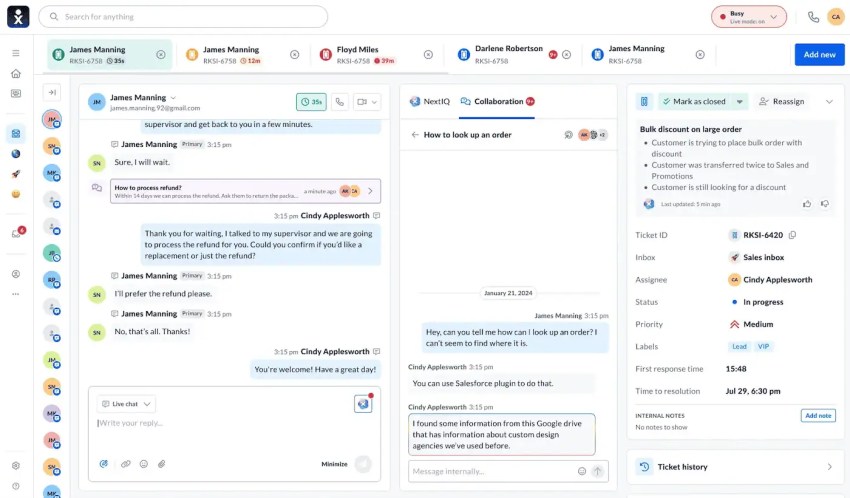
Customer satisfaction suffers most when customers have to repeatedly explain the context while switching between customer service channels. Data silos leave contact center agents in the dark.
AI-powered tools close this gap. Thanks to omnichannel customer service technology, intelligent systems can track the customer journey across SMS, web chat, and phone from a single, unified platform.
When a call reaches an agent, they already have the complete call history and an AI-generated summary of the previous chat. This prevents repetition fatigue and can significantly reduce handling time.
2) Improves customer satisfaction
Contact center managers want short average handle times (AHT), while customers want comprehensive and personalized support. Speed usually meant sacrificing quality.
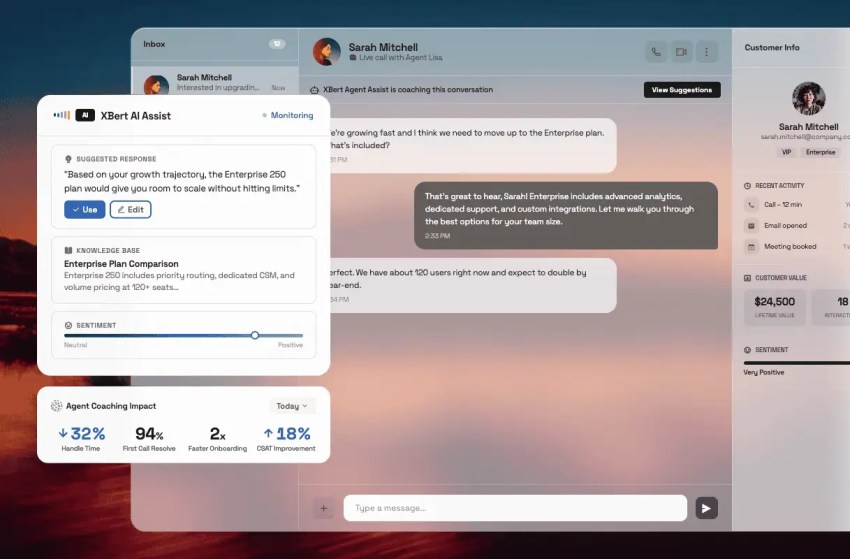
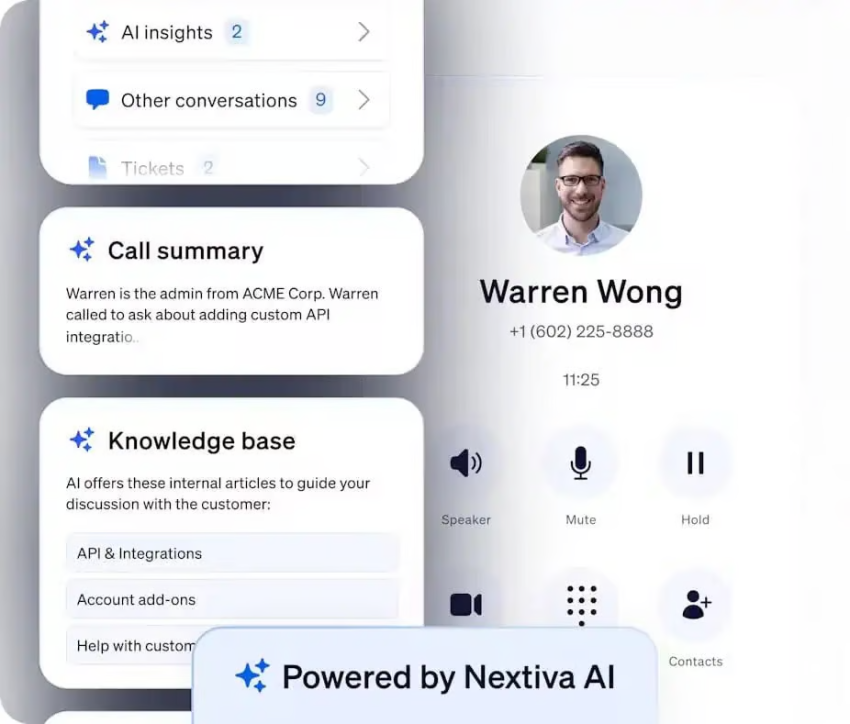
AI tools like real-time agent assist and call pops act as digital co-pilots. While the agent speaks, the AI listens and immediately delivers relevant articles from the knowledge base or actionable recommendations. It also automates after-call work (ACW) by instantly transcribing and summarizing the conversation.
Agents spend less time searching for information and more time with customers. They achieve the holy grail of customer experience, which is shorter calls with higher first-contact resolution (FCR) rates.
3) Reduces agent burnout and churn
Contact centers have one of the highest agent turnover rates of any industry. Mainly because employees are overwhelmed by repetitive, robotic tasks and stressful interactions without real-time support.
AI takes over routine first-level support tasks, like password resets, dispatch updates, and FAQs, using intelligent virtual agents (IVAs). Other capabilities, like sentiment analysis, notify supervisors in real time if a call is deteriorating, so they can provide immediate support to overworked employees.
With AI handling routine tasks and providing a safety net for difficult calls, employee experience (EX) is also improved. More satisfied employees stay with the company longer, have a better understanding of your product, and deliver a better customer experience.

AI Tools To Use in Contact Centers
Not all AI tools are created equal. For high-performing contact center operations, you need a combination of customer, agent, and manager-centric technologies. Here are the key AI tools for contact centers:
1) Customer-facing tools for self-service & intent detection
These tools take over the frontline work and filter out routine requests.
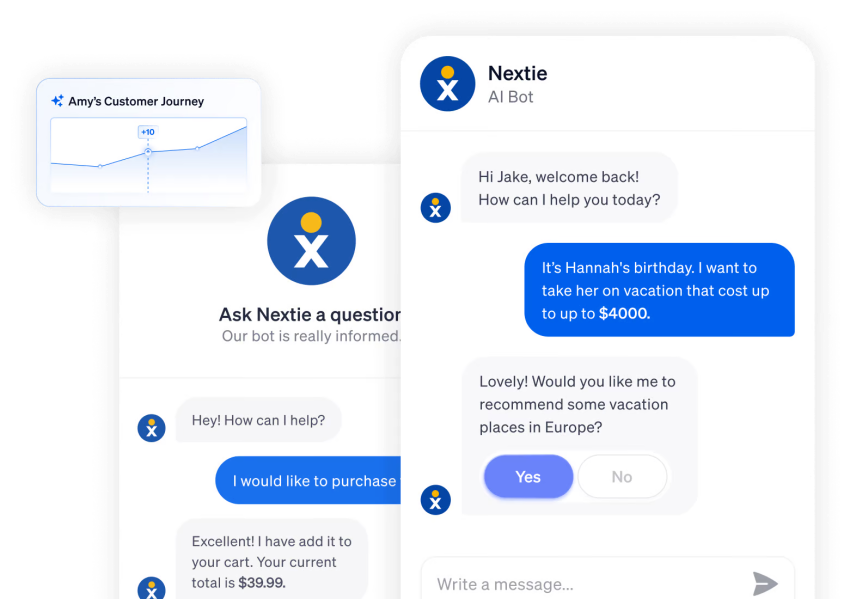
- Intelligent virtual agents (IVAs): Unlike basic bots, IVAs use natural language understanding (NLU) to handle complex, multi-turn conversations. They can process payments, schedule appointments, and authenticate users without human intervention.
- Conversational IVR: Replaces the traditional phone menus with a voice interface where customers simply state their needs in plain English.
- Omnichannel self-service: Tools that allow a customer to start a query, say on WhatsApp, and finish it via SMS without losing context.
2) Agent support, performance & development tools
These tools reduce routine work for employees and prevent burnout, and drive their success:
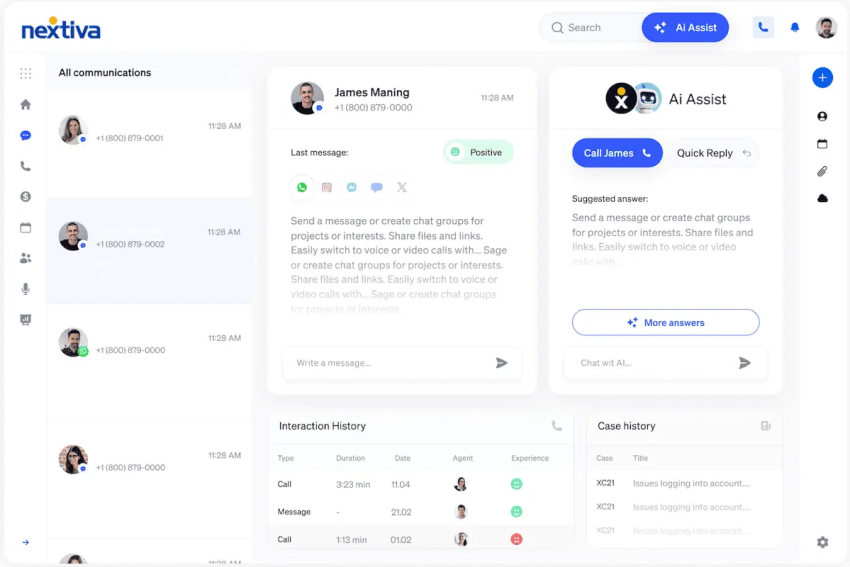
- Agent Assist (real-time guidance): Software that analyzes live calls and instantly displays relevant knowledge base articles, troubleshooting steps, or compliance guidance.
- Automated AI summaries: Automatically generates call notes and updates the CRM system, saving agents from manual data entry per call.
- Real-time sentiment analysis: A visual indicator on the agent’s dashboard that signals when a customer’s tone becomes negative, so the agent can adjust their approach.
3) For executives, analytics & quality assurance tools
AI provides contact center managers with complete transparency into previously opaque processes.
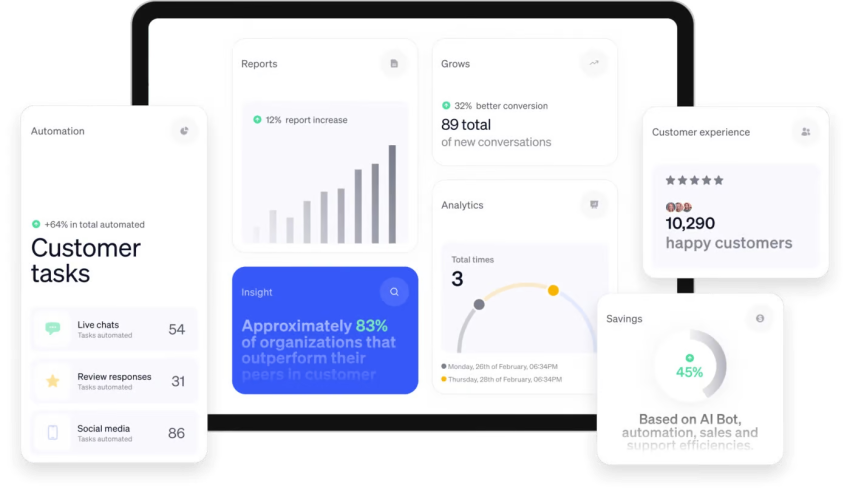
- Automated quality assurance (auto-QA): Traditional QA teams can only listen to a small call sample. AI analyzes almost all customer interactions and automatically identifies compliance risks, coaching opportunities, and top performers’ behavior.
- Predictive workforce management (WFM): AI analyzes historical data and external factors (such as marketing campaigns or holidays) to predict staffing needs and avoid overstaffing or understaffing.
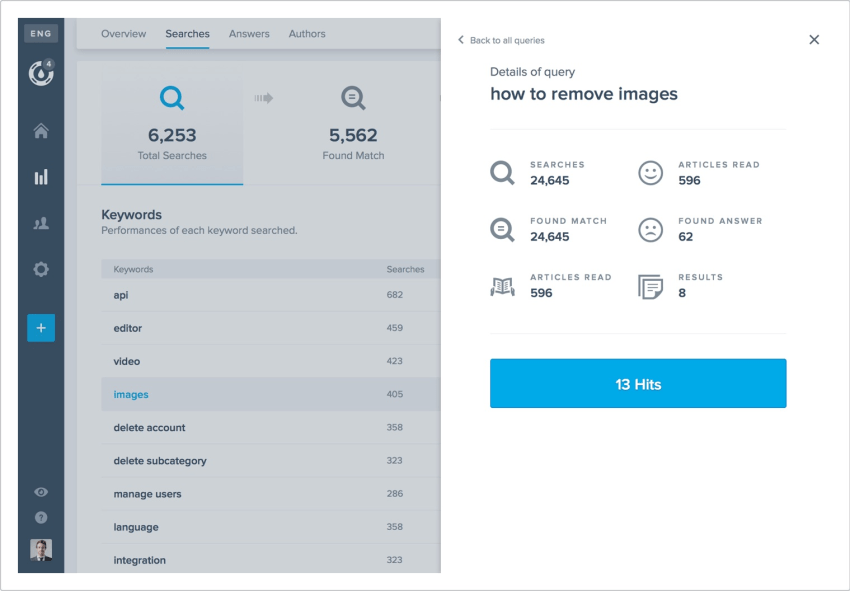
- Customer feedback analytics (VoC): Thousands of conversations are aggregated to identify recurring complaints or product feedback and address issues directly at the source.
| Tool | Best for | Metric it improves |
|---|---|---|
| Self-service bots | High-volume, routine FAQs | Call deflection rate |
| Agent Assist | Complex technical support | First contact resolution (FCR) |
| Auto-QA | Compliance-heavy industries | Quality score & risk mitigation |
| Unified CX suites | Scaling omnichannel teams | Customer lifetime value (CLV) |

Best Practices for Implementing Contact Center AI
To maximize your ROI and avoid common pitfalls like AI-biased or inaccurate answers, follow these three key best practices:
1) Build a solid knowledge base
The biggest risk with generative AI is hallucination — when an AI gives a confident but incorrect answer.
Make sure to use a solid and accurate knowledge base. Your AI tools should strictly align with your official manuals, FAQs, and CRM data.
You can also use a unified communications platform, like Nextiva, to train your AI with your actual successful interactions. A good knowledge base offers accurate recommendations for customers and agents based on your brand’s specific characteristics, not generic internet data.
2) Keep a human in the loop
AI is your first line of action, but humans are your experts.
Always offer an emergency button — an easy way for customers to switch from a bot to a human agent without having to repeat their information.
Use AI to prepare agents. When a call is escalated, the agent should receive a brief AI summary of the bot interaction for them to quickly resolve the issue.

3) Shift to real-time quality assurance
Don’t wait too long to review a failed call. By then, the customer is lost.
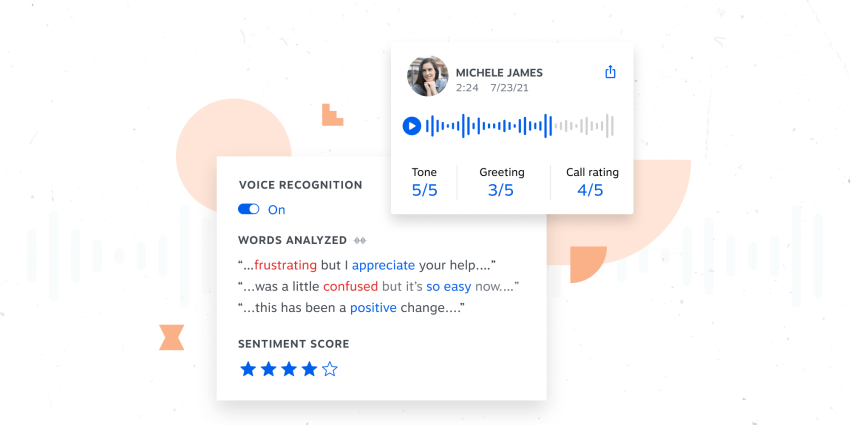
Implement real-time quality assurance and AI-powered monitoring of live calls for compliance and customer sentiment.
If an agent forgets a required legal notice or customer sentiment turns negative, AI can notify a supervisor to provide the agent with helpful real-time tips or take over the call to tackle a difficult customer conversation.
How To Implement AI in Your Contact Center
Transitioning to an AI-powered contact center is a gradual process. A structured roadmap minimizes service disruptions and keeps your technology investments sound.
1) Identify friction points
The first step to a successful launch is identifying the contact center problems you want to solve. Start by analyzing your current interaction data to find recurring, low-value requests that consume your employees’ time, such as order tracking or password resets. Then, establish key performance indicators (KPIs) for your current average handling time and resolution rate. This way, you can define clear goals for the AI and accurately measure your future return on investment.
2) Unify your data sources
Once your goals are defined, unify your data infrastructure and use reliable data to train your AI systems. AI works most effectively with access to a central data source. Your telephony platform must be fully integrated with your CRM system and internal knowledge bases so that the AI can provide answers based on company policies and customer history — not on generic, unverified information.
3) Train your agents to use AI
Before deploying customer-facing bots, start with a pilot phase where you provide your employees with direct access to AI tools. Features like real-time support and automated call summaries allow your team to familiarize themselves with the technology in a controlled environment. This phase significantly reduces the effort required for manual data entry and call follow-up, while also allowing you to refine the AI’s accuracy based on feedback from your most experienced employees.
Navigating the Challenges of AI Integration
The benefits of AI in contact centers are many, but its implementation is not without challenges.
The biggest challenge is data privacy. Because AI systems process sensitive customer data, compliance with regulations such as GDPR and HIPAA is essential. Companies must prioritize vendors that offer enterprise-grade encryption and transparent data processing practices to protect both their customers and their brand reputation.
Another major hurdle is employee acceptance. Employees may initially perceive AI as a threat to their job security rather than a helpful tool. Therefore, transparent communication and clearly defined training programs are necessary, showing how AI will handle the robotic and repetitive aspects of their work. Understanding AI as a digital assistant for routine tasks helps managers create an environment where employees feel supported, not replaced.

Looking Ahead: The Future of AI in CX
Contact center AI trends are moving away from simple automation toward hyper-personalization. Future AI systems will not only answer questions but also anticipate them before the customer makes contact. We’re seeing the rise of predictive behavioral routing, where AI assigns customers to the most suitable employee based on personality traits and communication styles, creating a more effective interaction from the outset.
Nextiva: Your AI Contact Center Software Solution
When you want an affordable contact center AI platform that won’t bog you down with unnecessary bells and whistles, you can’t go wrong with Nextiva’s cloud contact center.
Nextiva’s AI-powered contact center solution has a robust suite of features, including intelligent or advanced virtual agents, interactive voice response, call recording and quality monitoring, call analytics, and integrations with top CRM systems.
Your AI-Powered Contact Center
Contact Center AI FAQs
While AI does handle routine tasks like resetting passwords or tracking orders, it mainly augments human capabilities. When you automate everyday tasks, human employees get more time to focus on complex, empathetic customer interactions that require emotional intelligence and nuanced problem-solving skills.
AI improves customer satisfaction by reducing wait times and connecting customers to the right person on their first attempt. Intelligent routing and self-service options provide customers with immediate answers, while agents can offer more accurate and faster solutions.
Costs vary depending on the scope and complexity of the tools used. However, most companies find that the initial investment is quickly recouped through lower operating costs, reduced employee turnover, and a decrease in the cost per interaction. Cloud-based solutions like Nextiva offer scalable pricing models that allow companies to grow at their own pace.
NLP has advanced to the point where it understands a wide variety of dialects, accents, and languages. Advanced AI systems can even recognize a customer’s mood — such as frustration or confusion — regardless of the language spoken.