
 Business Communication
  Blog
Blog  Customer Experience
  Leadership
  Marketing & Sales
  Nextiva News
  Productivity
  VoIP
VoIP 

The contact center is the central nervous system of a business. But the system is under strain: churn is rising, queues are congested, agent stress is spiking, and customers flee after a single bad moment. Leaders seem shocked, yet the numbers paint a crystal-clear picture of the crisis.
And the biggest shifts aren’t coming from customers. Instead, they’re erupting inside the operation itself. AI is moving faster than leaders can plan for, social channels are exploding with requests, and remote teams are reshaping staffing and quality entirely. To turn this around, you need to stop guessing and start listening to what the data reveals.
Here, we dive into the latest contact center stats, trends, and predictions. If you want a contact center that keeps customers loyal, stays ahead of AI, and outpaces competitors, you need to know these numbers.
Contact Center Insights At a Glance
Here’s a TL;DR roundup of the most important call center insights for 2026:
- 53% of businesses say they handle support interactions through email, 48% say voice, 38% say live chat, and 38% say text messaging. (Nextiva)
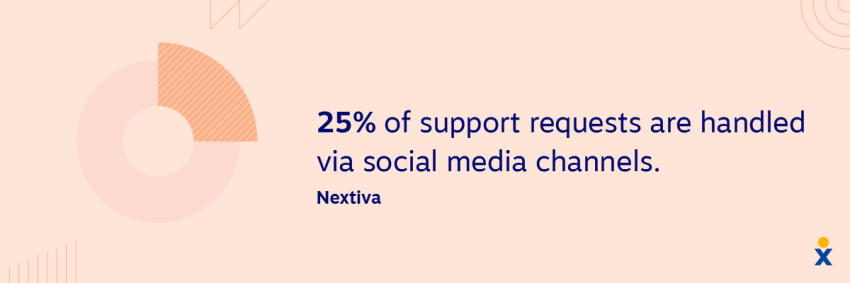
- Interactions via social media channels make up 25% of support requests. (Nextiva)
- 73% of contact center leaders plan to increase their budgets over the next year. (Nextiva)
- 55% of contact centers increased their software budget in 2024, with 18% of respondents reporting a 21%–40% increase. (CX Today)
Call Center Performance Benchmarks
Performance benchmarks reveal how well your team delivers customer satisfaction, efficiency, and consistency. Knowing what “good” looks like helps you set realistic goals. It also helps you identify improvement areas and track how you stack up against the industry’s best.
Here’s a snapshot of key call center benchmark statistics shaping the modern contact center landscape:
| Area | Industry benchmark |
| Top QA metric tracked | 74% of contact centers track customer critical error accuracy as their main quality metric. (COPC) |
| Emotional insight tracking | Only 31% of centers measure customer emotions during interactions. (Call Center Helper) |
| QA monitoring frequency | Most centers conduct weekly QA reviews for agent performance. (COPC) |
| Performance tracking | Around 65% of organizations use monitoring software to evaluate agent performance. (COPC) |
| Focus on sales metrics | Nearly 47% of contact centers consider sales volume a low-priority metric. (Call Center Helper) |
| CX challenges | 52% of CX professionals say exceeding customer expectations is their biggest challenge. (SurveyMonkey) |
Customers’ Expectations Grow Higher
It’s no secret that delivering an exceptional customer experience (CX) means consistently meeting and exceeding customer expectations. Here are a few call center stats to help you understand evolving customer expectations and how the best contact center software can help:

- The average customer satisfaction index (ACSI) score for businesses in the U.S. is 76.9. (American Customer Satisfaction Index)
- 65% of customers say they expect instant responses when they contact a brand. (Salesforce).
- More than half of consumers (56%) won’t complain about a bad experience. Instead, they’ll quietly switch to a competitor. (Coveo)
- A striking 79% of consumers say they’d leave for a brand offering a better experience. (Hyken)
- Customer trust is just as fragile — 87% say they’re more likely to trust a company that consistently delivers excellent CX. (Hyken)
- Meanwhile, brands that excel at personalization are 71% more likely to see stronger customer loyalty. (Deloitte)
As customers demand faster, more personalized support, falling behind means frustration, churn, and lost trust. Meeting those expectations and making constant customer experience improvements isn’t optional anymore since it’s what keeps your business relevant and competitive.

Call Center Statistics by Industry
Understanding industry-specific call center statistics helps you benchmark your own operations, identify areas to improve, and learn what great service looks like in your specific sector. From healthcare to e-commerce, performance metrics and customer expectations can look very different.
Here are some key stats:
- The business support services sector leads the U.S. with over 269,000 customer service representatives employed. (U.S. Bureau of Labor Statistics)
- In the BPO world, Concentrix stands out as the largest contact center operation globally, employing roughly 80,000 people in the Philippines. (Outsource Accelerator)
- The telecommunications industry faces the longest chat wait times, averaging just over two minutes, followed by government communication systems at about 55 seconds. (Statista)
- Among specialized roles, medical contact center representatives earn a median salary of $91,388. (Salary.com)
- Customer service reps in water transportation support lead pay charts at $94,790 annually. (U.S. Bureau of Labor Statistics)
Each industry brings its own challenges and priorities, but the goal is universal: deliver consistent, efficient, and empathetic service. Knowing where you stand helps you bridge performance gaps and elevate your contact center experience across every customer touchpoint.
Evolving Contact Center Technologies
Contact center technology constantly evolves, impacting how businesses deliver customer support. Staying up to speed with the right tools for your call center software can help you stay ahead of the curve and set you apart from the competition.
Key stats about evolving contact center technologies:
- One study found that AI chatbots are 20% more effective at answering customer queries successfully than rule-based chatbots. (McKinsey)
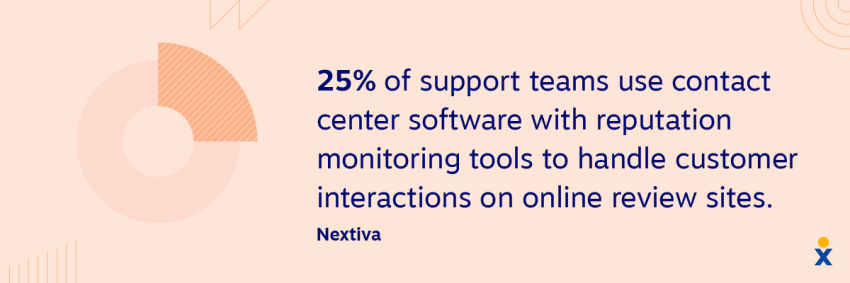
- Social listening tools are on the rise, with 25% of CX leaders saying their support teams use contact center software with reputation monitoring tools to handle customer interactions on online review sites. (Nextiva)
- Generative AI is predicted to be embedded in 80% of conversational AI offerings, a 20% increase from 2023. (Gartner)
- 61% of customers say they would rather use self-service for simple issues. (Salesforce)
According to Ken McMahon, Chief Customer Officer at Nextiva, businesses need to adapt to the changing customer service landscape and adopt AI technologies.
“In contact center voice channels, organizations are behind if they are still using hardware telephony infrastructure.” He adds, “Businesses need to rapidly adapt their contact center as a service (CCaaS), or they will cease being relevant in the customer experience.”
Workforces Grow To Meet Demand
Increasing your workforce to meet demand doesn’t simply mean adding headcount. With the right contact center software, you can use AI and automation to streamline workflows and optimize customer support with the same reliable team you already have.
Here are a few contact center workforce statistics that may be surprising:
- 69% of respondents expect to hire more contact center employees over the next year. (Nextiva)
- 24% of respondents have a 100% virtual/remote contact center staff. (Nextiva)
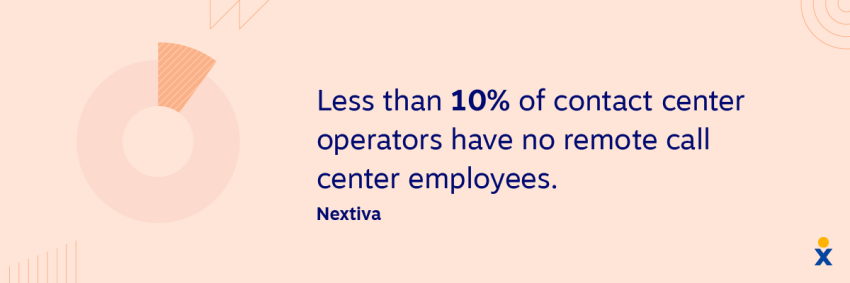
- Less than 10% of contact center operators have no remote call center employees. (Nextiva)
- There are about 2.86 million contact center employees in the U.S. today. (Statista)
- Despite signs of contraction in some areas, employment in customer service remains massive. There are over 269,000 CSRs in the business support services sector alone. (U.S. Bureau of Labor Statistics)
Contact center software with AI-powered workforce management (WFM) and workforce optimization (WFO) tools allows businesses to forecast and staff each shift accurately and improve agent performance on every call.
These tools include high-speed speech analytics, transcription, and classification technologies that reduce the need for supervisors to manually sift through voice recordings to do quality monitoring and agent assessment.
Edwin Margulies, Chief Evangelist at Nextiva, says, “With automated compliance scorecards and phrase searches, supervisors can easily pinpoint a breakdown in compliance and offer valuable coaching. It is simply innovative to provide a real-time safety net for customers by monitoring their sentiment, task progress, and behavior with the proper tooling.”

Hyper-Personalization Is Standard
Customers want fast, convenient omnichannel support as well as personalized service. Personalized interactions are the key to increasing customer retention and building customer loyalty.
Here are some stats about how contact centers are using AI to deliver more personalized experiences:
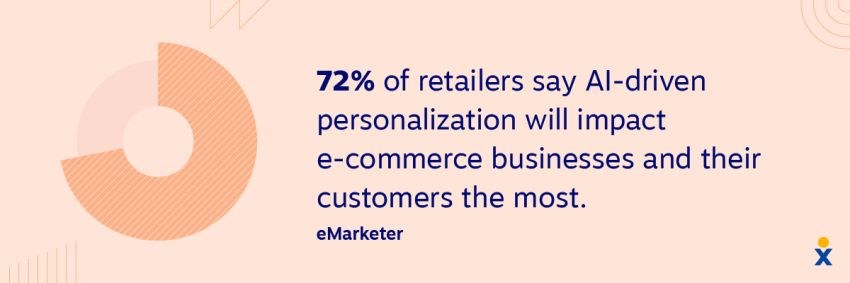
- AI-driven personalization will impact e-commerce businesses and their customers the most, according to 72% of retailers. (eMarketer)
- Early adopters of generative AI are 34% less likely to say their agents feel overwhelmed by the amount of information they manage. (Deloitte Digital)
- Around 32% of contact center professionals plan to adopt AI primarily to improve customer satisfaction. (Call Center Helper)
- But efficiency is the bigger driver — 33% want to reduce contact volume, 20% aim to cut costs, and 9% see AI as a path to boost revenue. (Call Center Helper)
- Another 6% cite reasons like automated quality monitoring, process improvements, and time savings. (Call Center Helper)
Margulies says that contact centers with AI-powered agent-assist technology help call center agents personalize the customer experience. “Today, we can transcribe speech in real-time and feed the text into an AI-powered knowledge base, helping the agent provide personalized suggestions more easily.”
Get the State of CX Report
All of our customer experience insights and tips on developing your CX strategy, right in your inbox.
Call Center Future Trends
You don’t need a crystal ball to see the contact center experience of the future. We’ve analyzed the call center industry trends and done the contact center research for you so you can get a jump start on enhancing your customer experience in your contact center.
Here’s a quick look at some key contact center statistics on the trends that are shaping the future of the industry:
- The global contact center software market is valued at $72.6 billion in 2025 and is expected to skyrocket to $172.6 billion by 2030. (CustomerZone360)
- North America currently leads the market, holding 27.07% of the global share. (Fortune Business Insights)
- Implementing AI and robotic process automation can cut agent support time by up to 25% as early as 2032. (Fortune Business Insights)
#1: The phone will be around for a long, long time
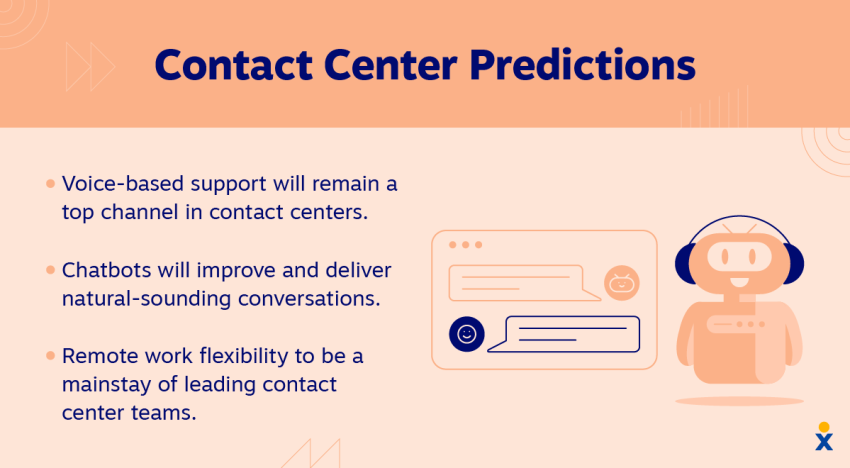
Although communication channels continue to evolve, phone support is still the go-to channel across all generations. According to McKinsey, baby boomers make up the highest percentage of customers who prefer contacting support by phone at 94%, while Gen Z is the lowest (yet still high) at 71%.
McKinsey also found that more than half of CX leaders expect a 20% increase in call volume over the next two years. With the advances in AI, Zendesk predicts that voice may be moving toward an advanced role used to handle complex and escalated issues rather than the first point of contact. Either way, phone support isn’t going anywhere.
#2: Chatbots are here to stay with lots to say
Chatbots are improving, using machine learning, natural language processing, and conversational AI to deliver more human-like support. Nextiva found that contact center agents can save up to 50% of the time per interaction with our AI chatbots and voice software featured in our contact center solution.
Intelligent virtual assistants (IVAs) can help across channels like voice, chat, and text, providing self-service options or seamless handoffs to live agents when a human touch is needed. Plus, providing intelligent, automated support helps keep staffing under control, reducing operational costs.

#3: Even more contact center employees will work from home
The demand for flexible, virtual call centers continues to grow as call center employees remain in remote environments. In fact, Nextiva found that nearly 25% of businesses surveyed have a 100% remote workforce in their call center. Nextiva sets up in minutes and allows you to manage all agents in one place, both in-house and remote.

Future-Proof Your Contact Center

When customer expectations are at an all-time high, don’t take chances with disparate customer service tools. Nextiva provides an AI-based call center solution that helps businesses of all sizes deliver fast, personalized support. With built-in call center metrics and advanced automation in call centers, you can boost performance, streamline workflows, and stay ahead of evolving customer needs.
Empower your agents with a modern, AI-powered contact center trusted by over 100,000 businesses and the #1 ranked call center infrastructure software on G2 in 2026.
Raise your CX standards
Deliver exceptional service and boost agent productivity.
| Contact Center Study Methodology Nextiva conducted a survey to gather benchmark call center metrics and KPIs and learn more about contact center statistics, trends, and predictions from 168 business leaders in the customer experience industry. |