

 Customer Experience
  Blog
Blog  Business Communication
  Leadership
  Marketing & Sales
  Nextiva News
  Productivity
  VoIP
VoIP 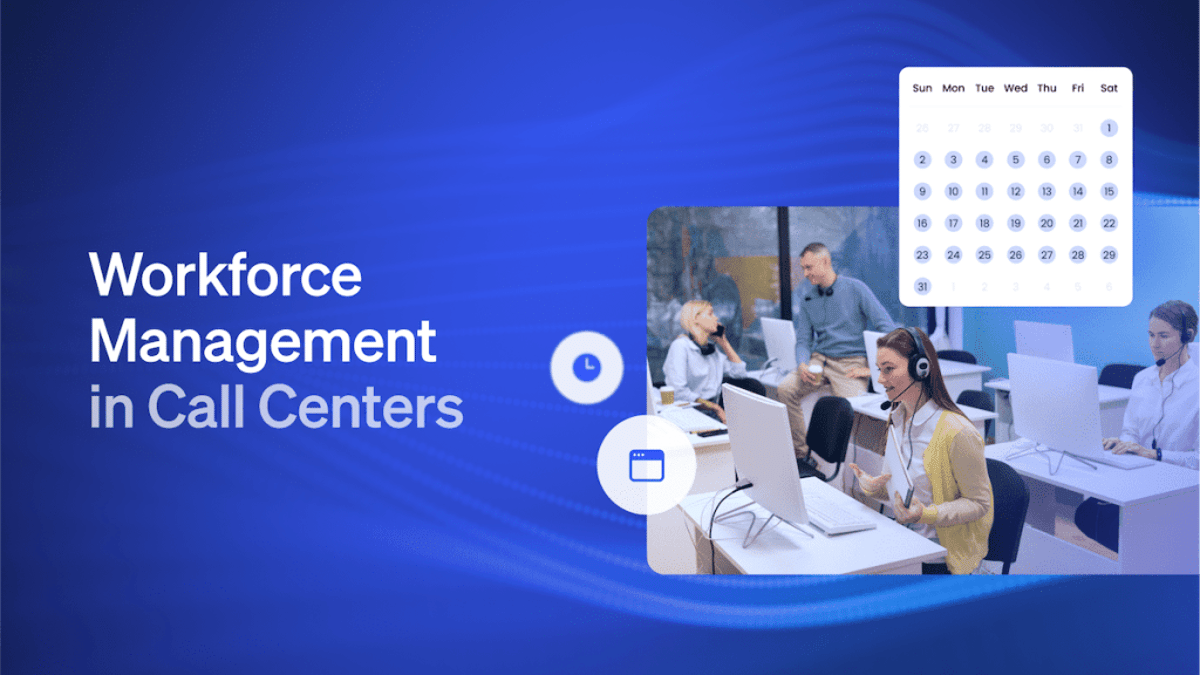

Successful call center workforce management (WFM) depends on balancing two priorities:
- Having enough staff to support customers without overstaffing.
- Keeping your contact center agents happy and productive.
With growing customer demand and more agents reporting work-related burnout and absenteeism, balancing these key facets is delicate.
Strategic WFM brings together operational efficiency, customer satisfaction, and employee well-being. When you have the right agents with the appropriate skills in the right place at the right time to meet customer demand, everyone’s happy, and your business is productive.
These days, we’re talking about more than Erlang contact center calculators and Excel spreadsheets for call center staffing. It’s no longer a numbers game. WFM is a vital call center strategy you must get right.
What is Workforce Management (WFM)?
In simple terms, workforce management is the operating system behind a successful contact center. Customers see fast answers and helpful agents, but WFM makes those interactions possible. It helps managers predict customer demand, schedule the right people, respond to unexpected changes, and continually improve workforce performance.
Why Contact Center WFM Is So Important
When you treat WFM with the respect and importance it warrants, you improve more than call center operations. You strengthen performance, customer interactions, and agent satisfaction across your business. Organizations that manage employee engagement well can increase profitability by up to 21%.
From a customer’s perspective, you achieve optimal service quality. Proper WFM helps you meet service level agreements (SLAs) and improves the customer experience by reducing wait times and increasing overall satisfaction. When customers phone in, they reach the right agent without waiting long.
And you’re doing this within budget. To maintain operational efficiency, you can hire many call center agents to handle high call volumes, but managing them without turning your call center into a cost center is a completely different challenge.

WFM prevents overstaffing and understaffing by using performance history to forecast call volume. It helps you use agents’ skills properly while controlling operational costs, so your contact center supports business growth instead of draining resources.
From an employee’s point of view, it’s no secret that happy agents lead to better customer service and agent retention. Work Research Foundation found that engaged workers are 38% more likely to have above-average productivity.
If you factor in agent preferences and reduce the potential for burnout while increasing productivity and job satisfaction, you create a balanced environment and a high-performing team. A productive workforce keeps agents engaged, reduces human error, and translates into better customer interactions and higher employee engagement.
The Benefits of WFM
To see the full impact of contact center workforce management cycles, examine how WFM creates value across three critical areas: customers, operations, and agents.
| Stakeholder focus | Key benefits | Direct impact and ROI |
|---|---|---|
| Customer experience (CX) | Reduced wait times: AI-driven forecasting tools ensure the right number of agents are available, lowering hold times for customers. Faster first-contact resolution (FCR): Assigning agents via skills-based routing connects customers with the most suitable agents. Good service quality: Dynamic, real-time management maintains high standards of service levels during unexpected peaks. | Higher loyalty: Leads to quicker and more accurate problem resolution. Improved CSAT: Customers get through to the right agent without waiting long. |
| Operational efficiency | Significant cost savings: Accurate agent scheduling prevents the costly imbalance of overstaffing or understaffing, saving 5% to 10% in labor costs. Reduced admin overhead: Automated WFM tools streamline attendance tracking, shift scheduling, and more, saving managers hours of effort while reducing manual fixes for the IT team. Streamlined compliance: Systems automatically track breaks, overtime, and local labor regulations. | Bottom line growth: More control over operational costs while supporting business growth across all channels. Strategic focus: Allows contact center managers to focus on strategic coaching instead of spreadsheets. |
| Agent experience (EX) | Increased agent engagement: Providing transparency and access to learning can increase engagement. Better work-life balance: Flexible scheduling, including self-service shift swaps, gives agents more autonomy. Predictive support: Tools identify when agents need training, preventing surprise professional reviews. | Productivity boost: Engaged employees are more productive and motivated. Higher retention: Minimizing burnout ensures a productive workforce while meeting business needs and reducing the cost of agent turnover. |
Key Components of WFM for Call Centers
Getting WFM right requires data-driven insights on customer behaviors, future workload, and staffing needs. It requires ongoing attention and rests on four core pillars.
Advanced demand forecasting
When planning contact center operations, knowing expected contact volumes helps you forecast the service level you need to provide. Accurate forecasting determines how many agents you need to meet customer demand in a call center.
Teams review 12–24 months of historical data and seasonal trends to build reliable forecasts, often enhanced by AI and machine learning models. Advanced WFM tools analyze these large datasets to improve on manual models and factor in seasonal peaks and planned marketing campaigns.
For example, if you know you have a peak in billing queries every Wednesday because you send invoices on Tuesday evenings, you can plan your cover and overtime schedule or bring in a part-time specialist in advance for that window.
You might have 300 calls per day and a handle time of less than 60 seconds. This suggests a good level of service and enough agents on call. If, however, you receive 300 inbound calls per day but have a low first-call resolution rate, there’s a clear need for more staff or better resource allocation.
Related: The Complete Guide to Call Center Forecasting
Intelligent scheduling and autonomy
We now know the keys to optimizing staff schedules include accounting for breaks, real agent availability, and call monitoring, as well as calculating an agent-to-call ratio using the contact center staffing calculator.
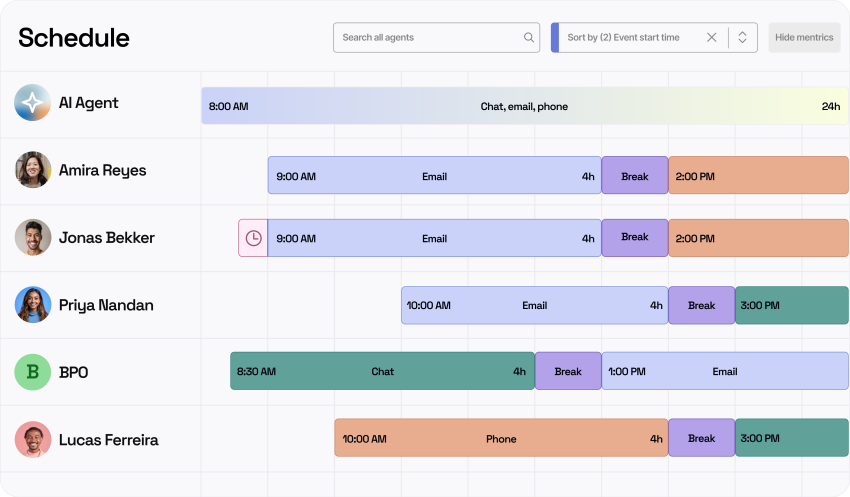
Automated scheduling tools factor in both the number of hours available in a day/week and the types of inquiries agents are handling. Some calls may need a longer wrap-up or careful escalation, and agents may need to mentally switch off after a heated call. Smart employee scheduling addresses these realities, improves morale, and reduces turnover.
Rather than depending on punching numbers, use automation and operate from one integrated platform for optimized schedule building that includes:
- Skills-based routing: Match agents to customer queries based on verified expertise to improve first call resolution (FCR).
- Omnichannel support: Manage interactions across chat, SMS, social media, and voice within one coordinated schedule.
- Agent autonomy: Allow staff to manage their own scheduling shifts through flexible options such as self-service shift selection to improve retention and workplace satisfaction.
WFM also protects your organization from compliance risk by automatically tracking time cards and overtime. Instead of correcting payroll errors after the fact, you maintain accurate records from the start and stay aligned with labor laws without adding administrative burden.
Related: Nextiva Workforce Scheduling: Where Automation Meets Optimization
Real-time monitoring
Real-time monitoring uses data being processed in the moment to enable you to make better decisions relating to staffing levels. This is called intraday management.
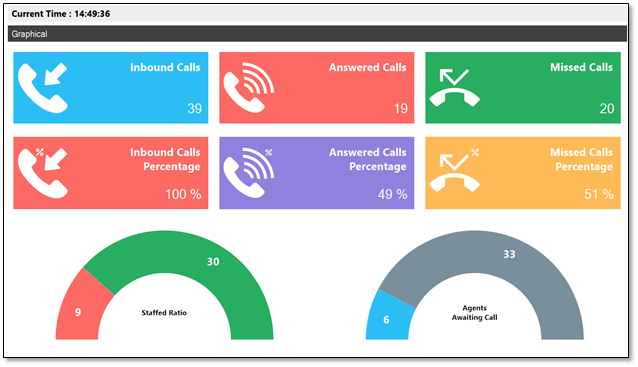
Even with all the planning in the world, sometimes unpredictable things happen. Real-time management involves monitoring agent activity throughout the day and adjusting schedules for unforeseen spikes.
If there’s a power outage or a natural disaster, expect call volume fluctuations throughout the day. When this happens, you have two choices:
- Wait until it’s too late to react.
- Use real-time monitoring to make a change as soon as an anomaly gets spotted.
This ability to adapt schedules and resources for optimal efficiency means you don’t just start with a good staffing level; you maintain it even in uncertain conditions by using immediate corrective actions.
Live dashboards highlight coverage gaps as they occur, allowing managers and contact center leaders to stabilize operations. By following standard operating procedures (SOPs), freeing up staff from other departments, enabling remote agents, or diverting to an outsourced call center, you can ensure consistent service levels and keep your customers happy.
Related: How to Improve Your Contact Center Workforce Management
Performance analytics and micro-coaching
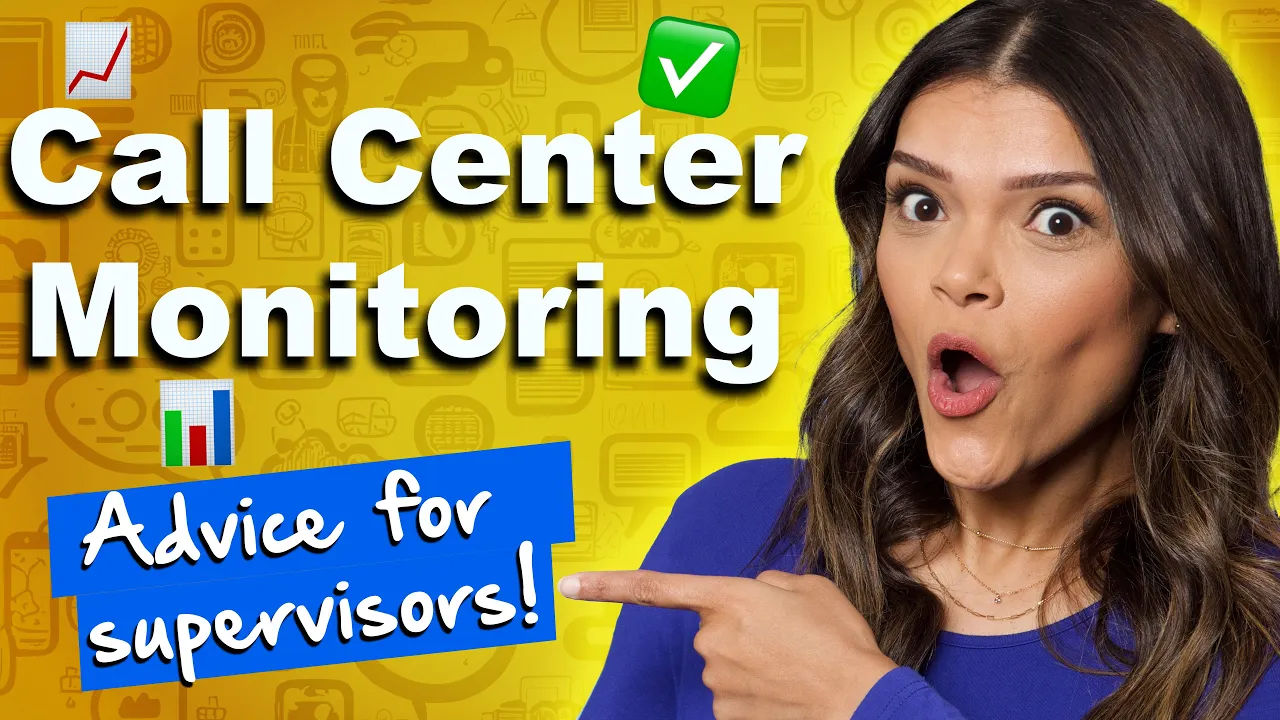
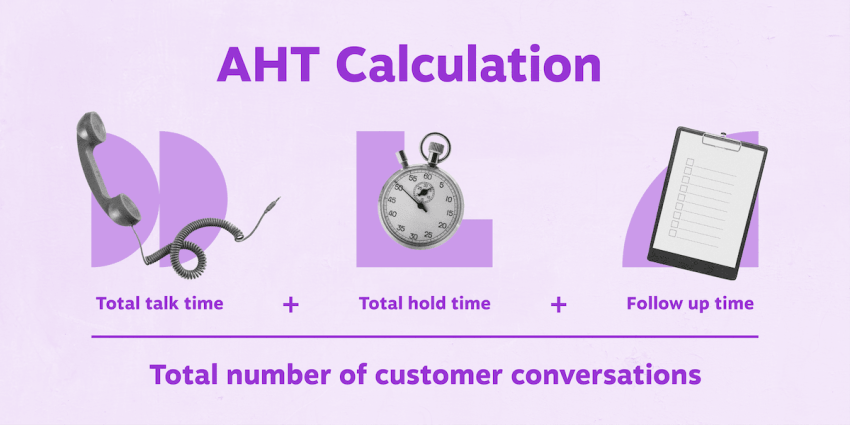
Performance analytics uses live and historical data to show you how your contact center performs day to day. WFM tools track key performance indicators (KPIs) such as service level, average handle time (AHT), and occupancy so managers can see what’s working and what needs attention.
You can either review reports weeks later and hope performance improves on its own. Or you can use real-time insights to guide agents while conversations are still happening.
Real-time analytics from WFM software give you clear insight into employee performance and day-to-day productivity. This approach supports improvement through:
- Micro-coaching: Managers use live call insights to give immediate, specific feedback. Agents adjust their approach in the moment instead of repeating the same mistakes.
- Performance recognition: Leaderboards and shared dashboards create healthy competition. Teams recognize strong performance openly, which motivates others to raise their standards.
How to Build a WFM Strategy for a Better Workplace
Switching on WFM functionality is a solid start. But you need to go further to deliver a best-in-class customer experience and support your staff.
Here are five simple strategies to adopt if you’re serious about call center WFM:
Empower your call center agents
When you keep agents informed, you give them everything they need to perform better. If it’s obvious which tasks and behaviors correlate with performance, agents will double down in these areas.
WFM systems can enhance communication within contact centers by integrating agent portals for alerts and notifications. Instead of chasing down supervisors for updates, this keeps everyone informed in real time.
There are three headline components to introduce when it comes to agent empowerment:
- Clear performance management: Set targets and use data to benchmark good and great customer service.
- Gamification: Encourage ownership and self-improvement by creating friendly competition and incentives that drive continuous improvement.
- Agent training and development: Provide upfront and ongoing support for both day-to-day task execution and career development. You can facilitate these opportunities through effective WFM practices.
“The only thing worse than training your employees and having them leave is not training them and having them stay.”
~Henry Ford
Make decisions based on data
To measure employee engagement, you need data. Modern WFM tools are bursting with numbers, charts, and outcomes.
When the time comes to make a change, lean on these three major data points:
- Key performance indicators: Track agent performance to ensure there’s no risk of burnout or elevated stress.
- Call center metrics: Use measures like service level, schedule adherence, agent utilization, and customer satisfaction to ensure company performance does not dip.
- Resource allocation: Make data-backed decisions for agent scheduling and always ensure you have the right people in the right places.

Take employee well-being seriously
A key theme of the modern approach to workforce engagement is ensuring you don’t get to the point of burnout.
But knowing it’s about to happen and preventing it are different.
If you let an agent get to the edge of the cliff, you’ve failed. You’ll end up with either a burned-out employee who can’t focus or one who leaves for a less stressful job.
Instead, you must facilitate an enjoyable and productive workplace:
- Schedule regular check-ins: Hold a monthly open conversation, either in person or via chat, that doesn’t focus on work performance.
- Have flexible scheduling options: Switch up rotas, types of customer interactions, and even locations.
- Incorporate work-life balance initiatives: Reduce commute times with remote working or allow a change in shift pattern for special occasions.
Let the software do the hard work
Let’s be honest. These might be drastic changes for some call centers. Changing your contact center scheduling processes can be a shock to the system, unless you have the right WFM software doing the hard work for you.
WFM solutions use AI and automation to optimize staffing and improve operational efficiency. AI can also help optimize workforce engagement by automating routine tasks, generating comprehensive reports and analytics, and providing real-time insights into agent performance.
A well-designed WFM system supports all types of contact centers, including omnichannel and multichannel contact centers, and balances staffing across multiple channels. For accurate forecasting, automated scheduling, and real-time monitoring, choose a WFM solution you can start using right out of the box.
That means a solution that integrates with your existing call center software and deploys it quickly to simplify operations from day one. All the data you’ve collected over the years will feed into a WFM tool, enabling a swift plan to forecast, schedule, and allocate resources.
Evaluating contact centers? Get the buyer’s guide.
This guide reveals the five pillars of a modern platform, key questions to ask, and red flags to avoid.
Related: How to Build a High-Performing B2B Call Center
Use smart frameworks to improve call center WFM
To stay competitive in a changing market, contact centers must adopt structured frameworks that align workforce capability with operational goals. These models guide hiring decisions, control costs, and support long-term agility without sacrificing service quality.
Use the 7 R’s to audit your current structure and the 5 B’s to execute your growth strategy when you identify gaps. This framework makes workforce management important for daily planning and for long-term growth.
The 7 R’s of a WFM audit
The 7 R’s provide a practical framework for evaluating workforce readiness, helping contact centers align customer demand and operational goals.
- Right people (cultural alignment): Hiring agents who align with company values and vision.
- Right skills (verified expertise): Ensuring your team has the specific expertise to handle advanced queries.
- Right shape (organizational mix): Balancing the ratio of junior agents to senior supervisors.
- Right size (headcount accuracy): Avoiding the costly traps of overstaffing or understaffing.
- Right time (peak demand): Having staff available exactly when volume spikes occur.
- Right place (strategic location): Optimizing remote, hybrid, and on-site teams for maximum productivity.
- Right cost (budget control): Allocating the workforce budget to ensure a high operational ROI.
The 5 B’s of WFM Growth
Once your audit identifies gaps, use this framework to build out your workforce:
- Buy (recruitment): Hire new talent to bring in specific skills your contact center currently lacks.
- Build (upskilling): Invest in training sessions and professional development for your existing team.
- Borrow (outsourcing): Utilize contractors or BPO partners to manage seasonal peaks and maintain optimal call handling times.
- Bind (retention): Prioritize employee engagement and WEM initiatives to retain top-performing agents.
- Boost (promotion): Accelerate high-potential staff to unblock your leadership talent pipeline.
How to Choose the Right WFM Software
Choosing the right WFM tools for your contact center is a high-stakes decision. The wrong choice wastes budget and frustrates agents, while the right one can increase operational ROI.
When evaluating WFM software, make sure it meets these five non-negotiables:
- AI-driven accuracy: Make sure the tool includes capabilities beyond basic calculations. It should use machine learning to forecast complex scenarios, including “what-if” planning for marketing campaigns and seasonal fluctuations.
- Omnichannel integration: Modern contact centers handle calls and much more. Your WFM solution should balance agent availability across chat, email, social media, and voice simultaneously.
- Mobile-first capability: Check if the vendor provides a robust WFM app. Agents who can manage shifts, swaps, and PTO from their phones are more engaged and more likely to adopt the system fully.
- Real-time agility: Look for intraday management features that send live alerts. A good system notifies you of coverage gaps before they affect CSAT scores.
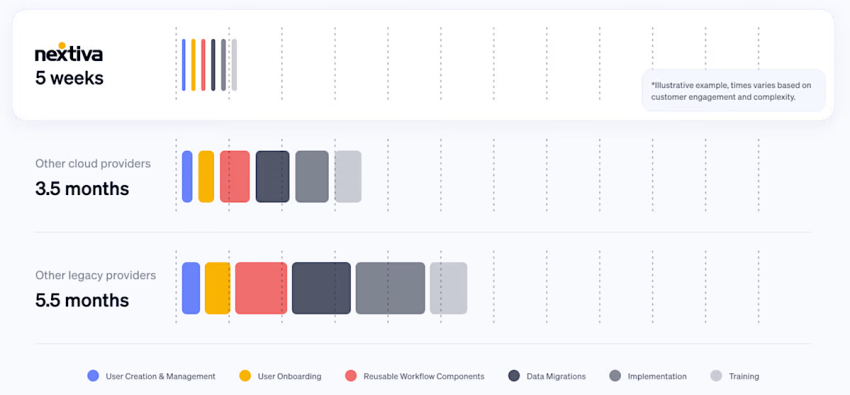
- Ease of deployment: Avoid legacy systems that take months to implement. Cloud-native solutions should integrate seamlessly with your existing communication platform, letting you start optimizing schedules quickly.
Traditional vs. AI-Powered Workforce Management
AI has transformed workforce management from reactive scheduling to predictive planning. The comparison below highlights the key differences between traditional and AI-powered WFM.
| Traditional WFM | AI-Powered WFM |
|---|---|
| Manual forecasting using spreadsheets and historical data | AI-driven forecasting with predictive analytics and what-if scenario planning |
| Static schedules updated manually | Dynamic schedule optimization based on real-time demand |
| Limited visibility across communication channels | Omnichannel workforce planning across voice, chat, email, SMS, and social media |
| Reactive staffing adjustments | Predictive staffing recommendations and automated schedule changes |
| Historical reports are reviewed after the fact | Real-time dashboards with live workforce insights and alerts |
Pair Your WFM With Nextiva
If you want to implement WFM software but aren’t sure where to start, Nextiva’s contact center solution gives you a clear path forward.
When you integrate WFM tools directly into your communications platform, you bring demand forecasting, automated scheduling, and real-time monitoring into one system. You build a stronger foundation for consistent customer support and higher employee satisfaction.
Self-service drives the Nextiva experience. Agents should manage their schedules without jumping through hoops. WFM transformation consultant Irina Mateeva makes the expectation clear:
Shift swaps. This should be standard functionality. If this is a vendor’s selling point, then the vendor doesn’t have much else to offer.
Nextiva treats shift swaps as a standard feature, not a headline benefit. Agents can trade shifts in seconds, whether they need to handle a last-minute appointment or adjust their schedule. Managers spend less time on manual updates, and agents gain the flexibility they expect.
With Nextiva, you get access to:
- A single platform for omnichannel contact management and resource planning
- Gamification and team benchmarking backed by real-time and historical data
- Extensive analytics for performance stats, queue traffic, and campaign success
- Supervisor tools like artificial intelligence (AI) transcription and intuitive coaching
- Advanced features like virtual agents, AI-driven productivity tools, and rich automation
If you run a high-growth or high-volume call center with skilled customer service agents, Nextiva WFM gives you the structure and control you need to scale with confidence.
Related: How to Spot Call Center Absenteeism and Fix It
Better output with WFM.
Unlock your team’s full potential and revolutionize customer experiences with the power of workforce management (WFM).
Frequently Asked Questions (FAQs) About WFM
WFM (Workforce Management) focuses on operational forecasting and effective scheduling, making sure the right number of agents are available at the right time. WEM (Workforce Engagement Management) builds on WFM by prioritizing the agent experience, including recognition, voice of the employee (VoE), and career development.
AI analyzes historical interaction data along with external factors like marketing campaigns and seasonal trends. This enables “what-if” scenario planning and predicts staffing needs with far higher precision than manual spreadsheets, often reaching up to 95% accuracy.
Yes. Modern workforce management solutions use advanced WFM tools to coordinate agent availability across voice, chat, email, and SMS. They create unified schedules and account for concurrency, aligning workloads with each agent’s call handling ability so teams can manage multiple digital interactions without bottlenecks.
Cloud-based WFM scales easily as your center grows, allowing you to add agents, teams, or international locations. AI models improve with larger data sets, providing more accurate insights over time.
Nextiva provides WFM features through a mobile-responsive portal or an app integrated with its WEM suite, letting teams manage operations from anywhere.
For agents: Participate in shift bidding for preferred schedules, swap rotations instantly, submit PTO and time off requests, and track performance dashboards.
For supervisors: Receive intraday alerts for staffing gaps, approve swaps on the go, and monitor live queue metrics.