

 Customer Experience
  Blog
Blog  Business Communication
  Leadership
  Marketing & Sales
  Nextiva News
  Productivity
  VoIP
VoIP 

The future of customer service is intelligent and driven by a powerful combination of technologies, including natural language processing (NLP), machine learning (ML), and generative AI, which are the building blocks of AI-driven customer service.
Using customer service AI isn’t a distant possibility; it’s already a reality. AI is expected to handle a whopping 95% of customer interactions, and 78% of businesses already use AI in at least one business function. The statistics signal a critical shift in customer communication. Your business needs to adapt to stay ahead and better engage customers.
Where does your CX strategy stand with AI?
Take the AI Maturity assessment to get personalized recommendations on how to enhance your CX.
But where do you begin?
We’ll cover everything you need to know about using AI in customer service, including benefits, challenges, and implementation opportunities to build a more responsive customer service experience.
What Is AI Customer Service?
AI customer service refers to the strategic use of artificial intelligence technologies to improve, optimize, and partially automate the customer support process. It’s a sophisticated approach that employs intelligent systems to understand customer inquiries, analyze customer behavior, and deliver personalized service at scale.
Customer service AI enables companies to serve customers more efficiently while maintaining high service quality. The goal is not to replace human support teams but to augment their capabilities, automate routine inquiries, and create exceptional support experiences that meet changing customer expectations.

Why Use AI in Customer Service?
AI strengthens customer service operations in ways that extend far beyond 24/7 availability. It helps support teams control channel sprawl, where customers expect instant and consistent responses across phone, chat, email, and social media.
Managing these simultaneous channels with human staffing alone often becomes difficult to scale. AI reduces this pressure by handling the digital workload. It identifies customer intent, organizes requests, and routes inquiries before agents step in.
This approach allows support teams to focus on complex issues that require judgment and empathy.
When companies integrate AI into customer service, they move from reactive problem-solving to a proactive service model where each interaction aims for the fastest possible resolution.

We are not using AI, and we don’t encourage our customers to use AI, from the perspective of cost savings. We look at it from the perspective of driving a better customer experience and delivering amazing service.
— Peter Biber
Here are the key outcomes of AI integration in customer service
- Faster resolution speed: AI retrieves customer data instantly and shortens response times while reducing Average Handle Time (AHT).
- Smarter routing: AI analyzes customer intent and routes the request to the agent best equipped to resolve the issue.
- Higher first-call resolution (FCR): AI provides real-time prompts, knowledge suggestions, and guidance that help agents resolve issues during the first interaction.
- Stronger agent retention: AI automates repetitive inquiries so agents can focus on complex problems and meaningful customer interactions.
- Elastic scalability: AI handles sudden spikes in support volume during peak periods without requiring immediate hiring.
How Does Customer Service AI Work?
AI customer service uses multiple AI technologies to develop intelligent support systems that enhance customer service operations and improve the overall customer experience. Let’s break down the core concepts:
| Technology | Role | What it does | Example |
|---|---|---|---|
| Natural language processing (NLP) | Understanding | Translates human speech or text into structured data the system can process. | Recognizes that “where’s my stuff” and “track my order” mean the same request. |
| Generative AI | Communicating | Generates natural, human-like responses, summaries, and suggested replies. | Drafts a personalized email response using the customer’s previous interaction history. |
| Machine learning (ML) | Learning | Analyzes past interactions and improves decision accuracy over time. | Identifies that a specific technical question usually requires a Tier 2 specialist. |
| Intent detection | Routing | Identifies the purpose behind a message and directs it to the right workflow or agent. | Classifies an incoming chat as billing or technical support before an agent joins. |
| Robotic process automation (RPA) | Acting | Executes repetitive system tasks and backend workflows automatically. | Updates a shipping address in the CRM after a customer confirms the change. |
Here’s a simple example of how these technologies work together:
When a customer types a question into a chatbot, NLP helps the system understand customer queries, ML finds the best answer from a knowledge base based on similar past interactions, and Generative AI phrases the response in a natural, human-like way.
Benefits of Using AI in Customer Service
Many businesses consider using AI in customer service to be ineffective or merely a minor addition. But combined with a human customer service team, it has a powerful impact. Here are the key advantages AI customer service solutions offer:
1. Round-the-clock availability and instant support
Using AI in customer service provides customers with instant support, regardless of time zone or day of the week. AI-powered chatbots and virtual assistants enable this.
24/7 availability eliminates customer issues caused by limited service hours, getting customers the help they need, and resolving issues at any time. This continuous support increases customer convenience and satisfaction, which strengthens customer relationships.

2. Enhanced speed and efficiency in issue resolution
AI in customer service accelerates response times and shortens the duration of customer service interactions. Intelligent customer service software automatically processes customer requests and instantly answers common customer questions, reducing wait times. Your support team also gets freed to focus on more urgent or complex customer issues that require faster resolution and faster service.
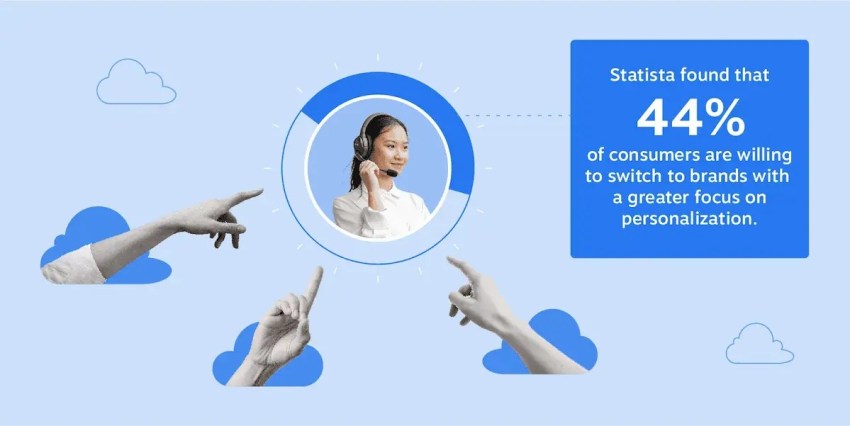
3. Personalized and proactive customer engagement
AI tools analyze extensive customer data like past interactions, purchase history, and preferences, enabling hyper-personalized experiences. This enables tailored interactions and relevant responses.
AI can also anticipate customer needs, enabling proactive support that builds stronger connections and loyalty. This level of personalization increases customer satisfaction and conversion rates.
4. Seamless and consistent omnichannel experiences
Imagine interacting with a business and feeling like they always know where you left off, no matter how you reach out. That’s the expectation in an omnichannel environment, and AI helps deliver it.
Customer service AI ensures that context and past interactions are smoothly carried over between web chat, social media, email, and calls, eliminating the frustration of having customers repeat themselves while saving support agents time.
5. Scalable and cost-effective operations
One of the key benefits of using AI for customer service is its unprecedented scalability. Businesses can efficiently handle fluctuating customer requests without hiring additional service staff.
During peak periods such as peak seasons or promotional campaigns, intelligent virtual agents can effectively handle increased demand and maintain consistent service without additional staffing costs. Heightened scalability combined with automation leads to more cost-effective customer service.
6. Data-driven insights for improvement
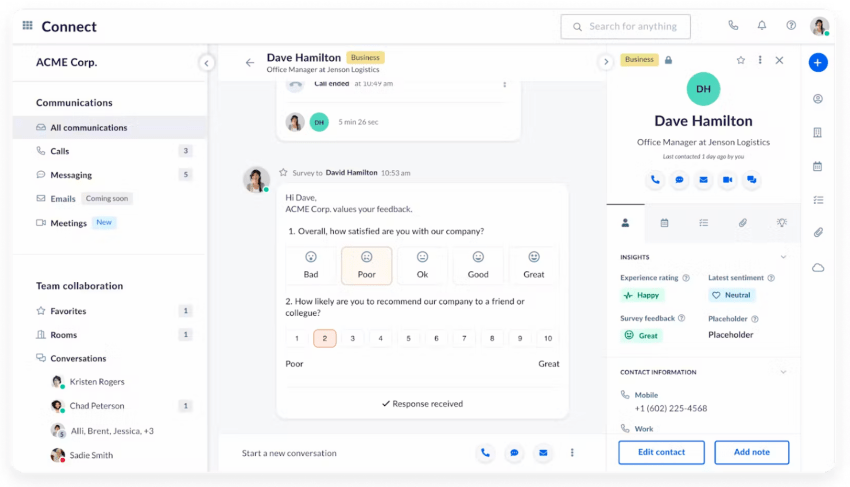
Every customer interaction generates valuable data, and AI excels at extracting meaningful insights from these conversations. Customer intelligence software analyzes patterns, customer sentiment, and recurring customer pain points to identify trends, predict issues, and provide practical insights. Customer data analytics helps refine customer service strategies, improve employee training, and enhance the customer experience.
Key AI Customer Service Tools & Platforms
AI in customer service offers numerous tools for optimizing various aspects of customer interaction. Here’s an overview of the most important AI tools for customer service:
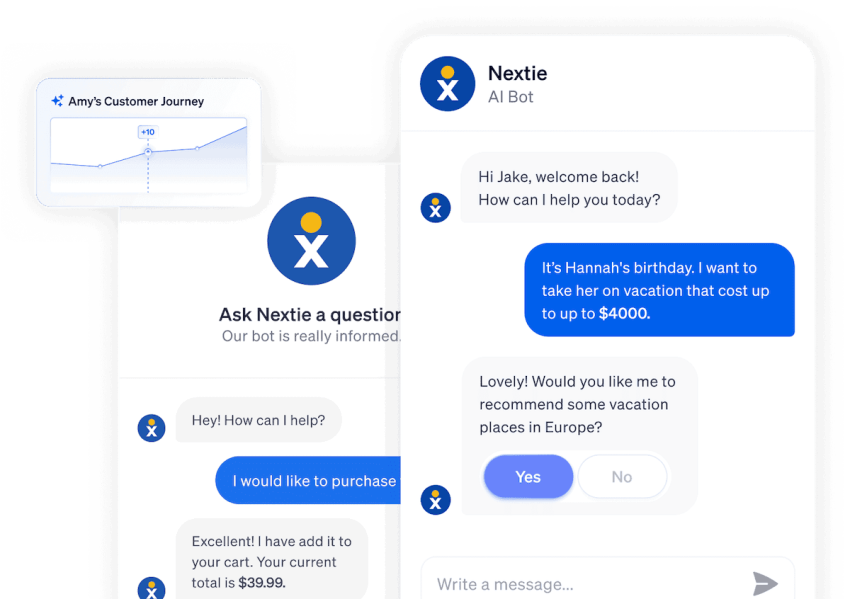
AI-powered chatbots & voice bots
These digital assistants handle common customer inquiries by answering frequently asked questions (FAQs), guiding users through basic troubleshooting, and tracking order status. Automating routine tasks frees human agents to focus on more complex issues and provide immediate support around the clock.
Popular platforms offering AI-powered chatbots include Nextiva, known for its AI-powered customer experience management capabilities; Ada, known for its no-code automation; Tidio, with live chat and chatbot capabilities; and Intercom, a comprehensive customer communication platform with powerful chatbot capabilities.
Virtual customer assistants (VCAs)
Virtual customer assistants or intelligent virtual agents go beyond simple chatbots and conduct more complex, multi-step conversations while maintaining context throughout the customer journey.
They can handle complex and sophisticated requests and are often integrated with backend systems to perform actions for the customer. While some advanced chatbot platforms offer similar features, VCAs are custom-designed for deeper, more human interactions.
AI-enhanced help desks & ticketing systems
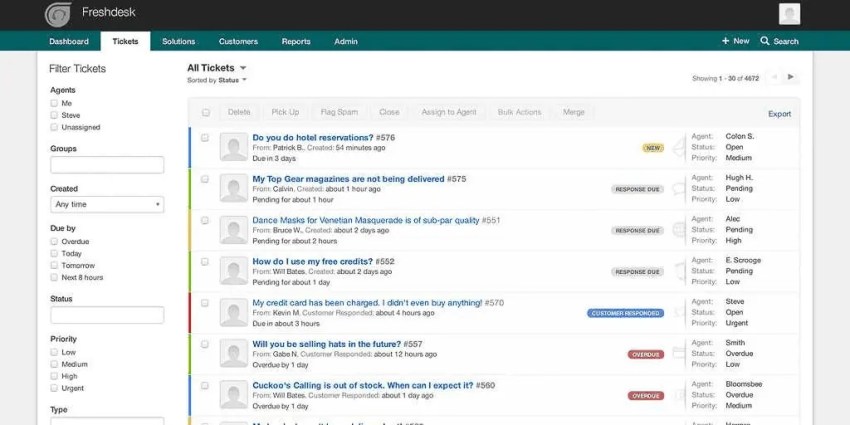
Leading help desk platforms are now integrating AI to optimize customer support workflows. These AI-powered features include intelligent ticket routing that routes requests to the most appropriate agent, automated ticket prioritization based on urgency and sentiment, and AI-driven agent suggestions that provide relevant knowledge-based articles or canned responses.
Here are some businesses that offer help desk capabilities:
- Zendesk, with its AI-powered automation and insights
- Freshdesk with Freddy AI for automation and self-service solutions
- HubSpot Service Hub with built-in AI for conversational bots and automation
- HappyFox with AI-driven ticket management
- Zoho Desk, with its intelligent AI assistant Zia
Agent assist tools
These AI-powered solutions provide real-time support to human agents during live customer interactions.
Key features include AI-assisted coaching that establishes the right tone and best practices, suggested answers for common queries, and intelligent knowledge queries that instantly surface relevant information. Agent assist tools boost agent efficiency and contribute to consistently high service quality.
AI analytics & sentiment analysis
Conversation analytics tools analyze customer data from various channels to understand customer emotions and identify feedback trends.
By interpreting customer sentiment, businesses can identify areas for improvement, proactively address customer issues, and gain valuable insights into the customer experience. Many comprehensive customer experience (CX) platforms and specialized analytics providers offer these capabilities.
AI-powered knowledge bases
Intelligent knowledge bases enable companies to build dynamic self-service portals that continuously learn and improve by analyzing customer usage and questions. AI algorithms uncover relevant information, understand natural language queries, and identify gaps in the knowledge base. Customers get effective self-service options, reducing the need for direct support.

Predictive analytics
Predictive analytics forecasts customer needs and identifies issues before they escalate. This could include identifying customers at risk of churning or predicting frequent support requests based on their past behavior.
AI tools analyze customer conversations and historical data and patterns, helping businesses proactively engage customers with relevant solutions or information, increase customer satisfaction, and prevent customer churn.
Challenges and Ethical Concerns in AI Customer Service
While the benefits of AI in customer service are clear, addressing several challenges and ethical considerations is crucial for its responsible adoption:
The nuance of human touch and empathy
AI still lacks the nuanced human touch and empathy essential for sensitive or emotionally charged customer issues. Human agents remain indispensable in complex situations and during times of customer distress.
Over-reliance on AI in these areas can negatively impact customer satisfaction. You need to implement clear escalation paths for emotionally sensitive issues.
Implementation complexities
The initial investment, integration into existing systems, and the required expertise are hurdles, especially for small businesses. Adopting a phased implementation strategy and, where possible, exploring user-friendly AI solutions with little or no code helps a great deal.
Upholding data privacy and security
Responsible and secure handling of sensitive customer data is necessary. Compliance with regulations like the General Data Protection Regulation (GDPR) and the California Consumer Privacy Act (CCPA) requires robust security and transparent data practices. It’s a must that businesses prioritize data security measures and ensure clear communication about data usage.

Preventing algorithmic bias
Biased training data can lead to unfair or discriminatory AI results. It’s important to use diverse and representative datasets for training and implement continuous mechanisms to monitor and correct biases.
Addressing accuracy and comprehension limits
AI’s understanding of complex or nuanced requests isn’t always perfect, which can lead to frustration. Businesses should implement intelligent routing to easily escalate complex issues to human agents when AI doesn’t offer the help customers need.
Building customer trust and acceptance
Some customers are hesitant to interact with AI. Ensuring transparency regarding AI use and focusing on helpful and efficient AI experiences helps build trust.
Alleviating job displacement concerns
Concerns about AI replacing human employees require proactive communication. Emphasize AI’s role in augmenting human capabilities, automating routine tasks, and freeing employees for higher-value work.
Best Practices To Successfully Implement AI in Customer Service
To maximize the benefits of AI in customer service while effectively addressing its challenges, consider these best practices:
Establish clear, measurable goals
Define the specific problems you want AI to solve. Set clear targets such as reducing average handle time, increasing FAQ automation rates, or improving first-contact resolution. Clear goals help teams measure progress and prove the value of AI investments.
Implement incrementally
Start with focused AI pilots. Test the technology in limited use cases, gather feedback, and refine the approach before expanding deployment. This gradual rollout reduces risk and allows teams to adjust based on real-world performance.
Select fit-for-purpose AI tools
Evaluate available AI solutions and choose tools that match your business needs, customer expectations, and technical capabilities. The right platform should integrate easily with your existing systems and workflows.
Prioritize high-quality training data
Train AI systems with accurate, relevant, and diverse data. Strong data quality improves performance and reduces the risk of bias. Well-trained models also produce more consistent and reliable responses for customers.
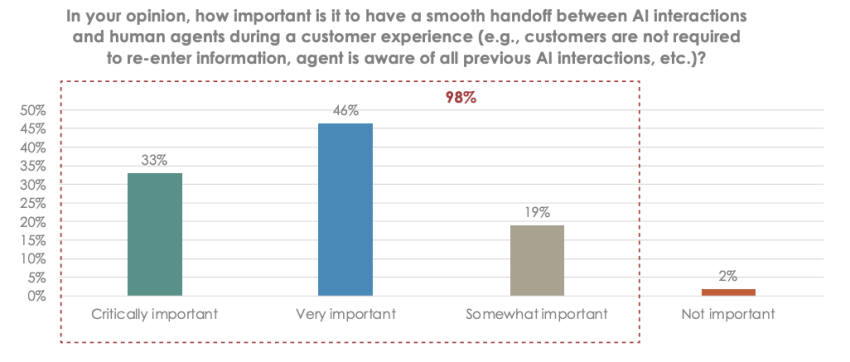
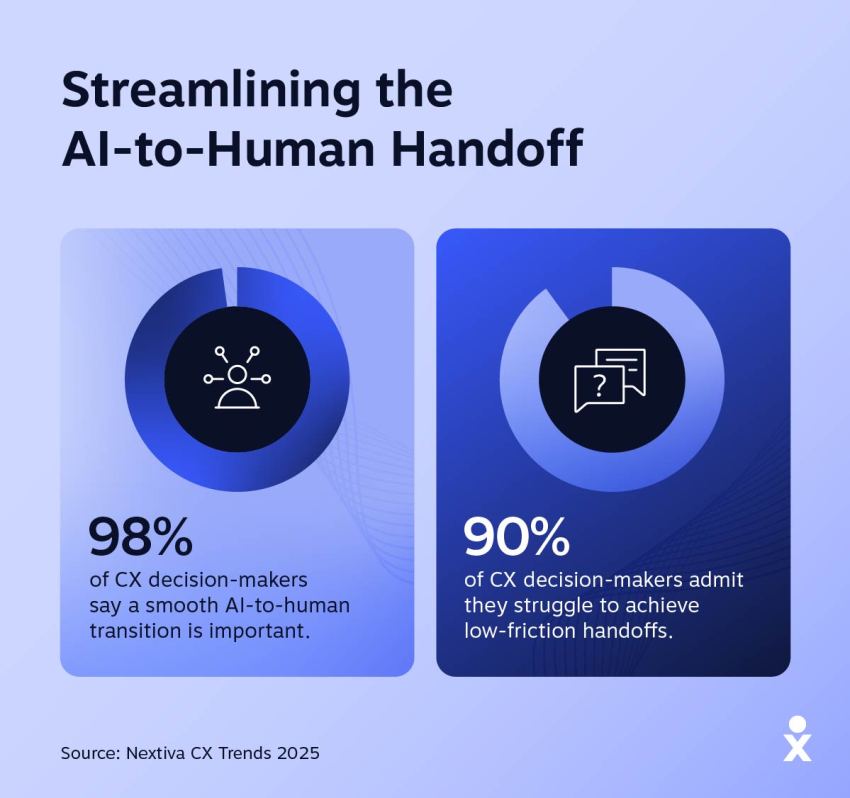
Design frictionless human handoffs
Create clear escalation paths that transfer conversations from AI to human agents smoothly. Preserve context so customers do not need to repeat information. Smooth handoffs protect the customer experience when automation reaches its limits.
Maintain customer transparency
Inform customers when they interact with AI. Transparency builds trust and sets clear expectations about the system’s capabilities. Customers are more comfortable with automation when companies communicate openly about its role.
Augment human agents
Use AI to support agents, not replace them. Automate routine tasks and provide real-time assistance so agents can focus on complex, high-value interactions. This approach improves both productivity and job satisfaction.
Continuously monitor and improve
Track performance through key metrics and customer feedback. Analyze results and refine AI models and workflows to improve outcomes over time. Ongoing optimization ensures the system continues to deliver value as customer needs evolve.
Establish ethical AI guidelines
Set clear policies for the responsible use of AI. Address data privacy, bias prevention, transparency, and appropriate use cases to maintain trustworthy customer interactions. Ethical governance also protects the organization from regulatory and reputational risk.

Where AI Fits in the Service Journey
You can’t just apply AI and hope for the best. You’ve got to strategically choose where and when to use it. Here are the three most common scenarios that work well in contact centers today.
Autonomous self-service
Your new customer journey includes AI-powered chatbots and interactive voice response (IVR) systems handling structured, predictable tasks like provisioning, password resets, or FAQs.
These AI-driven flows guide customers step by step, reducing confusion and improving the journey from start to finish. Customers get shorter queues and 24/7 availability, while agents benefit from reduced workload.
Autopilot with easy human handoff
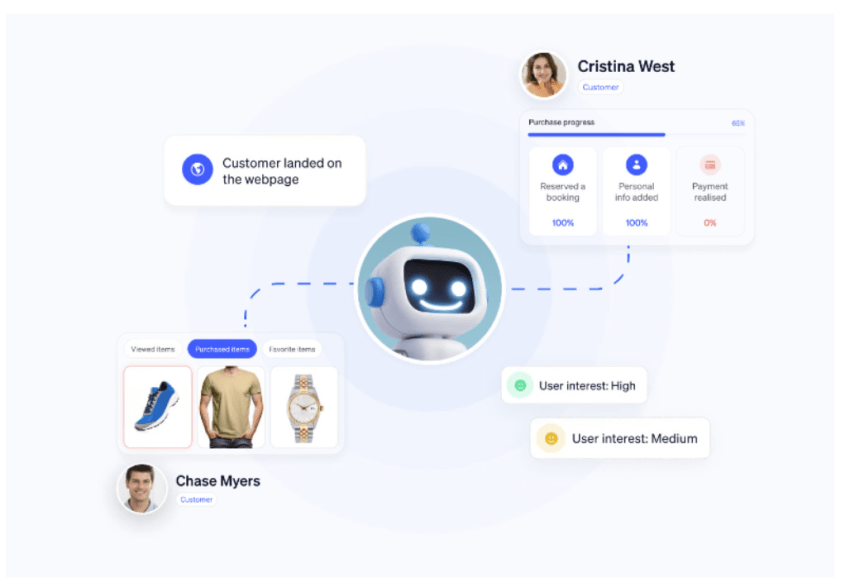
AI handles part of the process, such as gathering account details, and then hands it off to a live agent. At the beginning of customer interactions, AI speeds up identity verification and problem qualification and then ensures a smooth transition to the right agent with full context.
It’s not a rushed process but an information-gathering workflow that enables the right agent to handle the issues. Customers also appreciate having a choice. They can resolve simple problems via automation or move to a human agent when the situation requires it.
Copilot for live agent assist
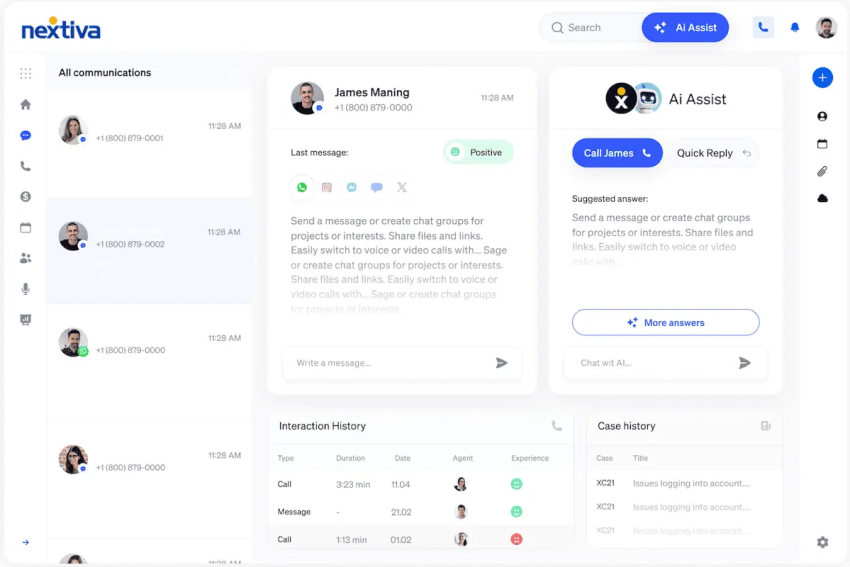
During calls, AI listens, transcribes, and suggests relevant actions during customer conversations. This might be by way of recommended next steps, policy reminders, or product articles.
Both the agent and customer benefit here. You’re reducing reliance on memory or lengthy searches, while your AI agent stands by to keep conversations on topic by stepping in if an agent gets stuck. Live agent assistance is fast becoming critical for complex cases where speed and empathy matter most.
Common High-Impact AI Use Cases
To get the biggest bang for your buck, focus on using AI for customer service in these proven high-impact areas first.
Account and billing automation
- Handles routine tasks like payment updates, invoice lookups, or subscription changes
- Removes the need for customers to hold in line for a human agent
- Escalates anomalies (e.g., payment failure) to a human quickly
Knowledge surfacing for complex questions
- Scans internal databases and past cases for relevant answers
- Returns suggested solutions with confidence scores and citations
- Ensures that agents don’t give the wrong information or advice in sensitive scenarios
Quality assurance and coaching insights
- Scores every call or chat for compliance, empathy, and tone
- Highlights clips for supervisors to review with agents
- Provides coaching data far faster than manual quality assurance (QA) sampling
Fraud and abuse detection
- Detects repeat offenders, spam calls, or inappropriate content
- Allows security support teams to act within minutes instead of hours
- Removes the reliance on post-call fraud analysis when it may be too late
Real World Example of AI Customer Service
Real-world applications show how companies use AI to deliver measurable business value across industries:
| Industry | Real-world example |
|---|---|
| Retail | H&M uses AI assistants to provide 24/7 style recommendations and help customers track their orders. |
| Finance | DNB Bank automated 20% of support traffic with a “chat-first” AI strategy, while Ally uses AI to detect fraud patterns within seconds. |
| Travel | Lufthansa uses AI virtual assistants to manage complex flight rebookings and baggage claims across multiple languages. |
| Telecommunications | Verizon uses predictive AI to anticipate call intent for about 80% of its 170 million annual calls. |
| Lead generation | Yelp uses 24/7 AI receptionists to answer calls, qualify leads, and schedule appointments. |
| Insurance | Lemonade processes and pays out claims in as little as three seconds through specialized AI bots. |
| E-commerce | Amazon uses generative tools to help sellers create product titles and descriptions from a few keywords. |
| Automotive retail | CarMax uses AI to summarize thousands of customer reviews into clear insights for faster decision-making. |
| Healthcare | Ontrak Health uses AI to analyze health records and social interactions to identify patients needing urgent mental health support. |
AI supports customer service across many industries. In retail and e-commerce, it helps customers discover products, receive personalized recommendations, and track orders. Financial institutions and insurance providers use AI to analyze large data sets, detect fraud, process claims, and answer account questions faster.
Telecommunications and travel companies use AI to manage high volumes of service requests. Predictive systems analyze customer history, behavior, and service data to anticipate why someone is contacting support. This allows companies to route inquiries faster or resolve issues through self-service.
Healthcare providers use AI to identify patterns in medical records, behavioral signals, and engagement data. These systems can flag patients who may need urgent support, allowing care teams to intervene earlier.

These examples show how AI customer service has moved beyond basic automation. Companies now use it to predict customer needs, automate complex tasks, and deliver faster, more personalized support.
How to Measure the Success of AI-Powered Customer Support
Track these customer service metrics to assess the impact of your AI-powered customer support:
- First response time (FRT): How quickly customers receive an initial response.
- Resolution rate: The percentage of customer issues resolved successfully.
- Customer satisfaction (CSAT) score: Measures customer happiness with the support experience.
- Customer effort score (CES): Indicates the ease with which customers can resolve their issues.
- Average handle time (AHT): The average time an agent (or AI) spends handling a single interaction.
- Agent productivity: Measures how effectively human agents are utilizing their time, often improved by AI assistance.
- Automation rate: The percentage of customer interactions handled entirely by AI.
- Cost per interaction: The average cost of resolving a customer issue.
- Customer retention rate (CRR): The percentage of customers who continue doing business with you over a period.
- Sentiment analysis trends: Tracking changes in customer sentiment over time.
AI Customer Service Trends To Watch Out For
Recent customer service statistics highlight how quickly AI is transforming support operations. The future of customer service AI will be defined by these key trends:
- Widespread AI integration: Businesses will seamlessly integrate AI into virtually all customer interactions, both in direct customer contact and to support human agents.
- Advanced generative AI: Expect more human-like AI conversations and improved capabilities for proactive engagement and knowledge-based content creation.
- Dominance of predictive and proactive support: AI will better anticipate customer needs and resolve issues before contact.
- Real-time hyper-personalization: AI will leverage live data for instant, tailored customer experiences.
- Rise of autonomous AI agents: AI agents will perform more complex, multi-step tasks independently.
- Greater focus on AI trust and ethics: Transparency, fairness, and sound ethical guidelines will be paramount.
- Evolution of human agent roles: Human agents will focus on complex, empathetic problems, quality assurance, and AI monitoring.
- Accelerated industry-specific adoption: Customized AI solutions will quickly gain traction in industries such as retail, finance, healthcare, and telecommunications.

Combining Technology and Human Touch for Superior Customer Experiences
Customer service AI offers unprecedented efficiency, personalization, and scalability. The most successful strategies, however, will strategically blend AI’s technological prowess with the essential human elements of empathy and complex problem-solving.
The future lies not in choosing between AI and human agents, but in forging a powerful partnership that uses their combined strengths to create exceptional customer experiences. Thoughtful and effective customer service automation, focused on augmenting human capabilities, is the key to growing in the customer-centric economy ahead.
The resolution balance: AI vs. humans
Delivering a smooth customer experience requires a clear balance between automation and human expertise.
| Feature | Use AI for | Use humans for |
|---|---|---|
| Task complexity | Routine tasks such as password resets, order status checks, and basic FAQs | Complex issues such as technical troubleshooting or multi-step problem resolution |
| Emotional context | Neutral or informational interactions | Situations involving frustration, urgency, or emotional distress |
| Customer context | Single-touchpoint inquiries that require quick answers | Relationship-building conversations and cases that require historical understanding |
| Response type | Data retrieval, categorization, and routing requests to the right workflow | Empathy, judgment, and creative problem-solving |
The Future of Customer Service AI Starts With Nextiva
From self-service options to intelligent agent assistance, AI has already transformed the face of customer service.
With Nextiva’s AI-powered contact center, you get all the bells and whistles to enhance the customer experience. From fast, AI-generated call summaries to AI-powered quality assurance tools, Nextiva has everything you need to deliver exceptional customer experiences. The future is now. Try Nextiva today. 👇
Scale up with contact center AI
The modern contact center has arrived. See how Nextiva helps you deliver the best customer experience at scale.
AI Customer Service FAQS
Still have questions? Our FAQ provides you with all the information you need about how AI is being used in customer service.
AI has significantly elevated customer expectations for speed, 24/7 availability, and personalized service based on their history. Businesses using AI to provide instant responses, tailored interactions, and seamless channel transitions are meeting these demands and gaining a competitive edge.
Begin with focused, high-impact applications like an FAQ chatbot for common service inquiries, AI-powered suggestions for email responses, or sentiment analysis of customer feedback. Start in areas with high volume and repetitive tasks, and gradually expand as you gain experience.
Explore tiered pricing models, free or low-cost entry-level platforms, and AI-as-a-service options that minimize upfront investment. Prioritize high-ROI applications, as the efficiency gains and cost savings from automation often offset the initial expense.
Establish clear guidelines for AI and human agent roles. Use AI for routine inquiries, initial information gathering, and data triage. Route emotionally complex or nuanced issues to human agents, ensuring smooth handoffs with preserved context. Keep refining these boundaries based on performance and customer feedback.
Calculate ROI by comparing implementation costs against measurable benefits such as reduced staffing needs, increased agent efficiency (more inquiries handled), improved conversion rates, higher customer retention, and extended service hours. Track quantitative metrics alongside qualitative improvements like customer satisfaction and agent morale.
Customer service professionals need AI oversight skills (identifying AI errors), complex problem-solving abilities (handling escalated issues), empathy and emotional intelligence (providing human connection), technical literacy (understanding AI capabilities), and adaptability to evolving technologies.
AI excels at analyzing large datasets to identify behavioral patterns humans might miss. This includes segmenting customers, predicting churn risk, identifying common pain points, recognizing sentiment trends across segments, and correlating issues with satisfaction levels.
Implement robust data governance policies, ensure transparency about data collection and usage with clear consent processes, anonymize data where feasible, follow regulations (GDPR, CCPA), provide opt-out options, and conduct regular audits for privacy vulnerabilities.
In 2026, businesses focus less on basic chatbots and more on Agentic AI. These autonomous systems respond to questions and take action. AI can process refunds, update orders, or reroute shipments without human involvement. Instead of waiting for customers to report problems, businesses now use predictive customer experience (Predictive CX). AI analyzes IoT signals and customer behavior patterns to detect issues early and resolve them before customers notice a problem.
Pros:
Provides 24/7, always-on support that handles customer requests at any time.
Reduces operational costs by an average of around 30% through automation.
Delivers hyper-personalized interactions by using real-time customer context and data.
Cons:
Poor training data can introduce algorithmic bias and affect decision quality.
Small businesses may face high upfront implementation costs.
AI still lacks the human empathy required for complex or emotionally sensitive issues, which often require human support agents.