
 VoIP
VoIP  Blog
Blog  Business Communication
  Customer Experience
  Leadership
  Marketing & Sales
  Nextiva News
  Productivity

When comparing Five9 vs. Genesys — or any top-tier contact center solutions — it’s critical to look beyond the standard feature lists. In 2026, the real battle is between technical complexity and operational agility.
This article compares features of Five9 and Genesys to help you choose the right business communications tool. We’ll cover a head-to-head comparison of the two cloud giants and introduce an alternative that provides better ROI for your business scale and needs — with a focus on identifying which solution offers better value for different business needs.
Five9 vs. Genesys At a Glance
| Functionality | Five9 | Genesys Cloud CX |
|---|---|---|
| Main plan | Core | Digital + voice |
| Starting price | $159 per monthly seat | $75 per user per month (Cloud CX 1, voice-only) |
| Voice-only plan | Not specified | Cloud CX 1: $75/user/month for voice channels only |
| Key limitation | Requires third-party UCaaS for telephony | Long, expert-led implementation |
| Standout feature | Generative AI Studio; additional features like chatbot analytics | Enterprise analytics & WFM; omnichannel support and advanced AI integration |
| Ease of use | Moderate (learning curve) | Technical (expert needed) |
| Best For | Self-service-heavy orgs | Complex, global deployments needing omnichannel support |
Five9 Contact Center & Capabilities
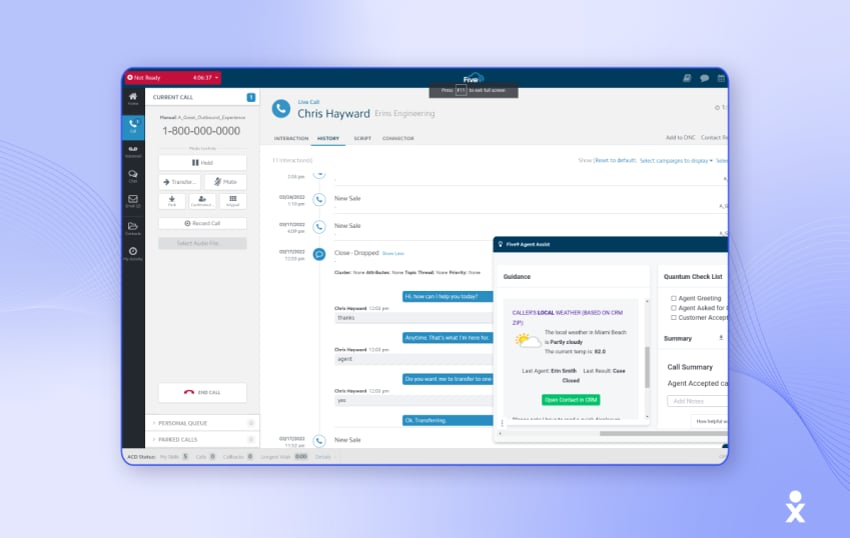
Five9 is a leader in conversational AI, improving customer interactions through high-quality automation. It has shifted from a traditional cloud dialer to an intelligent CX platform, integrating human and AI capabilities through collaborative intelligence. Five9 is best for outbound campaigns and remote teams, offering tools that support high-volume calling, agent productivity, and flexible work environments.
Five9 is also known for its workflow automation and self-service solutions, helping businesses streamline operations and empower customers to resolve issues independently. The platform integrates with major CRM systems such as Salesforce, ServiceNow, Microsoft Dynamics, and Oracle, as well as popular helpdesk tools like Zendesk and Bright Metrics, enhancing both customer service capabilities and analytics.
Five9’s strengths
- Practical GenAI Studio: Five9 stands out with its click-to-customize GenAI Studio. This allows non-technical administrators to build and deploy Generative AI applications — like custom virtual assistants— using pre-built templates. It supports prompt engineering directly within the contact center, giving you granular control over the AI’s brand voice and guardrails.
- Industry-specific outbound power: Five9 is great for outbound sales. Unlike generic dialers, it offers specialized predictive, progressive, and power dialing modes with native tools for TCPA compliance. This is particularly effective for healthcare (HIPAA compliant) and financial services where regulatory risk is high.
- Detailed KPI reporting: With a library of over 120 standard reports and deep customization options, Five9 provides a data-rich environment. Contact center managers can track everything from real-time agent productivity to long-term sentiment trends across thousands of interactions.
- Global voice quality: Their Global Voice infrastructure uses regional points of presence (PoPs) to ensure low-latency, carrier-grade audio. This is a significant advantage for BPOs and multinational teams that need clear voice quality across continents.
Five9’s weaknesses
- Infrastructure fragmentation: Five9 is primarily a CCaaS (Contact Center as a Service) provider, not a primary UCaaS (business phone) provider. To get full office telephony features, many businesses have to integrate it with a third-party system like Nextiva or Microsoft Teams, which can add layers of management and billing complexity.
- Pricing premium and add-ons: While the Digital and Core plans start around $119–$159/user/month, many of the key features — like advanced AI Agent Assist, WFM, or certain CRM adapters — are gated behind higher tiers (Plus, Pro, Enterprise) or offered as paid add-ons. This can lead to a higher total cost of ownership than initially expected.
- Seat minimums: Five9 requires a 50-seat minimum (typically for enterprise customers) and annual contracts, which may not suit smaller teams. Five9’s lower pricing tiers may be voice-only, limiting access to digital channels for businesses needing multichannel support.
- Legacy admin friction: While they’re transitioning to a modern web-based console, some administrative tasks still lean on legacy Java-based tools. Users report a steep learning curve for admins and occasionally fragmented user interfaces when moving between different modules.
- Uptime sensitivity: Despite promoting Five Nines (99.999%) availability, historical user data and Gartner reviews highlight stability issues with softphones and digital channel orchestration compared to carrier-native platforms. Users have also reported technical issues affecting call quality, such as background noise or unreliable answering machine detection, which can impact the user experience during implementation.
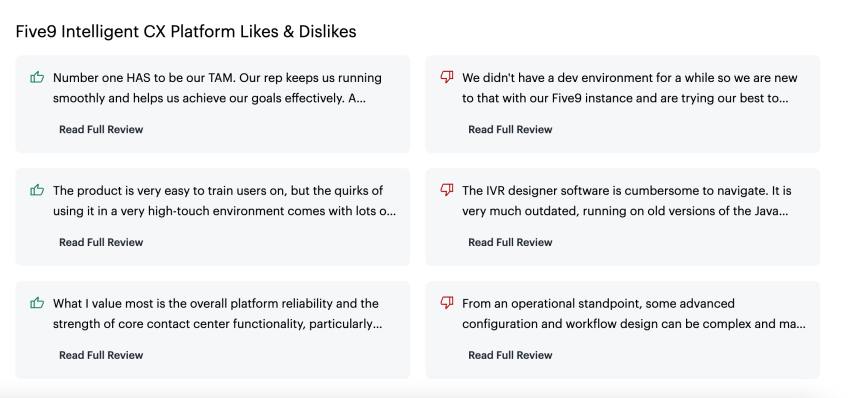
Designed to simplify multichannel communications for sales and support teams, Five9 is a strong fit for organizations with outbound sales strategies.

Genesys Cloud CX Contact Center & Capabilities
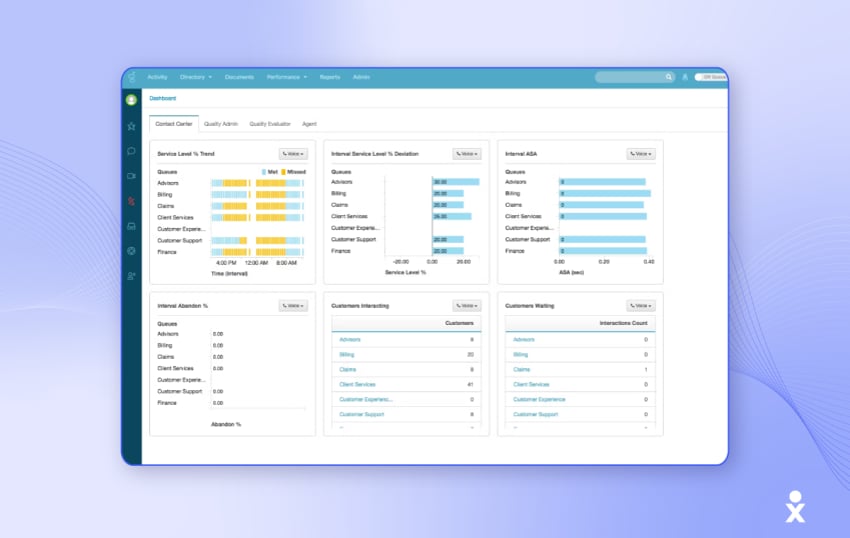
Genesys sets the standard for orchestrating customer experiences. It’s ideal for large enterprises and regulated industries with stringent compliance and security requirements. Its native microservices architecture enables deployment in global organizations that demand high scalability, flexibility, and extensive technical customization, as well as in digitally driven businesses and organizations with dedicated IT teams.
Core features of Genesys Cloud CX include advanced IVR systems, AI capabilities, and AI-powered virtual assistants. These enable sophisticated self-service, natural language processing, and sentiment analysis across multiple channels. Predictive customer engagement and optimized workflows enhance customer journey management and intelligent call routing, increasing employee efficiency and customer satisfaction.
Genesys also offers comprehensive workforce management tools and additional features such as scheduling, forecasting, and quality management. These support complex omnichannel requirements and advanced workforce planning.
Genesys’ strengths
- 360-degree interaction analytics: Genesys excels at tracking customer tone and sentiment in real-time. If a customer sounds frustrated during an automated interaction, the system can dynamically reroute them to a high-empathy senior agent, preventing escalation before it happens.
- Advanced quality management: Their automated scoring systems evaluate 100% of interactions. Instead of supervisors manually sampling calls, Genesys uses AI to score performance based on compliance, resolution speed, and sentiment across every transcript.
- Workforce engagement management (WEM): Genesys offers the most sophisticated WEM suite in the industry, featuring AI-powered forecasting. It predicts staffing needs by analyzing historical interaction patterns, ensuring lean but effective coverage even in volatile environments.
- Open API & composable ecosystem: With an API-first architecture and the AppFoundry marketplace, Genesys is highly modular. It allows enterprises to compose their ideal contact center by integrating specialized third-party tools for everything from biometrics to niche CRM systems.
Genesys’ weaknesses
- Complex implementation: Genesys is not a plug-and-play solution. Deploying the platform requires months of expert-led professional services and specialized technical knowledge to navigate its composable architecture.
- Support & resolution latency: Because Genesys deployments are highly technical and heavily customized, resolving deep-seated system glitches can involve a slow, multi-stage escalation process that frustrates agile teams.
- Workforce management (WFM) friction: Despite its power, some users find the WFM interface to be less intuitive than modern competitors, reporting a steep learning curve for new supervisors and data accessibility challenges.
- Total cost of ownership (TCO): While the base price points are competitive (starting at roughly $75–$155/user/month), the costs can skyrocket once you add the necessary AppFoundry integrations and premium modules required to unlock the platform’s full potential.
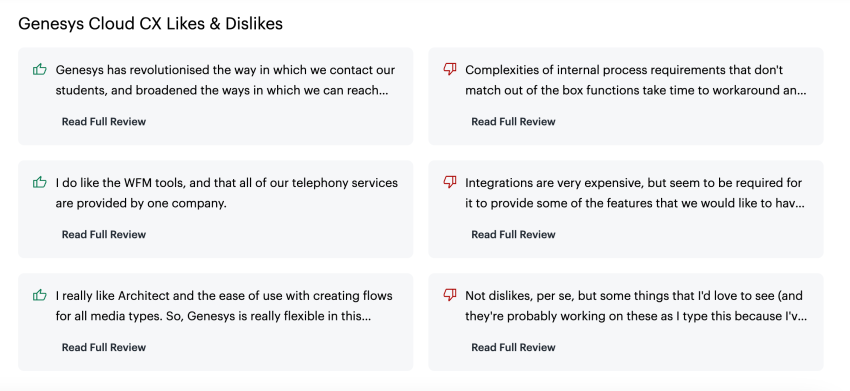
Genesys Cloud CX is best for businesses managing complex omnichannel customer journeys, requiring high customization, and operating in highly structured or regulated environments. With a suite of digital engagement tools, Genesys provides deeper analytics and omnichannel optimization for advanced coaching, forecasting, and customer journey orchestration compared to Five9.

Five9 vs. Genesys Comparison
When comparing these two industry giants, it’s important to note that Five9 and Genesys Cloud CX are both leading CCaaS providers offering cloud-based, AI-driven solutions. The decision usually depends on whether your company prioritizes outbound sales and plug-and-play AI, or enterprise-wide orchestration and in-depth workforce management.
Both Genesys and Five9 offer a slew of features, suitable as one platform for different business needs.
| Area | Five9 | Genesys Cloud CX |
|---|---|---|
| Strength | Outbound sales & Practical AI | Enterprise orchestration & WEM |
| Ease of use | Moderate (admin Java-legacy) | Moderate (admin Java-legacy) |
| Implementation | Weeks (moderate) | Months (technical) |
| AI focus | Agent assistance & IVA Studio | Predictive routing & sentiment |
| Best for | Mid-market to large (sales focus) | Global enterprises (complexity focus) |
| Pricing model | Per-agent/per-month | Per-agent/per-month |
AI focus: Practical assistance vs. journey orchestration
The approach to artificial intelligence (AI) is arguably the most significant functional difference between the two providers. Five9, with its GenAI Studio, focuses on Practical AI. This solution is for immediate operational impact, enabling managers to develop and deploy intelligent virtual assistants (IVAs) and agent assist tools that provide real-time coaching maps during calls. It’s a bottom-up approach to boost agent productivity from day one.
Genesys, on the other hand, prioritizes predictive orchestration. Its AI not only supports agents but also analyzes the full customer journey over months to predict the best next action. Genesys excels at predictive routing, which uses machine learning to match customers with the most suitable agent based on predicted emotional compatibility and the agent’s past success with similar customer profiles.
Genesys also offers real-time agent assist for immediate coaching and insights during live interactions. Notably, Genesys includes AI features like self-service automation and agent assist tools even at the base tier.
Choose Five9 for immediate, agent-centric AI productivity. Choose Genesys for long-term, data-driven orchestration of the customer journey.
Implementation and operational agility
Implementation experiences vary depending on the technical complexity of the respective platform. Five9 is considered the more agile, cloud-native option for mid-sized and large enterprises looking to accelerate their modernization efforts.
With less legacy architecture, setting up advanced features like CRM integrations and IVA workflows can be accomplished within a few weeks. Five9 is known for its quick deployment and excels in ease of use, especially for sales environments that require rapid deployment and minimal complexity.
While Genesys Cloud CX is powerful, it’s an industrial-grade platform that requires a phased migration. Designed to coexist with complex legacy systems and hybrid infrastructures, a full implementation can take months of expert support. It prioritizes stability and extensive customization over quick, out-of-the-box functionality.
Five9 is the preferred choice for organizations needing rapid time to value; Genesys is the standard for large enterprises requiring a highly customized, phased migration.
Outbound sales vs. complex inbound routing
Although both platforms are omnichannel-enabled, they have different strengths when it comes to call routing.
Five9 is the leading provider for outbound calls. If your revenue depends on a high volume of outbound sales, its predictive dialer and industry-specific compliance controls (such as automatic TCPA checks) are arguably the best on the market.
Five9 is designed to maximize talk time and minimize cost per lead. Both Five9 and Genesys support chat messaging as part of their digital engagement, integrating chat messaging with AI virtual assistants, chatbots, and voicebots to facilitate seamless customer interactions across digital channels.
Genesys offers a more balanced suite and is the leader in complex inbound call routing. Its engagement workflow is a key part of the call routing and management system, enhancing call handling efficiency and personalizing the customer experience through intelligent routing and data integration.
If your organization has multiple departments, global voice requirements, and complex if-then logic for customer inquiries, Genesys’ Architect tool is a powerful flow builder available. It ensures that even the most complex global routing requirements are met with the utmost precision.
Five9 is the better choice for sales-driven environments with high outbound call volume. Genesys is better suited for companies with high volume and complex inbound service requirements.
A Better Alternative: Nextiva Contact Center
While Five9 and Genesys dominate the enterprise space, their technical debt and a fragmented user experience can be big bottlenecks for many customers. Nextiva Contact Center has become a leading alternative for teams that value simplicity, reliability, and unified communication.
Why Nextiva wins on practicality
Nextiva natively combines UCaaS (internal collaboration) and CCaaS (external customer service) in a unified interface. Some of its key strengths include:
- High reliability: Unlike Five9 or Genesys, which run software layers over third-party networks, Nextiva owns and operates its own network. This results in 99.999% availability and superior voice quality that traditional cloud applications can fail to achieve.
- Unified digital inbox: Nextiva eliminates the need to switch between apps. Your employees manage WhatsApp, SMS, email, and phone calls in a single, chronological chat history. This stands in stark contrast to the fragmented dashboards commonly found in Five9 or Genesys implementations.
- AI for all employees: Nextiva offers integrated AI-powered transcription, real-time sentiment analysis, and automatic call summaries (via its AI receptionist, XBert) — all without the complex, expert-managed studio setups required by Five9.
- Rapid time to value: While implementing Genesys takes months, Nextiva is built for speed. Its intuitive admin portal allows users to create IVR systems and call histories with drag-and-drop functionality — no technical certification required.
Five9 vs. Genesys vs. Nextiva: Summary Comparison
| Feature | Five9 | Genesys Cloud CX | Nextiva |
|---|---|---|---|
| Key strength | Outbound sales & Practical AI | Enterprise journey orchestration | Unified UCaaS + CCaaS platform |
| Ideal user | High-volume sales & IVA-heavy orgs | Global enterprises with complex IT | Agile teams valuing reliability & UX |
| Support teams | Intuitive interface, quick onboarding, integrated CRM, multichannel support | Advanced AI-driven support operations, multichannel communication | Easy onboarding, streamlined support workflows |
| Workflow automation | Customizable automation via Zapier, streamlines operations | Robust workflow automation, deep AI integration | Simple workflow automation for agile teams |
| Workforce management tools | Scheduling, forecasting, quality management included | Comprehensive workforce management: scheduling, forecasting, long-term planning | Basic workforce management features |
| Implementation | Weeks (moderate) | Months (technical/expert-led) | Days (intuitive/rapid) |
| Uptime/reliability | Software-based (99.9% range) | AWS-native (high scalability) | Carrier-grade (99.999% uptime) |
| AI capability | GenAI Studio & Agent Assist | Predictive routing & Sentiment | Agentic AI (summaries & XBert) |
| Dashboard | Historically Java-influenced/web | Unified but technically dense | Clean, single-threaded inbox |
| Integrations | Zapier for customizable integrations[^1] | 600+ AppFoundry Marketplace apps[^2] | Popular business app integrations |
[^1]: Five9’s integration with Zapier allows for highly customizable integrations, making it a flexible choice for businesses.
[^2]: Genesys offers integrations with over 600 applications through its AppFoundry Marketplace.
Nextiva Is the Reliable Contact Center Platform Your Business Needs
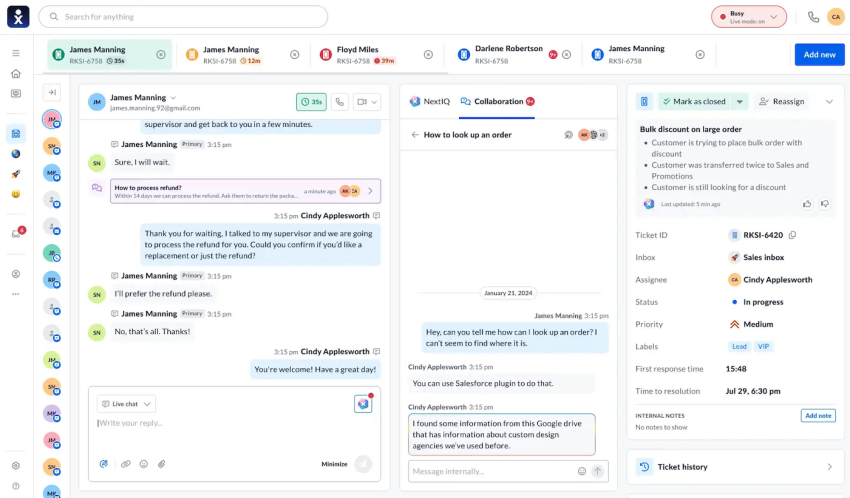
Five9 and Genesys are solid solutions in their own right. If you’re looking for a comprehensive suite of features and have complex technical deployment needs, they’re good options.
However, Nextiva comes out on top in usability, reliability, a wide range of features, and ease of use. And it’s packed with all the features you really need, like real-time data and insight, which can help improve agent performance, and intelligent routing using AI capabilities.
So, if you’re in the market for an omnichannel contact center that’s simple to get started and that users and admins love, why not take Nextiva for a spin?
Top Ranked AI-Powered Contact Center Solution
Transform your customer interactions with a contact center platform that saves you time and money, reduces agent and supervisor stress, and flexibly adapts to fit your needs.
Frequently Asked Questions (FAQs)
Neither Five9 nor Genesys is inherently designed for small businesses; both are enterprise-grade solutions. However, Five9 is easier to deploy for mid-market companies, whereas Genesys requires a significant IT investment. For smaller or growth-oriented teams, Nextiva is the more practical alternative due to its ease of setup.
Five9 is mainly a CCaaS provider. While they offer Global Voice, many businesses still choose to pair Five9 with a separate UCaaS provider, like Nextiva, to handle their full office telephony and internal collaboration needs.
Genesys is a highly composable platform for massive global deployments with thousands of agents. Nextiva is a unified platform that combines your phone system, team chat, and contact center into one app, making it more reliable and easier for agents to use without constant app-switching.
Five9 is best for building custom virtual agents via their GenAI Studio.
Genesys is best for predictive AI that matches customers to agents based on behavior.
Nextiva is best for Agentic AI, which automatically handles administrative work like call summarization and CRM updates so agents can stay focused on the conversation.
Yes. Because Nextiva is a carrier-grade provider, the porting process and implementation are streamlined. Most businesses find that they can migrate their call flows to Nextiva in a fraction of the time it takes to set up a legacy enterprise system.