

 Customer Experience
  Blog
Blog  Business Communication
  Leadership
  Marketing & Sales
  Nextiva News
  Productivity
  VoIP
VoIP 

Customer lifecycle management is the process of managing and improving how customers interact with your business across every stage of the relationship, from initial awareness to retention and loyalty.
CLM helps teams coordinate customer data, touchpoints, workflows, and goals so each stage supports a better customer experience and stronger business outcomes.
In this guide, we’ll explain how customer lifecycle management works, how it relates to the broader customer lifecycle, and how to build a practical CLM strategy. You’ll also learn which metrics to track, which tools can support the process, and how to improve each stage of the customer relationship.
What Is Customer Lifecycle Management (CLM)?
Customer lifecycle management (CLM) is the process of managing, measuring, and improving the relationship between a business and its customers across every stage of the lifecycle, from initial awareness and acquisition through retention, loyalty, and advocacy.
A strong CLM strategy connects customer data, interactions, teams, and workflows so businesses can understand what customers need and respond with the right action at the right time. With connected customer experience platforms, automation, and AI tools, teams can personalize engagement, identify churn risks, streamline service, and improve the customer experience at scale.
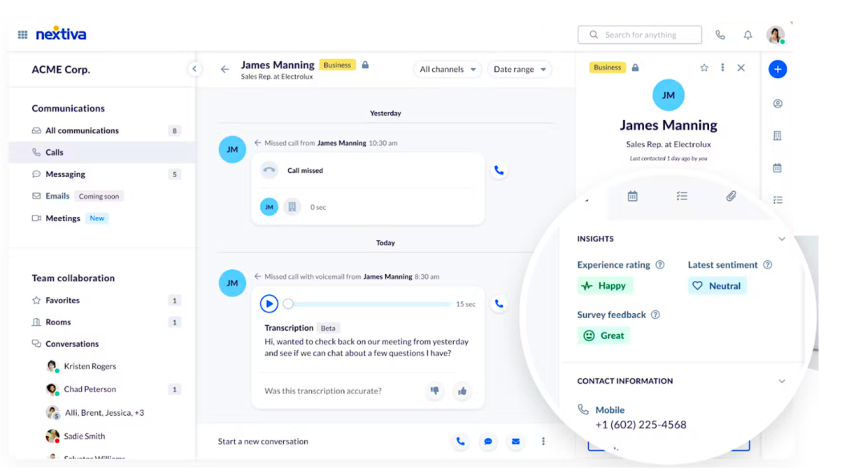
The goal of customer lifecycle management is to build stronger, longer-lasting relationships that increase retention, customer lifetime value, and sustainable growth.
Customer Lifecycle Management at a Glance
Done well, customer lifecycle management can help businesses:
- Increase customer lifetime value (CLV) by encouraging stronger, longer-lasting customer relationships.
- Improve customer retention rate and reduce churn by identifying customer needs and potential problems earlier.
- Create more consistent customer experiences by connecting interactions across teams and channels.
- Personalize engagement based on customer behavior, needs, and customer lifecycle stage.
- Make data-driven decisions using lifecycle metrics rather than relying on isolated interactions.
- Build customer loyalty and advocacy by continuing to deliver value after the initial purchase.
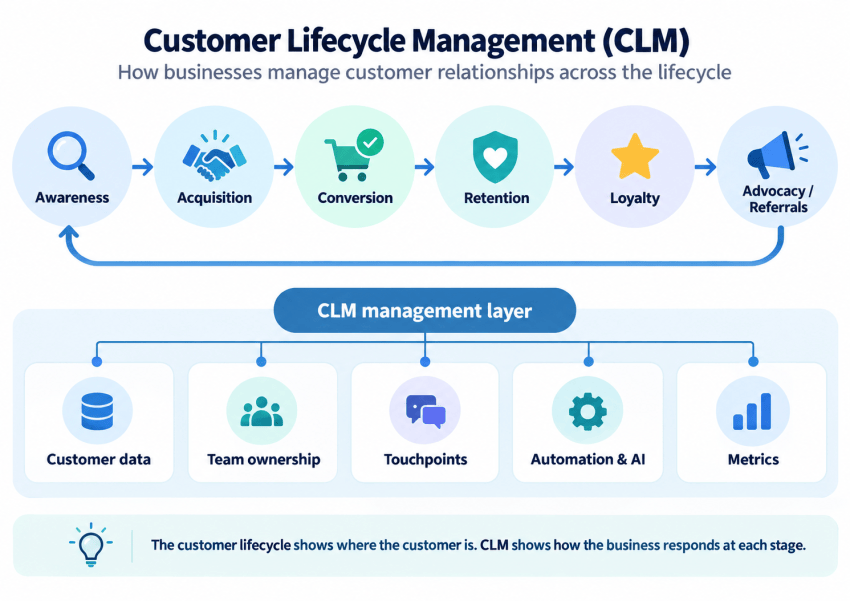
This diagram illustrates an important distinction: the customer lifecycle describes where the customer is in the relationship, while customer lifecycle management determines how the business responds at each stage.
Customer Lifecycle vs. CLM vs. CRM vs. Customer Journey
Customer lifecycle, customer lifecycle management, customer relationship management, and customer journey are closely related concepts, but they serve different purposes. This table gives a clear overview of each one.
| Concept | What It Means | Primary Focus | Example |
|---|---|---|---|
| Customer lifecycle | The stages a customer moves through during their relationship with a business | Where the customer is | A customer moves from awareness to acquisition, conversion, retention, and loyalty |
| Customer lifecycle management (CLM) | The strategy and processes used to manage and improve the customer relationship across those stages | What the business should do next | A company identifies an at-risk customer and triggers proactive support before renewal |
| Customer relationship management (CRM) | The practice — and often the software — used to organize customer information and interactions | What the business knows about the customer | A CRM records contact details, sales conversations, purchases, and account activity |
| Customer journey | The individual interactions and experiences a customer has with a business | What the customer experiences | A buyer sees an ad, visits a pricing page, talks to sales, signs up, and contacts support |
One simple way to think about the relationship is:
- The customer lifecycle provides the overall structure.
- CLM is how the business manages that structure.
- A CRM stores and organizes much of the customer data used to manage it.
- The customer journey shows how customers actually experience the business as they move through it.
For example, retention might be a stage in the customer lifecycle. A company’s CLM strategy determines which actions should improve retention, such as monitoring product engagement, analyzing customer support interactions, or reaching out before renewal. Its CRM and other customer platforms provide the data teams need to coordinate those actions, while a customer journey map reveals the individual touchpoints and friction customers encounter along the way.
These concepts work best together. Looking only at lifecycle stages can hide problems within individual experiences, while looking only at individual interactions can make it difficult to see the broader customer relationship.
How Customer Lifecycle Management Works Across Each Stage
Customer lifecycle management applies strategies, data, ownership, and automation across each stage of the customer lifecycle. While lifecycle models vary by business and industry, a common framework includes five stages, usually labeled as: awareness, acquisition, conversion, retention, and loyalty.
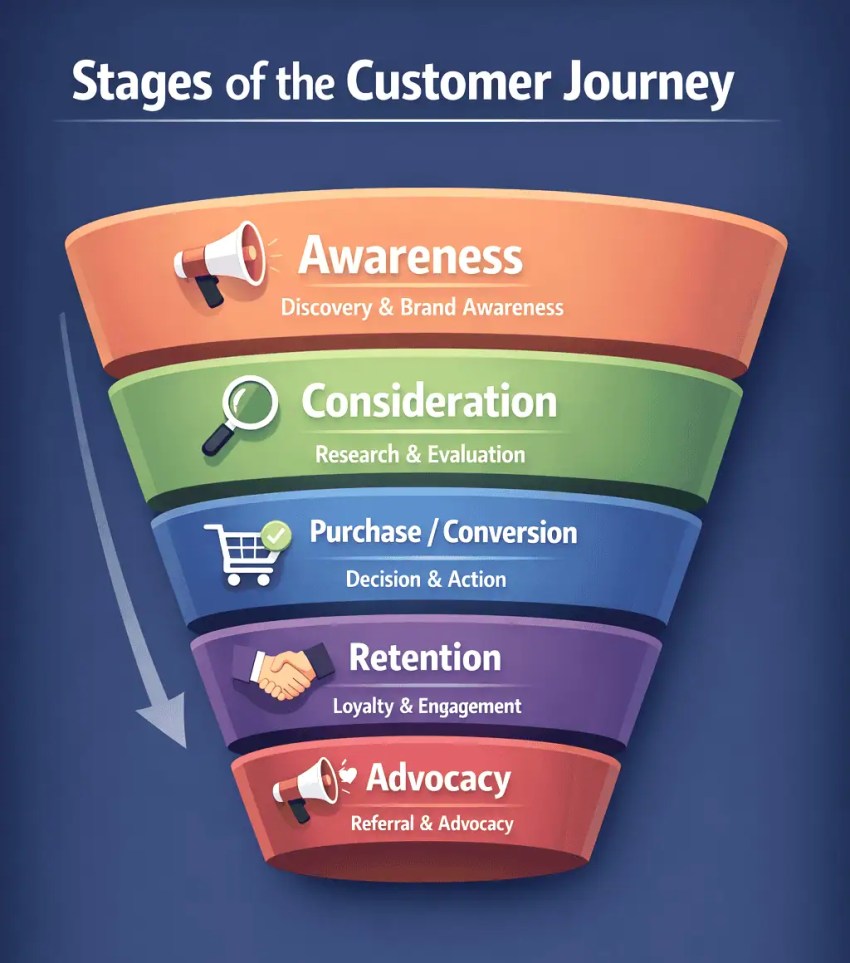
Here’s what customer lifecycle management looks like at each stage:
| Stage | Customer Goal | CLM Focus |
|---|---|---|
| Awareness | Discover a solution to a need or problem | Reach relevant prospects through useful content, search, advertising, referrals, and other channels |
| Acquisition | Learn whether the business can meet their needs | Capture customer information, answer questions, personalize engagement, and nurture interest |
| Conversion | Confidently make a purchase decision | Reduce friction, make value clear, and create a smooth path from prospect to customer |
| Retention | Continue receiving value after the purchase | Support customers, monitor satisfaction and engagement, address problems early, and encourage repeat business or renewal |
| Loyalty | Build an ongoing relationship with the brand | Deepen engagement, recognize loyal customers, identify expansion opportunities, and encourage reviews, referrals, and advocacy |
The lifecycle doesn’t necessarily end at customer loyalty. Loyal customers can become advocates who generate referrals, reviews, and word-of-mouth awareness, bringing new prospective customers into the cycle.
For subscription and B2B businesses, it can also be useful to break the post-purchase relationship into more granular stages such as onboarding, adoption, retention, expansion, and advocacy. The right model is the one that reflects how your customers actually build value with your business.
Each stage should have clear customer signals, responsible teams, actions, and metrics. For example, a new customer’s onboarding completion rate may indicate whether they’re progressing successfully, while declining product engagement or negative support sentiment could signal customer churn risk. AI-powered analysis and automation can help teams spot those signals sooner and respond at scale.
For a deeper look at each stage and how to optimize it, see our complete guide to the customer lifecycle.
How to Build a Customer Lifecycle Management Strategy
A strong customer lifecycle management strategy defines how your business will identify, manage, and improve customer relationships across each stage of the lifecycle.
Rather than treating marketing, sales, onboarding, support, and retention as separate processes, CLM connects them through shared stage definitions, customer data, ownership, triggers, actions, and performance metrics.
Use these seven steps to build a practical CLM strategy.
1. Define the criteria for each lifecycle stage
Start by defining what qualifies a customer for each stage of your lifecycle.
Avoid relying on vague labels such as “lead,” “active customer,” or “loyal customer.” Instead, use observable behaviors or milestones that show where a customer is in the relationship.
For example:
- Awareness: Visits a product page or engages with educational content
- Acquisition: Submits a form, starts a trial, or contacts sales
- Conversion: Completes a purchase or signs a contract
- Retention: Continues using the product or renews the relationship
- Loyalty: Makes repeat purchases, expands usage, leaves reviews, or refers others
For subscription and B2B businesses, you might also want to define stages such as onboarding, adoption, expansion, renewal, and advocacy.
Pro tip: Use behavioral and transactional data to define stages whenever possible. A customer’s actual actions usually provide a more reliable lifecycle signal than demographic information alone.
2. Assign ownership to each stage and transition
Every lifecycle stage should have a clear owner, but the handoffs between stages are just as important.
Marketing may own awareness and acquisition, sales may take the lead during conversion, and customer success or service may manage onboarding and retention. Product, operations, and support teams might also share responsibility depending on the business.
The goal is not to force each customer into a single department. It is to make sure someone is accountable for moving the relationship forward. Pay particular attention to transitions such as:
- Marketing to sales
- Sales to onboarding
- Onboarding to customer success
- Support to retention or renewal
- Customer success to expansion or advocacy
Poor handoffs often create gaps in the customer experience, even when individual teams are performing well.
Pro tip: Document who owns each stage, who supports it, and what information must transfer when a customer moves to the next stage. Make sure every department has easy access to this documentation.
3. Map the customer touchpoints within each stage
Once your lifecycle stages are defined, map the key interactions that customers have with your business at each one. For example, these touchpoints could include:
- Website visits
- Search and social media
- Emails and SMS
- Sales calls
- Live chat
- Product usage
- Onboarding sessions
- Customer service interactions
- Self-service resources
- Surveys and feedback
- Renewal or upsell conversations
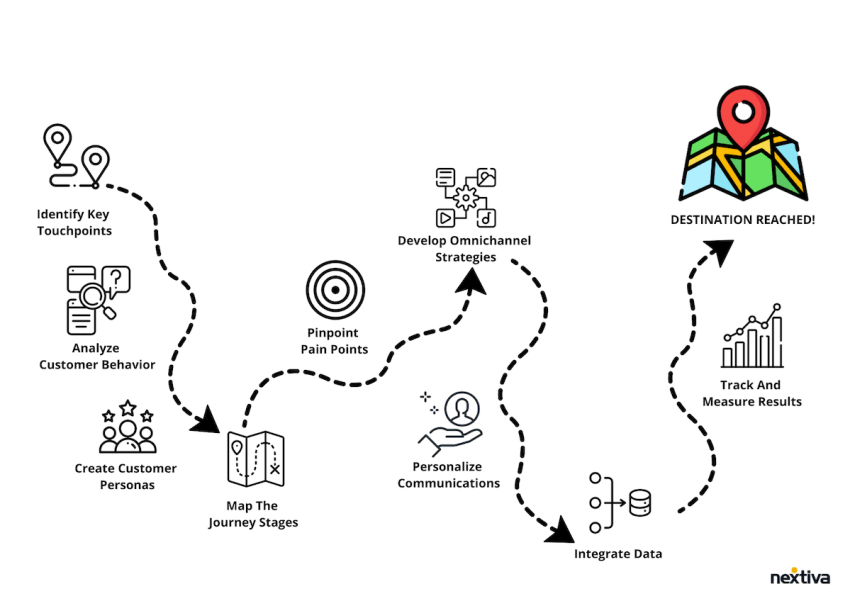
A customer journey map can help you see where these interactions occur and where customers experience friction. Look for gaps between channels and teams. For example, a customer may explain an issue to a chatbot, repeat it to a support agent, and then explain it again during a phone call. Connecting those interactions gives teams better context and creates a more seamless experience.
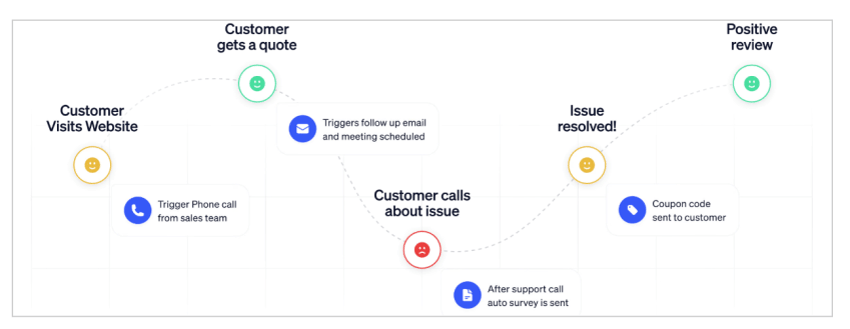
Pro tip: Include both digital and human touchpoints. CLM works best when automated experiences and live customer interactions share the same context.
4. Define the customer signals and triggers that require action
Effective lifecycle management depends on recognizing when a customer is progressing, stalled, at risk, or ready for the next step. So you should define the signals that should trigger action at each stage. Examples include:
- A prospect visits a pricing page several times
- A trial user completes a key activation step
- A new customer fails to complete onboarding
- Product engagement drops significantly
- A customer contacts support repeatedly about the same issue
- Sentiment becomes negative during service interactions
- A contract approaches renewal
- Usage increases enough to suggest an expansion opportunity
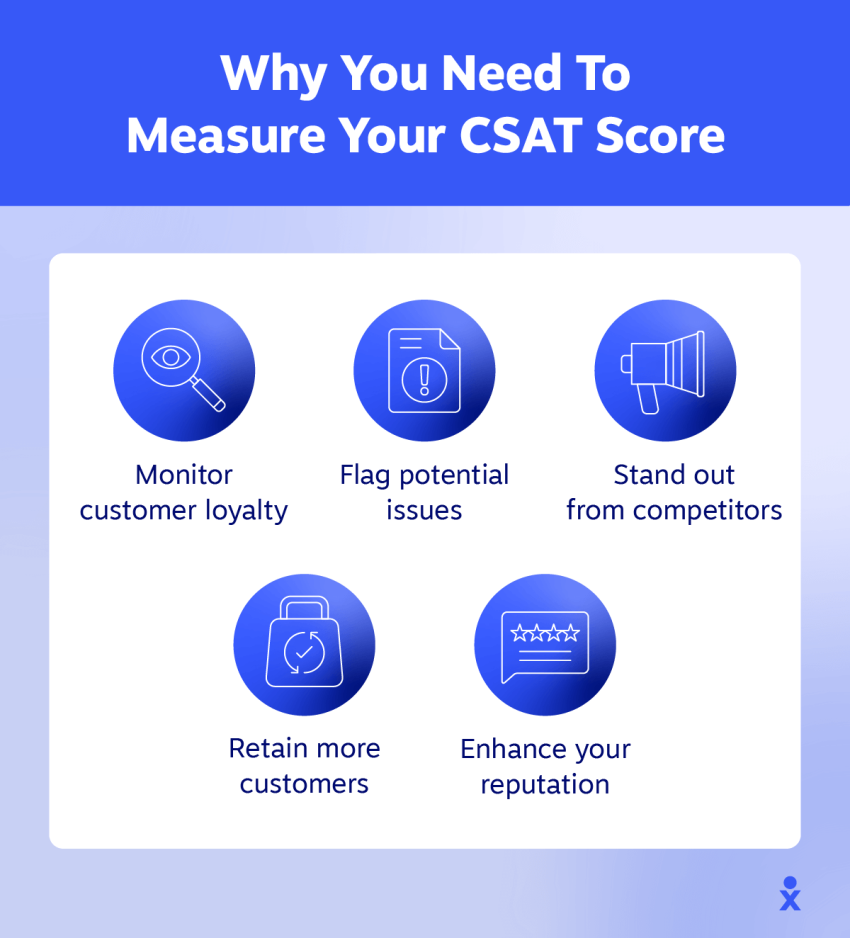
- A satisfied customer gives a high CSAT or NPS score
AI tools help identify these signals across large volumes of customer data. Conversation intelligence, sentiment analysis, predictive models, and behavioral analytics can spot patterns that can be difficult for humans to see.
Pro tip: Prioritize signals that indicate a meaningful change in customer intent, satisfaction, engagement, or value rather than triggering workflows for every minor action.
5. Choose the right action for each trigger
Once you know which customer signals matter, define what should happen next. Actions can be automated, handled by an employee, or both combined. For example:
| Customer Signal | Possible CLM Action |
|---|---|
| Prospect downloads high-intent content | Send relevant follow-up content or alert sales |
| New customer has not completed onboarding | Trigger an onboarding reminder or customer success outreach |
| Customer repeatedly contacts support | Escalate the issue and review the account for churn risk |
| Engagement falls sharply | Launch a re-engagement workflow or proactive check-in |
| Renewal date is approaching | Begin a renewal sequence and surface account health data |
| Customer shows strong satisfaction | Request a review, testimonial, or referral |
| Usage exceeds current plan | Identify an appropriate expansion opportunity |
Automation makes your responses faster and more consistent, and AI can personalize messaging or recommend the next best action based on customer context. Not every interaction should be automated, though. High-value, sensitive, or complex moments should be left to human judgment.
Pro tip: Decide in advance which lifecycle events require automation, which require human outreach, and which require both.
6. Set KPIs for each lifecycle stage
Define how you will measure whether customers are successfully progressing through the lifecycle. Avoid relying on one top-level metric for the entire customer relationship. Each stage should have KPIs that reflect the outcome you want customers to achieve.
Examples include:
- Awareness: Qualified traffic, engagement, branded search
- Acquisition: Lead conversion rate, cost per lead, customer acquisition cost
- Conversion: Win rate, purchase conversion rate, sales cycle length
- Onboarding: Completion rate, activation rate, time to value
- Retention: Churn rate, renewal rate, customer satisfaction
- Expansion: Upsell rate, expansion revenue, net revenue retention
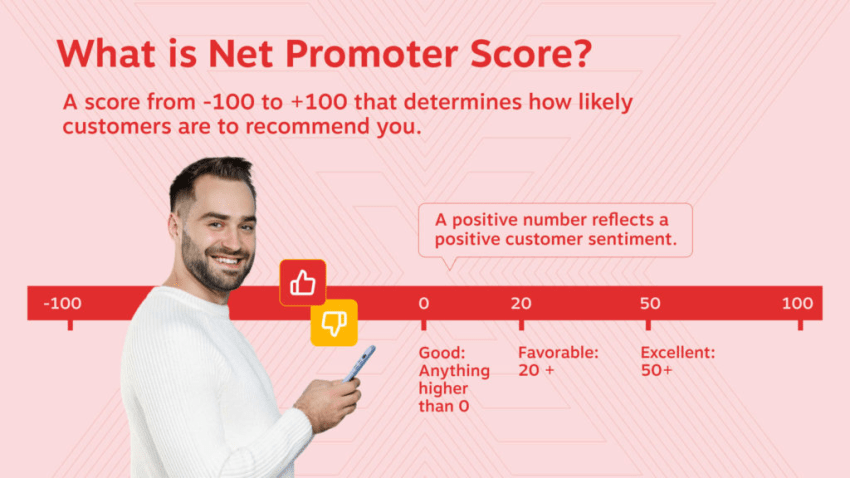
- Loyalty and advocacy: Repeat purchase rate, referrals, reviews, NPS
You should also track how effectively customers move between stages. A strong conversion rate doesn’t mean much if newly acquired customers consistently fail to activate or they churn soon afterward.
We’ll cover the most important CLM metrics in more detail below.
Pro tip: Combine lagging metrics such as churn and revenue with leading indicators such as engagement, sentiment, onboarding progress, and product usage.
7. Connect customer data across your systems
Customer lifecycle management is difficult if each team sees a different version of the customer. Be sure to connect data from the platforms your teams use, such as:
- CRM systems
- Marketing automation platforms
- Customer service software
- Contact center and communication platforms
- Product analytics
- Customer success tools
- Billing and subscription systems
- Customer data platforms
- Survey and feedback tools
The goal is to create enough shared context that teams can understand a customer’s history, current lifecycle stage, recent interactions, and likely next need.
Connected data is also increasingly important for AI-powered CLM. AI systems can provide better recommendations, personalization, summaries, and predictions when they can analyze customer information across channels instead of working from isolated datasets.
Pro tip: Focus first on connecting the data that helps teams make decisions. A complete customer data warehouse is not useful if employees still cannot tell what happened in the customer’s last interaction.
Once these elements are in place, customer lifecycle management becomes a repeatable operating system rather than a collection of disconnected campaigns and service processes. Teams know where the customer is, what signals matter, who owns the next step, and how success will be measured.
CLM Metrics to Track at Each Stage
Customer lifecycle management is only useful if you can actually measure how customers progress from one stage to the next. The right CLM metrics help you identify where customers are engaging, where they are getting stuck, and where revenue or retention may be at risk.
But rather than tracking the same KPIs across the entire lifecycle, choose the metrics that reflect the goal of each stage.
| Lifecycle Stage | Key CLM Metrics | What They Tell You |
|---|---|---|
| Awareness | Qualified website traffic, branded search volume, content engagement, reach | Whether the right audience is discovering and engaging with your brand |
| Acquisition | Lead conversion rate, cost per lead, customer acquisition cost (CAC), marketing-qualified leads | How efficiently you turn interest into identifiable prospects |
| Conversion | Purchase conversion rate, win rate, sales cycle length, cart or form abandonment | How effectively prospects become customers |
| Onboarding | Onboarding completion rate, activation rate, time to value | Whether new customers are successfully reaching their first meaningful outcome |
| Retention | Churn rate, renewal rate, repeat purchase rate, customer satisfaction (CSAT) | Whether customers continue receiving enough value to stay |
| Expansion | Upsell rate, cross-sell rate, expansion revenue, net revenue retention (NRR) | Whether existing customers are increasing their value over time |
| Loyalty and advocacy | Net Promoter Score (NPS), referral rate, review volume, repeat engagement | Whether satisfied customers are becoming loyal advocates |
Track both leading and lagging indicators
Some CLM metrics tell you what has already happened. Others can help you spot what might happen next.
Lagging indicators include metrics such as churn, renewal rate, revenue, and customer lifetime value. They are important for measuring outcomes, but they often reveal problems only after they have occurred.
Leading indicators can provide earlier warning signs or opportunities. These include:
- Declining product or service usage
- Incomplete onboarding
- Repeated support contacts
- Lower engagement with emails or communications
- Negative customer sentiment
- Increased response times
- Changes in purchase frequency
- High-intent behavior before an upgrade or renewal
Monitoring both types gives you a clearer picture of customer health throughout the lifecycle.
Segment lifecycle metrics for better insight
Company-wide averages can hide important differences between customer groups, so it’s a good idea to break down CLM metrics by each relevant customer segment, such as:
- Customer type or plan
- Industry
- Acquisition channel
- Product or service
- Customer tenure
- Geographic market
- Lifecycle stage
- High-value vs. lower-value accounts
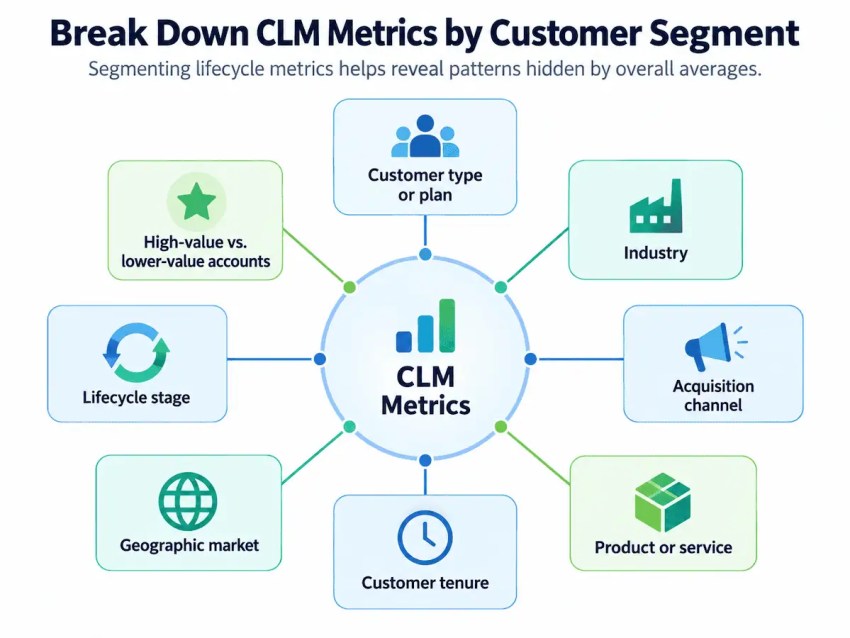
For example, an acceptable overall churn rate could mask much higher churn among customers acquired through a particular channel or customers who fail to complete onboarding.
Use AI to identify patterns in lifecycle data
AI tools help you analyze large volumes of lifecycle data and bring to light patterns that are difficult to detect manually. It depends on the technology and data available, of course, but AI can help identify:
- Customers at higher risk of churn
- Common issues affecting satisfaction
- Changes in customer sentiment
- Accounts that may be ready for expansion
- Recurring friction across support interactions
- Behavioral patterns associated with customer retention or conversion
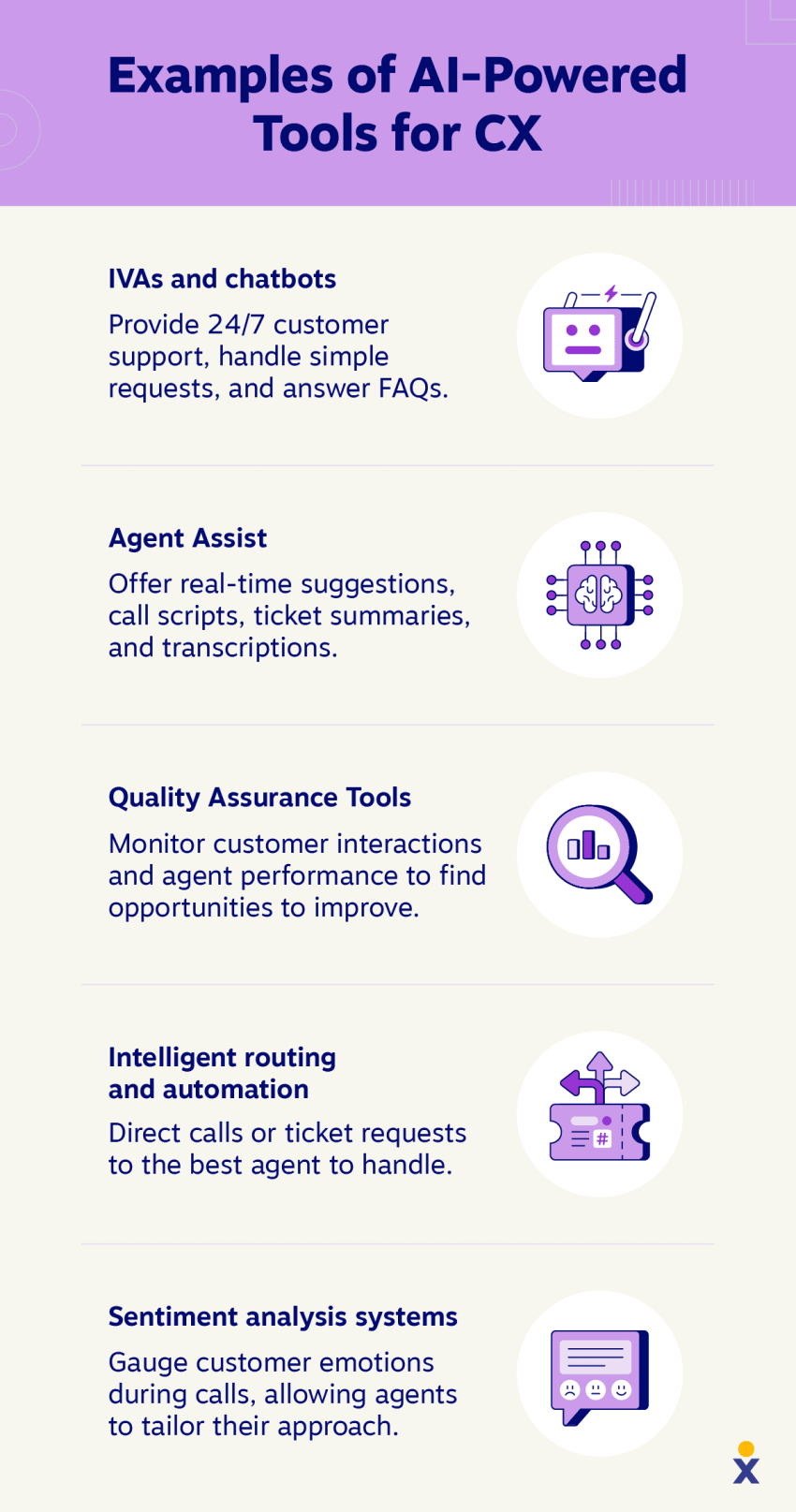
These insights will help you prioritize outreach and act earlier rather than waiting for a customer to churn, complain, or disengage.
Customer Lifecycle Management Software and Tools
Customer lifecycle management software helps your business collect customer data, coordinate interactions, automate workflows, and measure performance across the lifecycle. In many organizations, CLM is not managed in one system but through a connected set of tools.
Some of the most common CLM technologies include:
| Tool | How It Supports CLM |
|---|---|
| CRM software | Tracks customer and prospect information, sales activity, interactions, and account history |
| Customer data platforms (CDPs) | Unify customer data from multiple sources into profiles that can support segmentation and personalization |
| Marketing automation | Triggers emails, campaigns, lead nurturing, and other communications based on customer behavior or lifecycle stage |
| Customer service and contact center software | Manages support interactions across channels and preserves context throughout the customer relationship |
| Customer success platforms | Track account health, onboarding, adoption, renewal, churn risk, and expansion opportunities |
| Analytics and feedback tools | Measure lifecycle KPIs, customer satisfaction, behavior, sentiment, and journey performance |
| AI tools | Analyze interactions, identify patterns and risks, personalize responses, summarize conversations, and recommend or automate next actions |
CRM and CDP systems serve different but complementary purposes: CRM software typically records direct relationship and interaction data, and CDPs unify behavioral and first-party data from multiple sources.
AI is also an important part of the CLM stack. Modern customer success platforms can use product, CRM, billing, and interaction data to identify account health, surface churn risks, and recommend next-best actions.
Note: When evaluating CLM tools, prioritize integration and shared customer context over the number of features. Fragmented systems can create duplicate data, disconnected conversations, and inconsistent lifecycle triggers.
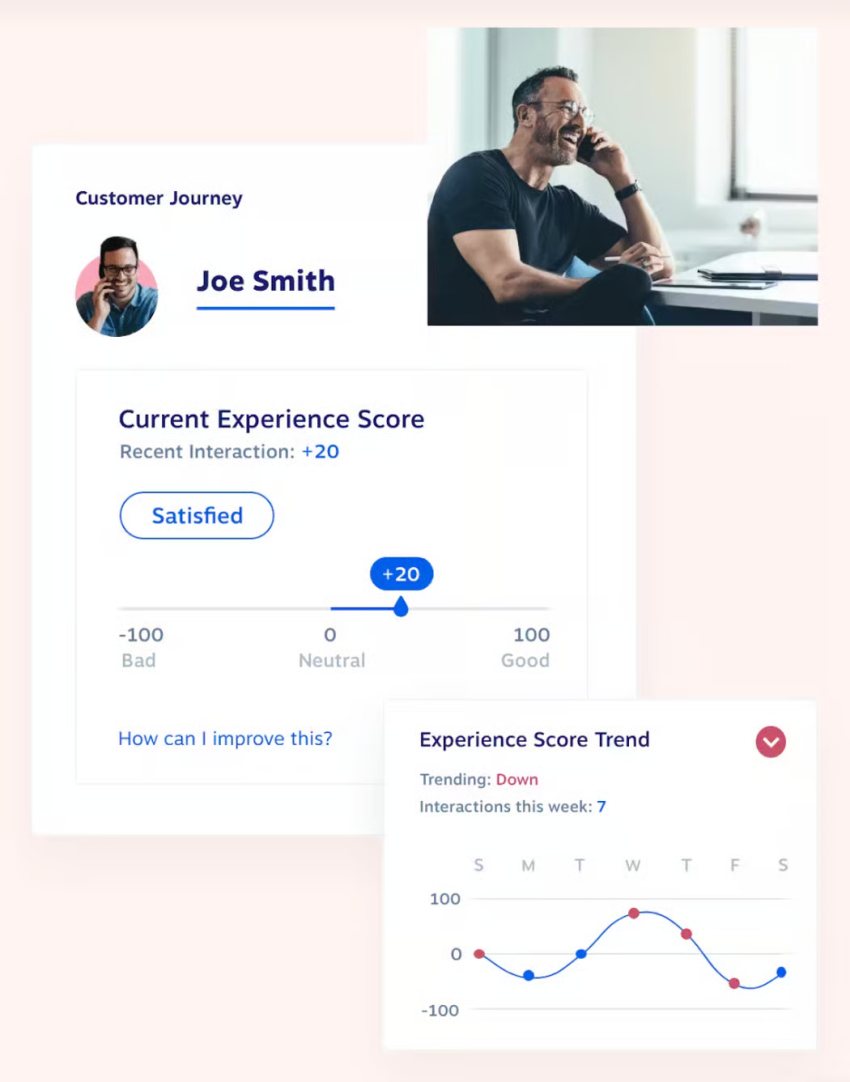
Nextiva, for example, brings customer conversations across voice, chat, email, text, and social into a unified customer view and uses AI for capabilities such as sentiment analysis, automated workflows, journey monitoring, summaries, and intelligent routing. It can also connect with CRM and helpdesk platforms so teams can maintain customer context across systems.
Common CLM Mistakes
Customer lifecycle management usually breaks down because departments, data, and processes are disconnected—not because the lifecycle model itself is wrong.
Watch for these common CLM mistakes:
1. Treating the lifecycle as a rigid, linear path
Customers do not always move neatly from one stage to the next. They tend to pause, skip stages, return after disengaging, downgrade, expand, or move backward in the relationship.
Fix: Use customer behavior and lifecycle signals to determine what happens next instead of assuming every customer follows the exact same timeline.
2. Using vague lifecycle stage definitions
If teams cannot agree on what qualifies someone as “acquired,” “active,” “at risk,” or “loyal,” automation and reporting quickly become unreliable.
Fix: Define clear entry and exit criteria for each stage using observable customer behaviors, milestones, or outcomes.
3. Failing to assign ownership to handoffs
One stage may have an owner but the transition to the next stage does not. That can create gaps between marketing and sales, sales and onboarding, or support and customer success.
Fix: Assign responsibility not only for each stage but also for important lifecycle transitions, including what data and context must move with the customer.
4. Optimizing individual teams instead of customer outcomes
Marketing can hit its lead target, sales can increase conversions, and support can close tickets faster and yet the overall customer experience still gets worse.
Fix: Connect departmental KPIs to lifecycle outcomes such as activation, retention, customer value, and successful progression between stages.
5. Tracking only lagging metrics
Metrics such as churn, renewal rate, and revenue tell you what already happened. But by the time they are deep in decline, the opportunity to intervene may have passed.
Fix: Pair these outcomes with leading indicators such as product adoption, onboarding progress, support friction, customer sentiment, and changes in engagement.
6. Keeping customer data in silos
When marketing, sales, service, and customer success rely on disconnected systems, each department sees only part of the customer relationship.
Fix: Connect the customer data needed to understand lifecycle stage, recent interactions, account health, and relevant next actions. This is especially important when AI tools depend on that data to generate recommendations or predictions.
7. Automating every interaction
Automation and AI can make CLM faster and more scalable, but not every customer moment should be automated.
Fix: Use automation for tasks such as routing, reminders, summaries, simple service requests, and lifecycle triggers. Create a clear path to a human for complex, sensitive, high-value, or emotionally charged interactions.
8. Setting and forgetting the lifecycle model
Customer behavior, products, channels, and business models change over time. A customer lifecycle map created once and never revisited quickly stops reflecting how customers actually engage with the business. This mistake can cost you repeat customers.
Fix: Review lifecycle stages, triggers, ownership, and metrics regularly, especially after major changes to your products, customer segments, or go-to-market strategy.
Customer Lifecycle Management Best Practices
Once your CLM framework is in place, these best practices can help you keep it useful, consistent, and responsive to changing customer needs.
Best Practice 1: Prioritize customer outcomes ahead of internal processes
Lifecycle management works best when stages are defined around what the customer is trying to achieve, not just what your business is doing.
For example, instead of treating onboarding as complete when your team finishes a checklist, define success by whether the customer has reached a meaningful first outcome. Salesforce similarly recommends defining lifecycle stages around customer needs and the actions required to help customers succeed.
Best Practice 2: Segment customers instead of using one lifecycle for everyone
Different customer groups may have different goals, behaviors, risks, and paths through the lifecycle.
Segment customers using factors such as product, account value, industry, purchase history, behavior, or engagement level, and then adapt messaging, service, and lifecycle actions accordingly. For complex businesses, more than one lifecycle framework is appropriate.
Best Practice 3: Unify customer data
CLM depends on teams working from the same customer context.
Connect data across marketing, sales, service, product, and customer success systems, and regularly check for duplicate, incomplete, or outdated records. Clean, connected data improves reporting and also gives AI tools a stronger foundation for recommendations, predictions, and personalization. Salesforce specifically emphasizes both unified data and ongoing data hygiene when using CRM automation and AI.

Best Practice 4: Use AI and automation selectively
Automation can handle repetitive lifecycle tasks such as follow-ups, reminders, routing, segmentation, summaries, and simple support interactions. AI can add another layer by helping identify risk, prioritize customers, personalize outreach, and recommend next actions.
Use these tools to make customer interactions faster and more relevant, not simply to remove people from the process. Human involvement still matters for complicated or sensitive interactions.
Best Practice 5: Monitor customer satisfaction before they churn
Don’t wait for cancellations or failed renewals to reveal that something is wrong. Track leading signals such as onboarding progress, engagement, service history, usage patterns, sentiment, and customer feedback. Customer health scores or early-warning systems can help teams identify accounts that need attention before revenue is at risk.
Happy customers are your best advocates. Encourage them to share their positive experiences and generate more customer reviews and referrals by offering discounts and referral bonuses.
Best Practice 6: Coordinate teams around shared lifecycle outcomes
Marketing, sales, service, product, and customer success should not optimize their parts of the lifecycle independently.
Define shared goals, ownership, and handoff expectations so that one team’s success does not create problems for the next. Current CLM guidance consistently identifies disconnected teams and poorly owned transitions as common causes of lifecycle breakdowns.
Best Practice 7: Continuously test and improve the lifecycle
Customer expectations changes, so your lifecycle strategy should too.
Regularly review lifecycle metrics, customer feedback, journey data, and drop-off points to identify where the experience can improve. Test changes to onboarding, messaging, service workflows, automation, and customer retention programs, then use the results to refine your CLM strategy.
The goal is not to build a perfect lifecycle once. It is to create a system that keeps learning from customer behavior and improves over time. This commitment to continuous improvement ensures that you deliver top-tier customer experiences with every interaction.
Optimize the Customer Lifecycle With Nextiva
Effective customer lifecycle management depends on connected data, coordinated teams, and timely action at every stage of the customer relationship.
Nextiva helps bring customer conversations across channels into a more unified experience, giving teams greater context while using automation and AI to support routing, analysis, workflows, and customer engagement. That can make it easier to respond to customer needs, reduce friction, and build stronger relationships over time.
A successful CLM strategy is not about optimizing one isolated interaction. It is about continuously improving how customers experience your business from first contact through retention, loyalty, and advocacy.
The only platform for every business conversation.
NEXT is where AI handles every conversation end-to-end: resolving issues, closing deals, and delivering better experiences at scale.
Customer Lifecycle Management FAQs
Check out these customer lifecycle management FAQs for some additional information.
Customer lifecycle management is the broader strategy for managing customer relationships across every stage of the lifecycle. CRM software helps support that strategy by storing customer data, tracking interactions, and coordinating sales, marketing, and service activities.
CLM is typically a cross-functional responsibility shared by marketing, sales, customer success, service, product, and operations teams. Each stage should have a clear owner, with defined handoffs when customers move from one stage to another.
Review your lifecycle model and key metrics regularly, especially when customer behavior, products, channels, or business goals change. Many businesses review performance monthly or quarterly and make larger lifecycle updates when significant changes occur.
Yes. AI can help analyze customer behavior and sentiment, identify churn risks, personalize communications, summarize interactions, recommend next actions, and automate routine lifecycle workflows. It is most effective when connected to accurate customer data and used alongside human judgment.
Customer lifecycle marketing is the practice of tailoring marketing messages and campaigns to people based on where they are in the customer life cycle. It can help attract and nurture potential customers, support conversion, and keep each existing customer engaged through retention, loyalty, and advocacy efforts.