
 VoIP
VoIP  Blog
Blog  Business Communication
  Customer Experience
  Leadership
  Marketing & Sales
  Nextiva News
  Productivity

I recently worked with a growing business that had been on AT&T Phone for Business for two years. They were paying over $130 per month under AT&T’s pricing plan for three voice-only lines bundled with AT&T Business Fiber.
This meant they weren’t getting video conferencing, business SMS, team messaging, or a mobile VoIP app. They were stuck with physical phones and voice-only options at a high price. When they asked AT&T customer support about AI features or CRM integration, the answer was the same every time, and they were told, “That’s a different product.”
They weren’t unhappy with the call quality. AT&T’s network is solid and reliable. But they were running a 2026 business on a 2010 phone system, and the gap was starting to cost them. They worried it was hurting their productivity, causing missed calls, and tying their small team down with manual workarounds to compensate for features their business phone system didn’t include.
That conversation is why I wrote this comparison. Having evaluated legacy telecom carriers and cloud VoIP systems side by side in real operating environments, I found that the differences between AT&T Phone for Business and Nextiva aren’t minor.
This guide walks you through everything you need to know about AT&T vs. Nextiva, including pricing, features, AI capabilities, scalability, and total cost. And best of all, we’ll do this fairly, with the numbers in plain sight so that you can make the right call for your business.
AT&T Phone for Business: What You Get
Before comparing the two platforms, let’s be clear about what AT&T Phone for Business is.
It is a VoIP phone service that runs over AT&T Business Fiber. It supports up to six phone lines, connects to existing analog phones and hardware, and includes 30+ standard calling features, including caller ID, call forwarding, call waiting, and basic voicemail.
It is designed for small businesses that want to add phone lines to an existing AT&T fiber connection without buying new equipment or switching vendors.
It is not a unified communications platform. There is no video conferencing, no business SMS, no team messaging, and no mobile app.
All this said, let’s take a look at the service’s strengths and weaknesses.
AT&T’s strengths
- Brand trust. AT&T is one of the most recognized telecom brands in the country. For some buyers, the name alone provides confidence. This is a legitimate factor, especially in enterprise environments where vendor stability matters.
- Fiber reliability. AT&T Business Fiber delivers strong voice quality over a managed IP network. Reviewers on multiple platforms consistently cite call quality and connectivity as AT&T’s standout strengths.
- Legacy device support. AT&T Phone for Business is compatible with existing analog phones. If your business runs on legacy hardware, this matters.
- 5G backup. Eligible plans include automated 5G internet backup that activates during fiber outages. This is a genuine and powerful differentiator for mission-critical environments.
- No contract. Month-to-month engagement with no long-term commitment required, though some customers reported costs upon cancellation.
AT&T’s limitations
- Fiber-only availability. The service requires AT&T Business Fiber at your location; without it, there is no phone service. Businesses outside AT&T’s fiber footprint, unlike with Verizon or cloud-native VoIP, simply can’t use this particular product.
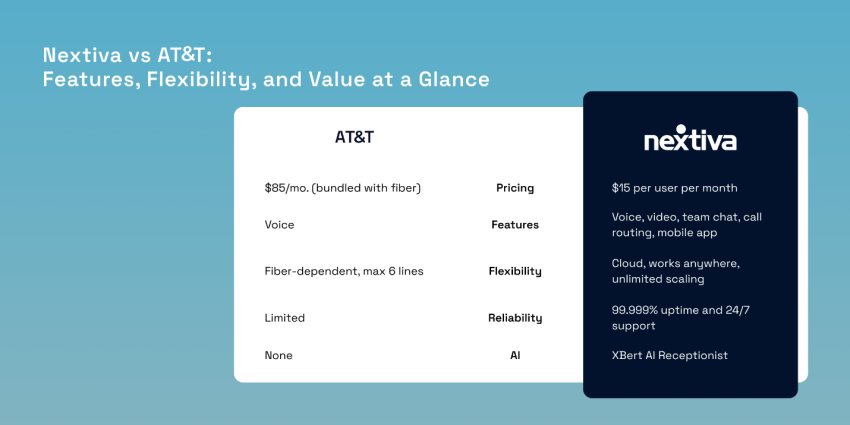
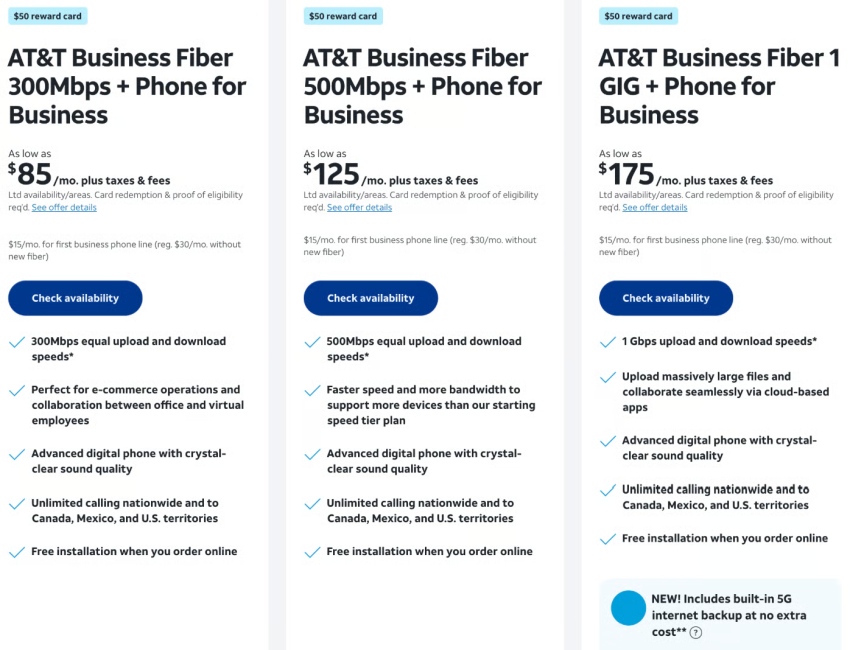
- Bundled pricing masks the real cost. The $15/line/month price requires a fiber bundle starting at $85/month. Three lines cost $130+/month for voice only.
- Six-line cap. The account maximum is six lines. Need a seventh? You’re migrating to a completely different product.
- Voice-only functionality. No video conferencing, team messaging, or business SMS. Only call forwarding is included.
- Lack of AI features. You aren’t getting advanced call routing, voicemail transcription, or an AI receptionist at any price point, which is now a disadvantage.
- Office@Hand confusion. This is AT&T’s UCaaS product, which is a completely separate service with its own pricing. Many buyers don’t realize they’re looking at two different products until after they’ve signed up.
- Billing and support frustrations. Billing errors lasting months, undocumented support calls, and FCC complaints are the most consistent themes across AT&T’s business phone reviews.
Nextiva: What You Get
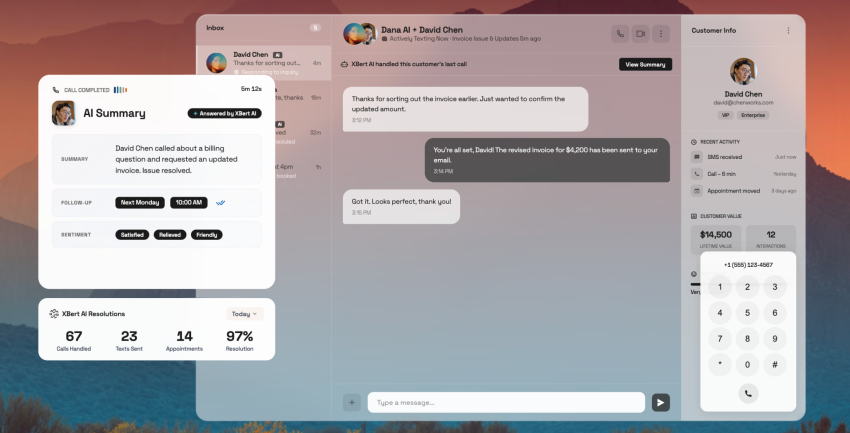
Nextiva is a unified communications and cloud-native VoIP platform, and one of the best AT&T business phone alternatives. It doesn’t require fiber, capping your line, or separating voice, video, and messaging into different products. Here’s what it looks like in practice.
Unified communications in one platform
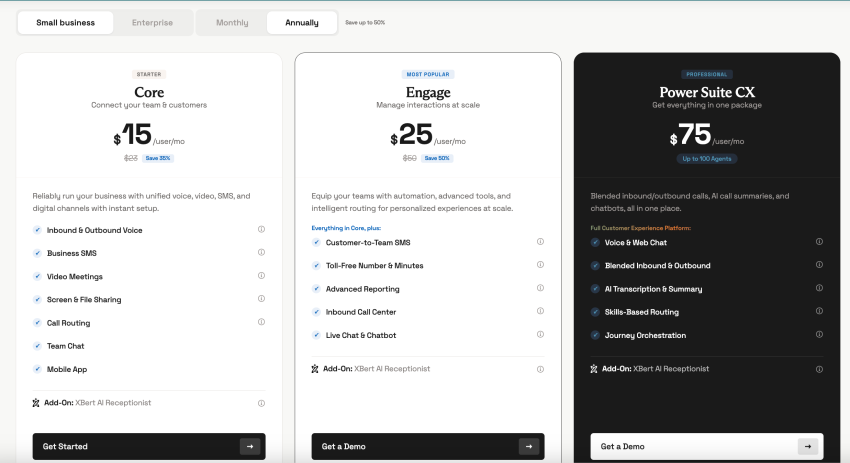
Nextiva’s Core plan starts at $15/user/month (billed annually) and includes the following native features:
- Voice
- Video
- SMS
- Team chat
- CRM integrations
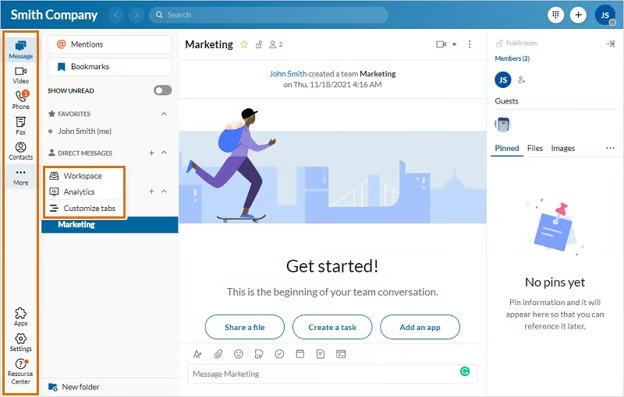
This means your team gets a truly unified workspace, with a single platform for every communication channel, from phone calls to text messaging to video meetings.
The Engage plan at $25/user/month (billed annually) adds advanced features like call center queue management, intelligent call routing, and an AI-powered chatbot for businesses that need contact center functionality. It also adds call recording, IVR, and real-time analytics, which are essential tools that let small teams operate with the discipline of a much larger organization.
The Sclae plan at $75/user/month (billed annually) adds advanced contact center features, workforce engagement management, and customer journey orchestration for larger teams with complex communication workflows.
Every plan includes the NextivaONE app for desktop, mobile (iOS and Android), and browser. This means your team can work from anywhere and on any smartphone, without a separate product or subscription. It also supports open APIs for businesses that need to build custom integrations into their existing tech stack.
And critically, Nextiva works over any internet connection. There’s no fiber requirement or location dependency, which means you aren’t restricted by geography of any kind.
AI-powered capabilities
This is where the gap between AT&T and Nextiva becomes most stark. AT&T Phone for Business has no AI features. Nextiva has several, and they’re built into the platform — not bolted on.
- Smart call routing. AI analyzes caller intent and routes calls to the right agent or department based on their skills, availability, and context.
- AI voicemail transcription. Voicemails are transcribed automatically and delivered to your inbox. No more listening to two-minute messages to find the one piece of information you need.
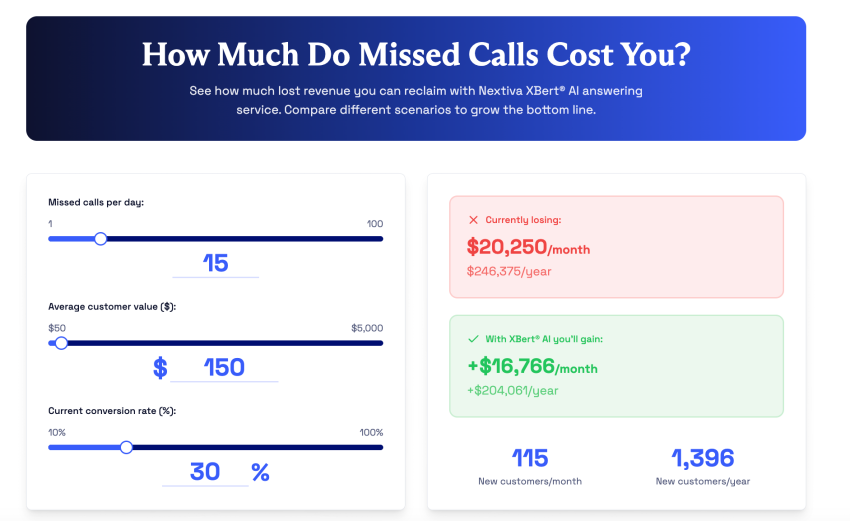
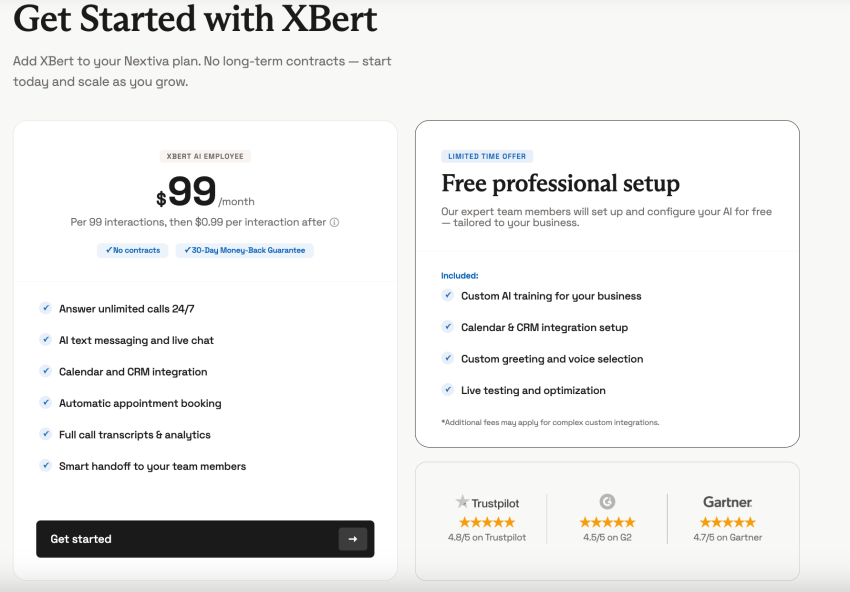
- XBert AI Receptionist. For businesses that want 24/7 AI call handling, Nextiva’s AI employee XBert answers calls, books appointments, qualifies leads, and routes complex inquiries, starting at $99/month. This is a capability AT&T Phone for Business doesn’t offer at any price point.
Scalability, reliability, and support
One of the most significant benefits of Nextiva is its scalability.
Nextiva scales from one user to an enterprise, with no line caps or arbitrary limits. As your team grows from five people to 50, you can keep on adding users without needing to migrate to a new product.
Want to expand into a new market? Toll-free numbers are supported across all plans, and international calling is available for businesses with global communication needs.
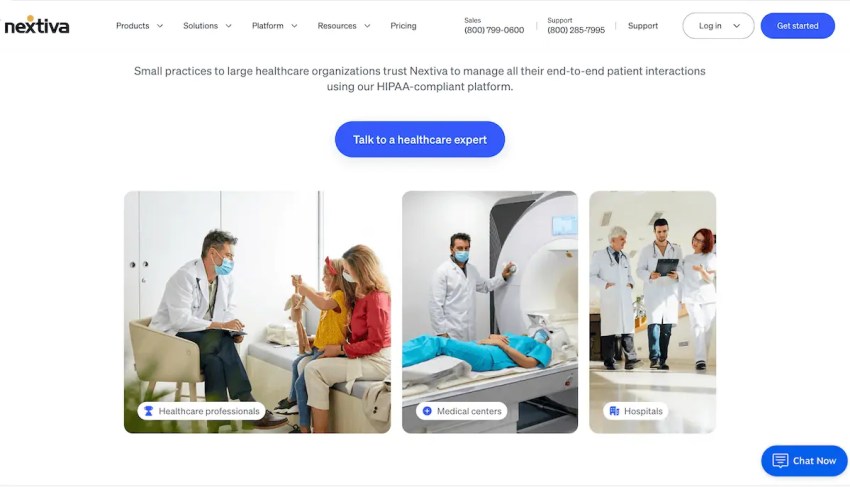
For businesses in regulated industries, Nextiva also offers specialty solutions. For example, Nextiva is HIPAA-compliant, which is a requirement for healthcare organizations that need a business phone service built to handle protected health information.
The platform strives for a 99.999% uptime SLA backed by eight globally distributed data centers. That’s less than six minutes of downtime per year. This matches AT&T’s Phone for Business 99.99% uptime.
Support is 24/7 via phone, chat, and email, and is U.S.-based. U.S. News & World Report has named Nextiva the best business phone system for four years running. Given AT&T’s reviews about support quality, this is not a minor distinction.
Finally, Nextiva number porting is free. This means you can bring your existing AT&T business number to Nextiva, and your customers will never know you switched. Native integrations with Salesforce, HubSpot, and other CRM platforms mean your call data flows directly into the tools your sales and support teams already use, making the adoption easy.
AT&T Phone for Business vs. Nextiva: Head-to-Head Comparison
Want a simplified, clear comparison? Take a look at how the two platforms measure up on key features, pricing information, and more:
| Features | AT&T Phone for Business | Nextiva |
|---|---|---|
| Starting Price | $85/mo + $15/mo/line (fiber bundle required for this pricing) | $15/user/mo (standalone) |
| Per-Line/User Cost | $15/line (bundled only) | $15/user (all-inclusive) |
| Contract Required | No | No |
| Fiber/Internet Required | AT&T Business Fiber required | Any internet connection |
| Unlimited Calling | U.S., Canada, and Mexico | U.S. and Canada |
| Video Conferencing | Not included | Included (all plans) |
| Team Messaging | Not included | Included (all plans) |
| Business SMS | Not included | Included (all plans) |
| Mobile App (VoIP) | Separate product | Included (NextivaONE) |
| CRM Integrations | Not native | Outlook, Google, Salesforce, HubSpot (add-on) |
| AI Features | None | AI voicemail, smart routing, conversational AI, XBert AI ($99/mo.) |
| Max Users/Lines | 6 lines per account | Unlimited |
| Uptime SLA | 99.99% | 99.999% |
| 24/7 Support | Technical repair only | Phone, chat, and email |
| Desk Phone Support | Analog phones | 150+ VoIP desk phones + analog adapters |
| Scalability | Capped at 6 lines | 1 user to the enterprise |
A few things stand out when you look at this side by side.
- AT&T provides a phone line, while Nextiva offers a complete communications platform. Voice, video, SMS, team chat, CRM integration, and AI are included in one system from Nextiva.
- AT&T’s $15/line price is misleading. This pricing requires the $85+/month fiber bundle. Nextiva’s $15/user/month is all-inclusive with no mandatory bundles, no fiber requirement, and no infrastructure dependency.
- AT&T caps at six lines. Nextiva scales from one user to thousands, with no arbitrary limits or migration required as you grow.
- AT&T has zero AI capability. Nextiva offers AI voicemail transcription, smart call routing, and XBert AI Receptionist for 24/7 call handling; this is a category AT&T doesn’t compete in at all.
Pricing Breakdown: What You Pay
This is the analysis I run with every business that asks me to compare the two. When you put real numbers on paper, the results are hard to argue with.
AT&T’s total cost of ownership
AT&T Business Fiber requires AT&T Phone for Business. That means business phone plan starts at $85/month before a single phone line is even added.
Here’s what that looks like:
- One line: $85 (fiber) + $15 (one line) = $100/month — voice only
- Three lines: $85 (fiber) + $45 (three lines) = $130/month — voice only
- Five lines: $85 (fiber) + $75 (five lines) = $160/month — voice only
- Six lines (maximum): $85 (fiber) + $90 (six lines) = $175/month — voice only, and you’ve reached the limit
Nextiva’s total cost of ownership
Nextiva’s pricing was designed to be transparent. Our Core plan is $15/user/month, billed annually. That’s the all-in price, and it includes voice, video, SMS, team chat, mobile app, and CRM integrations.
- Three users — $45/month: full unified communications platform
- Five users — $75/month: less than AT&T’s three-line cost, with dramatically more included
- 10 users — $150/month: full platform, still under AT&T’s six-line maximum cost
- XBert AI Receptionist — $99/month: 24/7 AI call handling — a capability AT&T doesn’t offer at any price
There are no fiber requirements, mandatory bundles, line caps, or hidden infrastructure costs.
The five-user comparison is the one I find most compelling in practice when it comes to Nextiva’s cost. You spend $75/month on Nextiva for a full communications platform versus $160/month on AT&T for voice-only service. That’s $85/month in savings, and the Nextiva team gets video, SMS, team chat, a mobile app, and CRM integrations that the AT&T team doesn’t have at all.
When you look at the total cost per line, the case for Nextiva’s business VoIP cost only gets stronger as you add users. AT&T’s cost per line stays fixed, but the feature limit remains at voice-only. Nextiva’s cost per user decreases at scale, and the platform keeps growing with you.
When AT&T Phone for Business Still Makes Sense
We’re going to keep this objective. There are scenarios where AT&T is the right call.
These are the situations when we may not recommend switching over to Nextiva:
- Businesses already on AT&T Fiber that have minimal needs. If you have AT&T Business Fiber installed, need one or two basic phone lines, and genuinely don’t need anything beyond a reliable dial tone, adding AT&T Phone for Business is low-friction and cost-effective.
- Legacy equipment dependencies. If your operation relies on analog fax machines, alarm panels, or POS systems that require a traditional landline VoIP connection over fiber, AT&T is built for that.
- Small, static operations. If you have a small team of one or two people in an AT&T fiber service area with no growth plans and no need for video, SMS, or collaboration tools, and all you need is a reliable landline replacement and a straightforward calling experience, AT&T works.
- Mission-critical 5G backup needs. If automatic failover during fiber outages is a hard requirement, AT&T’s 5G backup feature is a genuine differentiator.
Even in these scenarios, it’s worth noting that AT&T’s six-line cap means any meaningful growth forces a migration anyway. And the billing and support issues documented in real customer reviews don’t go away just because your current needs are simple. The long-term cost and feature trajectory still favor a cloud platform, but these are the situations when AT&T can be a good choice if everything else aligns.
How to Switch From AT&T Phone for Business to Nextiva
If you’ve decided that switching from AT&T Phone for Business is the right choice for you, here’s how you can switch to Nextiva:
- Audit your current setup. Document all phone numbers, extensions, call flows, and any equipment or integrations tied to your AT&T account. Know what you have before you start.
- Choose your Nextiva plan. Most small businesses find that the Core plan at $15/user/month covers everything AT&T offers (and significantly more). Businesses that need call center queues, call recording, or intelligent call routing to streamline their customer experience should look at the Engage plan at $25/user/month.
- Port your numbers. Nextiva supports full number porting from AT&T. Keep your AT&T account active during the port — do not cancel early or you risk losing your numbers. Porting is free.
- Set up your system. Nextiva can be configured in minutes, as no hardware installation is required. The NextivaONE app works on desktop, mobile, and in a browser so that your team is up and running the same day.
- Train your team. Most teams are fully operational within an hour. Nextiva’s interface is intuitive, and 24/7 support is available throughout the transition. Make sure they understand the processes, essential features, and expectations.
- Cancel AT&T. Only cancel after your numbers have been fully ported and your Nextiva system is operational and tested. The typical migration timeline is around one to two weeks total, but this depends on your business’s size and adoption process.
One important note from real AT&T customer reviews: get your cancellation confirmation in writing. Multiple reviewers described unexpected cancellation fees and equipment charges that surfaced after verbal confirmation. Don’t close the loop until you have written confirmation in hand.
AT&T’s Reputation Is Built on the Network, and Nextiva’s Is Built on Experience
AT&T Phone for Business was designed for a different era, when all a business needed was a reliable dial tone tied to a fiber line. That product still exists, and for a narrow set of use cases, it genuinely still works.
But in 2026, businesses need voice, video, messaging, AI, and CRM integration in a single platform that works anywhere, scales as they grow, and doesn’t require an $85/month fiber bundle just to make a phone call. AT&T’s Phone for Business gives you a phone line, but Nextiva gives you a business communications platform, making it well-suited as a phone and answering service for small businesses.
Having evaluated both side by side in real business environments, the numbers don’t lie. Five users on Nextiva’s Core plan costs $75/month — less than AT&T’s three-line cost — and includes everything AT&T doesn’t. Think video, SMS, team chat, a mobile app, CRM integrations, AI voicemail, and smart call routing. For businesses that want 24/7 AI call handling, XBert takes every call starting at $99/month. That’s pricing and scalability that’s hard to beat.
The reviews have spoken, and the math is clear. Get voice, video, SMS, optional AI, and support that answers, starting at $15/user/month with Nextiva. Try it today.
Elevate your brand with the best business phone system.
With many advanced features at no extra cost, such as a toll-free number, auto attendants, team messaging, and email integrations, this is the unified communications solution every small business needs.
Frequently Asked Questions
For most businesses, yes. Nextiva includes voice, video, SMS, team messaging, a mobile app, virtual receptionists, and 24/7 U.S.-based support. It all starts at $15/user/month with no fiber bundle required. AT&T Phone for Business is voice-only, capped at six lines, and requires a fiber internet plan to qualify for the $15/line/month pricing.
Yes, you can keep your AT&T phone number if you switch to Nextiva. Nextiva supports full number porting from AT&T at no charge. Keep your AT&T account active during the porting process to avoid losing your numbers. The process typically takes one to two weeks and is supported throughout by Nextiva’s team.
Nextiva supports 150+ VoIP desk phones and includes analog adapters for businesses that want to use existing hardware. The NextivaONE app works on desktop, mobile (iOS and Android), and browser, so your team can use whatever combination of hardware and software works for them.
Nextiva includes AI voicemail transcription, smart call routing, and AI agent Xbert, which answers calls, books appointments, qualifies leads, and routes complex inquiries 24/7, starting at $99/month.
AT&T Phone for Business has no AI features at any price point. Neither does AT&T Office@Hand in its standard tiers, as it isn’t an AI answering service.
Most businesses complete the corporate phone system migration in one to two weeks. Nextiva can be configured and operational within a day, so the primary timeline is driven by number porting, which typically takes several business days. Nextiva’s support team assists throughout the process at no additional cost.
Yes, Nextiva is reliable enough to replace AT&T as a VoIP alternative. Nextiva strives for a published 99.999% uptime SLA backed by eight globally distributed data centers, resulting in less than six minutes of downtime per year.