

 Customer Experience
  Blog
Blog  Business Communication
  Leadership
  Marketing & Sales
  Nextiva News
  Productivity
  VoIP
VoIP 

The era of traditional interactive voice response (IVR) systems is ending. Customers today demand instant answers, yet most support and sales teams are already at capacity.
Enter the AI voice agent.
While many businesses are hesitant to hand the phone over to AI, early adopters are already seeing the payoff: zero wait times, consistent answers, and higher revenue capture. But implementation requires a strategy, not just software. Before you deploy new technology, you need a playbook to understand AI voice agents’ benefits, risks, and the metrics that matter to assess their performance.
Try the best AI answering service free for 14 days
XBert AI answers questions and captures leads. Add your 24/7 answering service in minutes.
What Is an AI Voice Agent?
An AI voice agent is real-time intelligent software that understands callers, speaks naturally, and completes key tasks like answering questions, booking appointments, qualifying leads, routing calls, and collecting information. You provide a self-service option as your first port of call for service or new business inquiries, and it proceeds to the next action (troubleshooting, call transferring, etc.) as deemed necessary. Often, these smart agents can handle an entire call without the need for human escalation.
Unlike a human agent, AI operates 24/7 and can handle many (almost unlimited) phone calls simultaneously. There’s no need for an AI agent to take a break, and it doesn’t burn out.
The main difference: Do not confuse an AI voice agent with an IVR system. IVR systems can be inflexible and force customers into cumbersome menu navigation. The customer has to do a lot. An AI voice agent, on the other hand, is a conversational partner. It hears open-ended statements (“I need to reschedule my appointment for Tuesday”), understands intention, and executes tasks immediately. It takes the work off customers’ hands.

Why this matters to businesses
AI voice agents act like scalable, tireless teammates who never miss a beat. They ensure consistency, capture every opportunity, and provide a seamless experience for customers, all at a fraction of the cost of hiring additional agents.
The combination of cost savings, instant call answering, and lower wait times proves a major hit with both customers and businesses.
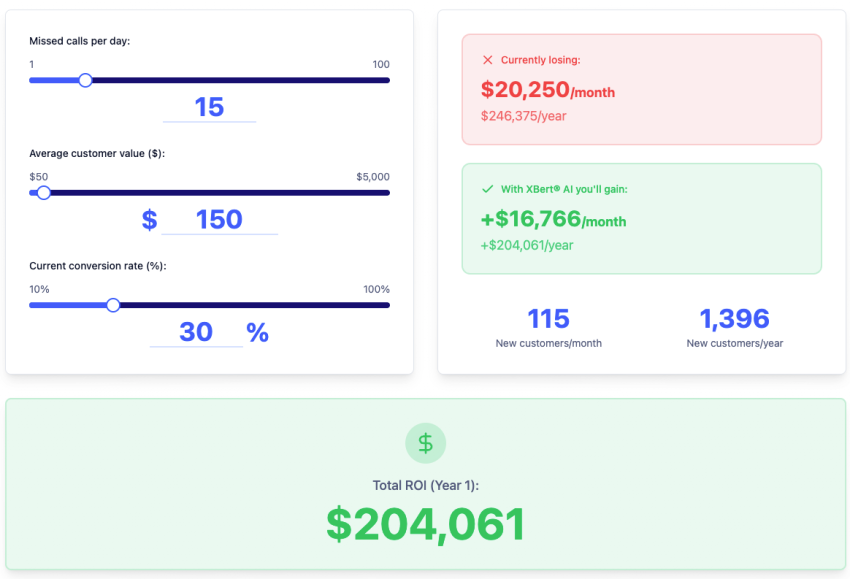
How Much Do Missed Calls Cost You?
See how much lost revenue you can reclaim with Nextiva XBert® AI answering service. Compare different scenarios to grow the bottom line.
How AI Voice Agents Work
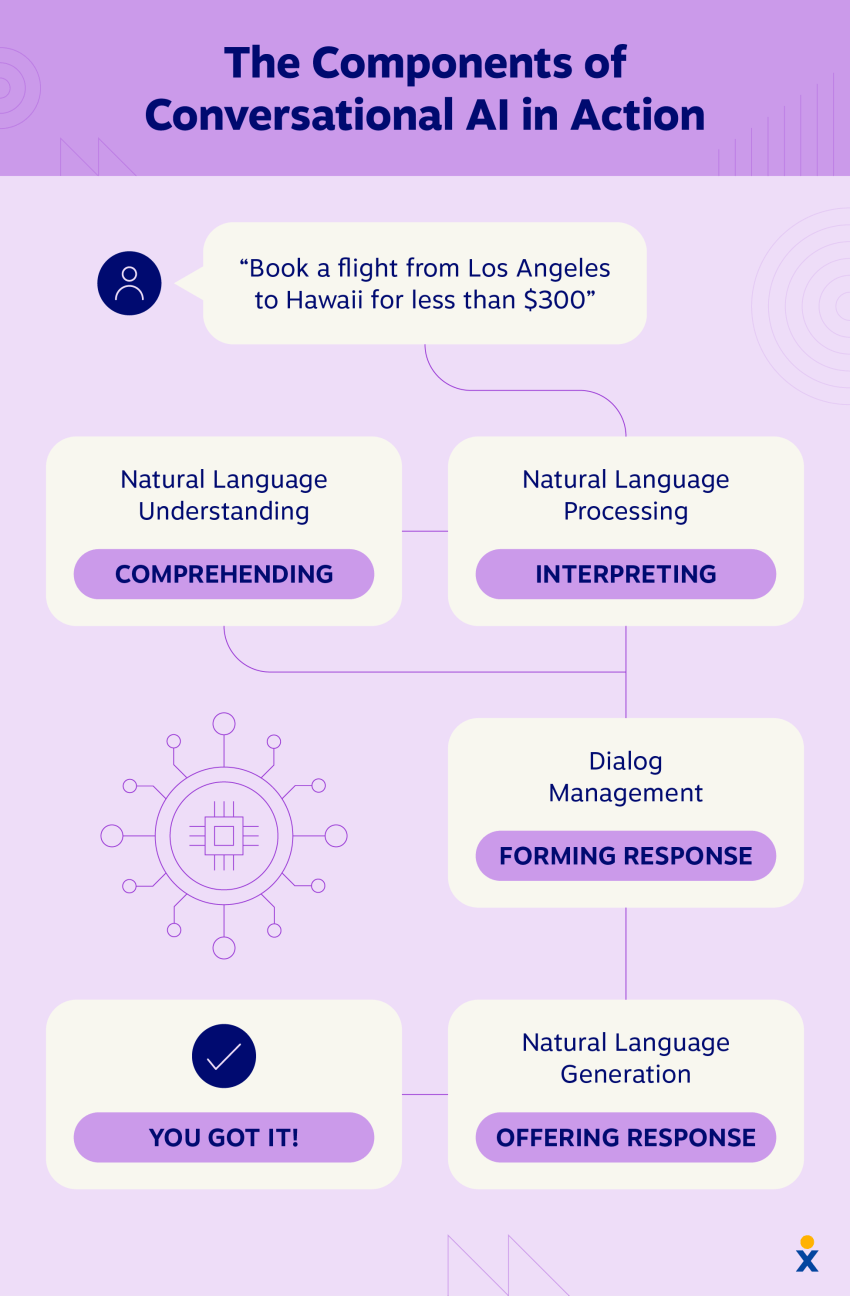
At the heart of AI voice agents is conversational AI — a method of holding a two-way conversation without the need for both parties to be human.
We can break this functionality down into four major components:
- Comprehending: Natural language understanding
- Interpreting: Natural language processing
- Forming responses: Dialog management
- Offering responses: Natural language generation
Core workflow
You can think of an AI voice agent as a human brain working at the speed of light. It hears speech, understands the meaning, decides on the policy-compliant response, and reproduces it — all quickly. Here’s a breakdown of the workflow it uses:
- Speech-to-text: Uses speech recognition to convert the caller’s spoken words into text (also supports text-to-speech for chatbot-type inquiries)
- Natural language understanding: Determines intent and context
- Workflow logic: Decides what action to take based on the intent
- Text-to-speech: Responds with clear, low-latency, natural conversation
- Integrations: Updates CRMs, calendars, help desks, or payment systems
Guardrails for real-world use
- Fallback prompts when confidence is low: Allows you to configure triggers to offer human support if negative sentiment is detected
- “Barge-in” support so callers can interrupt naturally: Prevents your AI voice agent from just reading answers without letting your customer speak
- Live transfer with full context when escalation is needed: Gives your human agents everything they need when taking over calls, rather than starting the conversation from the beginning
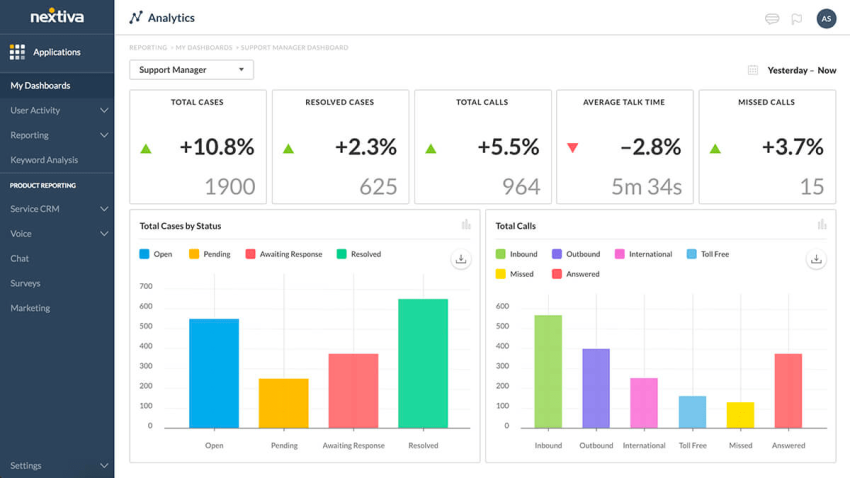
- Call analytics tracking outcomes, drop-offs, and sentiment: Lets you check the success of self-service usage and revisit prompts, answers, and AI-generated responses
Business Benefits of AI Voice Agents
Here are some of the best reasons to use AI voice agents in your business.
Capture every opportunity
- Provides 24/7 coverage, so no call goes to voicemail
- Converts after-hours or peak calls into booked appointments
Imagine this: You’re on a job site, in a meeting, or sleeping. The phone rings, but you can’t answer. That caller doesn’t leave a voicemail; they just call your competitor.
AI voice agents catch every call instantly, so you never lose a lead just because you’re unavailable.
Improve speed to first response
- Answers instantly to reduce hold times and customer frustration
- Accelerates callbacks and follow-ups for time-sensitive inquiries
The major benefit of any AI answering service is that there’s no queue for customers while waiting for a human agent to become available. Instead, your AI agent is always available and can answer on the first ring. The sooner you answer, the sooner you can start helping your customer.
Lower operational costs
- Automates repetitive questions and intake tasks
- Frees human agents to focus on complex, high-value calls
Unlike using a virtual receptionist — someone who answers calls for your business but isn’t an employee — there’s minimal cost associated with AI voice agents. They don’t require a salary, vacation days, or 401(k) plan. Instead, you pay a monthly fee that’s significantly lower than that of a human agent.
Deliver a consistent experience
- Provides brand-aligned responses every time
- Prevents leaving personalization to chance and human interpretation
Using your own AI receptionist, you can configure and maintain a uniform tone, greeting, and script. While there’s always a case for human sales patter and emotion, you can ensure the right lines get spoken at the right time — every time.
Gain actionable insights
- Captures structured data on intent, resolution, and follow-up needs
- Reveals trends in customer behavior and call patterns across your integrated AI customer service tools
Every part of every customer interaction gets reviewed and reported on by AI and metric systems. You can link these to key performance indicators and inform other parts of your business, like product and marketing teams.

Hear why XBert AI is the best AI receptionist
XBert AI receptionist handles customer questions, captures leads, and books appointments. Try it free for 14 days.
High-Impact Use Cases for Businesses
You can use an AI answering service in many scenarios to speed up the rate of answering, provide self-service options, and qualify early sales stages. See if your own contact center resonates with the example use cases below.
Service businesses
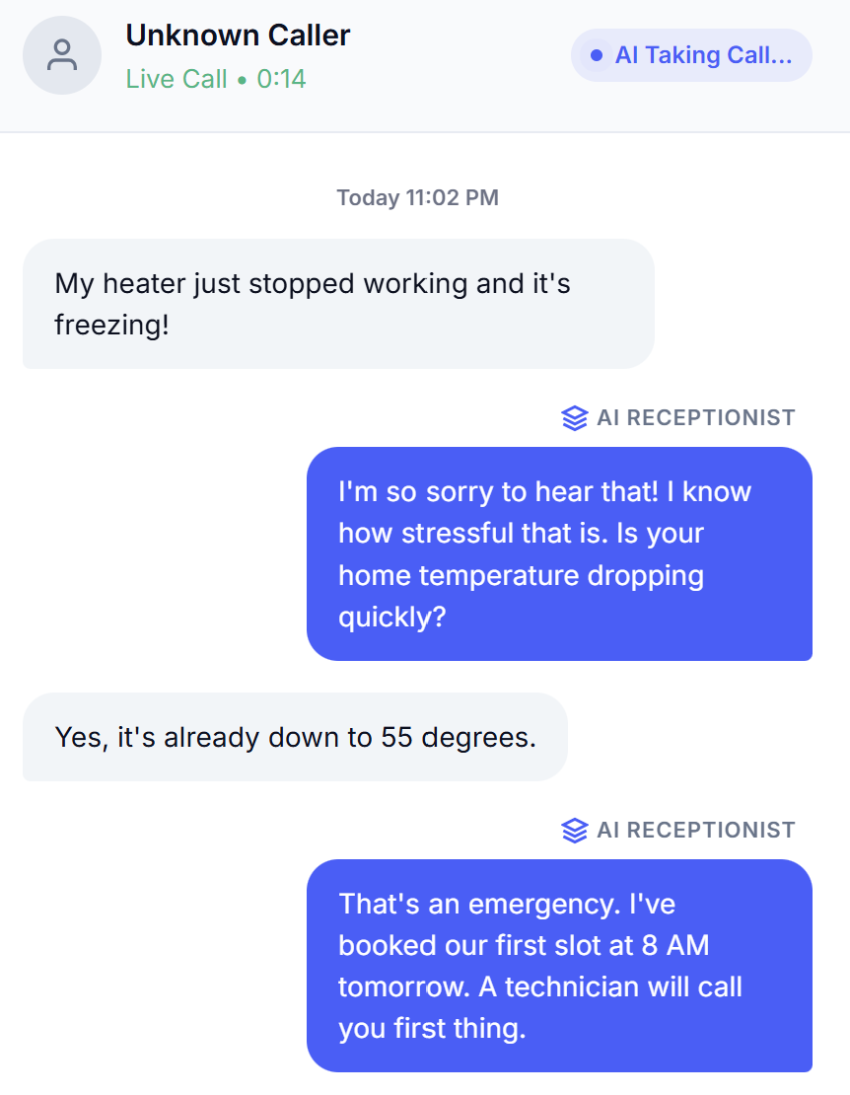
AI voice agents handle scheduling, emergency dispatches, and job confirmations. In urgent situations, efficiency is the name of the game. With an AI voice agent, callers won’t be left waiting in line when they have no heat in the middle of winter.
Likewise, non-emergencies (like appointment scheduling) get taken care of without the need for human intervention — freeing up your call center agents to take care of more specialized queries.
Healthcare and dental
Local and national healthcare practices can manage appointment changes and routine insurance questions without needing human input.
Building from a core stack of frequently asked questions, docs, and templates you grant access to, and using machine learning and large language models to add to these and progressively answer more, an AI voice agent allows healthcare professionals to deal with more complex or empathetic patients.
Listen to XBert scheduling patient visits:
Professional services
Anyone who works in legal or financial services will tell you they need to spend more time on billable work. With voice AI handling the first stages of legal, accounting, or insurance leads, you can do just that.
While you wouldn’t want to hand off sensitive conversations or large transactions, queries like renewals, quotes, and general advice could all be served by an AI-powered voice agent.
Listen to XBert book tax appointments and respond to service questions:
Retail and hospitality
When customers call to check stock levels, book a table, or cancel their order, your AI agent can respond instantly after cross-referencing your inventory and existing systems.
Removing manual processes like opening browsers, logging into applications, and searching for the right date, product, or restaurant means a quicker process and a better customer experience.
Listen to XBert handle reservations and respond to menu inquiries:
Helpful Metrics You’ll Want to Track
Conversion and revenue
- Appointment booking rate: Percentage of inbound calls that result in a confirmed appointment
- Qualified lead rate: Share of calls that meet predefined qualification criteria (budget, intent, timeline)
- Revenue per inbound call: Average revenue generated per call, segmented by AI-handled vs. agent-handled
- After-hours call capture rate: Percentage of after-hours calls answered and converted instead of missed
- Lost-call recovery rate: Percentage of abandoned or missed calls that result in a successful follow-up.
Efficiency
- Average speed of answer: Time taken to answer inbound calls, expected to decrease as AI absorbs first-line demand
- Call abandonment rate: Percentage of callers who hang up before being served
- Automation containment rate: Percentage of calls fully resolved by AI without human agent involvement
- Average handle time: Average duration of agent-handled calls, typically reduced due to better pre-qualification
- Agent utilization rate: Proportion of agent time spent on high-value or complex interactions instead of triage
Quality
- Customer satisfaction score: Post-call satisfaction for AI-handled calls compared to human-handled calls
- First contact resolution: Percentage of issues resolved within the initial AI interaction
- Intent recognition accuracy: Percentage of calls correctly categorized and routed by the AI
- Data capture completeness: Percentage of calls where all required intake fields are captured accurately
- Handoff success rate: Percentage of AI-to-agent transfers completed with full context and no customer repetition
Voice Agent Risks and How to Mitigate Them
| Risk | Why It Happens | Mitigation Strategies | Practical Examples |
|---|---|---|---|
| Caller Frustration | Voice agents can feel slow, repetitive, or rigid if prompts are too long or users can’t reach a human when needed. Callers often abandon calls when they feel trapped. | • Keep prompts short and conversational. • Allow the caller to interrupt. • Fine-tune options and navigation to offer a clear, fast path to a live agent. | • Instead of “Please listen carefully as our options have changed,” use “How can I help you today?” • At any time, the caller can say “agent” or press 0 to reach a human. • After two failed attempts to understand intent, automatically transfer the call. |
| Inaccurate Answers | Voice agents may hallucinate, misunderstand intent, or answer beyond what their data reliably supports — especially with edge cases or policy questions. | • Maintain a verified, up-to-date knowledge base. • Use confidence thresholds to trigger escalation. • Restrict the agent to approved topics. | • If the agent is less than 80% confident, it responds with, “Let me connect you with someone who can help.” • Pricing, refunds, or legal questions get routed directly to a human. • Weekly reviews ensure FAQs reflect current policies. |
| Data Fragmentation | Call transcripts, analytics, and outcomes may be spread across tools (telephony, CRM, analytics), making insights incomplete or unusable. | • Centralize transcripts and metadata. • Use only approved, secure integrations. • Standardize data schemas and naming. | • All call transcripts are automatically stored in the CRM under the customer record. • Call outcomes (resolved, escalated, abandoned) are logged consistently. • Avoid one-off Zapier-style integrations that create data silos. |
| Privacy and Compliance Risks | Live calls may contain sensitive personal or financial information that must be handled according to regulations. | • Mask or redact sensitive data. • Limit customer data retention. • Enforce access controls. | • Credit card numbers are automatically redacted from transcripts. • Call recordings are deleted after 30 days unless flagged. • Only compliance-approved staff can access full call logs. |
| Poor Intent Recognition | Accents, background noise, or ambiguous phrasing can cause the agent to misunderstand what the caller wants. | • Train on real call data. • Use clarification prompts. • Provide fallback options. | • “I want to cancel” triggers, “Are you calling to cancel a subscription or an appointment?” • If noise is detected, the agent asks the caller to repeat instead of guessing. |
| Over-Automation | Trying to automate everything can lead to bad customer experiences when human judgment is required. | • Define clear handoff rules. • Blend automation with human customer support. | • Billing disputes always go to a human. • The agent handles status checks but escalates complaints immediately. |
Discover our curated list of the 6 Best AI Voice Agent Services for Businesses. These platforms stand out for their innovation, reliability, and ability to streamline customer interactions, making them some of the strongest solutions available in today’s market.
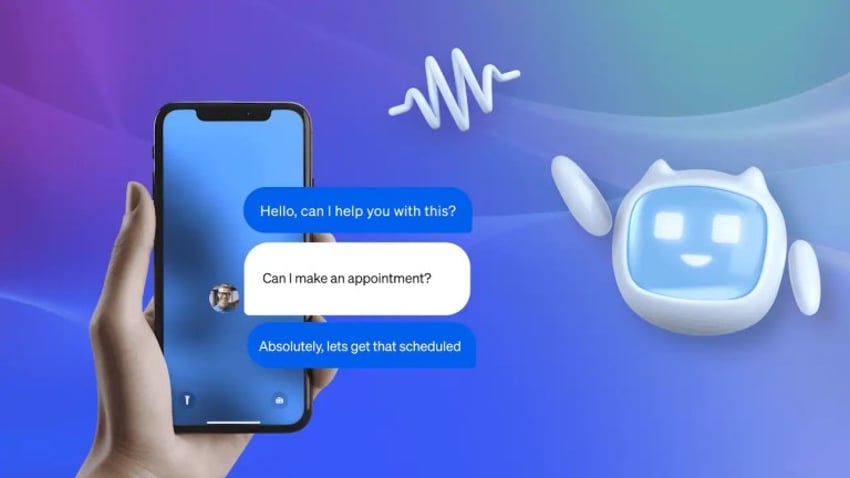
AI Voice Agents: The Smarter Way to Serve More Clients 24/7
AI voice agents turn missed calls into meaningful conversations, respond instantly, perform tasks accurately, and share detailed context when human help is needed, all without asking customers to wait in line or needing human agents to forfeit their time to basic inquiries.
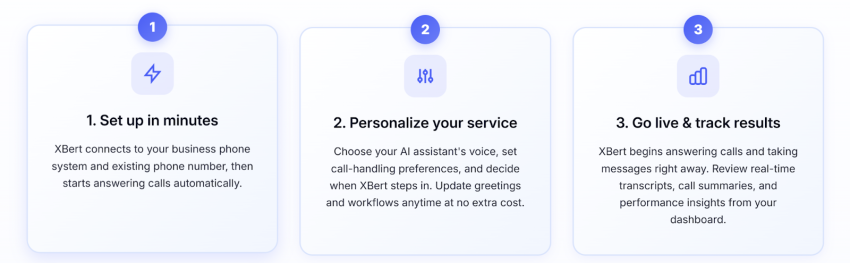
The right deployment pays for itself by capturing after-hours demand, improving conversion, and reducing operational costs — all while delivering a consistent, on-brand experience.
Nextiva makes this attainable today with XBert AI, a solution designed for the hybrid workforce.
XBert doesn’t try to replace your team; it protects them. It acts as the frontline defense, handling the high-volume, repetitive calls that clog up phone lines while ensuring complex, high-empathy conversations are instantly routed to your human experts.
With Nextiva, you get more than an AI bot; you get a unified ecosystem where call recordings, transcripts, and customer history live in one view, ensuring that regardless of whether a customer talks to XBert or a human, your business never loses context.
Ready to introduce self-service to your business? Try Nextiva XBert here. 👇
Your AI agent that never misses a call.
XBert is your AI answering service that handles calls, texts, and chats 24/7. It greets customers, books appointments, and captures leads while your business grows.