

 Customer Experience
  Blog
Blog  Business Communication
  Leadership
  Marketing & Sales
  Nextiva News
  Productivity
  VoIP
VoIP 

A customer starts a conversation with your brand on live chat. They get partially through their issue before having to step away. A few hours later, they followed up via email. The next day, needing an urgent resolution, they call your support line.
And every single time, the customers have to repeat themselves.
To the customer, this is one conversation with one brand about one problem. But to your team, it becomes three separate tickets in three disconnected systems.
This is not a channel problem. It is a system problem.
Customer expectations have permanently shifted. While most organizations claim to offer omnichannel support, the reality is that their communications remain deeply fragmented. Marketing uses one platform, Sales uses another, and Support uses a ticketing tool completely disconnected from the phone system.
Today, multichannel availability isn’t enough; unification is the new standard. In this guide, we’ll break down why unified customer communications is the true connective tissue of the customer experience, and how bringing your channels together drives efficiency, loyalty, and revenue.
What Is Customer Communications?
Customer communications cover every interaction between a business and its customers across the full lifecycle: awareness, consideration, purchase, onboarding, support, and retention.
This scope goes well beyond customer service. It includes marketing messages, sales conversations, support interactions, billing notifications, proactive outreach, and automated updates. Every touchpoint where a customer hears from you or reaches out to you falls under this umbrella.
Customer communication management (CCM) is the discipline of coordinating all these interactions. A modern CCM solution brings strategy, communication channels, customer data, tools, and teams into one unified system.
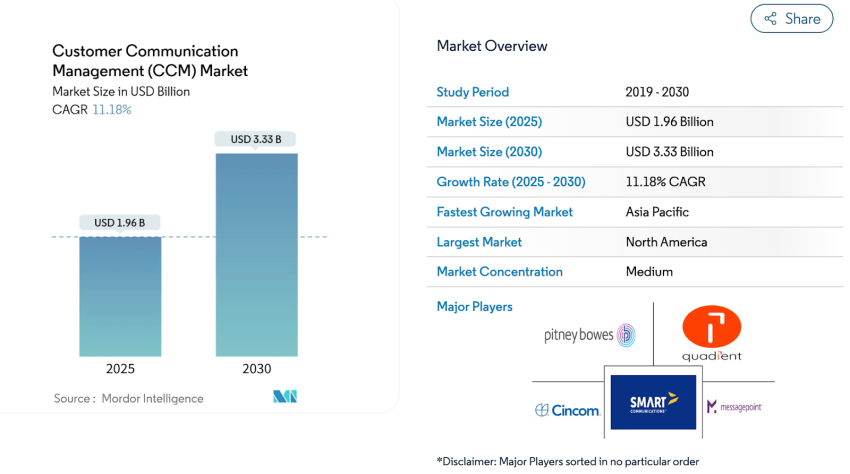
The market reflects how seriously organizations take this. The global CCM market is projected to grow from $1.96 billion in 2025 to $3.33 billion by 2030, at an 11.18% CAGR. The trajectory points in one direction: Businesses are investing heavily in CCM platforms that streamline how they reach customers.
Modern CCM expands beyond static messages. Communications are increasingly interactive: embedded forms, digital signatures, guided workflows, and in-message actions that let customers complete tasks without leaving the notification itself. Think of a billing statement that lets the customer dispute a charge, update payment details, or chat with support, all within the same message.
What it’s not
CCM isn’t customer relationship management (CRM). It’s not a help desk. And it’s not email marketing software. These are individual components of a larger system, not the system itself. Here’s a quick reference:
What is the difference between CCM, a CRM, and a CX platform?
| CCM | CRM | CX platform | |
|---|---|---|---|
| Primary focus | Designing, delivering, and governing communications across channels | Managing customer records, deals, and relationships | Mapping and orchestrating end-to-end customer journeys |
| What it manages | Messages, templates, notifications, documents, and delivery preferences | Contact data, sales pipelines, and interaction logs | Journey stages, feedback loops, and experience metrics |
| What it doesn’t do | Doesn’t replace your CRM or journey mapping tool | Doesn’t coordinate multichannel message delivery or content management | Doesn’t handle document design, compliance, or channel-level delivery |
Some believe in the misconception that if they have a multichannel setup, their communication is managed. Multichannel means you’re present. CCM means these channels are connected. They share customer data, conversation history, and context so the customer receives the right message through their preferred channels at the right point in the customer journey.
Without that coordination, communication turns reactive and inconsistent. Competitors who have figured this out will outperform you.
Why Unified Customer Communications Matters
When companies treat customer communications as a connected system, the impact shows up in retention and revenue. Here’s what the numbers say.
Customers expect continuity
Your customers don’t think in channels. They think in conversations. The average person now uses nine different channels to engage with a single company. When they switch from chat to phone, they expect the context to follow. When it doesn’t, trust breaks.
Data supports this.
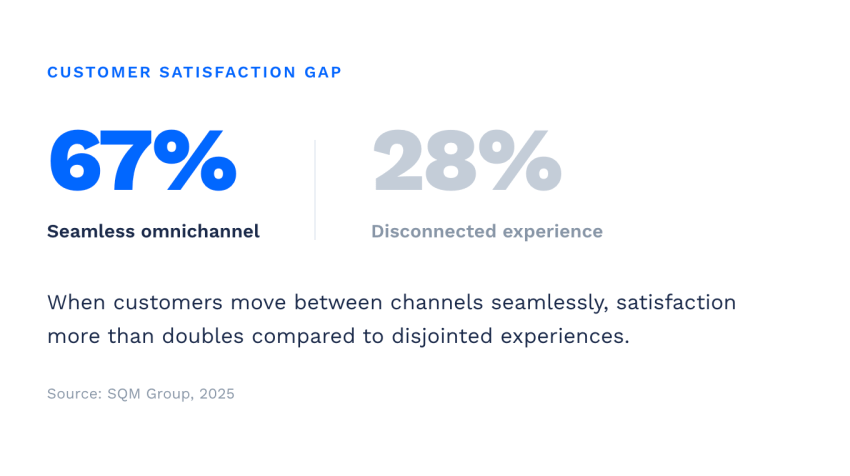
Customers experience at least some context loss when switching channels. If you have heard customers’ complaints about it, it’s not too late to implement an omnichannel communications strategy and improve satisfaction.
Fragmented tools create operational drag
When agents toggle between four or five systems to help a single customer, the problems stack up fast:
- Duplicate data entry: Support teams manually enter the same information across ticketing, CRM, and voice platforms.
- Incomplete customer profiles: No single system holds the full picture.
- Conflicting information: Marketing says one thing, Sales promises another, and Support can’t see either.
- Reporting blind spots: Leaders pull metrics from separate dashboards that never quite align.
According to 80% of companies, the biggest barrier to true omnichannel communication is the lack of unified functionality. That’s from a survey of 300 senior leaders.
The downstream effects are real. Fragmentation increases handle time, lowers first contact resolution (FCR), and frustrates everyone involved.
Unified communications improves key metrics
Companies using integrated omnichannel solutions resolve issues 31% faster and cut customer wait times by 39% (Zendesk, 2025). Moreover, retention is where it gets striking. Brands with strong omnichannel strategies retain 89% of customers. Those without retain 33%.
A clear overview of what makes the most sense for customer communications.
| Metric | Unified approach | Fragmented approach |
|---|---|---|
| Customer satisfaction | 67% | 28% |
| Customer retention | 89% | 33% |
| First-resolution time | 31% reduction | Baseline |
| Customer wait time | 39% decrease | Baseline |
Depending on this, it makes more sense to implement an omnichannel customer communication strategy.
Core Customer Communication Channels
Here’s what most guides won’t tell you: Adding channels might worsen your CX. If each new channel creates another disconnected silo, you’re not expanding access, you’re multiplying friction.
An effective omnichannel strategy for customer communication is less about being on every channel and more about creating seamless, connected experiences.
Phone
Voice is still the go-to for complex or emotionally charged issues. It lets customers solve problems in real time with a human who can read tone and adapt. Text-based channels can’t match that kind of nuance. When Gen Z consumers hit a problem they can’t solve on their own, 70% still prefer picking up the phone.
Modern voice support needs more than a dial tone. Your phone system should route callers intelligently, pull up their CRM profile before the agent says hello, and feed real-time analytics back to supervisors. Without this, calls become expensive dead ends. Your customer should reach the right agent based on their history and needs, not just whoever’s available next.
Email shines when the conversation needs depth. This is where customers get detailed explanations, written documentation, and the time to process information at their own pace. This makes it a natural fit for onboarding sequences, billing updates, recurring notification templates, and follow-ups.
When email lives in a silo, cut off from phone and chat interactions, support teams lose critical context. Customers end up explaining themselves again.
Live chat and messaging
Live chat and SMS used to be nice extras. Now they’re expected. Messaging apps are right behind them: 40% of businesses plan to invest in live chat, 29% in SMS, and 27% in in-app messaging for customer support.
Speed is the whole point. Customers expect near-instant responses. When they don’t get them, or when they have to start over because the chat agent can’t see their earlier phone call, the experience falls apart.
Chat and messaging need seamless escalation to voice when needed. A customer who started in chat shouldn’t have to re-explain their problem after transferring to a phone agent.
Shep Hyken, a customer service expert, puts it plainly:
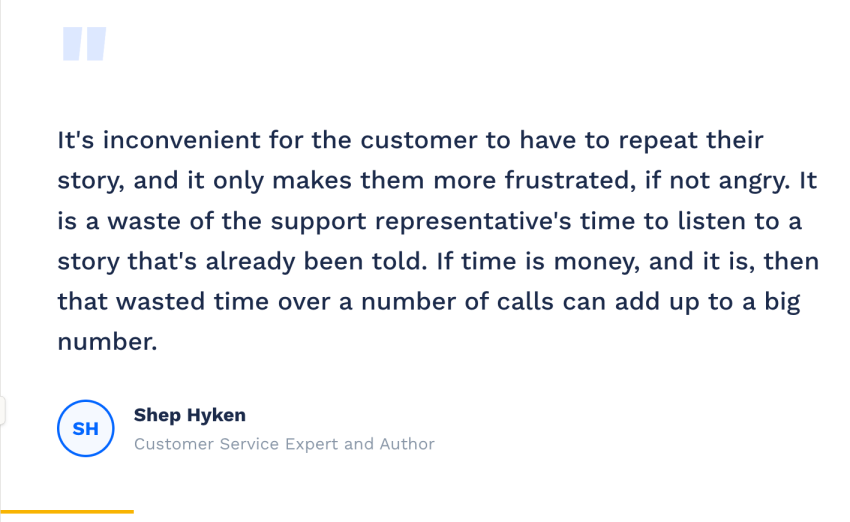
The handoff requires a unified messaging system where context travels with the customer.
Social media
Social media is unique because customer interactions happen in public. A complaint on X or a comment on Instagram is visible to hundreds or thousands of potential customers. This makes it both a customer support channel and a reputation management channel.
Social listening integration matters here. When your brand detects a complaint on social media, routes it to the right agent, and resolves it in real time, a public problem becomes a public win. Without that integration, your social media team operates in a silo, cut off from the customer history your support team already has.
Self-service
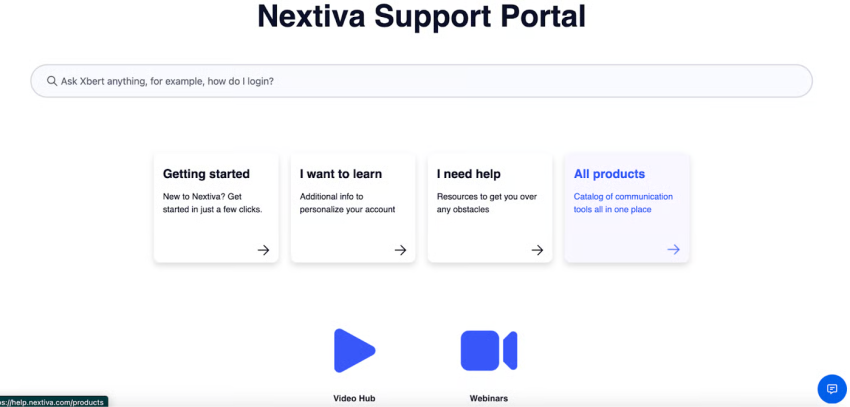
Knowledge bases, FAQs, and customer portals let customers resolve issues on their own. This cuts ticket volume for support teams and gives customers the on-demand speed they want.
But self-service only works when it integrates with live support. If an FAQ article doesn’t solve the problem, the customer should be able to escalate to a live agent who already knows what they’ve tried. Otherwise, self-service just adds another disconnected step to the experience.
Proactive outreach
Most of the channels above are reactive. The customer reaches out, and you respond. But the strongest customer communication strategies also work the other direction.
Proactive communications look like order status updates sent before the customer checks in. Renewal reminders that arrive a week early. Service disruption alerts that go out before anyone calls to complain. Appointment confirmations that reduce no-shows. These are the touchpoints that reach the customer before they need to pick up the phone.
Done well, proactive outreach cuts inbound ticket volume. It builds trust. It turns routine touchpoints into retention moments.
AI-powered interactions
Interest in customer-facing conversational generative AI is high, with 85% of customer service leaders planning to explore or pilot it in 2025.
AI is no longer optional for scaling customer communications. But it comes with a responsibility: transparency. Customers want AI that’s fast, accurate, and honest about what it is. By 2029, Gartner predicts agentic AI will resolve 80% of common service issues without human intervention, cutting operational costs by 30%.
The Role of AI in Modern Customer Communications
AI is changing how businesses handle customer interactions at every stage. But its value depends entirely on how thoughtfully you deploy it. If your data is fragmented and your channels are siloed, AI will automate that fragmentation, not fix it.
AI for immediate response
AI can handle the front line of customer communications at scale. It answers common questions and routes calls to the right department. It schedules appointments and captures lead information. All of this happens without a human agent getting involved.
But here’s the nuance: AI works best as the first line of support, not a replacement for humans. A March 2025 Gartner poll found that 95% of leaders plan to keep human agents. Gartner also predicts that by 2027, half of organizations will expect to significantly reduce their service workforce because AI will reverse course. AI frees agents to focus on complex, high-value conversations where empathy and judgment matter most.

AI for context and insight
Beyond answering questions, AI adds a layer of intelligence to every customer interaction:
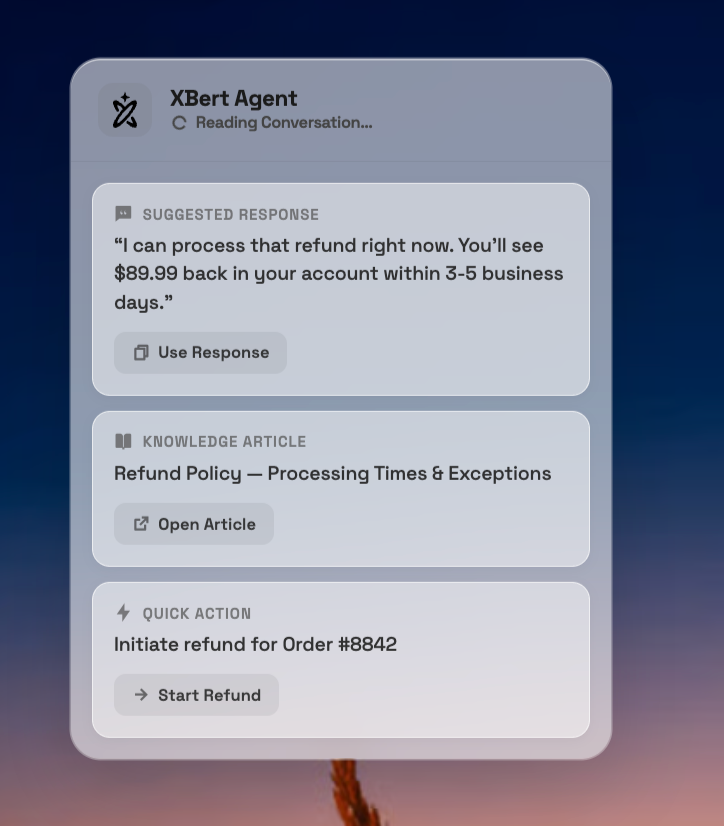
- Conversation summaries: AI gives agents a brief on everything the customer has already discussed, so no one asks the customer to start over.
- Sentiment analysis: AI detects frustration, satisfaction, or urgency in real time to help prioritize and route interactions.
- Real-time coaching: AI prompts agents with suggested responses or flags compliance risks during live conversations.
- Predictive routing: AI matches customers to agents based on past interaction patterns and predicted customer needs, rather than relying on basic skill-based routing.
These capabilities augment agents. They don’t replace them.
AI for 24/7 availability
Missed calls and after-hours gaps are among the biggest sources of lost revenue for service-based businesses. Your customers don’t limit their needs to business hours.
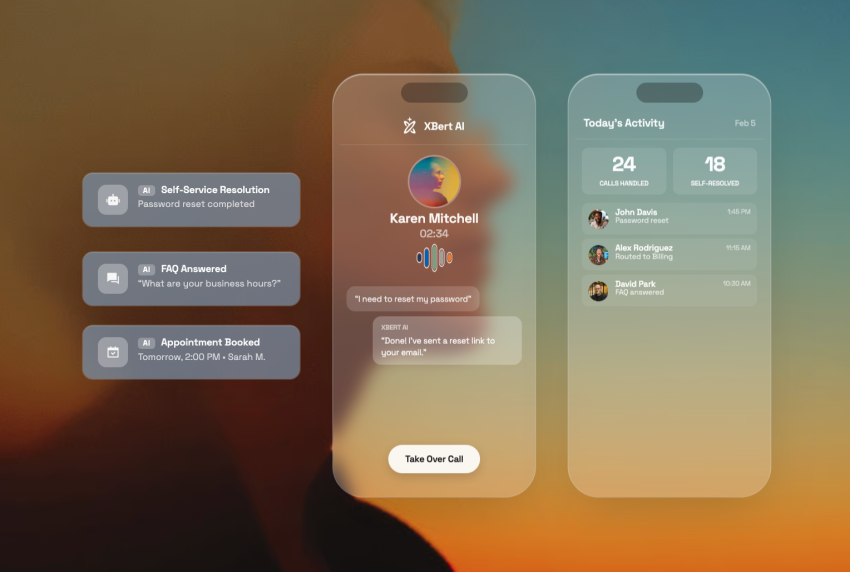
Modern AI receptionists solve this. Nextiva’s XBert AI answers calls, texts, and chats around the clock. It handles multiple conversations at once. It schedules appointments through real-time calendar integration. You get to capture lead information and route complex issues to human agents with full conversation context.
AI receptionist ROI calculator:
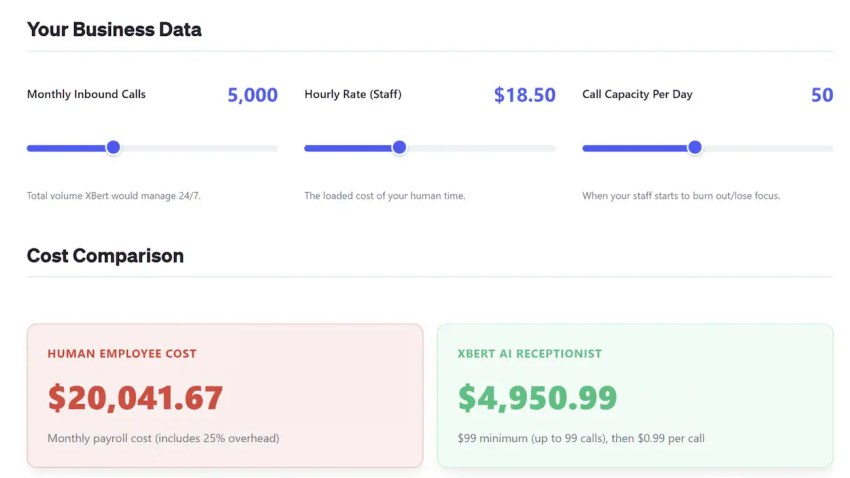
Run your numbers to see an estimate of how much missed calls cost you.
XBert learns from your website and business documents, so content creation for your AI assistant is minimal. If you’re exploring this category, Nextiva’s guide to automated answering services covers how AI receptionists compare to traditional options.
What makes XBert different from a disconnected chatbot is that it runs inside Nextiva’s unified platform. Every interaction, whether by voice, SMS, or web chat, is logged in a single shared conversation history. If a customer chats with XBert at midnight and calls your team the next morning, the agent already has the full context.
Signs Your Customer Communications Aren’t Unified
Before you can fix fragmentation, you need to spot it.
If these signs sound familiar, your customer communication strategies likely have structural gaps.
- Customers repeat themselves: They switch from chat to phone and have to restart their story. Your systems aren’t sharing context.
- Agents lack full customer history: A support rep can’t see previous purchases, open tickets, or recent marketing interactions. Every conversation starts from scratch.
- Customer data lives in multiple systems: You’re paying multiple vendors for voice, chat, and CRM, andeach provider creates its own data silo. More tools, more gaps.
- Reporting requires manual consolidation: If pulling a report means exporting from three platforms and merging them in a spreadsheet, you don’t have a single source of truth.
- After-hours calls go to voicemail: Every unanswered call is a potential customer choosing someone else. Nextiva’s missed calls calculator can help you put a dollar figure on that.
- Response times vary wildly by channel: When different channels are managed by different teams with different tools, the user experience feels inconsistent.
If three or more of these resonate, the problem isn’t the individual tools. It’s the lack of connection between them.
Building a Unified Customer Communications Strategy
Moving from fragmented tools to a unified platform isn’t a one-day project. But it doesn’t have to be an 18-month overhaul either. Here’s a practical road map for business users and IT leaders evaluating their next move.
Audit your current stack
Start by mapping every tool your organization uses across voice, messaging, CRM, ticketing, and analytics. Where does data flow freely? Where does it stop? Look for redundancies (e.g., two teams using different chat tools) and integration gaps that trap customer data in silos.
If your stack includes five or more disconnected tools, you’re likely overpaying for functionality that a unified communications company could consolidate into one platform.
Centralize customer data
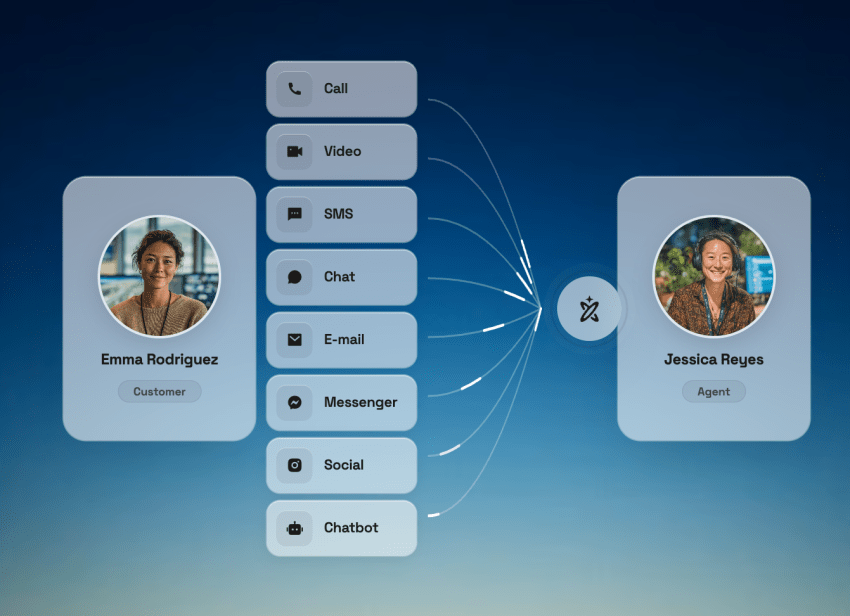
Everything hinges on a 360-degree view of the customer. When every team, from Marketing to Sales to Support, sees the same customer profile, personalized communication becomes possible at scale.
You can’t personalize at scale when customer data is scattered across five different systems. A unified CXM platform integrates with your existing tools and addresses this at the infrastructure level.
Align teams around shared visibility
Marketing, Sales, and Support can’t operate from separate systems and deliver a consistent customer experience. They need shared access to the same conversation history, CRM data, and dashboards.
This isn’t just a technology decision. It requires cross-functional agreement on how customer data gets captured, updated, and acted on. When a marketing campaign sends a prospect to the sales team, and that prospect later needs support, every handoff should feel seamless.
Introduce automation thoughtfully
Start with high-impact, low-risk automation:
- Intelligent routing: Send customers to the right agent based on inquiry type, history, and urgency.
- AI-assisted FAQs: Let AI handle common questions so agents can focus on the complex issues that need human judgment.
- Appointment booking: Automate scheduling, confirmations, and reminders with calendar sync.
- Call summaries: Use AI to generate post-interaction summaries. Agents spend less time on documentation and more time on the next customer.
Consider this flow: A customer starts on live chat, asking about a billing discrepancy. The AI assistant pulls up their account, identifies the issue, and resolves it. The customer requests an email confirmation and receives a follow-up that references the exact chat. Two days later, they called about an unrelated product question. Because the system is unified, the live agent already sees the full history.
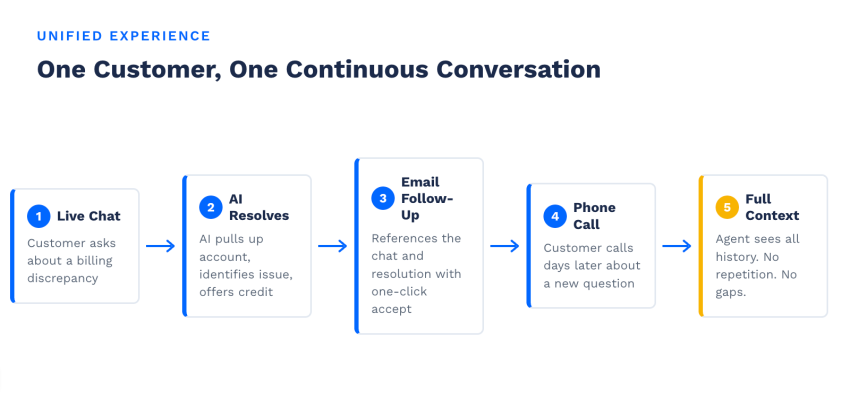
This is what happens when every channel shares the same customer record. Every tool feeds the same inbox, and AI handles the context-passing that humans used to do manually.
Measure what matters
The metrics you track shape how your teams behave. Focus on these:
| Metric | What does it tell you? |
|---|---|
| First response time | How quickly you acknowledge a customer’s issue |
| FCR | How often do you solve it in a single interaction |
| CSAT | Overall customer satisfaction after an interaction |
| Channel switching rate | How often do customers have to change channels to get help |
| Interaction volume by channel | Customer preferences on where they’d like to engage |
| After-hours conversion rate | Revenue captured outside business hours |
Track these across all channels in one place. A unified CCM platform gives you this visibility in a single view. For benchmarking, Nextiva’s CX Trends report offers data from over 1,000 CX leaders. It’s a solid white paper for internal planning.
Unify Your Communications With Nextiva
Nextiva’s unified-CXM platform brings every conversation into one AI-powered workspace, not as disconnected add-ons, but as a single system of record. The platform includes intelligent routing and real-time analytics. It generates conversation summaries automatically. And its unified inbox keeps support teams aligned across every channel.
For after-hours coverage and front-line automation, XBert AI answers calls and books appointments. It captures leads and hands off complex issues with full context. It works across voice, SMS, and chat from the same platform. Nothing falls through the cracks. Nextiva backs all of this with 99.999% proven uptime and 24/7 support.
Equip your team with Nextiva. Respond faster. Never miss an opportunity that is yours.
A New Dawn in Customer Experience
The complete customer experience platform. Win every conversation, measure every interaction, and use AI to optimize every customer journey. Grow your business without working harder.