
 Customer Experience
  Blog
Blog  Business Communication
  Leadership
  Marketing & Sales
  Nextiva News
  Productivity
  VoIP
VoIP 

Customers expect more from support than ever before. They favor brands that can deliver personalized, omnichannel, and fast support.
Fortunately for brands, this doesn’t have to be exclusively human support. Self-service options have become increasingly popular with customers, and they are more accessible than ever for businesses of all sizes to create and maintain.
With options ranging from knowledge-base articles to AI-powered bots, there are many ways to meet customer needs. And, as our 2025 report found that 60% of respondents believe centralized customer service is key to strong customer experiences, it’s clear that self-service solutions play a critical role in improving CX across the board.
I’ve seen firsthand how brands that enable customers to resolve their own issues experience higher customer satisfaction scores, higher retention rates, and reduced burden on their support teams.
In this post, you’ll learn how to put the right technology, escalation protocols, and strategies in place so you and your customers can realize these same benefits.
What Is Customer Self-Service?
Customer self-service is the ability for customers to access the information and functionality they need to resolve their own issues. The goal is to complete repetitive tasks independently, quickly, and conveniently, all without speaking to a customer service agent
While customers will happily jump on the phone for urgent or complex issues, they’re increasingly turning to self-service content and other options first. They’d much rather resolve their own problems and have access to 24/7 support.
It’s important to note that this is not about removing humans or cutting back on staff. Humans still and always will play a critical role in the customer experience, especially when someone needs an in person interaction.
The goal is to help customers manage “low-hanging fruit” challenges and get answers to frequently asked questions themselves. This frees your live support agents to handle higher-value and higher-stakes interactions.
Why Customer Self-Service Matters
Customer self-service support matters more now than ever before. Here’s why.
Customer expectations have changed
Today’s customers want fast, always-on answers for their routine needs. And by fast, I mean instantaneous; they expect to access services across multiple channels whenever they want.
Most customers prefer self-service to solve simple issues themselves because it provides quick access to answers instead of waiting even a few minutes on hold. They want real-time solutions. And, even though phone support still reigns supreme for complex issues, younger generations are increasingly looking for other options first.
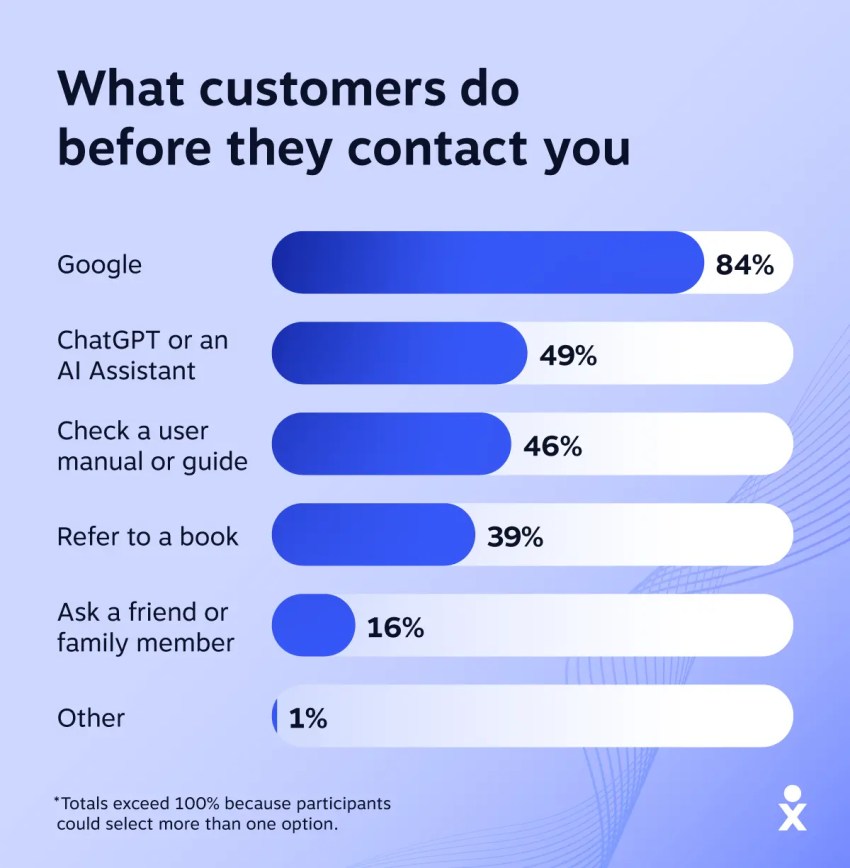
Gen Z, for example, still uses phone calls for support, but typically after they’ve tried to solve the issue themselves. 84% start the process on Google, and 49% say they check for an AI assistant before they pick up the phone. Speed and convenience are undeniably key reasons for this.
Support teams are under pressure
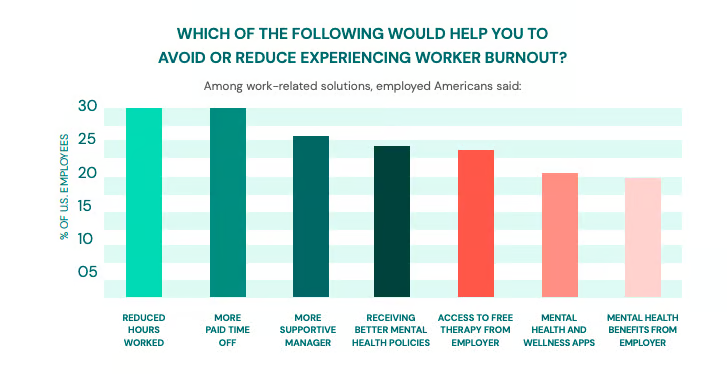
As most businesses are constantly trying to optimize their resources, many have experienced the challenge of a rising ticket volume without a matching headcount. When this happens, service agents feel rushed and face burnout, while customers have longer wait times and potentially worse support quality.
It can become a downward spiral that’s difficult to break out of.
That’s where self-service solutions shine. It helps control operational costs, improves operational efficiency, and reduces the overall load of customer questions, freeing up a significant burden from already-busy customer support staff.
With the load lightened, only the most complex issues need human support. Agents face less burnout, ensuring customers have reduced wait times, and you retain both employees and clients longer.
Self-service improves CX (when done right)
Thorough, useful self-service solutions can improve CX in multiple ways (when executed correctly). These are the telltale signs of a successful system:
First: faster resolution. When a customer can find the answer to their question in under a minute through a knowledge base article or chatbot, that’s a win that no phone queue can compete with. Self-service portals can resolve everyday customer issues up to three times faster than traditional customer service channels.
Second: less friction. Customers don’t have to explain their problem to someone, wait on hold, or navigate a transfer. They just find what they need and move on.
Third: more control. This one tends to be undervalued. Customers want agency over their own experience. Customer experience automation gives them exactly that. It puts the power back in their hands and on their schedule.
The downstream effects are significant. When you surface relevant information at the right moment, you improve customer satisfaction scores by creating more satisfied customers and drive improved customer loyalty. And when satisfaction goes up consistently, so does customer retention, which also helps businesses grow.
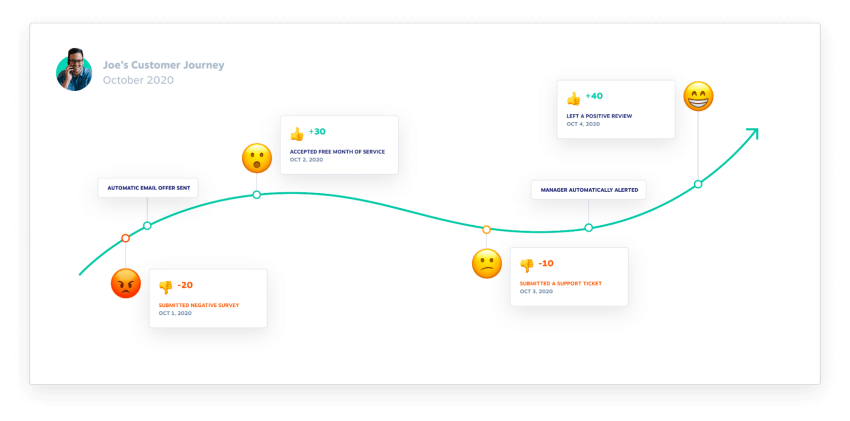
Core Types of Customer Self-Service Channels
When you think of self-service, what’s the first thing that pops to mind?
Is it an interactive voice response (IVR) system that allows you to pay your bill without direct assistance or speaking to an agent? A step-by-step video tutorial for troubleshooting? An AI-powered chatbot?
There are clearly multiple different customer self-service channels that brands need to account for when offering digital support. Let’s explore each one.
Knowledge bases and FAQs
Knowledge bases are foundational to self-support. While digital resources are the primary focus today, many organizations once relied heavily on printed materials for customer support.
Today, articles, guides, and troubleshooting content are designed to answer the questions your team fields most often. This may include walkthroughs, video tutorials, how-to guides for common issues, and other interactive features can make complex topics easier to understand.
The key is keeping this content easy to search, scannable, and current. A prominent search bar and intuitive search function help customers quickly locate relevant resources, detailed articles, and information.
Outdated knowledge base articles don’t just fail to help; they can actively erode trust. If a customer follows your instructions and they’re wrong, you’ve only made the problem worse.
AI chatbots and virtual assistants
Chatbots offer conversational access to answers and workflows. They work best when they’re guiding users to the right resource or helping them complete a next step, and not when they’re trying to replace a human.
The best AI chatbots are grounded in your actual company knowledge. Generic chatbot responses frustrate customers. But when a bot is pulling from your real documentation and product data, it can function as a genuinely useful after-hours answering service.
Customer portals
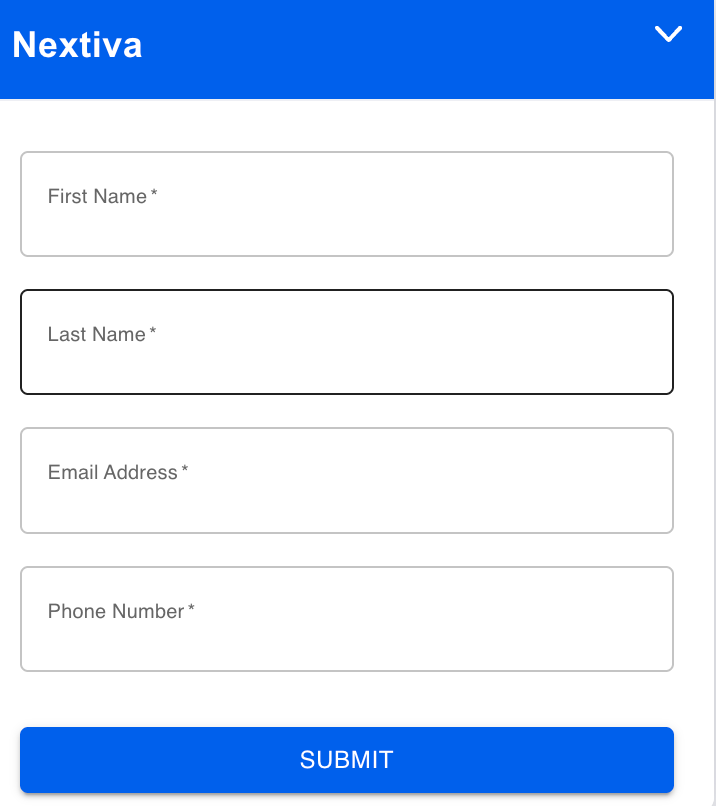
A customer self-service portal is an authenticated space where customers manage their own accounts. Order tracking, billing updates, and ticket status checks, for example, generate massive volumes of repetitive tickets when customers can’t manage them independently.
An effective self-service portal works best when it’s personalized. The best portals combine strong self service capabilities with intuitive access to account information and support resources. Customers should be able to view account details, purchase history, and support activity from a single online platform.
Showing a customer their specific order status or open support ticket upon login is useful. Dropping them into a generic dashboard with no context? Not so much. An effective self service platform should present relevant information immediately.
Community forums
For software companies and brands with complex products, community forums offer something unique in the form of peer-to-peer support and shared expertise. They help businesses gather valuable data about customer behavior, recurring issues, and emerging support trends.
Of course, there is a tradeoff. Forums require moderation and curation. Left alone, they become a graveyard of outdated advice. Done right, they’re a rich source of customer feedback and knowledge, and a powerful extension of your support ecosystem.
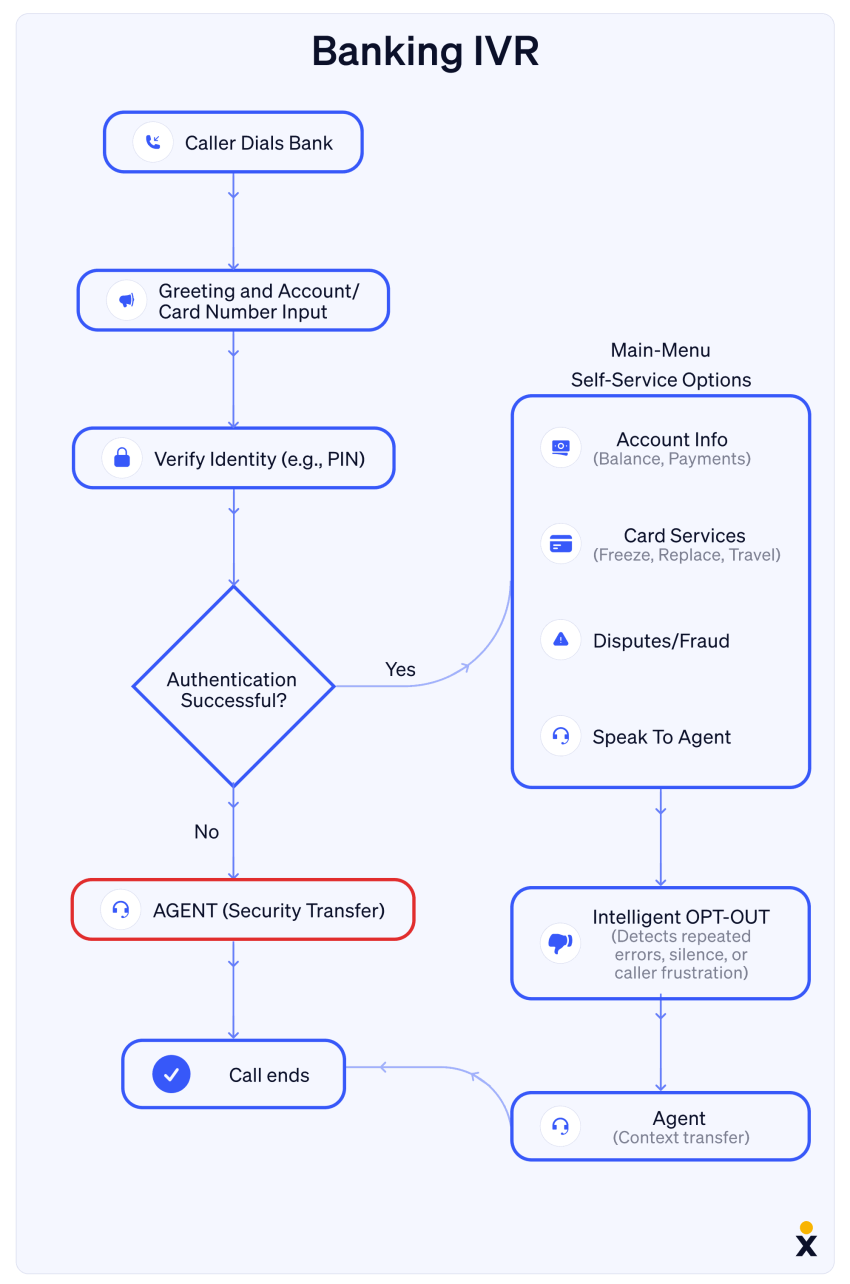
IVR and phone-based self-service
Phone-based self-service gets overlooked in a lot of digital-first strategies. But, for many businesses, calls are still a primary support channel. Traditional IVR systems handle status checks, routing, and simple requests.
However, advanced IVR systems are increasingly using AI voice systems that understand natural language. Instead of forcing callers through rigid menu trees (e.g., “Press 1 for billing, press 2 for technical support…”), modern IVR can actually listen to what the user needs and route them accordingly.
How to match the right channel to the right issue
Different customer issues require different self-service experiences. Customers checking an order status don’t need the same support path as someone troubleshooting a product or looking for expert advice. The most successful self-service strategies align the complexity of an issue with the right support channel.
| Self-service tier | Best for | Primary technology | Key success metric |
|---|---|---|---|
| Customer portals | Password resets, order tracking, billing updates, account management | Customer portal, CRM integrations | Portal adoption rate |
| Conversational self-service | FAQs, appointment scheduling, status updates, call routing | AI chatbots, AI voice assistants | Self-service resolution rate |
| Knowledge-driven self-service | Product setup, troubleshooting, policy questions | Knowledge bases, video tutorials, AI search | Search success rate |
| Community support | Advanced workflows, product expertise, best practices | Community forums, peer support | Answer rate and engagement |
This framework helps businesses direct customers to the most effective self-service option for their needs instead of depending on a single channel to handle every type of request.
Benefits of Customer Self-Service
The case for self-service solutions gets clearer the more you see it play out in practice. Here are the significant benefits of what it actually delivers:
- Lower support costs by deflecting routine tickets: When common customer issues are resolved before they ever reach an agent, it reduces support costs, creating measurable cost savings while improving service delivery.
- Faster resolution for customers: As customers can resolve more issues on their own, it frees up agents to resolve more complex scenarios faster.
- 24/7 availability without staffing shifts: Self-service never clocks out. Your customers get support around the clock without the need for additional staffing.
- Better use of human agents for complex or emotional issues: When your team isn’t buried in password resets and order status checks, they can give real attention to the interactions that actually need a human touch.
- More consistent answers across channels: Every customer gets the same accurate response whether they’re on chat, your knowledge base, or your phone system, allowing for consistent, streamlined, and omnichannel experiences.
- Empowering users: Self-service focuses on empowering users to solve routine issues independently and manage their own accounts.
Common Customer Self-Service Use Cases
Self-service touches nearly every stage of the customer journey. Here’s where it has the biggest impact.
Order and account management
Order and account management is typically the highest-volume category and a high-priority use case. Customers often access these services from a mobile device, making convenience even more important.
Order status checks, returns, and refunds, and updating personal information are all tasks that customers want to handle on their own schedule, not yours. These issues can also significantly chew up your agents’ time, even though the administrative tasks themselves are straightforward.
Troubleshooting and how-to
Troubleshooting and how-to content includes product setup instructions, common errors and fixes, and product usage guidance. Clear instructions can help customers resolve an error message without contacting support.
My rule of thumb: If your support team answers the same question more than a handful of times a week, it belongs in your self-service library.
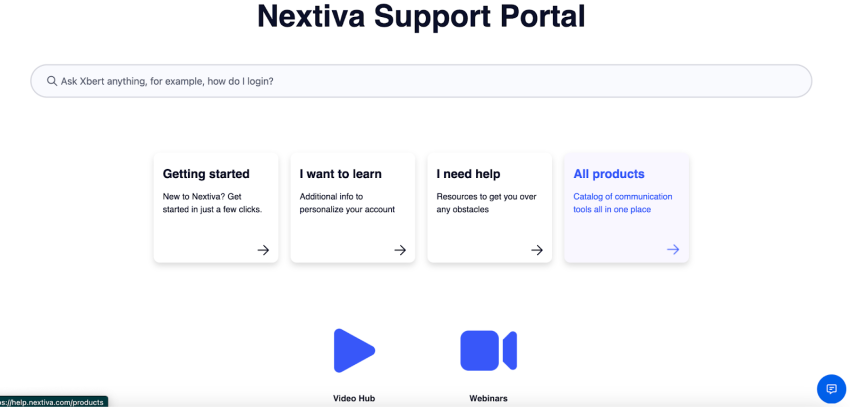
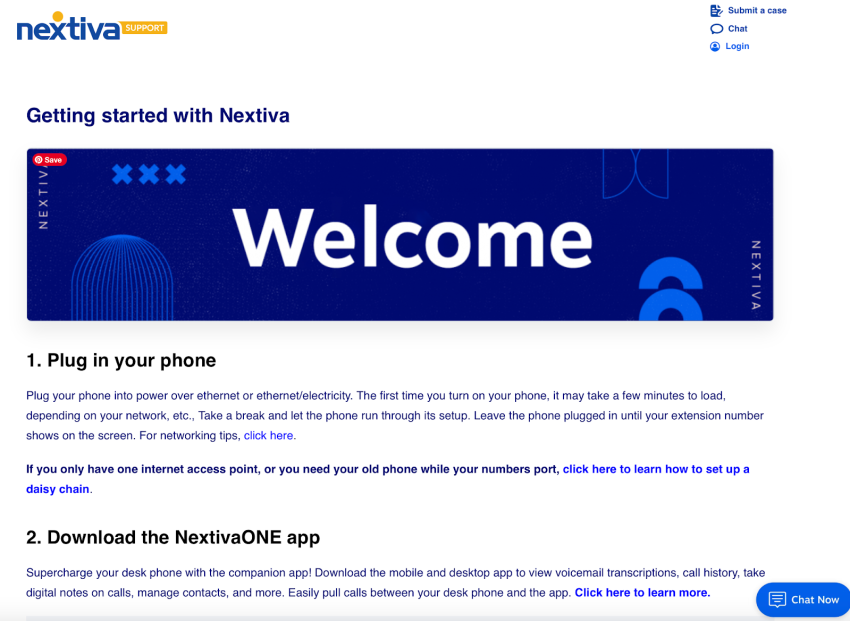
Here at Nextiva, for example, we have extensive online support documentation, including setup guides. Users can find these resources by searching on Google or on our site.
You’ll notice that, while the guides provide users step-by-step information through different processes, there are always multiple other support options (including live chat and submitting a case) if the customer still needs help.
Appointment and scheduling requests
Appointment and scheduling requests are a natural fit for automation. Booking, rescheduling, and confirmations can be handled without a live agent, and automating these requests reduces the back-and-forth that makes scheduling feel more painful than it needs to be.
Status updates and simple questions
Status updates and simple questions round out our use cases. Customers will ask about business hours, pricing basics, and policy details. This kind of information should never require a phone call, and clients want it to be easily accessible.
Best Practices for Implementing Customer Self-Service
Self-service strategies and tech should be implemented carefully, with all the key features in mind. They should strike the right balance between accessible and useful without losing the personal touch that defines great support. Here are some recommended best practices.
Keep it simple
This sounds basic, but it’s where most strategies fall apart. Opt for clear navigation, plain language, and minimal steps. If a customer has to click through four pages to find a return policy, you’ve already lost them.
Design for search first
Your internal search has to work well. If customers can’t find what they need within your self-service resources, they’ll leave or call your support line neither of which is the outcome you’re going for.
A user-friendly experience should make answers easy to find regardless of whether customers search your website, knowledge base, or other digital channels.
Where it makes sense, optimize your content for external search too. A lot of customers (and 84% of Gen Z) start their support journey on Google rather than your website. If your help articles rank, you’re catching them earlier in the process.
Use AI to scale content
AI technology can help you generate and update help desk articles faster, identify content gaps, and flag outdated material before it becomes a problem. This is especially valuable if your team manages a large help desk with hundreds or even thousands of articles.
The volume of content needed to run an effective self-service program is significant, and most teams simply can’t keep up manually. AI doesn’t replace your subject matter experts, but it accelerates their work dramatically.

Connect self-service to your CRM
When your self-service tools are connected to your CRM, your software can personalize responses based on a customer’s history. That alone is valuable.
But the bigger win is preserving context when someone needs to escalate. If a customer spends 10 minutes in your self-service portal and then calls your support agents, they shouldn’t have to start over from scratch. Instead, the context should travel with them to reduce frustration and decrease customer effort scores (CES).
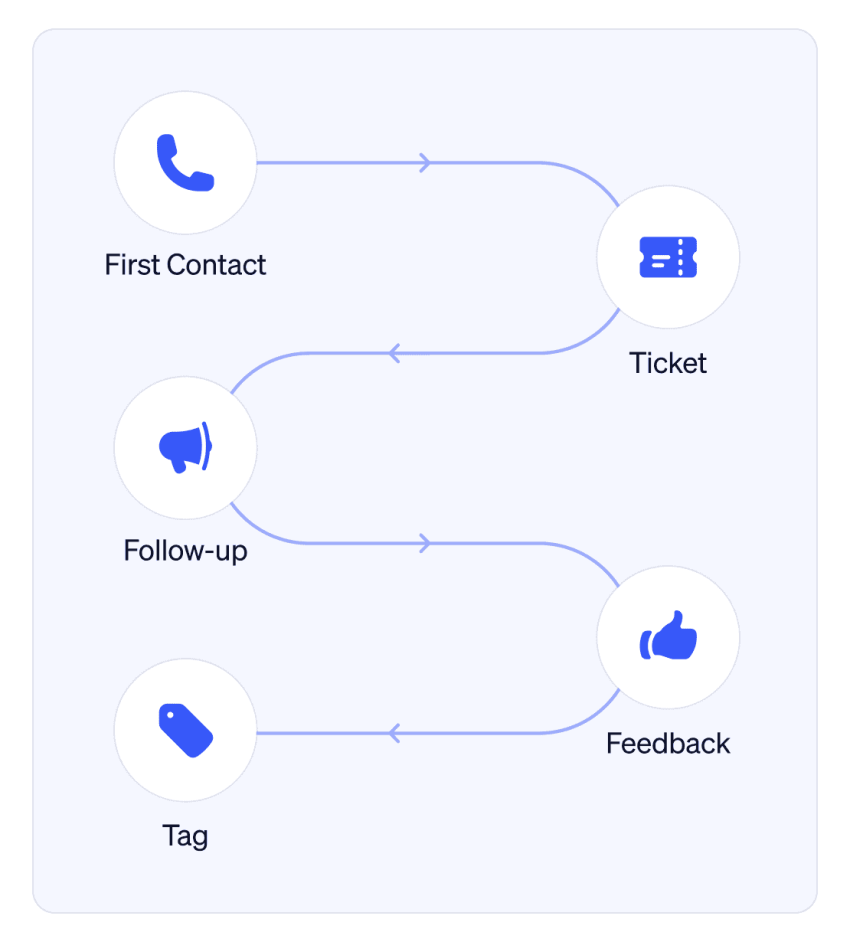
Three integrations play a critical role in creating a seamless self-service experience. Many organizations manage these connections through a centralized platform that keeps customer information synchronized across channels.
- Customer information: As soon as customers log in, your self-service tools should recognize their account information, active subscriptions, purchase history, and previous support interactions. This context allows systems to deliver more relevant and personalized support from the start.
- Shared knowledge: Your knowledge base, AI chatbot, AI receptionist, and support agents should all pull information from the same database. When every channel accesses the same content, customers receive consistent answers no matter where they seek help.
- Agent handoff: When customers move from self-service to a live agent, the system should automatically transfer conversation history, customer details, and completed troubleshooting steps. Agents can then continue the interaction without forcing customers to repeat information they have already shared.
Always offer an escape hatch
This is the one I care about most. Always make it easy to reach a human. Self-service should reduce frustration, not create it. I cannot stress this enough.
While automation can resolve many routine requests, some situations require personalized assistance.
- Transfer customers to a live agent after multiple unsuccessful attempts to understand their issue.
- Offer agent assistance when customers repeatedly ask to speak with a person.
- Route interactions to a live agent when chat or voice systems detect signs of frustration.
- Immediately involve an agent for sensitive billing, account security, legal, or customer retention concerns.
As of December 2023, only 14% of customer service and support issues are fully resolved in self-service. Even for issues customers describe as “very simple,” only 36% resolve fully without human help.
We’ve seen that metric improve for brands that adopt the right customer self-service tools and integrate AI-powered services, but the reality is that most self-service interactions still need an exit ramp.
Your escalation protocols matter just as much as your self-service content. Support agents should always be one click or one sentence away. Nothing drives customers away faster than feeling trapped in a loop with no way out.

How to Measure Customer Self-Service Success
You can’t improve what you don’t measure. Here are the metrics that matter:
| Metric | What it measures | Formula |
|---|---|---|
| Self-service resolution rate | Percentage of self-service sessions resolved without agent assistance | Successful self-service sessions ÷ Total self-service sessions × 100 |
| Ticket deflection rate | Percentage of support requests avoided through self-service | Deflected tickets ÷ total potential support requests × 100 |
| Customer satisfaction (CSAT) | Percentage of customers satisfied with a self-service interaction | Positive survey responses ÷ total survey responses × 100 |
| Customer effort score (CES) | Average ease of resolving an issue | Sum of all CES ratings ÷ Total responses |
| Time to resolution (TTR) | Average time required to resolve an issue | Total resolution time ÷ total resolved issues |
Beyond these metrics, businesses should also monitor search success rates and knowledge base article effectiveness. Together, they help you strengthen customer relationships, streamline your operations, and build a self-service experience that actually earns trust over time.
How to Keep Self-Service Content Accurate and Up to Date
As products, policies, and customer needs change, your knowledge base, FAQs, chatbot responses, and customer portal content must evolve as well.
A simple review process can help you keep content accurate, close information gaps, and prevent outdated resources from generating unnecessary support tickets.
Weekly (identify content gaps)
Review internal search data to find queries that return poor results or no results at all. These searches often reveal topics customers need help with but cannot easily find.
Use these insights to create new articles, update existing content, or improve searchability.
Monthly (review content performance)
Evaluate knowledge base performance using metrics such as article views, search success rates, customer feedback, and self-service resolution rates.
Look for content that consistently underperforms and update it to improve clarity, accuracy, and usefulness.
Quarterly (align content with support trends)
Analyze support tickets, chatbot conversations, and customer feedback to identify recurring issues.
Look for opportunities to reduce support demand by creating new knowledge base articles, expanding self-service workflows, improving AI responses, or adding new functionality to customer portals and employee portals.
By reviewing content on a regular schedule, you can keep self-service resources relevant, improve resolution rates, and help customers find answers before they need to contact support.
Common Self-Service Mistakes to Avoid
Self-service can be incredibly effective, but to preserve the customer experience, it’s important to avoid these common mistakes:
- Outdated or inaccurate content: Wrong content will frustrate customers and cause distrust.
- Over-automation with no human fallback: In many cases, customers who start with chatbots will still need human assistance, so there needs to be a clear path to that help.
- Treating self-service as a cost-cutting exercise only: Yes, self-service can reduce costs. But if you only see it as a cost-cutting measure, you’ll underinvest and end up with a tool nobody uses.
- Ignoring phone-based self-service experiences: Customers are still reaching for their phones for urgent or complex issues, so you can’t afford to ignore AI phone assistants.
- Failing to measure what customers actually use: Without real usage data, you’re guessing at what to improve (and those guesses can be wrong).
How AI Improves Customer Self-Service
In our 2025 report, 81% of respondents said their organizations were increasing spending on AI capabilities, either slightly or significantly, to improve the customer experience. Since AI offers expansive benefits as a self-service tool, this makes sense.
First, AI enables conversational access instead of rigid menus. Customers can describe their problem in their own words and get routed to the right resource, whether they’re using an AI answering service or live chat.
It also delivers faster answers without forcing customers to browse through long FAQ pages. Better intent detection means the system understands what someone is actually asking for. Modern AI systems depend on machine learning algorithms to improve accuracy and better understand customer intent over time.
Finally, AI provides consistent responses across channels, so a customer gets the same answer whether they’re on chat, your website, or your phone system. This gives self-service tools the ability to handle multiple requests in a single interaction, something traditional menu-based systems could never do.
The shift from static self-service tools to AI-powered ones isn’t incremental. It’s a fundamentally different experience for the customer. Brands that make this shift are seeing real, measurable gains in both satisfaction and retention.
As AI continues to evolve, self-service is becoming more proactive and action-oriented. Several trends are shaping the next generation of customer support:
- Generative AI search that delivers direct answers instead of lists of articles.
- AI voice assistants that can resolve requests through natural conversations over the phone.
- Personalized support experiences based on customer data, history, preferences, and previous interactions.
- Proactive support that identifies potential issues and surfaces answers before customers need to ask.
- Task automation that allows AI systems to update accounts, process requests, schedule appointments, and complete routine actions on behalf of customers.
The future of self-service is not just helping customers find information faster. It’s helping them complete tasks and resolve issues with minimal effort.

Supercharge Your Customer Service With XBert
Digital self-service channels are important for businesses of all sizes, but don’t forget about phone calls.
Many self-service strategies are currently so focused on digital support that they’re overlooking phone support entirely. For businesses where calls matter, voice self-service is essential.
That’s why Nextiva has created our AI receptionist, XBert. XBert extends self-service to inbound calls by answering questions, handling routine requests, and capturing intent before escalation is necessary.
As part of the Nextiva digital customer service platform, XBert helps turn phone calls into a self-service experience without sending customers to voicemail or forcing them through rigid menus or too many call transfers.
This reduces strain on your team and gets customers the answers they need the first time around, which is the ultimate win-win for everyone involved.
Want to learn more about how to add self-service to your phone channels? Check out our AI receptionist today.
Your AI receptionist that never misses a call.
XBert is your AI answering service that handles calls, texts, and chats 24/7. It greets customers, books appointments, and captures leads while your business grows.
Frequently Asked Questions About Customer Self-Service
Start with the requests customers ask about most often. Tasks like password resets, order tracking, billing updates, appointment scheduling, account changes, and status checks usually follow a clear process and are easy to automate.
More complex situations, such as legal concerns, sensitive complaints, retention discussions, escalations, and advanced troubleshooting, often require human judgment and personalized support. By automating routine requests first, businesses can reduce support volume while keeping the customer experience intact.
Most customers turn to self-service because they want a quick answer. When they can’t find what they’re looking for, they usually abandon the experience and contact support instead.
Common reasons include poor search results, outdated information, unhelpful chatbot responses, too many steps to complete a task, conflicting answers across channels, or difficulty reaching a live agent when needed.
The best way to prevent abandonment is to regularly review search data, customer feedback, and escalation trends. These insights can reveal where customers get stuck and help you improve the experience over time.
Not exactly. Customer self-service focuses on helping people solve problems on their own. Ticket deflection measures how many support requests never become tickets because customers found the answer themselves.
A successful self-service strategy does both. Customers get the help they need quickly, and support teams handle fewer routine requests.
You can measure knowledge base article effectiveness by tracking how often an article helps customers resolve their issue. One common method is to compare the number of successful article resolutions, such as helpful ratings, positive feedback, or confirmed resolutions, to the total number of article views.
Formula: Article Resolutions ÷ Article Views × 100
Customer self-service helps small businesses support more customers without increasing support costs. It gives customers instant access to answers for routine issues while reducing ticket volume and freeing employees to focus on more complex requests. As a result, businesses can improve productivity, scale support operations, and deliver a better customer experience.
Customer self-service allows customers to find answers and complete tasks on their own through tools such as knowledge bases, customer portals, chatbots, and IVR systems.
Customer service automation refers to the technology that powers those experiences. It includes workflows, AI tools, routing systems, and integrations that automatically perform support-related tasks.
In simple terms, customer self-service is the experience customers see, while customer service automation is the technology working behind the scenes.