
 Business Communication
  Blog
Blog  Customer Experience
  Leadership
  Marketing & Sales
  Nextiva News
  Productivity
  VoIP
VoIP 

Gen Z wants flexibility when they contact a brand, and these preferences have reshaped the elements of modern customer service. Are you delivering?
This generation expects on-demand service and to reach support however and whenever they choose, whether that’s through traditional methods like phone and email or modern options like chat and text messaging.
What Gen Z really values is flexibility, which our survey results below support. They want the freedom to choose between support channels without delays. When companies make support hard to access or limit their channels, Gen Z doesn’t just get frustrated; they move on.
Key Takeaways
- Over half (55%) of Gen Z always or often resolve issues without customer service support.
- 44.8% of Gen Z have canceled a product or service because their preferred support channel wasn’t available.
- When using support channels, Gen Z still relies heavily on traditional methods like phone (76.8%) and email (72.8%).
- 22.3% would pay 10% more, and 18.8% would pay 5% more for a service that has their preferred contact channels and 24/7 availability.
Learn more about Gen Z’s customer service support preferences below.
Gen Z Would Rather Find Solutions Themselves
Gen Z would rather take matters into their own hands and problem-solve for themselves than wait on hold for support. Our survey found that 55% of Gen Z “always” or “often” resolve issues independently, a sign that self-service has become the new standard for fast customer service.
This is a generation that grew up fully immersed in technology with constant and instant access to information. They expect the companies they interact with to offer that same level of convenience and availability through a full suite of support resources.
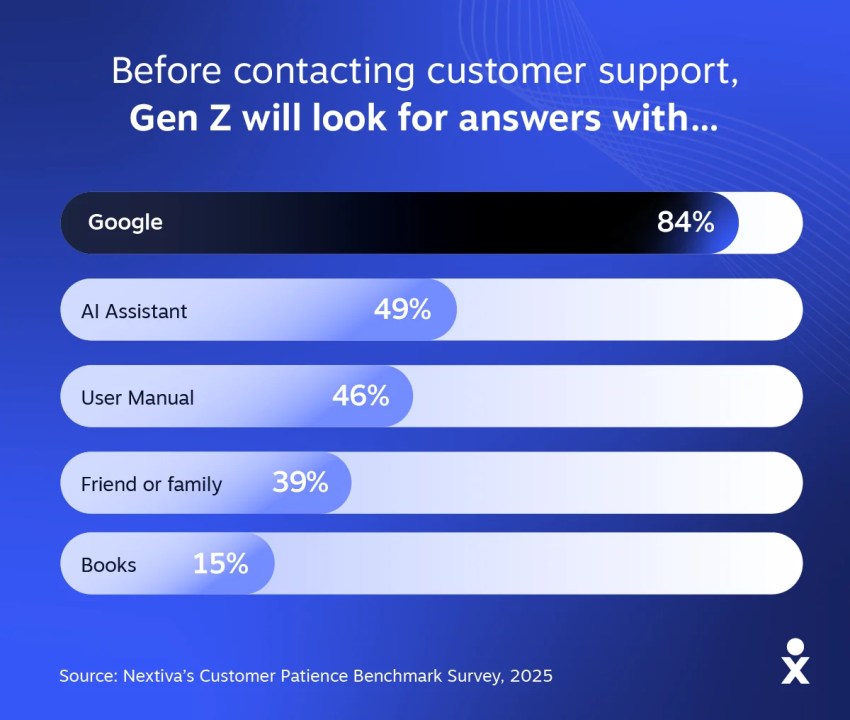
Before even contacting customer support channels, 83.5% of Gen Z respondents turn to Google, proving that the first step in their customer journey often happens outside a company’s owned channels. Additionally, nearly half (49.3%) of Gen Z are now using AI tools like ChatGPT as a first line of support, showing a clear preference for accessible, tech-driven solutions over waiting for traditional responses.
A key part of improving customer service efficiency starts with empowering Gen Z to help themselves. Building a comprehensive and searchable knowledge center and offering step-by-step video tutorials can make support feel instant while reducing pressure on live agents. These resources not only meet Gen Z’s expectations for self-service but also ensure faster resolutions.
The companies that win with this generation will be those that treat self-service not as an afterthought, but as the foundation of a truly connected, modern support experience.
Missing Customer Service Channels Push Gen Z Away
Convenience is non-negotiable for Gen Z customers. They expect support to meet them wherever they are and whenever they need it, whether it’s through live chat, text message, or a callback service that accommodates their schedule.
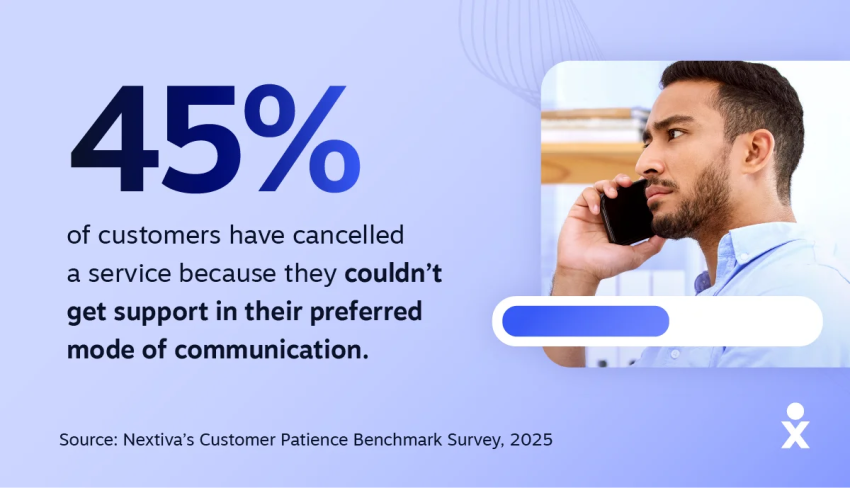
When multiple customer service channels are missing, Gen Z’s patience begins to wear thin. In fact, 44.8% said they have canceled a product or service simply because their preferred support channel wasn’t available. If companies don’t provide flexible customer communication channels, Gen Z won’t wait around — they’ll move on to a competitor that meets all of their needs on demand.
The Support Channels Gen Z Wants
Gen Z wants the freedom to choose whichever type of customer service channel works best in the moment. For them, true omnichannel customer service means having every option available and seamlessly connected, so when they start a conversation in one place, they can easily finish it in another without losing context or time repeating details.
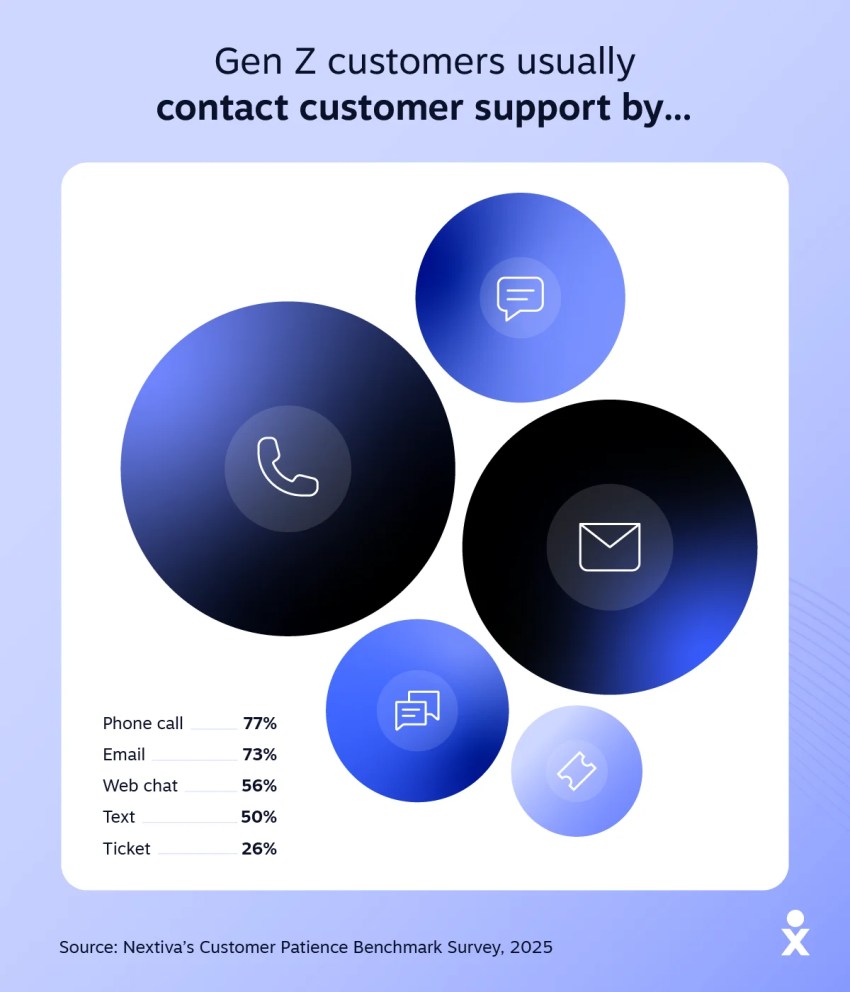
Loyalty is dependent on flexibility and knowing where Gen Z is likely to go for support when they have an issue. Our survey found that this generation is actively using a variety of customer support channels, with the top three being:
- Phone: 76.8%
- Email: 72.8%
- Website chat: 56.8%
Each of these types of customer service channels serves a different purpose in Gen Z’s communication flow. For example, email is preferred to keep a written record or for issues that require follow-ups, while website chats and SMS are helpful for quick answers. Then, when problems are complex or technical, Gen Z will choose a phone call with the expectation of being connected to a knowledgeable and helpful live agent.
Meeting these omnichannel expectations requires businesses to design support systems that are adaptable and personalizable. Investing in and offering this level of support improves service speed, provides consistent access, and gives customers control over their own experience.
Digital Natives Will Pay More for a Quality Customer Service Experience
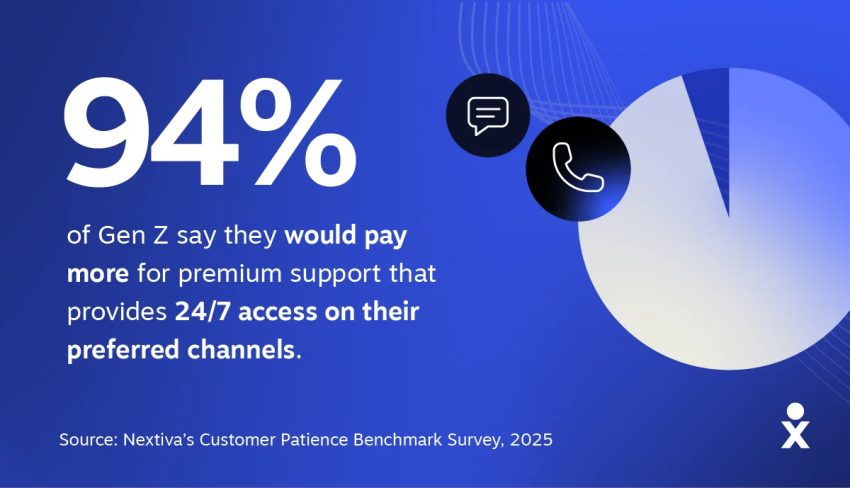
As Gen Z’s purchasing power continues to grow, so does their willingness to invest in quality support. Altogether, 56.6% of Gen Z are willing to pay extra for access and preferred channel choice. This shows that this generation’s focus is on convenience, speed, and accessibility.
When asked how much more they’d pay for 24/7 support through their preferred contact channels, 22.3% said they’d pay 10% more, and 18.8% said they’d pay 5% more. For a $50 per month service, this means a large percentage of Gen Z is willing to spend an extra $2.50–$5 each month for the knowledge that help is there when and how they need it.
This means that companies need to re-evaluate how they view customer support operations. Instead of thinking of them as a cost center, they should treat them as a value driver for revenue and customer retention. Investing in a strong customer service channel strategy reduces churn and builds loyalty that pays for itself over time.
Following customer experience best practices means offering 24/7 support across every support channel your customers care about. Utilizing AI-powered customer service allows companies to implement this level of support without overwhelming their human agents. With Gen Z’s demand for rapid response, automation can be the driver that delivers fast answers with seamless transitions between the channels that they desire.
Impress Gen Z With Fully-Integrated Support
To meet the needs of Zoomers, Digital Natives, and Gen Z, brands must offer a variety of integrated contact channels. This generation expects every interaction to feel effortless, no matter its origin.
These consumers prefer to interact with companies that let them easily switch between contact methods like chat, SMS, phone, and email — and have no fear of canceling service with those who don’t meet these needs.
To win over Gen Z, companies must evolve from disconnected systems to a fully connected, constantly available support network. Nextiva’s AI-powered contact center helps teams manage interactions across every channel while also providing the instant, personalized service Gen Z expects.
![Majority of Gen Z Still Use Phone Calls for Support — But They Turn to AI First [New Data]](https://www.nextiva.com/cdn-cgi/image/width=850,height=478,fit=cover,gravity=auto,format=auto/blog/wp-content/uploads/sites/10/2025/12/gen-z-still-embrace-phone-based-support-hero.webp?resize=768,432)