VoIP
 Blog
 Business Communication
 Customer Experience
 Leadership
 Marketing & Sales
 Nextiva News
 Productivity


Most small businesses pay $15 to $30 per user, per month for a cloud-based VoIP phone system. Advanced plans with AI, omnichannel communications, and premium features typically cost $30 to $50+ per user, per month, depending on your team size and business needs.
Determining the costs of switching from a landline to VoIP can feel like navigating a maze. Many business owners struggle to compare the many tariffs and find the right mix of basic and add-on features for their business needs. View a business telephone system as an investment in expanding your communication capabilities, not just another monthly bill.
This guide explains the complexities of VoIP pricing and helps you better understand what a modern system will cost in 2026 and 2027. We’ll examine key cost factors, from monthly subscriptions to one-time setup fees, and offer tips to help you make a smart, budget-friendly decision for your business.
2026 Business Phone System Pricing at a Glance
For most companies, switching to a VoIP solution will reduce monthly communication costs by 40 to 60% compared to traditional hardware.
Business phone system pricing varies by team size, required features, and provider. The table below provides a general overview of what businesses typically pay for a cloud-based VoIP phone system.
| Business size | Users | Typical plan | Cost (per user/month) | Common features |
|---|---|---|---|---|
| Small teams | 1-20 | Basic/Core | $15-$25 | Unlimited domestic calling, SMS, mobile apps, voicemail |
| Mid-sized businesses | 20-50 | Advanced | $25-$45 | CRM integrations, call recording, and multi-level auto attendants |
| Large enterprises | 50+ | Enterprise | $45+ | Agentic AI, omnichannel communications, advanced analytics |
Actual pricing varies by provider, contract length, and included features. Taxes and regulatory fees generally increase the total by 15% to 25%, depending on your business location.
Looking for Nextiva-specific pricing? Compare all plans on the Nextiva pricing page to see included features and pricing by plan.

See how Nextiva’s VoIP phone system works for your team
Find out why businesses across the country have already made the switch.
How to Estimate Your Phone System Costs
Before requesting quotes, you can estimate your monthly phone system budget using a simple calculation. While every provider prices its plans differently, this method gives you a realistic starting point for budgeting.
Step 1: Choose your plan
Start by selecting the plan that best matches your business needs and required features. Basic plans are designed for businesses that need essential calling features. Professional plans add capabilities such as CRM integrations, call recording, and advanced call management. Advanced AI plans are best for businesses that need AI-powered features, omnichannel communications, and advanced analytics.
Step 2: Multiply by your number of users
Most cloud-based VoIP providers charge per user. Multiply the monthly price per user by the number of employees who need a business phone line. If your team is expected to grow, estimate costs for both your current and future team size to avoid unexpected expenses.
For example:
20 users × $25 = $500 per month
Step 3: Add optional costs if needed
Depending on your provider and plan, you may also need to budget for optional expenses such as IP phones, call recording, CRM integrations, toll-free numbers, or international calling, which is typically charged based on usage. Some of these features may already be included in higher-tier plans, so compare what’s included before deciding.
Step 4: Estimated monthly cost formula
Once you’ve estimated your users and additional costs, use this formula to calculate your expected monthly bill.
(Number of users × Monthly plan price) + Optional add-ons + Taxes and regulatory fees = Estimated monthly VoIP cost
While every provider prices services differently, this estimate provides a realistic starting point for budgeting before requesting provider-specific quotes.
How to Evaluate VoIP Pricing by Business Size
Check which features are included and which fees could increase as your team grows.
Small teams (1-20 users):
- Choose a plan with softphone and mobile apps so you don’t have to buy desk phones
- Check whether the provider charges more per user for teams under 10
- Confirm number porting and setup are free
- Compare monthly and annual billing if your headcount changes during the year
Mid-sized businesses (20-50 users):
- Confirm call recording and CRM integrations are included rather than sold as add-ons
- Ask whether multi-level auto attendants and analytics come with the plan or cost extra
- Request volume pricing for your seat count
- Ask about the per-minute charges for AI transcription and translation
Multi-site organizations:
- Ask for a written SLA with 99.999% availability and service credits
- Check how long call recordings are kept for compliance purposes and whether extra storage costs more
- Ask about pricing for additional locations, numbers, and E911 fees per line
- Review termination and auto-renewal terms before signing a multi-year contract
How VoIP Pricing Works
On average, a VoIP phone system costs between $15 and $50 per phone line per month. However, the market has changed a lot in the last year. Most services now use a base-plus-add-on pricing model instead of simple per-user charges.
While a standard package remains affordable, the real value and the main price driver are in the scope of intelligent features your team needs.
The traditional user-based model
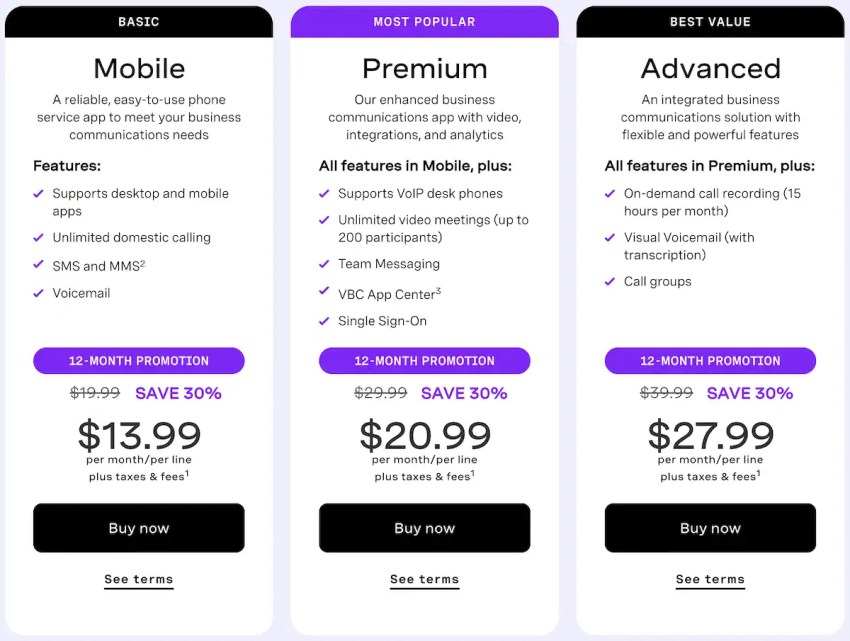
This is the classic VoIP billing method, proven over the years. It’s best suited for businesses that need reliable and basic communication tools.
- Basic user billing ($15–$25): You pay for the line, unlimited domestic calls, and essential features like caller ID and call forwarding.
- Line-based billing: This method is ideal for phone-intensive businesses that require multiple phone numbers and dedicated lines, rather than a large number of individual users.
Per-user pricing vs. flat-rate pricing
Most cloud-based VoIP providers use per-user pricing, while some smaller providers offer flat-rate plans. Understanding the difference can help you choose the right pricing model.
| Per-user pricing | Flat-rate pricing |
|---|---|
| Pay for each employee using the system | Pay one monthly fee regardless of users |
| Easier to scale as your business grows | Predictable monthly costs for very small teams |
| Most common pricing model among business VoIP providers | Less common for cloud business phone systems |
| Best for growing businesses | Best for businesses with fixed staffing levels |
For most businesses, per-user pricing provides greater flexibility because you only pay for active users and can easily add or remove licenses as your team changes.
Per-user rates often drop once you pass 20 or 50 seats. If your headcount is near one of those thresholds, ask each provider for volume pricing when you request a quote.
The AI-powered model
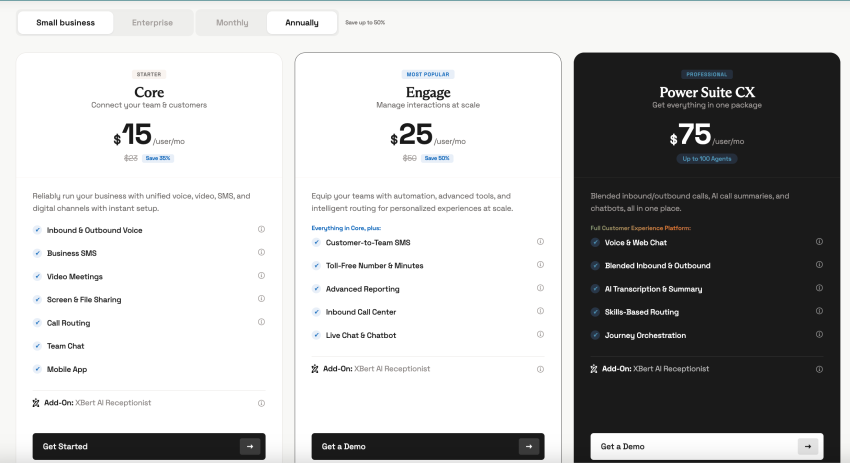
The VoIP industry has evolved toward tiered AI solutions. Most providers now offer dedicated AI-enabled plans that combine advanced computing power with standard voice services.
- AI-powered plans ($30–$55): These packages include built-in AI features, high-definition video conferencing, team collaboration tools (SMS/chat), and native CRM integrations.
- Agent AI plans (starting at $60): This premium package includes Agentic AI—autonomous assistants that provide call summaries, real-time sentiment analysis, and post-call task automation without human intervention.
- Usage-based AI credits: Beware of providers that offer a low base price but charge by the minute for AI transcription or real-time translation. These usage-based costs can unexpectedly triple your monthly bill.
Ongoing (recurring) costs
While the base subscription fee is the most visible cost, your monthly bill can consist of several items. Understanding these can help you avoid unexpectedly high bills as your team grows.
1) Monthly/annual subscription fees
Most providers offer a volume discount (20% to 33%) for signing an annual contract. Monthly plans are ideal for seasonal businesses or startups that need maximum flexibility without a long-term commitment.
2) Per-user or per-line fees
Besides subscription fees, VoIP providers commonly structure their pricing model based on a per-user or per-line basis. Typical fees range from $15 to $50 per month.
- Base packages ($15–$25): Includes basic telephony, mobile apps, and standard voicemail.
- Mid-range packages ($25–$50): Includes advanced features such as call recording, video conferencing, and multi-level auto attendants.
- Enterprise packages ($50 and up): Required for comprehensive analytics, omnichannel support, and high security standards.
3) Metered calling rates
Even with plans offering unlimited calling, certain types of calls are charged per minute.
- Domestic calls: Usually include the US and Canada.
- International calls: With VoIP, you can save up to 90% compared to traditional providers. International calling rates for popular destinations (e.g., the UK, Australia) range from $0.01 to $0.05 per minute.
- Remote countries: Calls to less common regions can cost up to $2 per minute.
- Toll-free inbound minutes: When customers call your toll-free number, your business pays for the minutes, usually through a monthly minute bundle. Inbound calls to an international toll-free number can roughly double the per-minute cost.
4) Feature add-ons
If certain tools are not included in your chosen package, you can add them individually:
| Add-on feature | Approx cost | Why add it |
|---|---|---|
| Call recording | $5–$10 | Essential for training and legal compliance |
| CRM integration | $10–$25 | Syncs calls with Salesforce, HubSpot, or zoho |
| Toll-free numbers | $5–$15 | Gives your business a professional, national presence |
| Video conferencing | $10–$20 | HD meetings and virtual rooms for remote teams |
| Agentic AI co-pilot | $15–$25 | Automatically updates crm records and sends follow-ups |
| Real-time translation | $0.03–$0.06/min | Allows your team to support global callers in 50+ languages |
5) Support and maintenance
Some providers include 24/7 support in every plan. Others offer support in tiers, so phone support or a dedicated account manager is only available on higher-priced plans. Check which level your plan includes before you compare prices. Hosted plans also cover software updates, security patches, and system upkeep that would require separate maintenance contracts or IT labor with a traditional on-premises system.
Upfront (one-time) costs
The transition to VoIP shifts costs from capital expenditures (Capex) to operating expenses (Opex). However, you still need to consider some initial investments during implementation.
- VoIP equipment: IP phones, headsets, and softphone licenses. For example, a quality IP phone can range from $50 to $300 per unit. A VoIP provider may offer hardware bundles or rentals to reduce upfront spending.
- Number porting: Transferring existing phone numbers to the new VoIP phone system varies by provider (covered in detail below).
- Staff training: Employees need training to use the VoIP system and its features effectively. Basic training is often included, but advanced sessions or custom onboarding can add $500+, depending on team size.
- Network modernization (infrastructure costs): To support high-resolution video and AI-processed voice transmission, your Wi-Fi 7 or 5G infrastructure must be ready for business voice. A network audit (typically starting at $550) is a recommended one-time investment to avoid latency issues.
While the recurring and upfront investment for VoIP can seem high, businesses realize major cost savings of up to 90% compared to traditional telephony — especially for international calling. VoIP usage is projected to grow 35% through 2036 as the benefits justify the implementation costs for most organizations.
Whether the system is hosted or on-premises also changes the upfront bill. On-premises VoIP needs your own servers, SIP trunks, software licenses, and technical labor to install and configure, which can push installation costs past five figures. With hosted VoIP, the provider runs that infrastructure, so installation costs close to nothing beyond any devices you choose to buy.
Hidden VoIP Costs
A VoIP phone system can save your business money in the long run, as long as you’re aware of additional costs that aren’t always listed on the main price page. These aren’t necessarily hidden fees; they are simply costs that depend on your location, your hardware choices, and your specific business requirements.
Why your final VoIP quote may be higher than the advertised price
Several factors can increase your total monthly cost.
| Advertised price includes | Additional costs that may apply |
|---|---|
| Basic calling plan | AI features and premium analytics |
| One phone number | Additional local or toll-free numbers |
| Annual billing | Higher month-to-month pricing |
| Standard features | CRM integrations and call recording |
| Domestic calling | International calling charges |
| Software only | IP phones or headsets |
| Base subscription | Taxes and regulatory fees |
When comparing providers, look beyond the advertised starting price and compare the total monthly cost based on the features your business actually needs.
Regulatory fees and taxes
These are the biggest surprises on your first bill. Because VoIP uses the public internet but is connected to the traditional telephone network, it’s subject to various government regulations.
- Average tax burden: Varies by location, but your monthly bill will typically increase by 15% to 25%.
- Federal Universal Services Fund (FUSF): A quarterly adjusted fee (usually 7%–12%) that supports telecommunications access in rural areas and schools.
- E911 emergency call fee: A government-mandated fee of $0.30 to $2.50 per line to fund local emergency infrastructure.
- Compliance and robocall mitigation: Many providers will start charging a $2.00 to $4.00 compliance fee to cover the costs of mandatory spam call blocking (STIR/SHAKEN) and privacy audits.

Usage and scaling fees
- Hardware leasing: If you don’t buy the phones outright, you’ll pay $5 to $20 per device per month — indefinitely.
- Additional phone numbers: Most plans include one number. Each extra local, toll-free, or vanity number is billed monthly, with toll-free numbers typically running $5 to $15 each. Get a quote for vanity numbers before you commit.
How Much Does VoIP Cost for the Top 7 VoIP Providers
In addition to other pricing factors, many providers have simplified their structures and now offer extras such as softphone apps and basic setup. Based on market data for annual subscriptions, here’s how the top services compare.
| Provider | Starting price (annual) | Standout included feature | Best for |
|---|---|---|---|
| Nextiva | $15.00 | AI voicemail & unified app | SMBs and unified communications |
| 8×8 | Quote-based | Multi-level auto attendant | Global teams (unlimited international calling) |
| Dialpad | $15.00 | Native AI meeting summaries | Mobile-first or AI-focused teams |
| Ooma | $19.95 (billed monthly) | No-contract flexibility | Small offices/brick & mortar |
| Vonage | $13.99* | 50+ specialized features | Custom or A la carte users |
| Zoom Phone | $10.50 | Video-first integration | Budget-conscious or metered users |
| RingCentral | $20.00 | CRM integrations require Advanced or higher | Large-scale app ecosystems |
Pro-tip: When comparing prices, pay particular attention to the starting price. Most providers (including Dialpad) increase the price per user if you have fewer than 10 employees. Nextiva remains a top choice for small teams, as even the entry-level Core plan offers enterprise-level reliability.
Switch to Nextiva today and save up to 60%
Join now and start calling in less than 10 minutes. Instant set up. Enterprise-grade reliability.
Typical VoIP Phone System Costs to Be Aware Of
At Nextiva, we believe in eliminating uncertainty. Here’s how our cost structure compares to the industry average.
1) VoIP service plan pricing
What it is: Your monthly subscription that covers core calling features, user licenses, and platform access.
Typical industry range: $15-$50 per user per month, but this can vary significantly based on what’s included.
Nextiva’s approach: Our plans start at $15/user/month and include voice, video, chat, and SMS in a single unified platform. While competitors often charge separately for video conferencing ($15/month), team messaging ($12/month), or premium features, Nextiva bundles everything together.
💡 Cost-saving tip: Look for providers that include multiple communication channels in one plan rather than charging separately for each tool. You’ll avoid the expense and complexity of managing multiple vendors.
2) Hardware and devices
What it is: The physical phones, headsets, and adapters needed to use your VoIP system.
Your options with VoIP:
- Bring Your Own Device (BYOD): Use existing smartphones, computers, or compatible IP phones
- Certified IP phones: Provider-recommended devices optimized for call quality (typically $50-$300 per unit)
- Software-only: Mobile and desktop apps with no hardware required
Nextiva’s approach: We support all three options. Our certified IP phones are pre-configured and arrive ready to plug in, while our mobile and desktop apps work on any device. Many teams start software-only and add physical phones as needed.
💡 Cost-saving tip: Start with software-only implementations to test VoIP functionality before investing in new hardware. Most teams find that the mobile and desktop apps meet their needs perfectly.
3) Setup and porting fees
What it is: Charges for configuring your system and transferring existing phone numbers to your new provider.
Typical industry charges:
- Setup fees: $100-$500, depending on complexity
- Number porting: $10-$30 per number
Nextiva’s approach: Zero setup fees, and number porting is included with every plan at no additional cost. We handle the entire porting process, including coordination with your previous provider.
💡 Cost-saving tip: Always ask about setup and porting fees upfront. These one-time charges can add hundreds to your implementation costs with some providers.
4) Installation and IT costs
What it is: Professional services to configure your system, set up users, and integrate with existing tools.
Traditional approach: Many providers require IT professionals or charge for professional installation services, adding $500-$2,000+ to your total cost.
Nextiva’s approach: Most teams go live in under an hour with no IT support required. Our browser-based admin portal and visual call flow builder make DIY setup simple. We provide step-by-step guidance, and our support team is available 24/7 if you need assistance.
💡 Cost-saving tip: Choose a provider with intuitive self-service setup tools. Professional installation is rarely necessary for modern cloud-based VoIP systems.
5) Add-ons and hidden fees (or Lack Thereof)
What it is: Extra charges for features like call recording, analytics, voicemail transcription, or advanced routing.
Common industry add-ons that cost extra:
- Call recording: $5-$10/user/month
- Voicemail-to-email: $3-$5/user/month
- Advanced analytics: $10-$30/user/month
- Auto attendant: $5-$15/month
- CRM integrations: $10-$25/user/month
Nextiva’s approach: Our higher-end plans include phone call recording, voicemail-to-email, advanced analytics, auto attendant, and CRM integrations as standard features. No surprise add-on charges for essential business functionality.
💡 Cost-saving tip: Calculate the total cost, including add-ons you’ll actually use. A slightly higher base price that includes key features often costs less than a low base price with expensive add-ons.
6) Scalability and ongoing costs
What it is: How pricing changes as you add users, features, or phone lines.
Common scalability challenges:
- Per-user costs that increase with different feature tiers
- Surprise charges for exceeding usage limits
- Complex pricing for additional phone numbers or locations
Nextiva’s approach: Predictable per-user pricing that scales cleanly with your team. Add users instantly through the admin portal with the same transparent pricing. No surprise fees for additional phone numbers, and our plans grow with your business needs.
💡 Cost-saving tip: Ask about pricing for adding users mid-contract and whether any usage limits could trigger additional charges.
How Long-Term Commitments Affect VoIP Pricing
Before signing a contract, understand the terms and conditions. This way, you know exactly what’s expected of you and what you can expect from your provider. While contracts have become more standardized, the fine print still determines your overall cost.
👉 Length of Contract: Month-to-Month vs. Long-Term Commitments
The contract duration is often the most important factor in reducing the price per user.
- Monthly contracts: These offer maximum flexibility and are ideal for startups or seasonal businesses, but are 20 to 30% more expensive.
- Annual contracts: The industry standard for the most affordable plans; most providers require this to waive setup or activation fees.
- Multi-year contracts: For larger businesses, a 3-year contract can often lead to further discounts or free premium hardware.
👉 Termination Fees
- Early termination fees: If you cancel before the contract ends, you have to pay the remaining balance or a flat fee of several hundred dollars.
- Refunds for promotional offers: If a provider gave you free phones or waived installation as part of a long-term contract, you may have to repay these costs if you cancel early.
👉 Service-Level Agreements
A Service Level Agreement (SLA) serves as your quality assurance. Look out for the five-nine standard
- 99.999% availability: This guarantee means that the service is expected to experience no more than 5.3 minutes of downtime per year.
- Compensation clauses: If the provider fails to meet these availability standards, they will typically issue service credits as financial protection.
👉 Limitations or Restrictions on Usage
Some contract agreements might have clauses that limit or restrict certain types of usage constituted as abuse. Examples include automated or predictive dialing — a questionable practice employed by telemarketers.
These restrictions aim to prevent the misuse of the VoIP service and ensure fair usage.
You must be aware of any limitations of this type to ensure your business operations comply with the contractual agreement.
👉 Auto-Renewal
Auto-renewal clauses mean the contract will automatically renew for a similar term and price unless either party terminates it before the renewal date. This also ensures your company’s communications stay uninterrupted.
Be aware of your VoIP contract’s renewal policy, and review the contract terms and explore other options in the market at least three months before your renewal date. This gives you time to negotiate better terms or switch to a more cost-effective provider if needed.
ROI of VoIP: Is It Worth It?
To determine whether investing in VoIP is right for your business, look beyond the monthly bill. A complete ROI includes measurable cost savings, revenue security, and increased team performance.
VoIP vs. traditional PBX
For a mid-sized company with 100 employees, the financial difference between a traditional, locally installed telephone system and a modern cloud VoIP system like Nextiva is significant.
| Cost category | Traditional PBX (year 1) | Nextiva VoIP (year 1) |
|---|---|---|
| Hardware & installation | ~$12,500 | $0 (using apps/BYOD) |
| Monthly recurring fees | ~$4,150 | ~$1,500 |
| Total year 1 cost | $62,300+ | ~$18,000 |
- Estimated savings: Over 60%!
- Reduced chaos: Unified messaging, video, and voice in one app saves employees an average of 32 minutes per day.
- Faster lead response: Features like instant ring groups and AI call routing ensure potential customers aren’t left waiting, directly protecting your revenue.
- Remote flexibility: Because the system works anywhere with an internet connection, you can hire the best talent regardless of their physical location without paying for additional office infrastructure.
Traditional phone lines are prone to local outages or cable damage. Cloud VoIP offers built-in disaster recovery. Providers like Nextiva use multiple data centers across the continent; if one fails, your calls are rerouted instantly and without interruption. If the office loses internet, your team can switch to mobile apps on 5G, keeping your business accessible to customers at all times.

For a 10-person team, apply the cost formula using a $25 plan, one toll-free number at $15, and taxes at the upper 25% estimate:
- Monthly cost: (10 users × $25) + $15 = $265, or about $331 after taxes and fees
- Year 1: About $3,975, with no hardware spend if the team uses softphone apps
- Three years: About $11,900
- Five years: About $19,900
- Optional desk phones: 10 IP phones at $50 to $300 each add $500 to $3,000 once, while leasing them at $5 to $20 per device runs $50 to $200 every month
A traditional system at this size still needs on-premises hardware, professional installation that often adds $500 to $2,000+, and IT staff to maintain it. Long-distance charges are extra. Those costs come before the first call, and the maintenance bill continues for the life of the system.
Multiple Communication Apps vs. Centralized VoIP System
Most businesses now use a variety of applications for daily operations—an infrastructure referred to as a tech stack. However, using multiple apps for video, chat, and phone calls increases costs and forces employees to constantly switch between applications.
A unified communications platform can replace several of these subscriptions, saving costs and simplifying the infrastructure.
1) Video conferencing programs
Subscription costs for platforms like Zoom can take up a significant portion of your budget. For a 50-person team, Zoom costs approximately $9,000 annually.
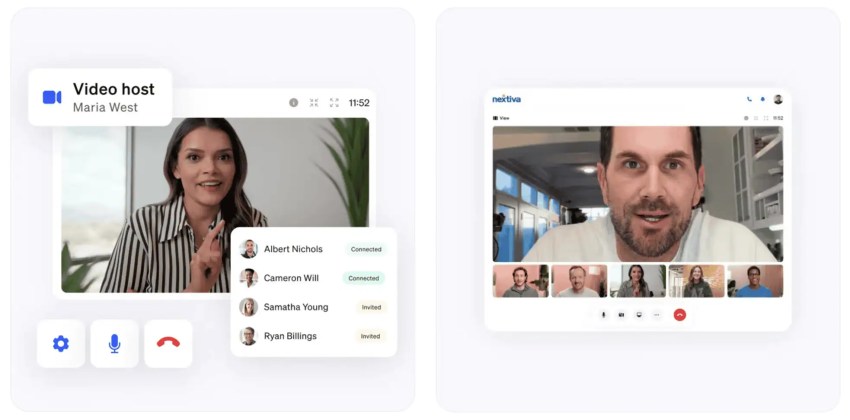
Most VoIP providers (including Nextiva) offer HD video conferencing at no extra charge in their basic or mid-range plans. By switching, you’ll save $15 per user per month on a separate video subscription.
2) Team collaboration tools
Tools like Slack or Microsoft Teams are essential, but their costs overlap with those of VoIP functionality. Slack, for example, costs approximately $7.25 per user per month, which adds up to $4,350 per year for a team of 50.
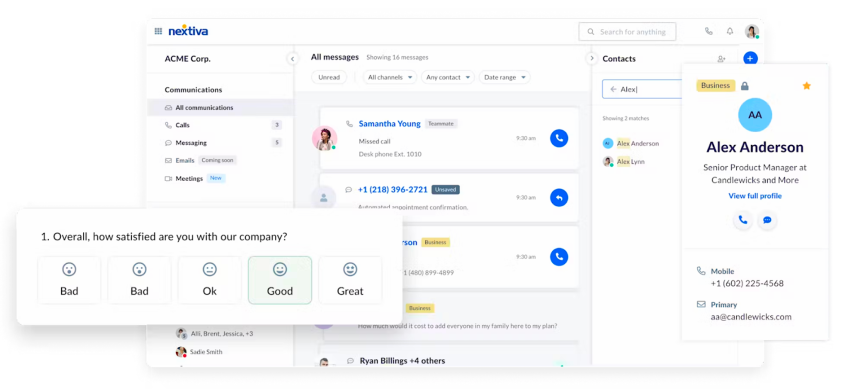
Modern VoIP platforms offer integrated text messaging, file sharing, and team chat. A unified communications platform allows you to manage all internal and external communication from a single screen.
3) Company cell phones
Many companies spend over $50 per month per user on mobile phone contract reimbursements or providing hardware. VoIP systems offer softphone apps that employees can download to their personal devices. These apps separate business and personal calls, reducing mobile phone costs to about 8% of total expenses.

4) Operational security
Using private messaging apps for work purposes poses risks for legal and HR departments. Centralized VoIP systems offer high security, data encryption, and the ability to lock or delete company data when an employee leaves the company.
Unified platforms ensure that all customer interactions are recorded and stored securely on a single platform.
Business VoIP vs. Traditional Phone Systems
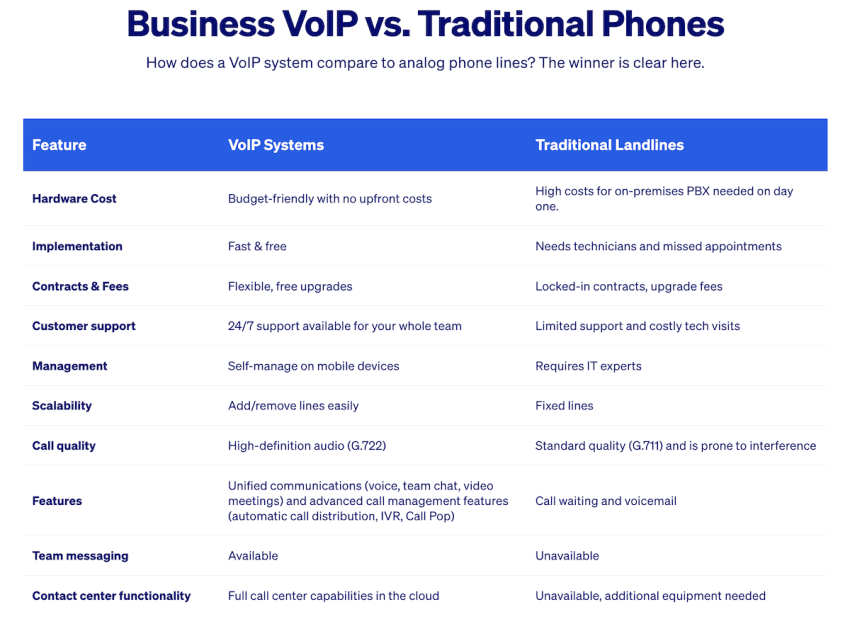
Comparing VoIP with traditional landline connections goes beyond mere functionality — it affects the fundamental way your business operates.
- Personnel: Traditional phone systems require dedicated IT staff for maintenance; VoIP is managed through a simple web portal, reducing technical monitoring costs.
- Equipment: On-premises hardware is expensive and depreciates quickly; VoIP utilizes existing laptops or cost-effective IP phones.
- Infrastructure: Analog systems rely on copper lines, which are expensive to install; VoIP leverages your existing high-speed internet connection.
- Long-distance calls: VoIP eliminates the long-distance call charges that traditional providers use to inflate monthly bills, especially for international calls.
Why Choose Nextiva for Small Business VoIP?
Switching to a VoIP phone system is a smart step toward rethinking your business. Nextiva’s pricing is transparent and eliminates the hidden fees common with other providers.
- Nextiva Core ($15/user/month): Ideal for small teams that need reliable voice, video, SMS, and team chat capabilities in a single app.
- Nextiva Engage ($25/user/month): Offers advanced features such as call recording, live chat, and a chatbot for efficient interaction management.
- Nextiva Scale ($75/user/month): For teams that require comprehensive omnichannel support, including AI transcription, call summaries, and advanced routing.
With Nextiva, you get robust calling features, superior reliability & scalability, high-end security, hassle-free PBX options, affordable pricing, amazing customer support, and more

Nextiva’s pricing is curated for hybrid workforces. There are no hidden AI fees in the fine print. All Nextiva plans are carrier-grade and built on intelligent technologies.
- Integration costs: There are additional à la carte fees for connecting your existing tools (Salesforce, HubSpot, Zendesk); certain packages include these integrations on request at no additional charge depending on volume.
- Porting and setup included: We handle the regulatory burden of number porting at no cost, saving you hundreds of dollars in hidden setup fees.
- 99.999% availability: Because Nextiva owns and operates its own network, your ROI isn’t at risk from downtime — a single hour of downtime can cost more than a year’s worth of service.
Ready to see exactly what VoIP will cost your business? Our pricing is transparent, our setup is simple, and our support team is standing by to help you get started.
Switch to Nextiva today and save up to 60%
Join now and start calling in less than 10 minutes. Instant set up. Enterprise-grade reliability.
Frequently Asked Questions About VoIP Pricing
Listed prices usually show the lowest-priced annual plan with basic calling features. Your final quote may increase if you add call recording, CRM integrations, AI capabilities, additional phone numbers, hardware, international calling, or choose month-to-month billing. Taxes and regulatory fees can also increase your monthly bill.
Annual billing usually offers the lowest per-user pricing, with many providers offering discounts of 20% to 30% compared to monthly plans. Monthly billing provides better flexibility for businesses with seasonal staffing or uncertain growth, but it generally comes at a higher monthly cost.
No. Most cloud-based VoIP providers do not charge setup or activation fees for their standard business phone plans. Onboarding and implementation support are often included, and many providers also let businesses port their existing phone numbers at no additional cost. However, your total cost may still include taxes, regulatory fees, optional hardware, and premium add-ons.
Every VoIP provider prices its plans differently. Some charge per user, while others use usage-based or tiered pricing. The features included also vary from one provider to another. One provider’s basic plan may only include calling, while another includes video meetings, business texting, AI tools, or CRM integrations. Instead of comparing only the starting price, compare total cost and included features to find the best value for your business.
Free VoIP Options for Businesses
Is there a free VoIP service for businesses?
Yes, but free services are built for personal use or a one-person operation. They usually lack auto attendants, call routing, number porting support, and the reliability guarantees a business line needs. Most teams that outgrow a free app move to a paid plan in the $15 to $25 per user, per month range, which covers unlimited domestic calling, SMS, mobile apps, and voicemail.