

 VoIP
VoIP  Blog
Blog  Business Communication
  Customer Experience
  Leadership
  Marketing & Sales
  Nextiva News
  Productivity

Five9 and NiCE CXone are two of the most established players in the Contact Center as a Service (CCaaS) market.
- Choose Five9 if you manage a high-volume outbound sales team requiring advanced dialer technology.
- Choose NiCE CXone if you’re a large enterprise (500+ agents) prioritizing deep workforce management (WFM) and granular analytics.
- Consider alternatives if you require a solution that is faster to deploy, seamlessly combines UCaaS and CCaaS, and demands fewer technical resources to manage.
When deciding between these two contact center software, understanding the specific nuances —particularly regarding AI implementation and Total Cost of Ownership — is critical. We’ve compiled a detailed comparison to help you make your decision.
Five9 vs. NiCE CXone At a Glance
Before diving into the features, here’s how the two market leaders stack up in 2026.
| Feature | Five9 | NiCE CXone |
|---|---|---|
| Best for | Outbound sales & blended teams | Enterprise support & analytics |
| Starting price | $159/seat/month | $110/agent/month |
| Deployment time | Months (complex) | Months (complex) |
| AI capabilities | Genius AI (focus on agent assist) | Enlighten AI (focus on behavior) |
| Workforce management (WFM) | Strong (via Verint partnership or native) | Best-in-class (Native) |
| Key strength | Outbound dialing logic | Deep analytics & WFM |
| Primary complaint | Outdated UI & login issues | Confusing à la carte pricing |
| Free trial | Proof of concept only | 60 Days (select plans) |
Overview of Five9 and NiCE CXone
Here’s a closer look at what each contact center platform offers and how they differ in their approach.
Five9: A Cloud-Based Contact Center Solution
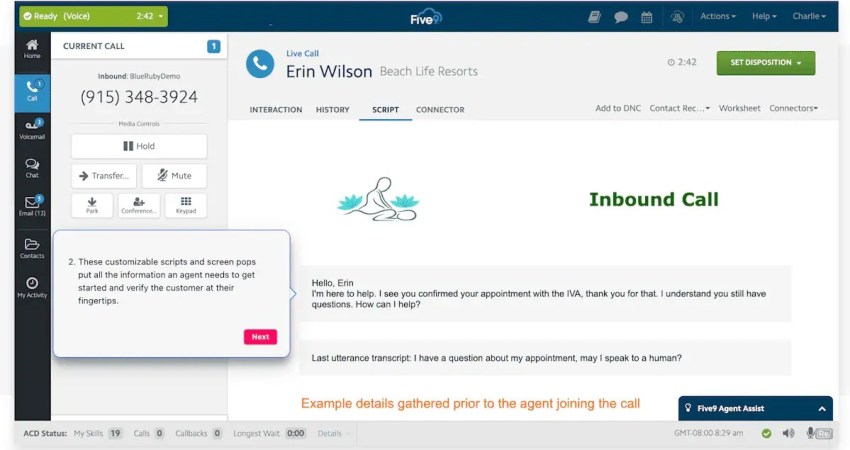
Five9 is a pioneer in cloud-based contact centers. The company gained prominence through outbound dialing, helping sales teams meet their sales targets with predictive dialers. Today, it has evolved into a fully-fledged intelligent cloud contact center with powerful omnichannel capabilities.
Five9 prioritizes functionality and throughput. It’s an effective tool for sales-oriented businesses, although some users note that the user interface focuses more on ease of use than modern design.
NiCE CXone: A Cloud Customer Experience (CX) Management Platform
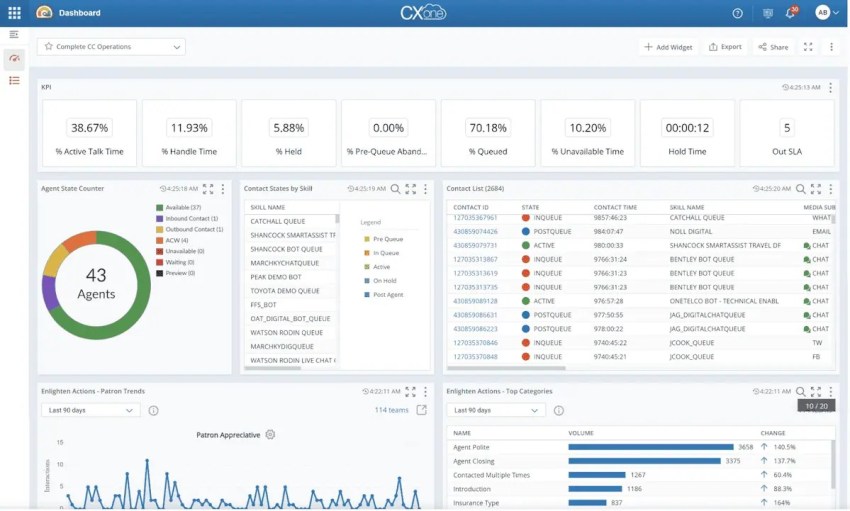
NiCE (formerly NiCE inContact) is a feature-rich customer experience platform. Its key differentiator is workforce optimization (WFO). In addition to call routing, the system is known for analytics of agent behavior and historical data to predict staffing needs with high accuracy.
NiCE is data-centric and highly sophisticated. It’s great for operational managers who need detailed reports on key performance indicators (KPIs) such as average handling time (AHT) and adherence to schedules.
Five9 vs NiCE Feature Comparison
While both platforms check the same boxes on an RFP (omnichannel, AI, WFO), their architectural philosophies are radically different. Here’s how they compare:
AI and automation
Five9’s AI strategy is built around the live agent experience. Its Agent Assist listens to calls in real-time and acts as a digital co-pilot, automatically pulling up knowledge base articles or competitive battle cards based on keywords the customer says. This is particularly helpful for coaching sales representatives during customer interactions.
With NiCE, the focus is on sentiment and behavior. It analyzes customer interactions to assess soft skills and customer sentiment. This makes it particularly suitable for quality assurance (QA) teams that want to automate compliance assessments.
Communication channels
Five9 excels in voice and SMS communication. Five9 has also invested significantly in video interaction, allowing agents to seamlessly convert a phone call into a video session — a valuable feature for telemedicine or environments with intensive customer contact.
NiCE offers a comprehensive omnichannel experience. NiCE integrates various digital channels (social media, chat, email) into a single agent workspace. For brands with high user traffic on platforms like WhatsApp or X (formerly Twitter), NiCE offers slightly enhanced routing.
Workforce optimization (WFO)
Five9 offers powerful WFO tools, enhanced through strategic partnerships or recent acquisitions.
NiCE is widely considered the industry standard. WFM is a core competency of NiCE. For companies managing thousands of employees across multiple time zones with complex shift schedules, NiCE provides the necessary expertise.
Business phone system
Both Five9 and NiCE CXone offer many business phone system features, including:
- HD voice quality: Both platforms prioritize high-quality audio for clear and crisp communication.
- Interactive voice response (IVR): Both offer IVR systems that allow customers to self-serve and route calls efficiently.
- Automatic call distribution (ACD): Both platforms provide ACD functionality to distribute incoming calls to the most appropriate agents based on predefined criteria.
User feedback suggests variations in user interface intuitiveness and ease of initial setup. Some users reported that Five9’s interface can be complex, while others found NiCE CXone’s interface sometimes difficult to access and navigate.
Workforce optimization
Both Five9 and NiCE CXone offer a range of workforce management (WFM) tools that increase agent productivity, improve efficiency, and streamline contact center operations. Some of these tools are for:
- Scheduling: Creating and managing agent schedules based on forecasted call volumes and agent availability.
- Forecasting: Capabilities for predicting future call volumes and staffing needs.
- Performance monitoring: Tracking agent performance metrics, such as call handle time, first call resolution rate, and customer satisfaction scores.
Both solutions use data points to analyze agent performance and optimize workflows, leveraging these insights to identify repetitive tasks and inform AI-driven recommendations and automation solutions.
The level of customization and reporting capabilities can vary. NiCE CXone is often praised for its advanced reporting and analytics capabilities. Five9 also offers strong reporting capabilities, but they are not as advanced as those of NiCE.
AI and automation
Both platforms use contact center AI and automation technologies to increase contact center efficiency and enhance customer experience.
Five9 includes AI-powered features such as:
- Virtual agents and chatbots for handling routine inquiries and providing self-service options
- Intelligent call routing to direct calls to the most appropriate agents
- Speech analytics to gain insights from customer conversations and improve agent performance
NiCE CXone’s advanced AI-powered analytics capabilities give businesses key insights into customer behavior, employee sentiment, and emerging trends. The platform also offers:
- Highly customizable chatbots that can be tailored to specific business requirements
- Automation workflows to streamline repetitive tasks and improve agent efficiency
User interface and experience
Both NiCE CXone and Five9 have intuitive user interfaces but differ in their approaches and strengths.
NiCE CXone offers a unified omnichannel experience and consolidates agent tools and customer interactions into a single, streamlined platform. Omnichannel is great for agents operating multiple communication channels as it reduces context switching. NiCE CXone’s user interface is also modern and customizable, allowing businesses to tailor the workspace to their unique workflows.
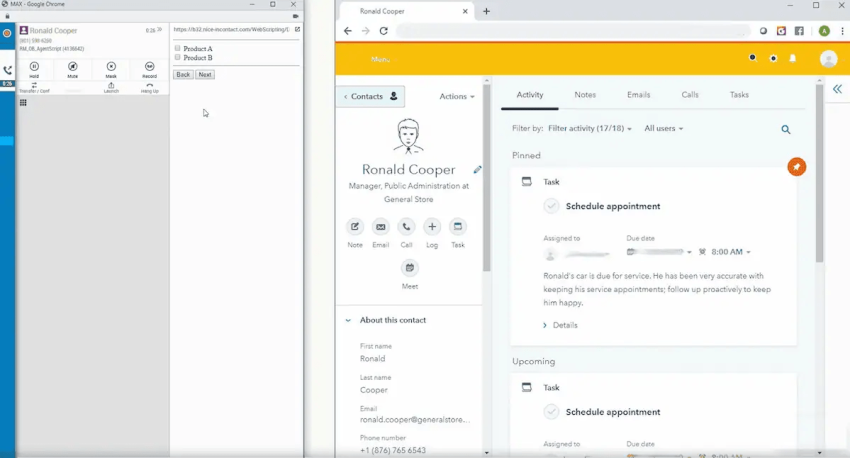
Five9, on the other hand, focuses on a user-friendly interface that prioritizes usability and agent efficiency. The user interface is simple with clear navigation and is relatively easy for new agents to learn. Five9’s design focuses on core call center functions, such as call handling and agent management, and is efficient in these areas.
While both platforms are developing their AI functionality, some user reviews suggest that NiCE CXone Mpower is more intelligently integrated into the agent interface, offering real-time sentiment analysis and intelligent routing.
Five9 and NiCE Pros and Cons
Every platform has its strengths and weaknesses. Let’s examine what each does well and where they might fall short.
Five9
✅ Strengths
- Dialer technology: Five9’s predictive, high-performance, and progressive dialers are industry-leading and minimize agent downtime.
- CRM integration: Comprehensive, pre-configured integrations with leading CRM systems such as Salesforce, Oracle, and Zendesk.
- Reliability: Consistently high availability and excellent voice quality.
❌ Considerations
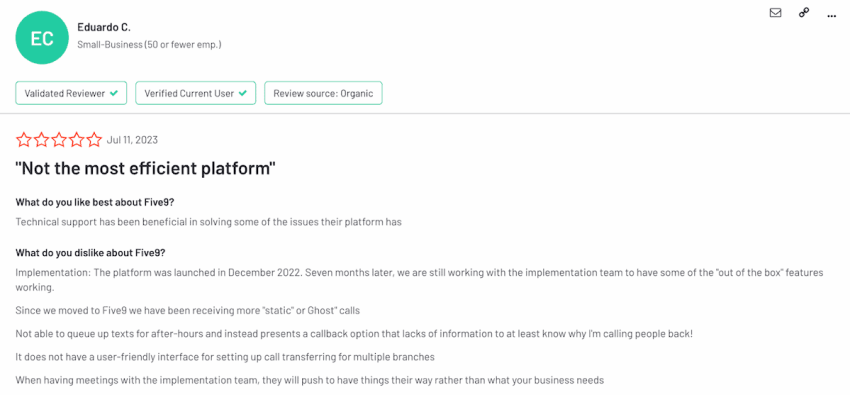
- Login stability: Some users report intermittent login issues that can disrupt shift starts.
- Connection latency: User feedback indicates potential delays (2–3 seconds) between call answer and agent connection.
- Learning curve: Configuration is complex, requiring a dedicated administrator or significant training time.
NiCE CXone
✅ Strengths
- Analytical depth: Provides extensive visualization and granular reporting capabilities for data-driven management.
- Scalability: Proven capability to support massive, global contact centers without performance degradation.
- Customization: Highly flexible workflows allow for tailored solutions if developer resources are available.
❌ Considerations
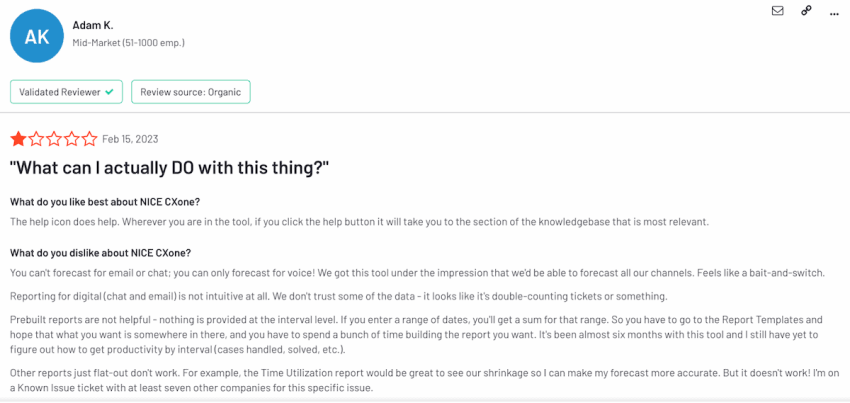
- Pricing complexity: Users frequently note that essential features or custom reports may require additional fees (add-ons).
- Support responsiveness: Support can be slower for mid-sized accounts compared to enterprise clients.
- Interface density: The UI is powerful but can be overwhelming for new agents due to the sheer volume of options and tabs.
Pricing Comparison: NiCE CXone vs. Five9
Contact center software pricing is complex and requires direct contact with vendors. However, here’s a general overview of the two solutions’ pricing structures.
NiCE CXone has a tiered pricing model (per user per month) and offers various packages to meet different business needs. Entry-level prices for individual agent features range from $110 for voice and digital channels to $209 for the complete suite.
Comprehensive packages with more extensive features start at $135 for the Essential Suite, $169 for the Core Suite, $209 for the Complete Suite, and $249 for the CXone Mpower Ultimate Suite. These entry-level prices may vary depending on the features selected and the number of agents. For exact, customized quotes, please contact NiCE sales directly.
In contrast, Five9 uses a quote-based pricing structure. For customized pricing information, you need to contact their sales team directly. Five9’s pricing depends on factors such as the number of employees, required features, and agreed-upon service-level agreements. Five9 doesn’t publicly publish all its prices, so for accurate pricing information, you should contact Five9 directly.
Final Verdict: NiCE CXone provides greater transparency by publishing prices for its tiered offerings, giving potential customers an initial overview of costs. Five9, on the other hand, has more personalized offerings and tailors its solutions to individual business needs. Both platforms offer scalable and customizable solutions, but you can only determine final pricing through their sales teams.

Should You Choose Five9 or NiCE?
Finding the right fit for your business needs requires understanding which solution aligns best with your priorities.
Who is Five9 best for?
- Sales-focused companies: Five9 is ideal for sales teams and companies that extensively use outbound campaigns.
- Companies that prioritize video engagement: The platform’s video conferencing features enable companies to enhance customer interactions through visual communication.
- Companies with complex integration requirements: Five9 offers strong integration options with CRM and other business applications.
Who is NiCE CXone best for?
- Companies requiring advanced analytics: NiCE CXone’s AI-powered analytics provide valuable insights for companies that value data-driven decision-making.
- Companies with high demands for customized solutions: The platform’s customization options tailor the solution to specific workflows and business needs.
- Omnichannel-focused organizations: NiCE CXonet’s omnichannel capabilities create smooth customer experiences across multiple touchpoints.
Choosing the Right Contact Center Solution
When choosing any communications platform, you need to know your needs, priorities, and budget first. And that goes with choosing between Five9 and NiCE, too.
Five9 is a strong choice for businesses that value outbound calling, video engagement, and CRM integrations. Its scalable architecture and reporting capabilities work well for growing businesses that need a reliable contact center infrastructure.
NiCE CXone features advanced AI-powered analytics, highly customizable solutions, and an omnichannel platform. Its strengths in social media integration and data-driven insights make it ideal for businesses that want to build personalized customer experiences across multiple touchpoints.

An Alternative You Should Consider
While evaluating the market leaders, it’s worth considering other options that might offer a different balance of features and value.
While Five9 and NiCE CXone offer comprehensive contact center solutions, Nextiva combines the positives of both. It offers easy-to-use and AI-powered contact center software that small businesses prefer because of its intuitive interface and simplified reporting capabilities.
Nextiva adds affordability to advanced features. It offers several pricing plans to help companies choose one based on their needs.

For mid-market and enterprise businesses, Nextiva delivers a comprehensive set of features with the advanced capabilities that bigger companies require. It offers call recordings, APIs to integrate with other business systems, workforce engagement features, and a robust cloud platform to deliver decent customer engagement and support.
Nextiva also provides a comprehensive knowledge base to promote self-service and enable customers to resolve issues faster.
Contact center service done right.
Level up team and agent performance with Nextiva – there’s something for every business.