Customer Experience
 Blog
 Business Communication
 Leadership
 Marketing & Sales
 Nextiva News
 Productivity
 VoIP
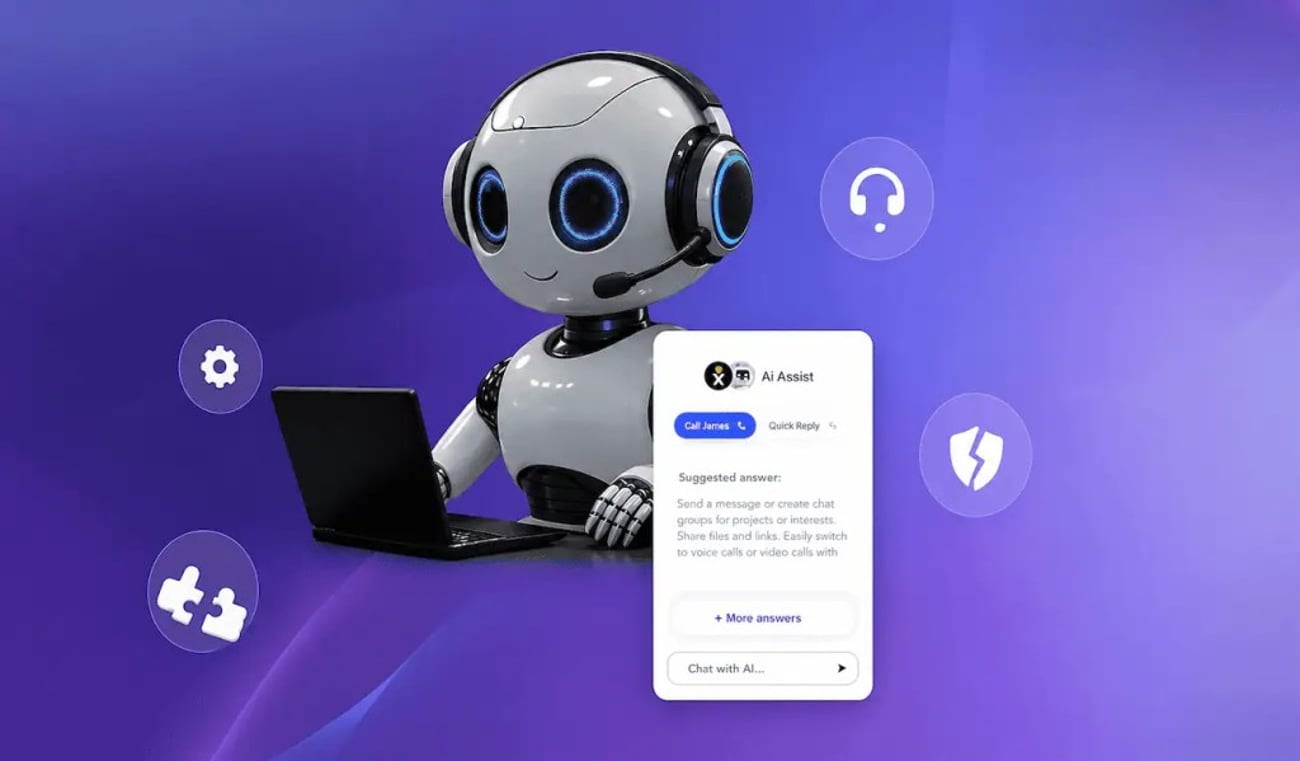

It’s 11 p.m.
A customer has an order number, a delivery date that slipped, and one question: “Where is my order?” Your support team is offline, so the call goes to voicemail.
Nextiva’s Customer Patience Benchmark found that customers expect a phone or SMS reply within five minutes. After missing that window, 56% switch channels and 28% abandon the product or service entirely.
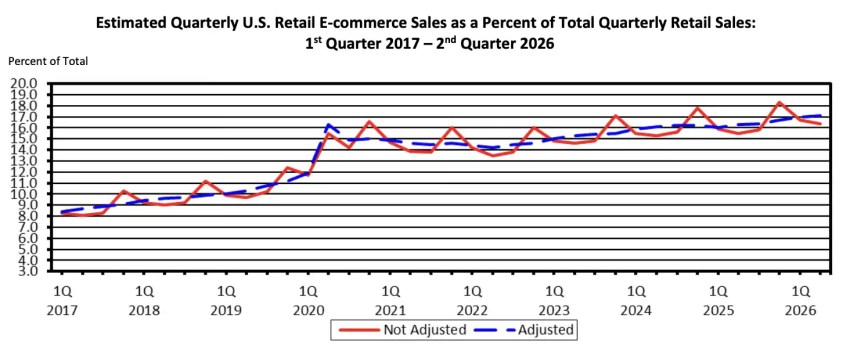
Phone support still has a place in ecommerce. U.S. ecommerce sales reached $340.2 billion in Q2 2026, representing 17.1% of total retail sales and a 12.2% year-over-year increase, per the U.S. Census Bureau. More orders mean more “where is it” calls.
The question is how to cover the phone without hiring virtual receptionists or a temporary support team every November.
Most store calls are some version of “where is my order?” (WISMO). For most ecommerce operators, the answer is to use AI for repetitive calls, connect it to real store data, and set a hard boundary around anything that requires judgment or sensitive payment information. I’ll show how an AI answering service for ecommerce answers those calls using live store data and exactly where it should stop.
What an AI Answering Service Does for an Online Store
An AI answering service uses a voice AI agent to understand inbound calls, retrieve information, answer routine questions, and transfer conversations when they reach a boundary you define. It relies on natural language processing to interpret what callers say.
A generic AI receptionist that can only take messages provides basic coverage. An ecommerce AI answering service becomes much more useful when it can access the systems behind the phone call.
Beyond handling multiple calls at once, an AI receptionist can help customers with smart product recommendations and analyze customer interactions.

Order status and shipment tracking
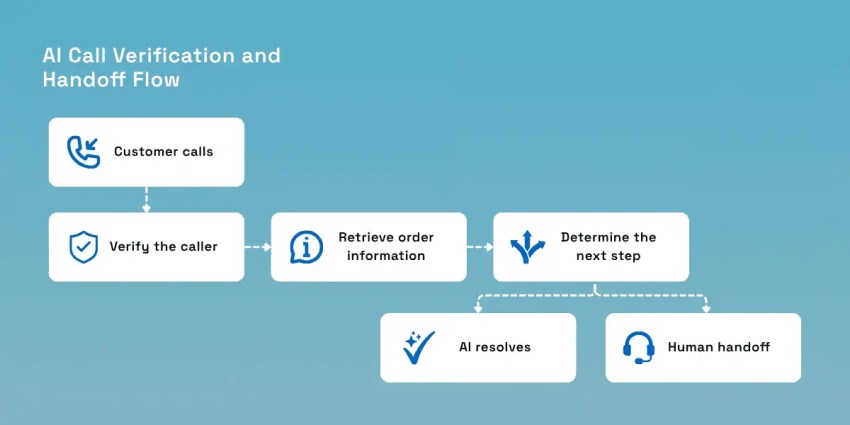
A reliable AI phone answering service should be able to identify the caller, verify them, pull up the order, read the tracking status, and text the tracking link while the caller is still on the line.
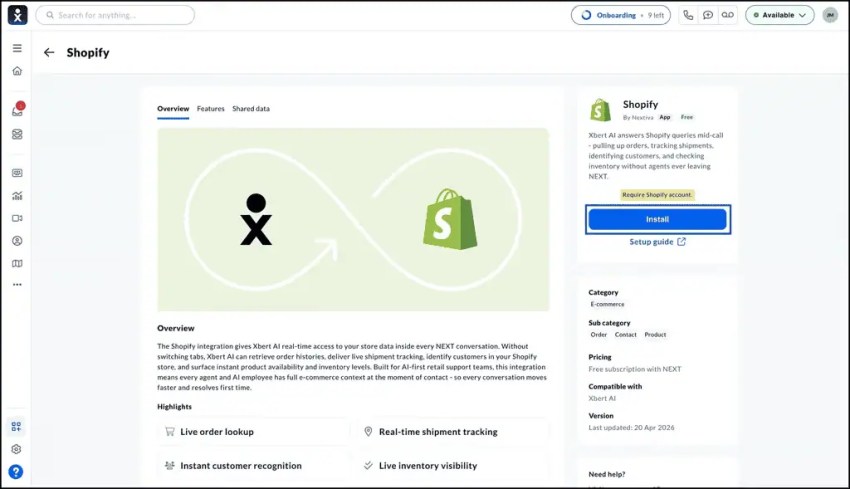
XBert, Nextiva’s AI receptionist, does all of these tasks through its Shopify integration. It retrieves order history and shipment tracking; identifies customers by name, email, or phone number; and checks live inventory levels.
That creates a much better call flow:
- The customer calls about an order.
- The AI receptionist verifies the caller.
- It retrieves the matching order.
- It checks the current fulfillment or tracking status.
- It explains the latest status.
- It can send the tracking link by text if the workflow supports it.
One type of call still goes to human agents. When the carrier says “delivered” and the customer says “it never arrived,” a lost or stolen package claim involves money and requires judgment. The AI answering service can read the status and pass the case on, along with the details.
Reading data, such as looking up a shipment, carries little risk. Changing an address, canceling an order, or issuing a refund, however, affects the customer’s transaction and should have tighter rules.
Product, shipping, and policy questions
AI agents can also provide consistent answers using approved store information, such as product availability, sizing, shipping timelines, return windows, and warranty terms.
The source should be your actual store information, not whatever a general-purpose AI model happens to know. And because the agent repeats whatever your documents say, two conflicting or outdated return pages produce two different answers. Pick one version of each policy and delete the old ones before launch.
This need for accurate store information is also one of the biggest reasons store integration and knowledge management deserve as much attention as voice quality when comparing AI answering services.
For example, a customer asking whether their size is available needs current inventory information. A customer asking whether a purchase can be returned needs your actual return policy. If the AI receptionist can’t verify the answer, the safer behavior is to say so and escalate to a human agent to protect customer satisfaction.
Add your shipping cutoffs too so the AI voice agents quote the right dates. If you sell to Spanish-speaking customers, test bilingual or multilingual support with a native speaker because voice quality can vary by language. Routine calls about products, shipping, and policies are the easiest wins in customer service automation.
Returns and damage claims
Returns are a good example of where an AI agent needs a defined boundary.
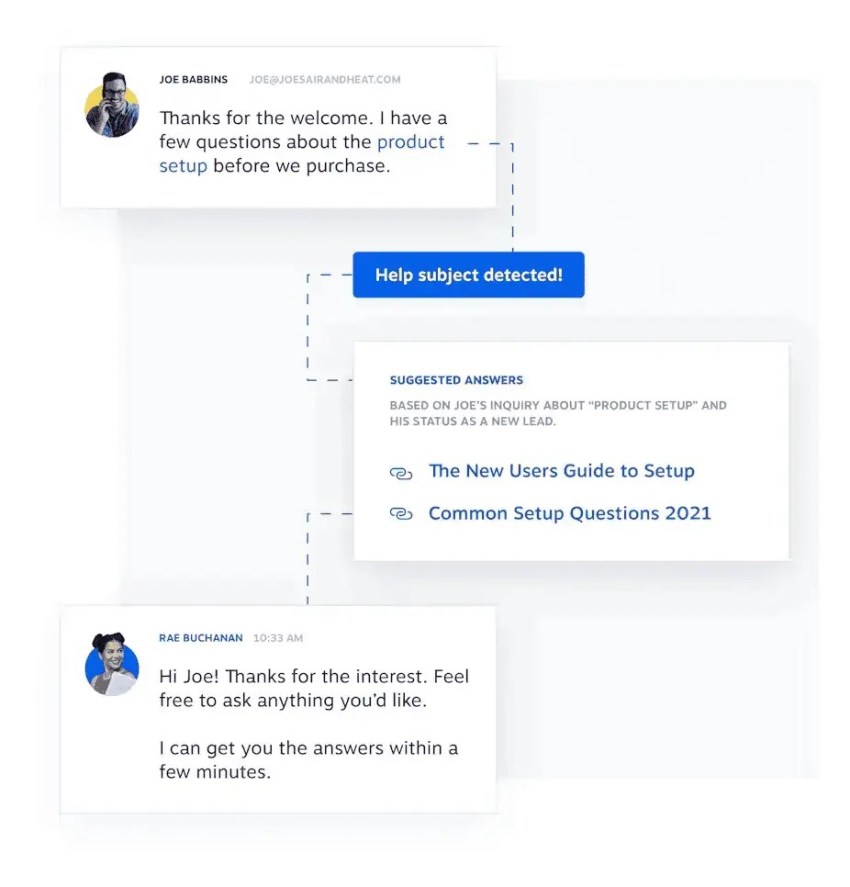
Many stores process returns in apps like Loop or AfterShip. The AI can check whether an order appears to fall within the stated return window and provide the correct return instructions. It can also send a link to the return workflow and route damage claims to a human agent.
XBert’s Shopify integration is built for lookups. During a conversation, it reads order history and fulfillment details, live shipment tracking, customer records (searchable by name, email, or phone number, with purchase history), and live inventory levels for product variants. It can also create and retrieve order information, as well as search and update customer contact information.
The integration needs an active XBert account or add-on and an active Shopify store.
A damaged item is different. The AI phone answering service may collect the order number, ask what’s wrong with the item, and request photos by SMS. But a human agent may need to review the evidence before approving an exception, replacement, refund, or other resolution.
That separation keeps the automated workflow useful without giving the AI unrestricted authority over customer disputes.

Information vs. Action: Where the AI Receptionist Should Stop
The biggest mistake I would avoid is giving an AI receptionist access to every action simply because the application programming interface (API) makes it possible. The better question is, “What does the caller need, and what happens if the AI gets it wrong?”
| Caller request | AI handles alone | Verification needed | Hand to a human |
|---|---|---|---|
| Where is my order | Yes | Phone match plus order number or ZIP | Lost or stolen package claims |
| Is this in stock | Yes | None | No |
| Can I return this | Yes, checks eligibility | Order lookup | Exceptions outside the window |
| Change my shipping address | Only before fulfillment | SMS one-time code | After the order ships |
| Update my payment | Sends a secure payment link | Never reads card numbers aloud | PCI-compliant payment flow |
| Damaged item or angry caller | Collects details and photos by SMS | Order lookup | Yes, with a full summary |
I sort every request into three groups: what the AI can look up, what it can change, and what it must never do.
Lookups are the low-risk group. Once a caller passes verification, the AI can share order status, tracking details, and whether an item is still eligible for return.
Changes include anything that alters an order or account. The only one I’d allow is a shipping address update, and only before the order goes to fulfillment, with an SMS one-time code as the check.
I’d launch with lookups only, then add address changes after detailed call summaries show the AI handles verification cleanly. Then, there’s the relatively short list of things the AI should never do:
- Read back a full address without stronger verification: A caller who only has an order number hasn’t proven who they are.
- Take card numbers by voice: This covers the card digits and security code.
- Approve policy exceptions: A refund or return outside your rules needs human approval.
- Decide fraud or lost-package claims: These involve real money and need human judgment.
- Promise a delivery date: If the carrier hasn’t confirmed it, the AI shouldn’t either.
Caller authentication
Caller ID is useful for routing, but because it can be spoofed per the FCC, it shouldn’t be treated as proof of identity by itself.
A safer approach is to combine signals. For example, the AI receptionist could match the caller’s phone number with an order number or ZIP. Another option is to send a one-time code by SMS before revealing order details or an address.
The exact authentication method should match the risk of disclosing the information. A customer asking about the general shipping time doesn’t need the same level of verification as someone asking for an order’s delivery address. The guiding principle is to verify before revealing customer-specific information.
Recordings and call summaries hold customer data, too. Ask where recordings live, how long they’re kept, and whether summaries mask the ZIP code and phone number.
Several states, including California and Florida, require every party to agree to recording, so the greeting should say that the call is recorded and that the caller is speaking with an automated assistant. If a vendor also offers outbound calling, ask your counsel about the FCC’s 2024 ruling that AI-generated voices count as artificial under the Telephone Consumer Protection Act.
Payments and PCI DSS
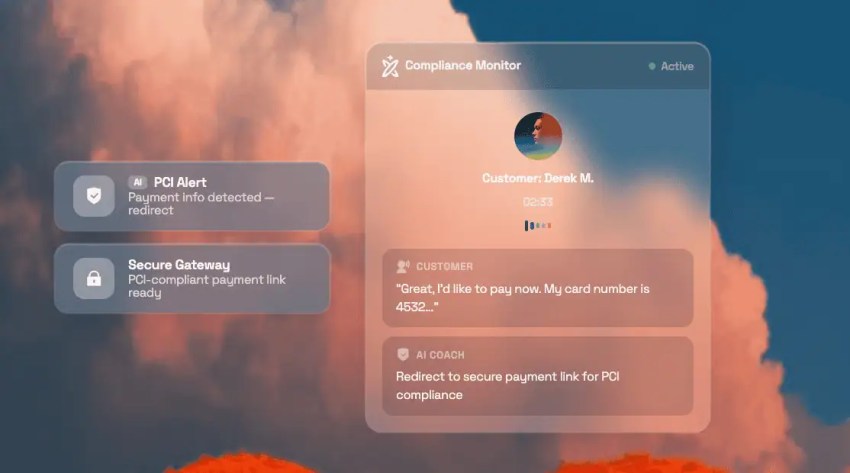
The AI should never collect card numbers by voice. If a caller needs to pay or update a payment method, the AI should text a secure payment or checkout link or hand off to a PCI-compliant payment flow.
Spoken digits end up in the transcript, recording, and summary. PCI DSS bars storing the card verification code, such as the CVV, after authorization, and a recording can capture one without anyone intending it. Keeping card data off the call removes that exposure.
Nextiva’s platform is PCI DSS-compliant, and Nextiva Contact Center offers secure payment handling on its higher tiers. Ask any AI answering service vendor, including Nextiva, for its PCI Attestation of Compliance and confirm it names the service you’re buying. A vendor’s compliance covers its systems. Your own scope depends on how customer data reaches you.
AI Phone Answering Service vs. Live Answering Services: The Cost Math
Published provider pricing shows how different the models can be when you’re considering an AI call answering service. Entry-level live answering plans work out to roughly $3 to $5 per minute. Ruby, for instance, starts at $250 for 50 minutes.
Other AI answering services, such as Rosie AI (a good option for small businesses that want to avoid missed calls) and Smith.ai, offer plans starting at $49 per month and $150 per month, respectively. Note that Smith.ai also offers a free plan for its AI-first call handling, which covers 25 calls per month.
Nextiva’s answering service cost guide lists the price for low or unpredictable call volumes as $0.75 to $1.50. Per the same guide, the monthly fee for an AI answering service can run between $50 and $300.
XBert costs $99 a month for 100 conversations, then $0.99 each. A conversation is a call over 30 seconds or a text or chat thread with three or more interactions. Per-minute AI answering service plans commonly run $0.10 to $0.50 a minute.
The cost math only matters if the phone line is worth keeping, and for high-consideration products, it is. The CEO of direct-to-consumer electric scooter maker Phat Scooters says customers “actually have to pick up the phone and call us.” Those buyers will call regardless, but the question remains who answers and what each answer costs.
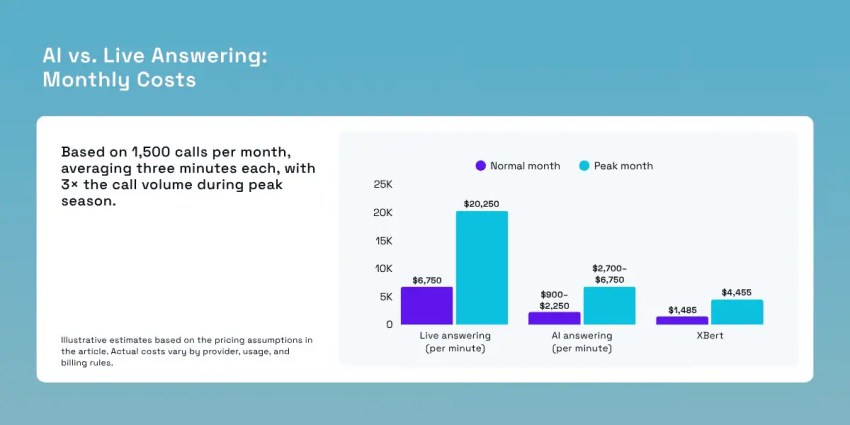
The figures in the table below are modeled on 1,500 calls per month, with peak season at three times the normal volume:
| Model | Rate assumption | Normal month | Peak month |
|---|---|---|---|
| Live answering, per minute | $1.50/min, per the Nextiva cost guide | $6,750 | $20,250 |
| AI, per minute | $0.20 to $0.50/min | $900 to $2,250 | $2,700 to $6,750 |
| AI, per conversation (XBert) | $99 for 100, then $0.99 | $1,485 | $4,455 |
The model is intentionally simple. Actual invoices depend on each provider’s billing rules, included allowances, overages, call duration, and which calls count as billable.
The per-minute AI answering service cost becomes attractive when calls are short. Per-conversation pricing is easier to model when you know roughly how many interactions you have, while live-agent pricing rises directly with the amount of human talk time required.
The bigger variable, though, is resolution.
If an AI receptionist answers 1,500 calls but sends nearly all of them to a human, the headline AI price tells you very little. If it safely resolves a large share of routine order status and policy questions, your support team spends less time on repetitive calls and more time on issues that need human judgment.
Peak season is where the models split
Black Friday, Cyber Monday (BFCM), and the holiday season are the periods when fixed staffing becomes challenging. A team of human receptionists has a physical limit. Add more calls, and you eventually add more people, queue time, or both.
An AI agent can handle many calls simultaneously. That makes it useful as an overflow layer even if you don’t want it answering every call year-round. Ask each vendor about concurrent call limits because “unlimited calls” can still hide a ceiling.
I would set up BFCM coverage before the rush. If you’re preparing for next year’s BFCM, start as early as July to audit your list health and performance, and setup should have been completed ideally before October.
Test it against real order scenarios while there’s still time to fix issues like bad answers, missing permissions, awkward call transfers, and authentication problems. Weigh temporary staff against automation to see which gives you the coverage you need. For more options, you can look into call center software for ecommerce.
Ask about setup fees, number porting charges, overage rates, and minimum contract terms. Also ask whether call recordings and detailed call summaries cost extra. These rarely appear in headline pricing, and they change the math for ecommerce businesses.
Best AI Answering Services for Ecommerce Compared
There’s no single pricing model or integration approach that fits every store. The important distinction is what each option can access and what happens when it reaches a request outside its scope.
| Option | Best for | Store integration | Channels | Pricing model |
|---|---|---|---|---|
| Nextiva XBert | Stores that want calls, texts, and chat answered by one AI with human handoff | Native Shopify: orders, tracking, customers, inventory | Voice, SMS, web chat | $99/mo for 100 conversations, then $0.99 per conversation |
| Ringly.io | Shopify brands that want a phone-only AI agent | Native Shopify | Voice | Per-conversation plans, with a minimum of $99/month for 50 conversations, then $1.99 per conversation |
| Gorgias AI Agent | Stores already running Gorgias as the help desk | Deepest on Shopify | Email, chat, SMS, social | Starts at $0.85 (Advanced plan) to $1.00 (Starter plan), per automated interaction |
| Live answering services | Stores that want a human on every call | Varies | Voice | Per minute or per call |
Nextiva XBert
XBert works as one AI employee across phone, text, and chat, with Shopify data inside the conversation. When it hands off, your team gets full context. For Shopify stores, the integration can retrieve order history, shipment tracking, customer records, and live inventory, giving your AI agent something much more useful than a static FAQ.
It offers a free 14-day trial and sets up in minutes. The underlying platform holds SOC 2 Type II and PCI DSS certifications. If you already run an ecommerce chatbot and only need phone coverage, a phone-only tool may be your best option.
Ringly.io
Ringly.io is a phone-specialist AI built for Shopify. It’s focused and fast to launch. It handles voice only, so you’ll need another tool for text and chat.
The platform can look up Shopify orders, verify caller identity, handle product questions, request returns, and create or send information by creating helpdesk tickets (Gorgias, Zendesk) and texting links to callers. Note that the latter is a custom skill. That makes it particularly relevant if the phone is the main problem you’re trying to solve.
Gorgias AI Agent
Gorgias is a strong fit for stores already using it for customer support. Its AI Agent is deeply connected to Shopify and can handle order tracking, returns, cancellations, and other ecommerce support tasks. Gorgias says its AI Agent works across email, chat, SMS, and social channels.
While its AI Agent doesn’t answer phone calls, the Gorgias Voice add-on lets human agents make and receive calls in the help desk. Third-party integrations bring AI voice into Gorgias and create tickets with call context.
Live answering services
Live services bring human intervention to complex sales calls at human prices. They suit low call volumes or work as overflow behind an AI. Nextiva’s ecommerce answering service guide covers that route in more depth.
How to Route Store Calls to AI in 4 Steps
Step 1: Connect the store and load your content. For Shopify, Nextiva’s set-up documentation says you need a custom Shopify app access token. The integration requires at least the read products permission scope, and the token is displayed only once in Shopify. By default, a Shopify app only reads the last 60 days of orders unless the store grants broader access, so ask how your vendor handles older orders.
Then load the information the AI agent needs to answer routine questions, such as shipping policies, return and exchange rules, product information, business hours, warranty terms, and escalation rules. Don’t give the agent permissions it doesn’t need.
Step 2: Forward calls. You can route inbound calls to the AI receptionist, use it after hours, or send calls to it only when your team is busy. You can also give the AI its own number. For a cautious launch, I would start with after-hours calls and overflow. That gives you real customer conversations without immediately putting every call through the new phone system.
Step 3: Define escalation triggers. Write these rules before launch. Send the call to a person for suspected fraud, chargeback language, high-value retail orders, damaged or missing shipments, repeat callers, and negative sentiment. The AI phone agents should also hand off when they can’t confidently verify the customer’s information.
Step 4: Test before you go live. Call with real order numbers and peak-season scenarios, such as a late order or an address change after shipping. Also test noisy backgrounds, accents, interruptions, corrections, and customers who change their minds halfway through a sentence. Beyond listening for a robotic voice, check whether your AI answering service gives confident wrong answers.
Nextiva’s network has eight points of presence and strives for 99.999% uptime, so the infrastructure shouldn’t be your weak link.
Answer Every Order Call With XBert
Back to the 11 p.m. caller.
What they need is an answer, and with the right setup, an AI receptionist picks up, verifies the caller, and texts the tracking link in under a minute. If the package is lost or the situation falls outside the store’s rules, the AI should get out of the way and bring in the right person with full context.
XBert is Nextiva’s AI receptionist. It handles Shopify order lookups across calls, texts, and chats; starts at $99 a month; and hands off to your team when it matters. Unlike traditional answering services, XBert can route calls, let you design custom call flows, answer frequently asked questions, schedule appointments, and generate instant call summaries. Beyond ecommerce, these key features are useful for most businesses, including small businesses and law firms.
Start with order status, keep card numbers off the phone, and set your escalation rules before Black Friday. That way, the next customer who calls at 11 p.m. with an order number gets the right answer instead of a voicemail.
See Nextiva’s AI answering service and start the free 14-day trial.
Stop missing calls. Use the best AI answering service.
XBert AI gives your business 24/7 coverage—handles calls, texts, and chats, books meetings, and escalates urgent calls so customers never have a bad experience.