

 Customer Experience
  Blog
Blog  Business Communication
  Leadership
  Marketing & Sales
  Nextiva News
  Productivity
  VoIP
VoIP 

I have spent years helping B2B companies build go-to-market strategies. One pattern has shown up often. Businesses pour money into generating demand but lose a surprising share of it at the moment of contact.
The product works. Pricing checks out. Nobody answers the phone, though, and the generated demand goes to someone else. A missed call solution is no longer optional.
Let’s say you missed 10 calls in a day for any reason. If your conversion rate is 10%, and the average customer value is $500, you’re missing out on 26 new customers and an ROI of close to $151K in the first year.
An AI receptionist fills in for you, not as a novelty but as a system that captures every inbound conversation and connects it to a business outcome.
Try the best AI answering service free for 14 days
XBert AI answers questions and captures leads. Add your 24/7 answering service in minutes.
What Is an AI Receptionist?
An AI receptionist answers your incoming calls, texts, and chats using natural language processing and artificial intelligence (AI). It understands what callers need, responds in real time, and takes action, such as booking appointments, qualifying leads, answering common questions, or routing complex requests to the right person with full context.
It’s a significant upgrade over traditional phone trees and rigid IVR menus. Instead of forcing callers to press 1 for sales, an AI virtual receptionist holds a real conversation. The shift from menu navigation to natural dialogue changes the entire process and caller experience. A typical workflow looks like this:
- A customer calls the business
- The AI voice receptionist answers instantly
- Speech recognition converts voice into text
- The AI identifies caller intent
- The system performs actions such as scheduling, call forwarding, routing, or answering questions
- CRM and calendar integrations update records automatically and connect with other business tools
- Complex conversations escalate to human agents with full context

What it is not: An AI receptionist is not a chatbot bolted onto a phone system. A true AI receptionist system operates across the full customer lifecycle, from first contact through post-sale support, to enhance customer satisfaction and deliver a memorable customer experience.
Gartner projects that by 2029, agentic AI will resolve 80% of common service issues without human intervention, cutting operational costs by 30%. When you adopt an AI receptionist, it’s the reality you’ll be building toward.
AI receptionist vs. IVR vs. chatbots vs. traditional receptionists
While all of them handle customer communication, they operate very differently. Before exploring AI receptionist use cases, you should understand how each solution operates and how they align with customer expectations.
| Technology | Interaction style | Primary channels | Data automation (CRM) | Concurrency (scalability) |
|---|---|---|---|---|
| Traditional IVR | Rigid menus (press buttons) | Phone only | None / limited | High (lines only) |
| Web chatbot | Scripted text flows | Website and chat apps | Moderate | Highly scalable |
| Human staff | Natural conversation | Phone / in-person | Manual updates | None (1 call at a time) |
| AI receptionist | Fluid, natural dialogue | Phone, SMS, and web chat | Real-time API sync | Highly scalable |
AI Receptionist Use Cases Across the Customer Journey
AI receptionists work at every stage of the customer journey, from the first inbound inquiry to post-sale queries and long-term customer retention.
A missed call during the awareness stage can cost you a lead, while slow support after a purchase can hurt customer loyalty. Understanding how AI receptionists support each stage helps businesses improve response times, reduce manual work, and create a better customer experience.
| Customer journey stage | AI receptionist use cases |
|---|---|
| Awareness | 24/7 call answering, lead capture, and FAQ handling |
| Consideration | Lead qualification, pricing inquiries, and callback scheduling |
| Conversion | Appointment booking, customer onboarding, confirmation calls |
| Support | Order tracking, ticket routing, self-service support |
| Retention | Feedback collection, renewal reminders, follow-ups |
| Operations | CRM updates, analytics reporting, compliance workflows |
Awareness and First-Contact Use Cases
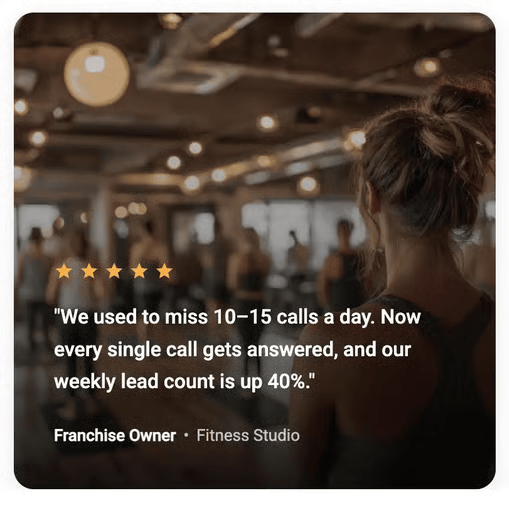
Most businesses think their awareness problem is about generating more leads. In my experience, the bigger problem is wasting the leads they already have.
A prospect clicks an ad at 7 p.m. and calls the number on your landing page. Voicemail picks up. They had real intent, but it vanished. A survey by Vida found that 42% of SMBs estimate they lose at least $500 per month due to missed calls alone.
An AI-powered answering service closes this gap by answering every inbound call instantly, including after hours, on weekends, and on holidays, which prevents callers from reaching voicemail or hearing busy signals. It’s the baseline, though; what happens next is what creates value.
What AI receptionists handle at first contact
Below are some common use cases that an AI receptionist supports during first contact:
- 24/7 call answering with real-time availability, and consistent brand messaging, whether someone calls even outside standard business hours
- Missed-call lead capture that logs the caller’s name, reason for calling, and urgency instead of routing calls to voicemail
- Intent-based call routing that directs callers by need (billing, new inquiry, emergency calls) rather than rigid menu options
- Spam and vendor filtering to screen robocalls and solicitors before they reach your team
- Source attribution that tags “How did you hear about us?” answers to the correct campaign, keyword, or referral
- Service-area confirmation using ZIP code logic, so out-of-area callers get a polite redirect instead of wasting human staff time
- Repeat caller recognition that identifies returning callers across sessions and channels
Additional first-contact workflows include:
- Website-to-phone escalation when visitors request instant answers
- Multilingual greeting support with multiple languages for global customers
- Urgent call prioritization for emergency inquiries
- Local branch routing based on geographic location
- Automated callback scheduling during high call volumes
- Lead source attribution connected to paid campaigns
- New customer intake before human handoff
- Business-hours messaging personalization
How this works in practice
A home services company runs ads on Google, Facebook, and local radio. After hours, XBert answers every call. It confirms service-area eligibility, logs how each caller found the business, and ties the conversation to the right campaign.
Hear why XBert AI is the best AI receptionist
XBert AI receptionist handles customer questions, captures leads, and books appointments. Try it free for 14 days.
Before this, leadership reviewed click data and guessed which ads worked. Now they see which campaigns generate actual service calls with qualified intent. This distinction changes how they allocate the budget.
McKinsey’s Global Survey on AI found that 88% of organizations now use AI in at least one business function. Another 62% are experimenting with AI phone agents. For small businesses, the opportunity is not about adopting AI for its own sake. It’s about plugging the revenue leak at the front door.
Yet adoption remains inconsistent.
Despite the clear cost of missed calls, only 22% of SMBs have adopted AI voice agents to address the problem. Many still associate the technology with the robotic phone systems of the past. This perception gap creates a window.
Businesses that adopt early capture the leads their competitors are still sending to voicemail.
Consideration and Evaluation Use Cases
Once someone shows interest, the next challenge is keeping them engaged long enough to convert. This is where sales teams get buried.
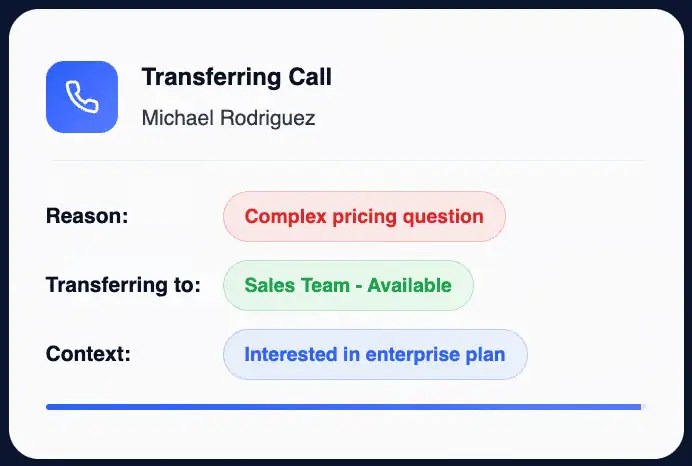
A prospect calls to ask about pricing. You are on another line with your rep. Several scenarios are possible, including the following two. The prospect is sent to voicemail, and instead of waiting for you to call back, the prospect calls a competitor and books with them.
Or maybe someone else in your office, who cannot speak to the specific service needed, picks up the call from the prospect and promises a callback. By the time you call back, the moment has passed.
An AI-powered receptionist handles these conversations without adding headcount. It answers questions and FAQs from your product and policy data, explaining service differences in plain language. It helps callers self-qualify before speaking with a sales representative.
What AI receptionists handle during evaluation
Below are some common use cases that an AI receptionist supports during consideration and evaluation:
- FAQ resolution using live product, service, and policy data from your knowledge base
- Service and plan comparisons explained in conversational language
- Pricing transparency by sharing ranges or estimates so callers self-qualify before talking to a closer
- Lead qualification through questions about budget, timeline, and fit, with conversation scoring built in
- Prioritized routing that sends high-intent callers to senior reps and routine inquiries to the right queue
- Prehandoff intake, capturing all relevant details before connecting to a human, so the rep does not start from scratch
- Objection logging that records what the caller said, in their own words, for sales coaching and product feedback
- Structured CRM updates with call summaries, call transcripts, scores, and next steps logged automatically
- Scheduled callbacks as an alternative to hold times, reducing call abandonment
Additional evaluation workflows include:
- Demo scheduling directly from inbound calls
- Budget qualification before routing to sales representatives
- Automated follow-up reminders
- Abandoned inquiry recovery workflows
- CRM-based personalization using prior interaction history
- Real-time lead scoring based on conversation quality
- Product recommendation prompts
- Territory-based lead assignment
How this works in practice
A law firm has to handle multiple calls each day. Some come from prospective clients with an urgent need for legal services. Others involve billing questions, document requests, or general inquiries. Without any filtering layer, attorneys answer every call regardless of whether it requires legal expertise.
XBert changes that. It screens each caller, captures case details, and logs them. Objections and concerns get recorded verbatim. Qualified matters route directly to the right attorney, and lower-priority inquiries receive a scheduled callback.

As a result, attorneys spend more time on billable work, and the firm captures structured data to refine its intake process over time.
Conversion and Onboarding Use Cases
The caller has done their research. They have asked basic questions, and they are ready to move forward.
Speed determines whether they convert or drift. If booking requires a callback, if the confirmation takes a day, or if nobody explains what happens next, friction compounds. Gartner reports that 85% of customer service leaders are now piloting conversational AI solutions to close exactly these kinds of gaps.
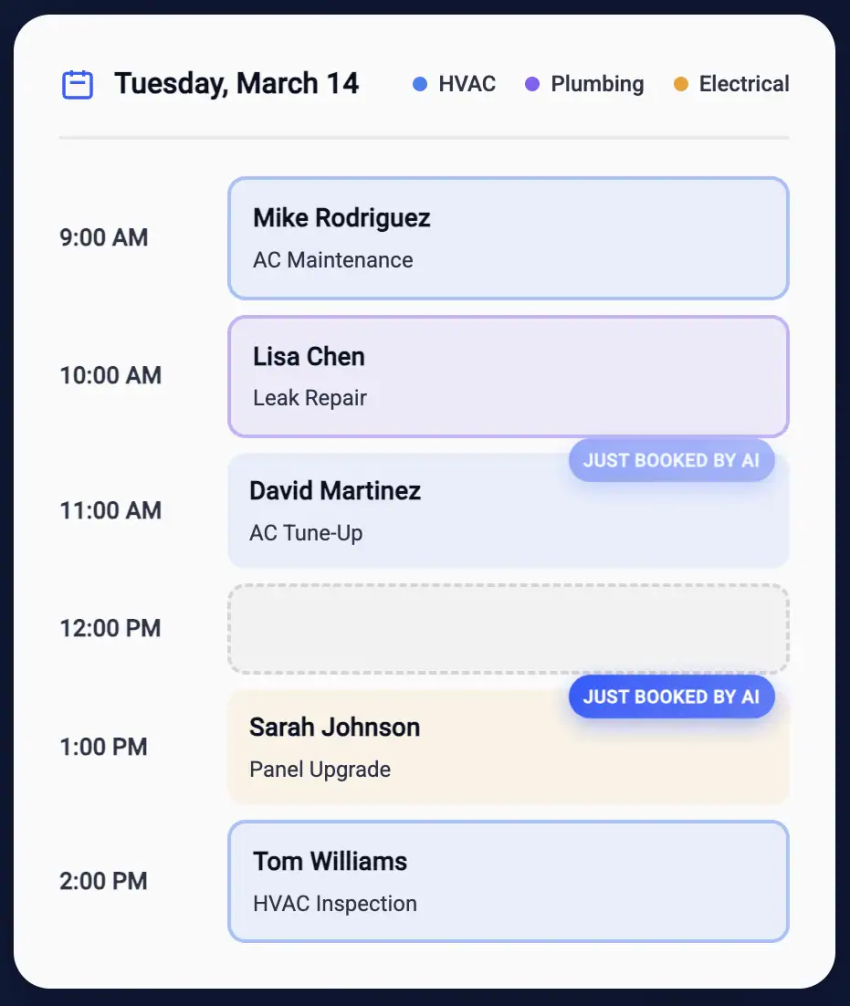
An AI receptionist ensures completion of the loop in real time. It books on live calendars, confirms by text, sends reminders, and walks the caller through the next steps before they hang up.
What an AI receptionist handles at the point of conversion
Below are some common use cases an AI receptionist supports at the point of conversion:
- Real-time appointment scheduling on live calendars with no human coordination required
- Voice and text confirmations for immediate communication after booking
- Same-day reminders to reduce no-shows, a costly problem for service businesses
- SMS consent collection using compliant language, with opt-in proof tied to the caller identity
- Preferred channel confirmation so follow-up happens where the customer wants it (text, email, or phone)
- Automated post-call follow-ups with next steps, welcome information, or onboarding documents
- Voice-based intake collection to capture insurance information, preferences, or account details before the first visit
- Immediate next-step walkthroughs so callers know exactly what to expect after purchase or booking
Additional onboarding and scheduling workflows include:
- Digital form collection before appointments
- Insurance verification workflows
- Payment reminder automation
- Waitlist management for cancellations
- Time zone coordination for remote consultations
- Recurring appointment scheduling
- Automated onboarding instructions
- New potential customer welcome sequences
How this works in practice
A medical practice loses bookings when human receptionists are already on calls. Patients phone during peak hours, get put on hold, and hang up.
XBert answers instantly. It books appointments into the scheduling system, confirms via SMS, sends a reminder the day before, and collects basic intake information by phone. It allows front desk staff to handle in-person patients without constant interruptions from ringing phones.
This is not about replacing staff. A study published in the Journal of the American Medical Informatics Association found that 72% of healthcare organizations rank reducing caregiver burden as their top goal for deploying AI. The technology handles call volume to let people handle care.
Support and Active Service Use Cases
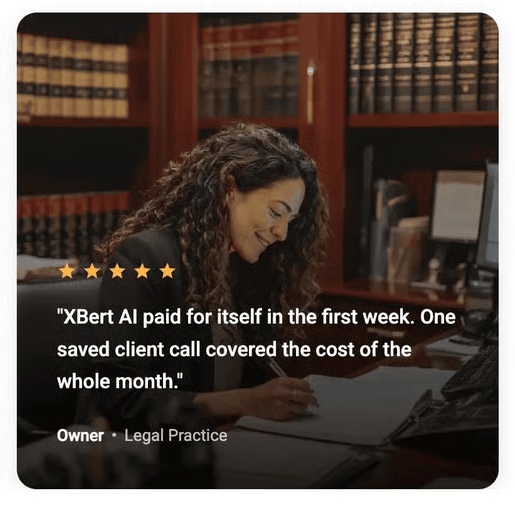
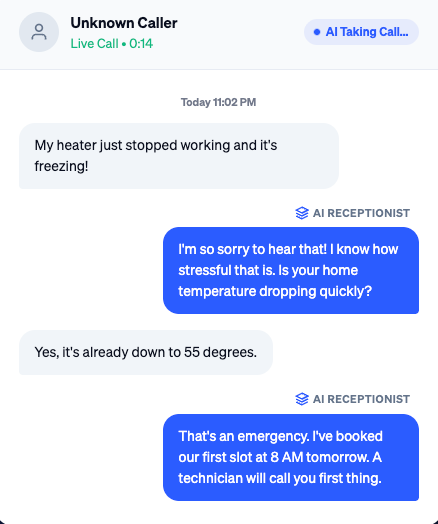
Support teams face a version of the same problem as sales: too many low-complexity interactions consume time meant for high-value work.
A customer calls to check their order status. An agent pulls it up, reads a tracking number, and the call ends, taking up three minutes of agent time with zero value beyond what an automated lookup could deliver. Now multiply that across every “Where’s my order?” call during a holiday promotion.
What AI receptionists handle during active service
Below are some common use cases that an AI receptionist supports during active service:
- Instant resolution of common questions like hours, policies, return windows, and account details
- Order, ticket, or case status delivery by phone without agent involvement
- Severity-based routing that triages by product, account tier, or urgency
- Detailed problem capture before escalation, so agents receive full context on transferred calls
- After-hours triage that categorizes and queues issues for morning follow-up
- Repetitive question deflection that keeps known-answer inquiries out of the agent queue
- Verbal self-service paths that walk callers through troubleshooting before routing to a human
- Resolution confirmation to close the loop and prevent repeat calls on the same issue
Additional self-service automation workflows include:
- Password reset guidance
- Subscription status inquiries
- Billing and invoice questions
- Return and refund policy explanations
- Store hours and holiday updates
- Troubleshooting walkthroughs
- Service outage notifications
- Ticket status updates
How this works in practice
An e-commerce brand runs a holiday promotion. As a result, call volume triples. Most callers want tracking updates. A smaller group has real issues: wrong items, damaged shipments, and payment questions.
XBert handles tracking requests instantly by pulling real-time data and delivering it over the phone. Genuine issues route to agents with full context, including the customer’s order number, prior troubleshooting steps, and the specific problem described in their own words.
The support queue stays manageable, allowing agents to focus on cases that require judgment and empathy.
| Interaction type | Without an AI receptionist | With an AI receptionist |
|---|---|---|
| Order status inquiries | Agent handles manually (3–5 minutes each) | AI resolves instantly |
| Complex issues | The agent receives a call with no context | The agent receives a call with a full summary |
| After-hours calls / Incoming calls after business hours | The agent addresses the voicemail on the next business day | System triages and queues with priority tags |
| Repeat calls on the same issue | Customer re-explains each time | AI confirms resolution, prevents repeats |

Retention, Expansion, and Intelligence Use Cases
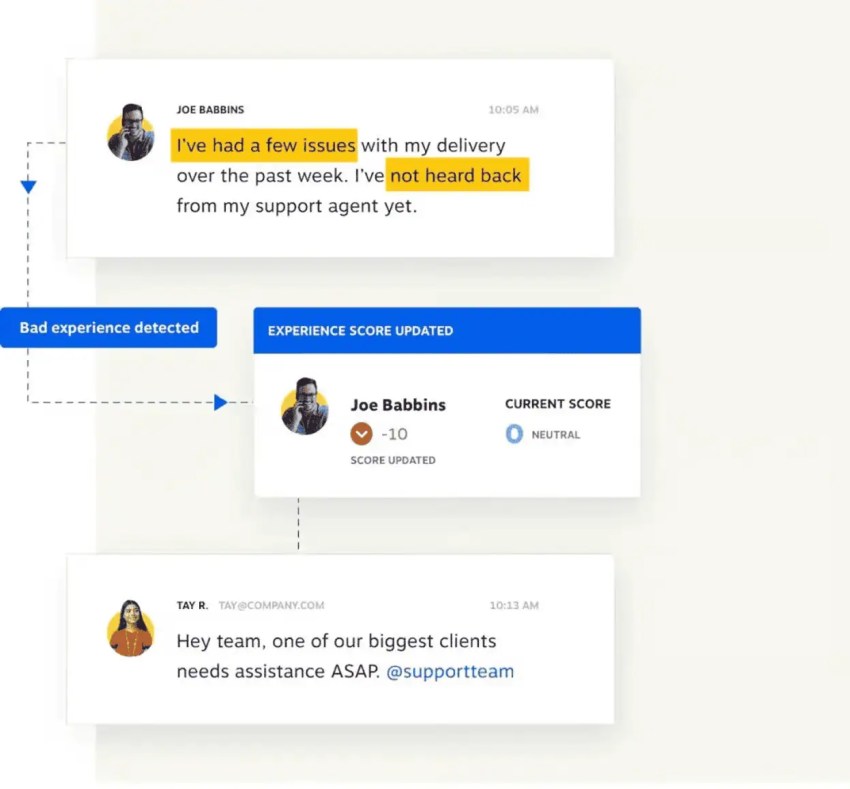
Most businesses track acquisition closely but treat retention as a reporting metric rather than an operational workflow. A customer who calls three times in two weeks about the same issue is sending a signal. If nobody acts on it, the next call is a cancellation request.
An AI phone receptionist does more than answer phones. AI agents listen for patterns indicating churn risk, expansion interest, or shifting sentiment. Then it routes those signals to the people who can act on them.
What AI receptionists handle post-sale
Below are some common use cases an AI receptionist supports after-sales:
- VIP and high-value customer routing that prioritizes accounts based on spend, tenure, or tier
- Churn risk detection triggered by repeated calls, negative tone, or escalation patterns
- Cancellation handling with structured save workflows, offering alternatives before processing the request
- Rep-free support answering renewal and contract questions directly
- Upsell and cross-sell routing connecting expansion-ready callers to specialists
- Revenue attribution that ties upsell conversations to the original acquisition sources
- LTV-based channel tracking that identifies which acquisition channels produce the highest lifetime value
- Structured feedback collection that captures data right after interactions, when recall is highest
- Voice-of-customer insights at scale that surface themes, objections, and requests across hundreds of conversations
Additional customer retention workflows include:
- Renewal reminder calls
- Membership expiration notifications
- Loyalty program updates
- Customer satisfaction surveys
- Review request automation
- Proactive follow-up campaigns
- Reactivation outreach for inactive customers
- Escalation routing for high-value accounts
How this works in practice
XBert captures feedback during each call, logs it in the CRM, and routes the next interaction to a retention specialist rather than general support. The specialist sees the full history and addresses the root cause before the customer reaches the cancellation page.
This is where AI receptionists move from cost savings into revenue protection. The value is not in answering the call. It is in understanding what the call means.
Operations and Revenue Optimization Use Cases
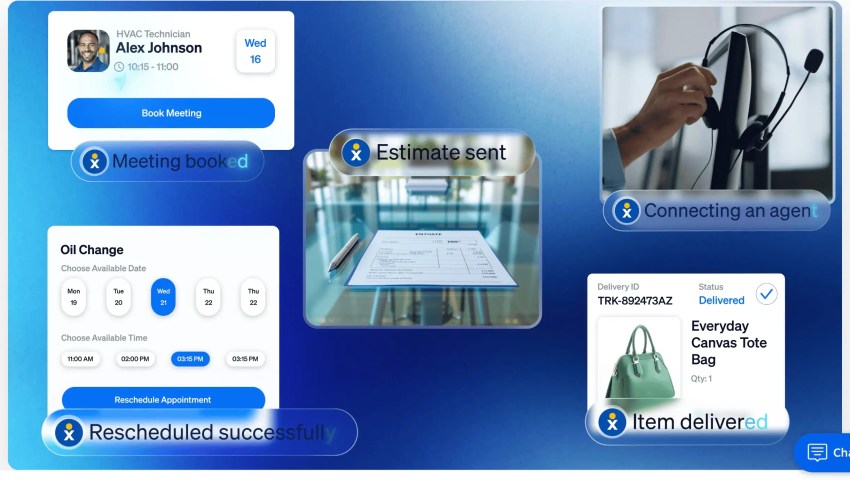
Every use case above generates data. The operational question is whether that data sits in call logs nobody reads or feeds decisions that improve the business. An AI receptionist functions as an operational intelligence layer. It streamlines call handling across locations and normalizes attribution data across channels.
What AI receptionists handle operationally
Below are some common use cases that an AI receptionist supports in operations:
- Peak-hour workload reduction by absorbing routine calls, so live agents handle only complex issues
- Cross-location consistency in call handling, messaging, and data capture
- Attribution normalization reconciling data across phone, CRM, and marketing platforms
- Phone-to-revenue credit assignment tying closed deals to the call that started them
- First-touch versus last-touch tracking so marketing teams understand the full journey
- Campaign quality scoring that evaluates ad channels by close rate, not just call volume
- Compliance enforcement for consent, disclosure, and regulatory requirements
- Call intent forecasting using trend data to predict staffing needs and campaign performance
- Training gap identification from patterns in mishandled or escalated calls
- ROI proof connecting conversations directly to revenue outcomes and case studies
Additional AI answering service workflows by industry include:
- Healthcare: Manage appointment scheduling, patient intake, insurance verification, prescription refill requests, appointment reminders, and after-hours triage
- Legal firms: Consultation qualification, case-detail collection, urgent matter routing, consultation scheduling, potential client intake
- Home service providers: Dispatch coordination, emergency call routing, service-area verification, estimate scheduling, technician reminders
- Real estate: Buyer qualification, property tour scheduling, lead routing, financing information collection, post-showing follow-ups
- Restaurants and hospitality: Reservation management, booking confirmations, waitlist updates, customer inquiries, multi-language support
- E-commerce: Order tracking, shipping updates, return workflows, payment issue escalation, seasonal support handling
- Dental clinics: Appointment confirmations, cancellations, insurance intake, reminder calls, answer frequently asked questions from patients
- Automotive services: Service booking, maintenance reminders, repair-status updates, roadside assistance routing
- SaaS companies: Demo scheduling, lead qualification, subscription support, renewal reminders, and onboarding coordination
- Property management: Tenant maintenance requests, rent reminders, visitor management, emergency escalation
How this works in practice
A multi-location business believes one ad channel is its top performer because it generates the most calls. Marketing allocates the budget accordingly.
XBert AI reveals a different story. A second channel produces fewer calls but far higher close rates and customer lifetime value. The high-volume channel generates tire kickers, but the smaller channel generates buyers.
Without structured call data tied to revenue, that insight stays hidden. Marketing keeps spending on volume, while revenue stays flat. With an AI receptionist capturing and structuring every conversation, the customer data is available to support smarter allocation decisions.
Common AI Receptionist Implementation Challenges
While AI receptionists improve operational efficiency, implementation quality determines long-term success. Businesses that own AI receptionists and use them without proper workflows, integrations, or escalation logic are unable to deliver a smooth customer experience.
Below are some of the most common implementation challenges businesses face:
| Challenge | Impact | Solution |
|---|---|---|
| Poor call flows | Frustrating customer experience | Optimize conversation design |
| Weak CRM integrations | Data silos | Use native integrations |
| Robotic conversations | Lower trust | Use conversational AI models |
| Improper escalation logic | Lost customers | Build smart handoff workflows |
| Compliance concerns | Legal risk | Use consent and disclosure workflows |
| Inaccurate speech recognition | Misrouted calls | Train industry-specific terminology |
Businesses that continuously optimize workflows, integrations, and conversational experiences typically see stronger long-term ROI from AI receptionist implementations.
Capture More Conversations With XBert
Missed calls, misrouted conversations, and lost context are not staffing problems. They are system problems.
Throughout this article, we have outlined over 51 use cases across awareness, consideration, conversion, support, retention, and operations. The thread connecting all of them is straightforward: every inbound conversation carries intent, and that intent has value only when someone captures it.
Nextiva’s XBert AI receptionist answers every call, text, and chat with a natural voice. It books appointments, qualifies leads, routes complex requests with full context, and logs structured data to your CRM, and setup takes just minutes. Its pricing starts at $99/month, making it a cost-effective solution with significant cost savings.
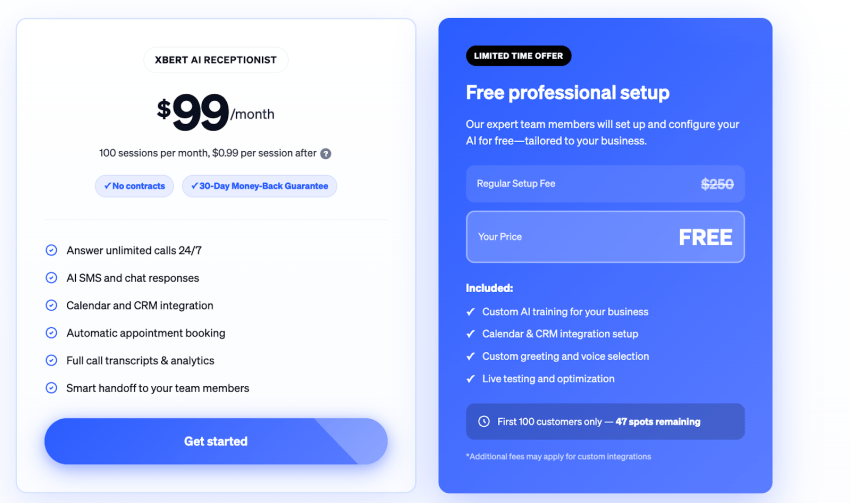
What separates XBert from basic answering services is scope. It handles interactions across channels, connects to your calendar and CRM, and turns every conversation into actionable data.
For business owners ready to treat phone calls as revenue-driving assets, the AI receptionist ROI calculator is a solid starting point. See exactly what unanswered calls cost you, and what capturing them could be worth.
Explore XBert and stop losing revenue to missed calls.
Your AI receptionist that never misses a call.
XBert is your AI answering service that handles calls, texts, and chats 24/7. It greets customers, books appointments, and captures leads while your business grows.
Frequently Asked Questions About AI Receptionist Use Cases
An AI receptionist answers calls and automates repetitive front-desk workflows using conversational AI. Modern AI receptionists have evolved into sophisticated digital teammates that manage end-to-end workflows across sales, support, scheduling, onboarding, and customer service operations.
Additionally, AI receptionists bridge the gap between online browsing and human support, providing a more professional customer service function.
AI receptionists help real estate teams respond quickly to inbound leads, qualify buyers based on budget and timeline, schedule property showings, and route inquiries to the right agents. Speed matters in real estate because responding within minutes can significantly improve lead conversion rates.
AI receptionists automate repetitive tasks like appointment scheduling, lead qualification, FAQ handling, and call routing. This allows human staff to focus on higher-value customer interactions, relationship building, and strategic work rather than routine administrative tasks.
The average traditional receptionist salary can exceed tens of thousands of dollars annually when factoring in wages, benefits, and overhead costs. In comparison, AI receptionist platforms typically cost a fraction of that amount, making them a more scalable option for many businesses.
Healthcare providers, law firms, real estate agencies, home service businesses, ecommerce brands, restaurants, hotels, and small businesses with high inbound call volume benefit significantly from AI receptionists.
AI receptionists act as an extra set of hands for solo practitioners or small teams to capture revenue that would otherwise be lost to voicemail by answering every inbound call, capturing leads, scheduling appointments, and reducing missed opportunities that would otherwise go to voicemail.
Yes. Hotels and hospitality businesses use AI receptionists for reservation management, contactless check-ins and check-outs, guest inquiries, multilingual support, and local recommendations for restaurants and nearby attractions.
Yes. Modern AI receptionists can support secure payment collection and document workflows by using PCI-compliant audio masking to process payment information safely over the phone. They can also send digital signature links through platforms like DocuSign to help customers review and sign contracts in real time.
AI receptionists may also flag overdue balances during inbound calls and guide customers through payment recovery workflows. However, businesses should still route complex legal or financial situations that require licensed expertise, strategic advice, or professional judgment to qualified human staff.