

 Customer Experience
  Blog
Blog  Business Communication
  Leadership
  Marketing & Sales
  Nextiva News
  Productivity
  VoIP
VoIP 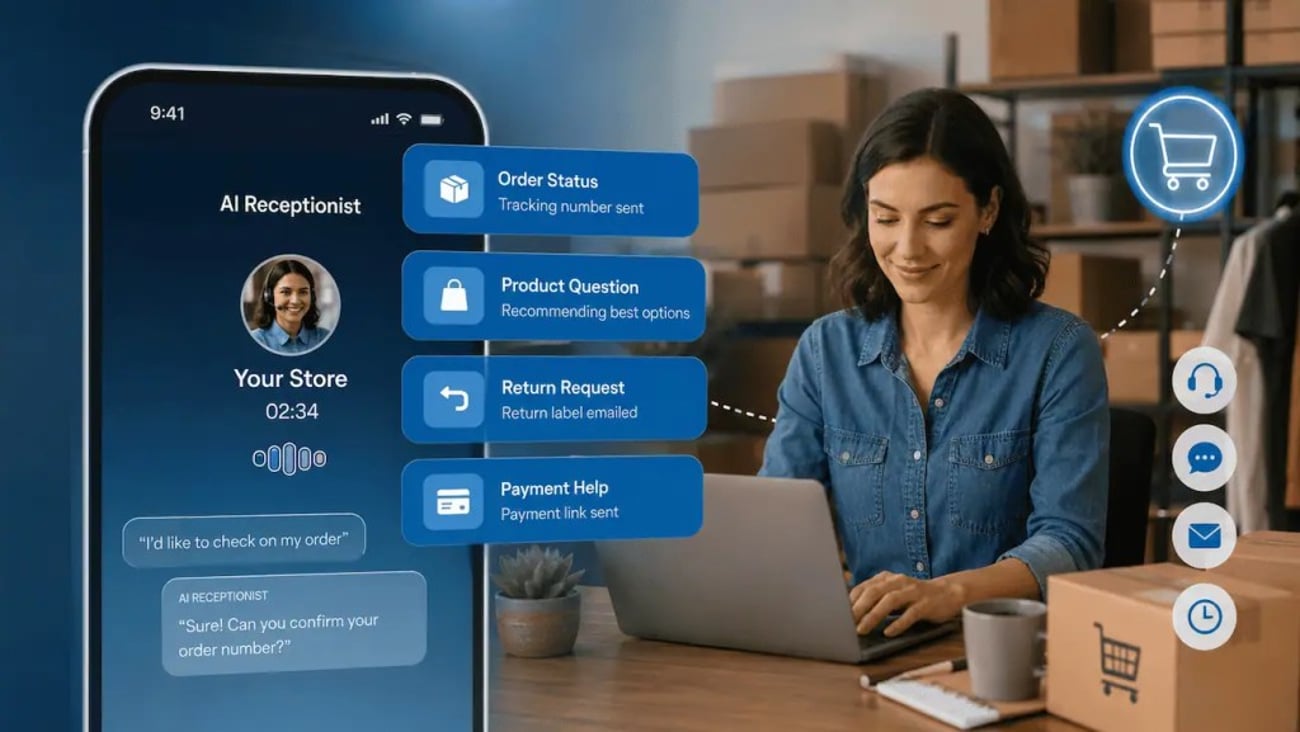

Most e-commerce operators I work with are very familiar with their CAC. However, when conversations drift to cart abandonment or reasons why shoppers drop out of their purchase journey, I usually get an informed guess or a wishful thought.
These drop-offs don’t create tickets or fire any reasonable alerts. They simply join the 70.22% average abandonment rate documented by the Baymard Institute.
At this stage, every department points fingers instead of owning the real reasons.
What if someone talked to the consumer before they dropped? Or did the customer reach out and no one was in the office to answer their call? They’re all speculations unless you have an e-commerce answering service available to address customer queries at all times.
Your business is operational 24/7, but you work only in a decent fraction of that time.
Let’s be real. An answering service alone won’t fix all leaks or cart abandonment, but it equips you to ensure you’re not losing deals to missed inquiries.
Try the best AI answering service free for 14 days
XBert AI answers questions and captures leads. Add your 24/7 answering service in minutes.
What Is an E-Commerce Answering Service?
An e-commerce answering service is a remote team, human or AI, or a system that combines technology and people to answer calls, chats, and texts for your online store. It works from your store’s live data, so it can process orders, share shipping details, and handle returns while the customer is still on the line.
This service aims to solve the issue a customer is facing. Often, you’ll find options that mimic a friendly voice or address a customer in a familiar tone. However, the north star here is to close the call with a solution or to take steps toward one, rather than simply logging it.
A friendly voice and supportive tone are good aesthetics. This is a welcome development. But the true satisfaction comes through solutions. These e-commerce answering services are set up intelligently to deliver solutions so a customer doesn’t feel ignored.
What does an e-commerce answering service do?
Shoppers often come with questions around delivery times, return availability, size and stock checks, and other billing-related issues. A capable service takes care of it all.
Trained agents or an AI receptionist answer incoming calls, respond to live chat, reply to texts, look up shipping details, start return and RMA requests, capture leads, and take new orders over the phone. Some also handle outbound calls for order confirmations and follow-ups.
Every action the service takes must be written back to your CRM and e-commerce platform. Without that sync, records become outdated, the next agent has no context, and the customer has to repeat their story.

How an E-Commerce Answering Service Works
The mechanics are simple. You keep your existing business number. Calls, chats, and texts route to the service based on rules you set, such as after business hours, when your lines are full, or all the time.
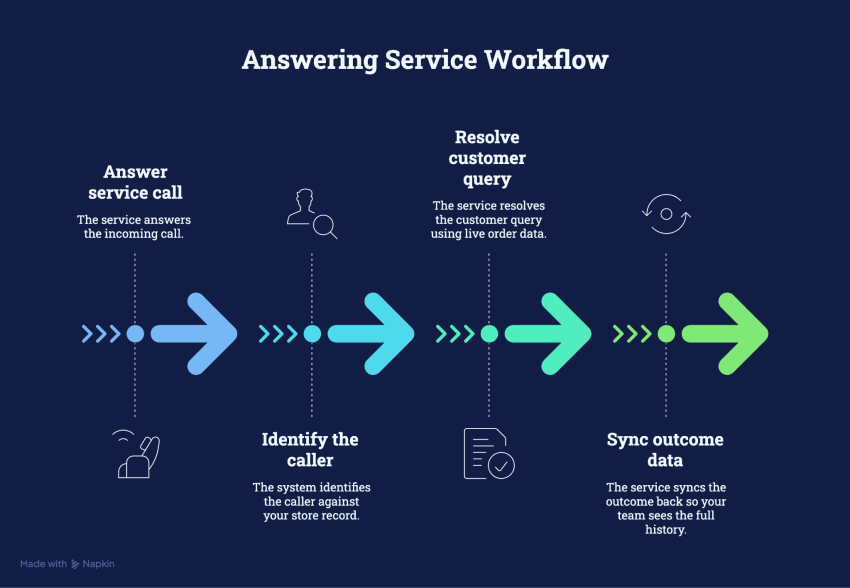
From there, a typical contact runs through four steps.
The service answers, identifies the caller against your store records, resolves the customer query using live order data, and syncs the outcome back so your team sees the full history.
If your operation is still small and growing, you might configure the system to forward calls on nights and weekends. But a high-growth brand will route every inquiry to an AI receptionist first and reserve in-house staff for escalations.
Benefits of an Answering Service in E-Commerce
An answering service earns its fee by preventing you from losing four specific kinds of money.
Recover carts before they empty
Most abandoned carts trace back to answerable doubts. These aren’t outright rejections. For example, 39% of US shoppers abandon their carts over unexpected extra costs like shipping and fees.
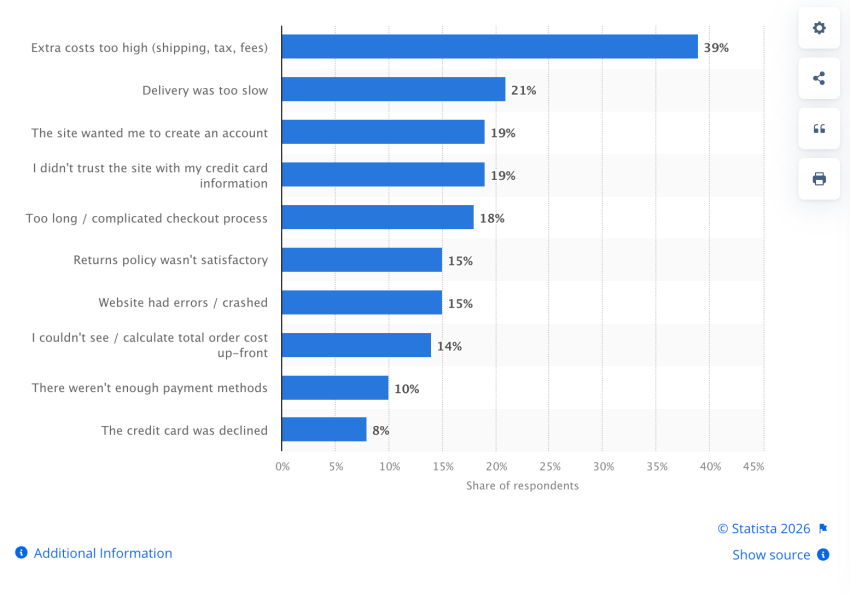
Those are questions with answers. When a shopper can get quick answers about shipping, taxes, or returns at the exact moment of doubt, some of those exits turn back into orders. An e-commerce answering service allows you to register your availability at the checkout moment, when it matters for the sale.
Protect the revenue that arrives after hours
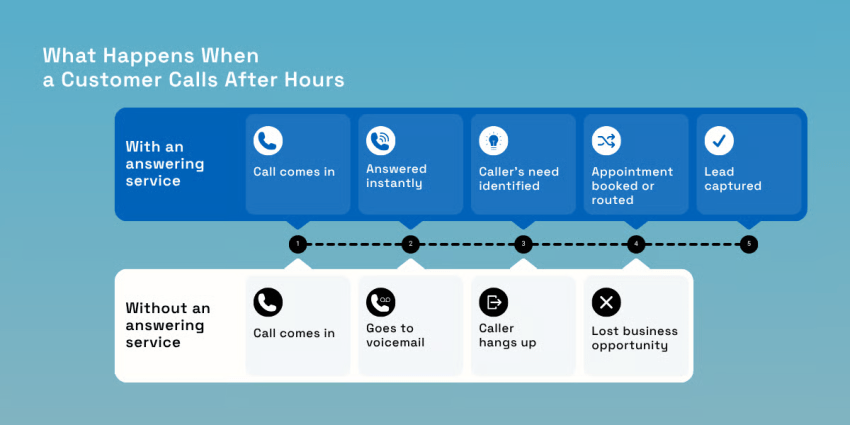
If you’re receiving global orders, customer questions can come in at any time.
They might come in when you’re presenting the highest revenue at your all-hands meeting or enjoying the American dream on your yacht while admiring the Statue of Liberty. These nudges might not sound an alarm in your dreams, but they surely sound a siren of cart abandonment.
An answering service for your online story helps you pick up that nudge and answer the call when it’s hot.
Phone calls still carry serious e-commerce revenue. Nextiva customer Phat Scooters, a DTC electric scooter brand, has finalized around 250 orders a month over the phone, walking buyers from first inquiry through payment.
Absorb peak season without hiring for it
Holiday sales in November and December have averaged about 19% of total annual retail sales over the past five years, per the National Retail Federation. This means that nearly one-fifth of the year’s revenue is crammed into two months.
At such times, call volumes spike, hold times lengthen, and buyers with money in hand drift to competitors who answer faster.
You could staff for the spike, but then you pay for that capacity in the quiet months. An AI answering service lets you address simple queries at this time autonomously, while your team reserves its hours for complex questions.
Turn support from a cost center into a revenue engine
Zendesk’s 2025 CX Trends report found companies leading in customer experience (CX) earn 49% higher cross-sell revenue than their peers, along with 33% higher acquisition and 22% higher retention.
There’s a natural opportunity here. When your answering service picks up calls reliably, it builds trust in your brand. The customer becomes less defensive. Customers are more likely to respond and explore the next time you reach out with an upsell or cross-sell opportunity.
AI vs. Human Agents for E-Commerce Calls
Should a robot or a person answer your customer calls? Ideally, both can. It’s really a question of which one is best suited for the respective task.
AI is tireless at retrieval. Order status, tracking numbers, return policies, and store hours: an AI-powered virtual receptionist pulls this information from your database in seconds for many callers at once.
Humans handle the calls that matter. For example:
- A furious customer holding a damaged package
- A high-ticket consultative sale where trust decides the outcome
| Task or factor | Human agent | AI receptionist |
|---|---|---|
| Order tracking, returns, FAQs | Handles well, but limited by business hours | Instant, 24/7, carries most of the routine load |
| Frustrated or high-ticket buyers | Excels through empathy and judgment | Hands off to a human with full context |
| Availability | Standard business hours, or costly night shifts | Always on |
| Cost | Per-minute billing — higher | Flat monthly rate — lower |
| Concurrent inbound calls | Capped by headcount | Many at once |
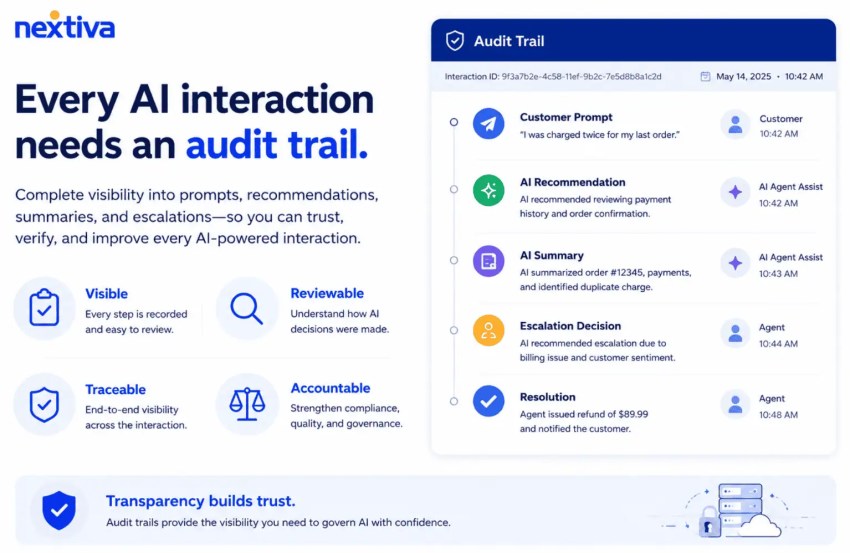
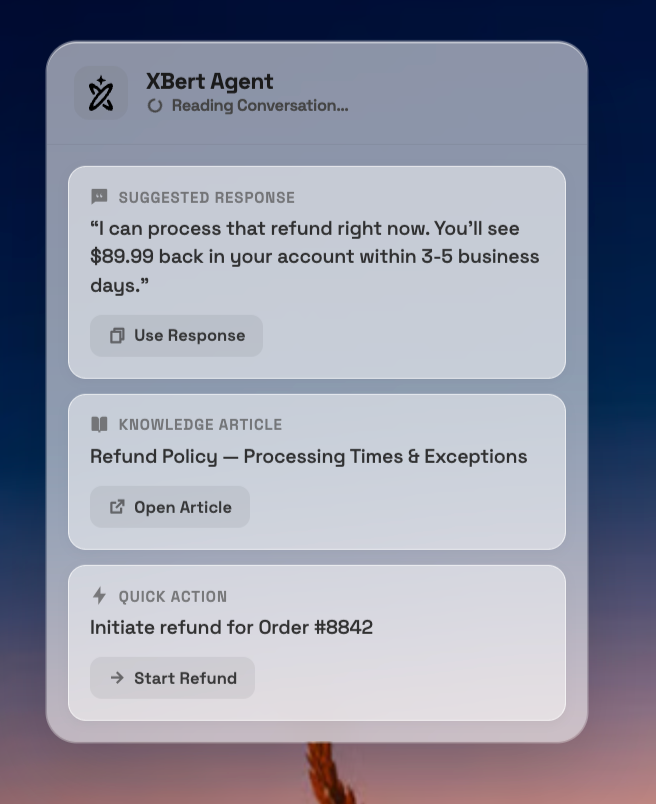
Let an AI answering service resolve your routine load instantly, around the clock. When a conversation needs a person, it should hand off with the transcript and context attached so customers never repeat themselves.
Nextiva’s XBert works exactly in this way: it answers and resolves what it can and passes the rest to your support team with the full history.

Hear why XBert AI is the best AI receptionist
XBert AI receptionist handles customer questions, captures leads, and books appointments. Try it free for 14 days.
Must-Have Features in the Right Answering Service
Choosing the right answering service involves five key factors. If you miss one, the other four won’t matter. Likely, the vendor won’t market its gaps, so it’s best to check for them yourself during the trial.
Direct integration with your e-commerce platform
The service must connect directly to Shopify, WooCommerce, or your CRM and read live inventory, order history, and customer records. Without that connection, even an experienced team is guessing at shipping details and stock levels.
Ask the uncomfortable question in the sales call: Does the integration write back or only read?
Read-only access produces polite agents who still email you a to-do list. Write access produces resolved tickets.
Payment security that survives an audit
If agents process payments over the phone, PCI compliance is necessary. Even if you don’t store the card data, if a card number is being spoken on a recorded line, it’s still processed and transmitted. The PCI Security Standards Council maintains the PCI DSS standard, which applies to any entity that stores, processes, or transmits payment data. This includes an answering service taking phone orders on your behalf.
Insist on a secure IVR transfer or a PCI-compliant capture portal so the agent never hears the raw card number. Shoppers already vote on these issues with their carts. Per Baymard’s checkout research (via Statista), 19% of US shoppers abandon checkout because they did not trust the site with their card information.
Multilingual support in the shopper’s language
Bilingual English and Spanish coverage protects a customer segment many stores lose without noticing. A shopper who cannot get answers in their language is not a difficult customer. They are a missed sale wearing a disguise.
A bilingual answering service closes that gap on both voice and chat, which matters more as your e-commerce store expands into new markets.
Reliability, uptime, and multichannel coverage
Every guarantee a provider makes is downstream of uptime. Look for 99.999% availability and SOC 2 certification, because a service that goes down during your biggest sales weekend is an expensive theater.
Coverage should also span voice, SMS, and live chat software, since customers contact stores wherever they already are.
Onboarding process and agent training
Ask how long onboarding takes, who builds the call scripts, and how agent training keeps the team current on your catalog, promotions, and return policy. A fast setup with weak scripting still fails callers on day one.
The better providers treat your knowledge base like a living document. It’s not a PDF from the onboarding process.
Comparing E-Commerce Answering Service Costs
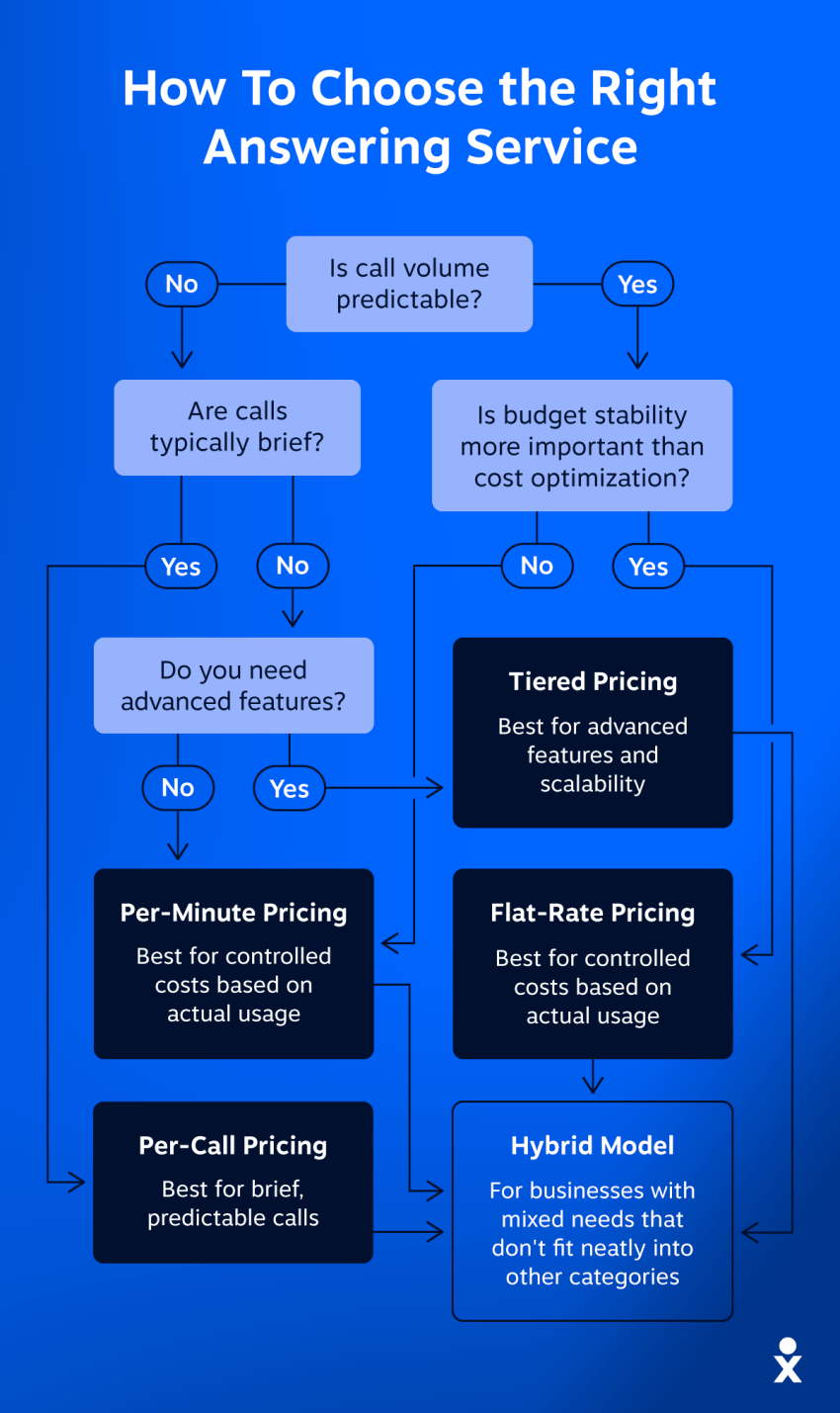
Providers bill in two basic structures. Per-minute plans charge for live-agent talk time, which climbs exactly when call volume spikes. Flat-rate plans charge a fixed monthly fee for a set quota of interactions, keeping budgeting predictable through the holidays.
Watch for hidden costs under either pricing model. Holiday surcharges, per-integration fees, and overage rates tend to appear on invoice three. Transparent pricing, published openly on the provider’s site, is a good early sign that the relationship will stay honest.
| Pricing model | Typical cost | What to watch |
|---|---|---|
| AI receptionist, flat rate | XBert at $99/mo for 100 interactions, then $0.99 each; Business Phone from $15/user/mo billed annually | Predictable, 24/7, scales through spikes |
| Per-minute live answering | Roughly $0.75–$1.50/min or $150–$300/mo starter bundles | Costs surge during holidays and flash sales |
| In-house support team | Salaries plus benefits per hire | True 24/7 coverage means staffing multiple shifts |
To be fair to the in-house option: It’s not wrong; it’s just expensive to run 24/7. Covering nights, weekends, and holidays with employees means three payroll shifts for call volume that arrives in unpredictable bursts.
A simple ROI formula
Skip the vendor calculators. The math fits on a sticky note.
Take the gross margin of the orders the service saved or took in a month. Subtract the monthly fee. If the number is positive, the service pays for itself, and everything above zero is the margin you were previously donating to competitors.
If your average order is $100 and your gross margin is 40%, then each saved order is worth $40. Against XBert’s $99 monthly fee, three saved orders put you ahead for the month.
Run the same math against a per-minute bureau or a new hire, and the comparison usually settles itself.
AI Receptionist ROI Calculator
See how much your business could save with the XBert® AI Receptionist ROI Calculator. Just enter your call volume and staffing costs to find out how quickly an AI assistant can pay for itself and start freeing up your time.
What Metrics Point to a Reliable E-Commerce Answering Service?
The single most revealing question you can ask a provider is one almost nobody asks: What is your resolution rate, not your answer rate?
The answer rate is deceptively simple to inflate. A service can pick up 100% of incoming calls and resolve none of them. Resolution rate measures how many contacts ended with the customer’s problem solved.
Track these numbers from the first month:
- First-contact resolution: The share of customer inquiries that are fully handled on the first touch. This is the headline metric, and it should climb month over month as scripts improve.
- After-hours revenue capture: Orders taken and carts saved outside standard business hours. This number feeds straight into the ROI formula from the cost section.
- Repeat-contact rate: How often the same customer calls back about the same issue. Rising repeats mean the service is deflecting, not resolving, no matter what its dashboard says.
Match the Tool to Your E-Commerce Business Needs
A smaller online store with modest call volume may only need an AI virtual receptionist to cover nights and weekends. The AI virtual receptionist answers routine questions, schedules the odd complex call for the morning, and lets the owner stop doing support at midnight.
A high-volume brand juggling voice, chat, and SMS across a bigger support team needs more machinery. It needs a full contact center solution with skills-based routing, analytics, overflow rules, and reporting that your CX lead can use to run the business.
Most stores sit between those poles and grow from one toward the other. Pick a platform that spans the range, so scaling up is a settings change rather than a migration.
Before you sign anything, put these questions to every provider on your shortlist:
- Can it read and write my Shopify or CRM data, or just read it?
- How are phone payments captured, and is the flow PCI compliant?
- How does the onboarding process work, and who maintains my scripts?
- When AI hands off to my team, does the context travel with the call?
Nextiva’s team doesn’t flinch while answering these questions. Nextiva XBert answers calls 24/7 for $99 per month for 100 AI conversations, resolves routine customer questions instantly, and hands complex conversations to your team with the context attached.
Get Nextiva XBert and answer customers who are calling after hours with a credit card in hand.
XBert AI receptionist never misses a call, text or chat.
Greet customers, book appointments, and capture leads while you run your business. See why it’s the best AI receptionist.
Frequently Asked Questions
It is outsourced customer support for online retailers. The service answers calls, texts, and chats around the clock. Nextiva provides the cloud phone system, AI receptionist, and contact center tools behind these workflows.
Pricing varies by model. Live services charge per minute or in monthly bundles. AI plans run on flat monthly rates. Nextiva plans start at $15 per user monthly, with XBert AI at $99 per month.
Use both. AI resolves routine tracking and billing questions instantly, day or night. Human agents handle upset customers and high-ticket sales. Nextiva XBert runs the AI side and hands off with context.
Yes. Leading providers connect to the Shopify admin through APIs. Agents can look up orders, check live stock, and process exchanges.
Yes, and that is their core value. Coverage runs through the nights, weekends, and holidays. AI receptionists like XBert never go off shift.
The routine work of running a store: order tracking, returns and exchanges, stock checks, and billing questions. Many also take phone orders and capture leads.
Audit a week of your real contact volume first. Then check four things: platform integration, PCI-compliant payments, a pricing model that fits, and multichannel coverage.
Yes. English and Spanish coverage is widely offered. It keeps businesses from missing sales to Spanish-speaking shoppers in diverse markets.