

 Customer Experience
  Blog
Blog  Business Communication
  Leadership
  Marketing & Sales
  Nextiva News
  Productivity
  VoIP
VoIP 

The call that goes unanswered might be the patient who needed an appointment today.
For healthcare practices, high call volume quickly becomes a patient access problem. Front desk teams can only answer one call at a time, while patients expect fast responses.
In medical practices, 42% of calls go unanswered during regular business hours. If you accept that some of these calls may be emergencies or at least high priority, that’s still far too many. AI answering services can take pressure off the front desk by handling routine calls simultaneously while escalating requests that need human attention.
In this guide, I’ll explain how AI answering services handle healthcare call volume, what to look for around HIPAA and EHR integration, and how to build safe escalation rules.
The Healthcare Call Volume Problem
The problem isn’t that your front desk staff can’t answer calls. It’s that they can’t answer dozens of calls at once. When call queues fill up, your staff must choose between answering the phone, checking patients in, processing paperwork, and dealing with the people already in front of them.
That creates a bottleneck. Someone is going to be left out. Someone is going to become frustrated. It’s not the staff member’s fault, but they are the face or voice your patient relates that problem to.
A major source of this bottleneck is routine requests. These make the problem worse because they consume the same staff time as more important conversations.
The fix? An automated answering service changes the capacity equation. It can handle multiple calls simultaneously, deal with routine requests, and send calls that need human attention to the right person.
The objective isn’t to automate every patient interaction. It’s to stop routine calls from competing with the patients who need your staff the most.
What an AI Answering Service Does for Healthcare Providers
The value of voice AI isn’t that it can answer the phone. It’s what happens after it answers.
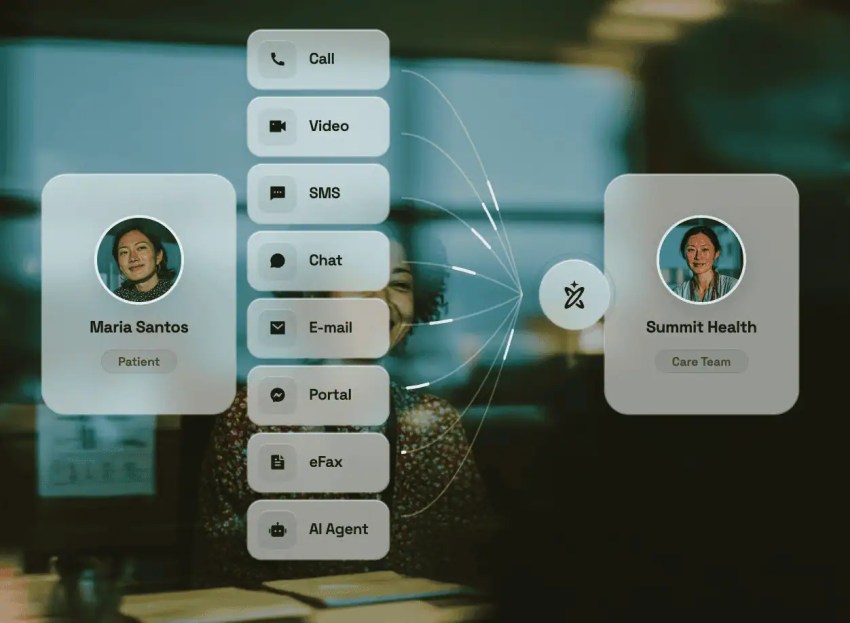
A healthcare AI answering service can understand why a patient is calling, complete approved administrative tasks, and route anything that needs human attention. That makes it useful for the calls that consume front desk capacity without necessarily requiring a staff member.
The distinction matters. Deflecting a caller to another channel doesn’t solve the capacity problem. Containment does. If your AI can book an appointment, capture a prescription request, or answer the office hours question without involving your front desk, that call has been contained rather than deflected.
The next question is which patient workflows are safe and practical to automate.
Key patient workflows automated by AI voice systems
The best place to start isn’t with the most complicated patient calls. It’s with the requests that follow a predictable process and don’t require clinical judgment. These are simple to automate and easy to manage and measure.
For most practices, that means automating workflows like:
- Appointment scheduling and changes
- Prescription refill requests
- Billing and office information
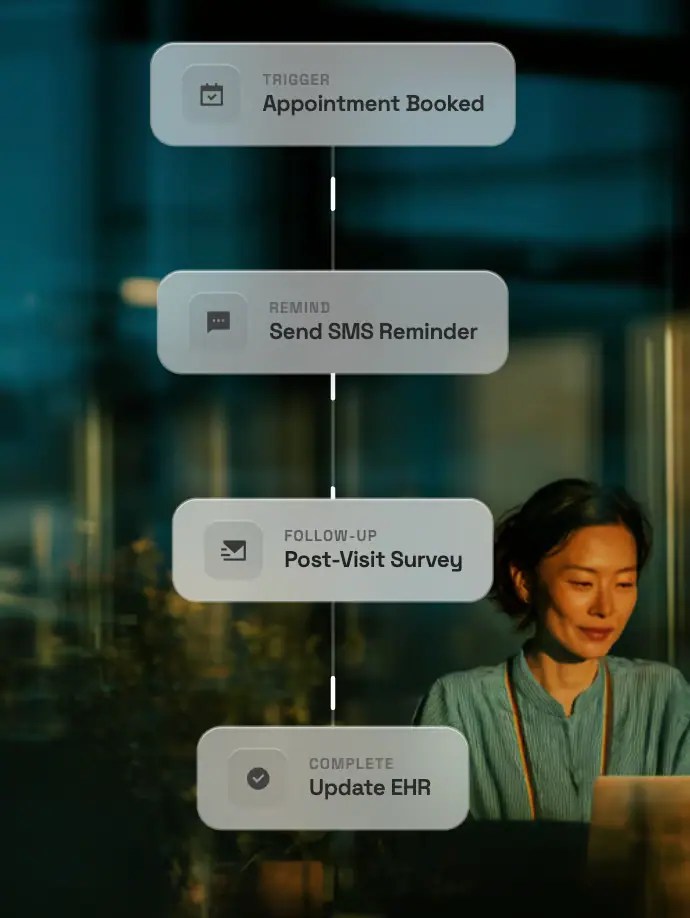
For appointment calls, the AI can identify the patient’s request, check available times, and book or change the appointment according to the practice’s rules. For prescription requests, it can collect the information needed by the practice and route the request to the appropriate pharmacy or staff workflow.
It can also handle frequently asked questions like:
- Opening hours
- Locations
- Billing
- Parking
- Other routine information
The benefit isn’t just answering more calls. It’s removing repetitive work from the queue so staff can spend more time on patients who need them.
Clinical safety and emergency escalation protocols
This is where healthcare voice AI needs a different set of guardrails. An AI answering service can handle administrative requests. But it shouldn’t improvise when a patient describes a potentially serious symptom.
Here, your AI system needs clear escalation rules for situations that require clinical judgment or immediate assistance. For example, a call mentioning chest pain, difficulty breathing, or severe bleeding could trigger an immediate escalation rather than continuing through an administrative workflow. Failure to act here has severe consequences, and your AI solution must recognize this immediately.
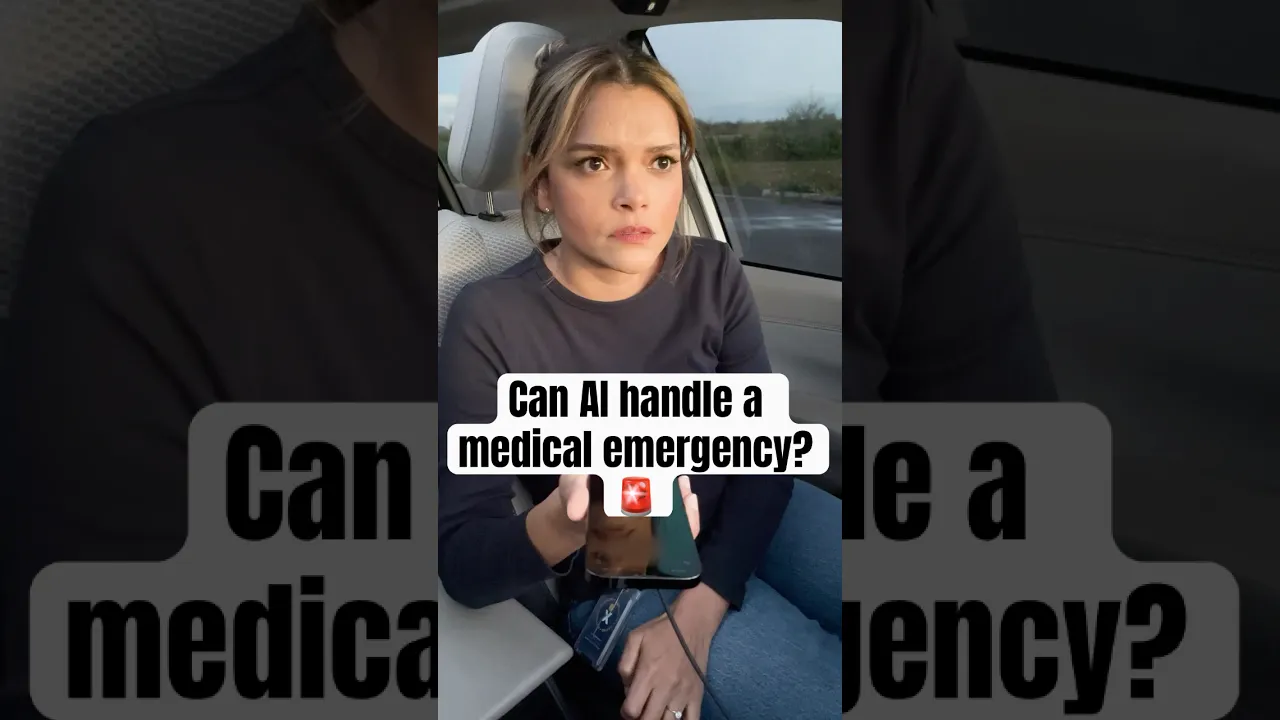
Your AI isn’t making a clinical diagnosis. It’s recognizing that the conversation has crossed a predefined safety boundary and following the established escalation workflow.
That distinction is critical. The safest healthcare AI isn’t the one that tries to handle the most calls autonomously. It’s the one that knows exactly when it shouldn’t.
Essential Compliance Standards for Healthcare Voice AI
Healthcare voice AI doesn’t get a pass on security because the conversation happens over the phone. That’s purely the vehicle. If an AI answering service handles protected health information (PHI), the same privacy and security requirements apply as they would to other systems handling patient data.
There are a few things I’d verify before putting it into production. First, the vendor should be willing to sign a Business Associate Agreement (BAA). The BAA establishes the vendor’s responsibilities when it handles PHI on behalf of the healthcare organization.
Then, look at how the platform protects voice recordings, transcripts, and other patient information. That includes:
- Encryption for voice and transcript data
- Access controls that limit who can access PHI
- Audit logs showing when protected information is accessed or changed
Don’t stop at the word “HIPAA” on a product page. You’ve got to dig deeper to protect your practice. Ask how the platform protects patient information, how access is controlled, and what gets recorded in the audit trail. It’s also worth looking at the vendor’s broader security controls. A SOC 2 report can provide extra evidence of how the provider manages security and operational controls.

For healthcare practices, compliance isn’t a feature you switch on after deployment. It needs to be part of the architecture from the start.
Comparing AI Voice Agents, Live Operators, and Hybrid Models
The biggest difference between AI and a live answering service isn’t the voice on the other end of the phone. We’ve come a long way in natural language processing and voice recognition. AI models sound almost like humans if programmed correctly, and you choose the right vendor.
The biggest difference between AI and humans is capacity:
- A live operator can handle one conversation at a time.
- An AI voice agent can handle many conversations concurrently, which matters when a practice gets a sudden spike in calls.
That changes the economics too. Live answering services typically charge by the minute, call, or monthly package. Published 2026 pricing for medical answering services commonly falls around $1 to $3.50 per operator minute, depending on the service and level of coverage.
AI services use different pricing models, so comparing the headline rate isn’t particularly useful. Look instead at the cost per resolved call and how many calls the system can handle without adding staff.
There’s also a third option.
The hybrid healthcare answering model
For most practices, I wouldn’t treat this as a choice between AI and humans. I’d use both.
AI can handle routine tier 1 requests, while staff take over when a call requires judgment, exception handling, or clinical intervention. That gives the practice additional capacity without removing the human escalation path.
It also means you can automate gradually. We’re not talking about a big bang implementation, and patients never get to speak to humans again.
- Start with predictable administrative workflows.
- Measure how often the AI resolves them successfully.
- Expand the scope only where the results and safety controls support it.
The market is moving in this direction. It’s projected that the global healthcare AI voice agent market will grow from $468 million in 2024 to $3.18 billion by 2030, representing a 37.8% compound annual growth rate.
The interesting question isn’t whether AI voice will become part of healthcare operations. That’s already happening. It’s where it can take pressure off your team without compromising the patient experience.
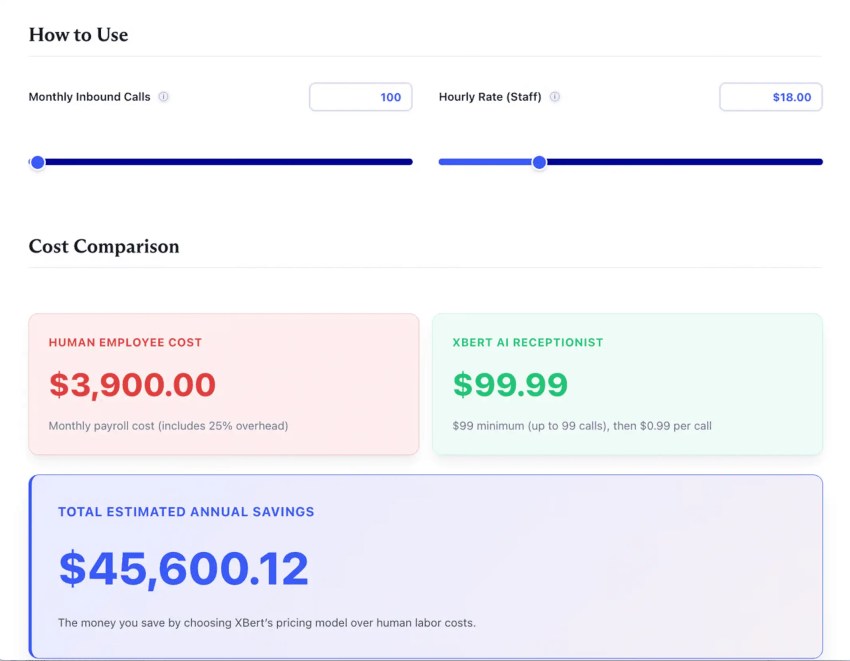
AI Receptionist ROI Calculator
See how much your business could save with the XBert® AI Receptionist ROI Calculator. Just enter your call volume and staffing costs to find out how quickly an AI assistant can pay for itself and start freeing up your time.
Core Features to Evaluate in a Healthcare AI Answering Service
Not every AI answering service is built for healthcare. A convincing demo can show an AI answering a phone call, but that doesn’t tell you whether it can work with your existing practice management systems, follow your routing rules, or give you enough visibility into what happens after answering a call.
I’d evaluate the platform against the workflows your practice needs to support.
| Feature | What to look for |
|---|---|
| Bi-directional EHR and practice management integration | Retrieve information from your electronic health record (EHR) or practice management system and, where supported, write approved updates back. For example, check appointment availability and complete a booking rather than simply taking a message. |
| Customizable call flow builder | Configure how calls are handled based on the patient’s request, department, business hours, holidays, and staff availability. |
| Voice, SMS, and web chat | Let patients continue routine interactions through different channels without having to restart the process. |
| Analytics and reporting | Track containment rate, peak call periods, transfer reasons, and where patients drop out of the workflow. |
| AI receptionist and front desk workflows | Evaluate how the AI fits into your existing front desk operation, including visual call flow management and configurable workflows for routine requests and human escalation. |
Scale Healthcare Call Handling Without Adding More Pressure to Your Front Desk
Healthcare call volume isn’t going away. Patients won’t stop calling even if you implement online consultations and self-diagnosis options. The question is how much of that volume your staff needs to handle themselves.
An AI answering service can take routine requests off the front desk, handle multiple calls during peak periods, and escalate conversations when a patient needs human or clinical attention.
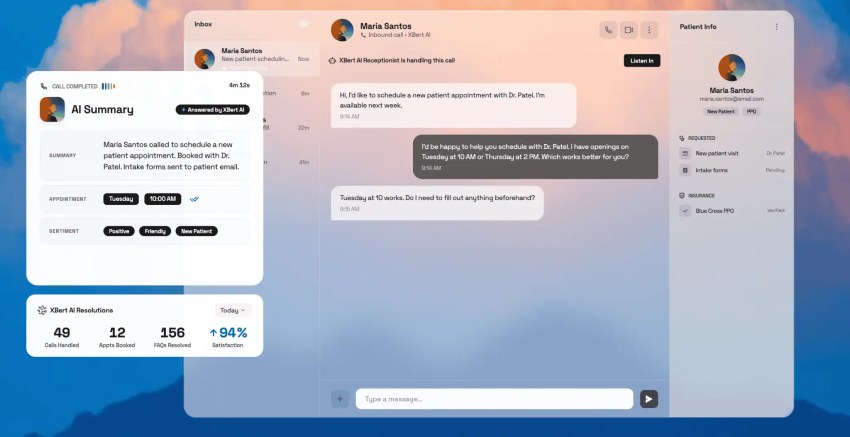
But the technology only works when it’s connected to the workflows behind the phone number. Look for the following when evaluating AI receptionists and automated answering services:
- Healthcare-specific compliance controls
- EHR integration
- Configurable call flows
- Reporting that shows what the AI is resolving
Nextiva’s AI answering service brings those capabilities together so your healthcare organization can automate routine patient calls while keeping a clear path to human support when needed. If your front desk is spending too much time answering the same questions, it’s worth looking at which calls could be handled automatically.
The goal isn’t to replace your front desk. It’s to give your team more capacity to focus on the patients who need them.
Want to see Nextiva XBert in action?
XBert: Your AI healthcare receptionist
An AI answering service that answers patient calls, books appointments, and routes urgent requests so your team can focus on caring for patients.
Frequently Asked Questions About AI Answering Services for Healthcare
An AI answering service uses a conversational AI voice agent to handle inbound patient calls. It can manage routine administrative requests, like appointment scheduling and office information, while routing calls that require human or clinical attention to the appropriate team.
AI reduces call volume reaching the front desk by containing routine requests before they get to a staff member. It can handle multiple calls simultaneously, which is particularly useful during predictable peaks like Monday mornings or seasonal demand. The result isn’t necessarily fewer patient calls. It’s fewer calls competing for the same limited front desk capacity.
It can be, but don’t assume HIPAA compliance from the product description alone. You must verify the provider can support HIPAA compliance, including a Business Associate Agreement (BAA), appropriate protection of protected health information (PHI), access controls, and audit logging.
Yes, depending on the platform and the specific EHR or practice management system. The most useful integrations are bi-directional, allowing the AI to retrieve information and complete approved actions rather than simply collecting information for a staff member to enter later.
The AI should follow predefined escalation rules rather than attempting to diagnose or manage the situation itself. If a caller describes symptoms or circumstances that meet the practice’s escalation criteria, the system can route the call to the appropriate clinical team. Emergency workflows can direct the caller to emergency services when appropriate.
Pricing varies based on the provider, call volume, integrations, and the level of automation required. AI answering services may charge per minute, per call, or through a monthly subscription. Live medical answering services commonly charge by the operator minute, so the most useful comparison is the cost of resolving a call rather than the headline price alone.
The right questions are how much capacity the system creates for your practice and how many calls it can resolve without requiring additional front desk staff.