

 VoIP
VoIP  Blog
Blog  Business Communication
  Customer Experience
  Leadership
  Marketing & Sales
  Nextiva News
  Productivity

Losing prospects or existing clients due to missed calls or slow responses can drain revenue. At the same time, separate tools for customer data and interactions can mean more work for your team.
Many companies choose Crexendo for its cloud-based phone system. But growth may prompt them to look for more direct access to helpdesk support for their accounts. Others expect stronger uptime and simpler tools to manage customer conversations across channels 24/7. Meanwhile, others search for all that plus AI-powered workflows in one workspace. That includes features that can automate lead capture around the clock.
Comparing several providers can help you decide which unified communication solution can accelerate your long-term growth. If you’re exploring Crexendo alternatives, this guide presents seven options.
Quick Comparison of the Best Crexendo Alternatives
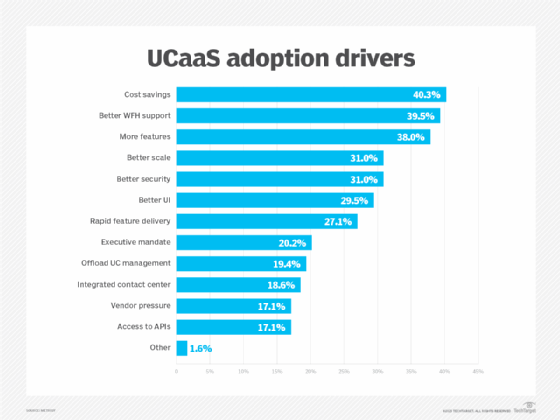
Cost efficiency is the leading motivator among companies to adopt Unified Communications as a Service (UCaaS) — about 40% of adopters upgraded to the technology to reduce expenses, according to Metrigy data.
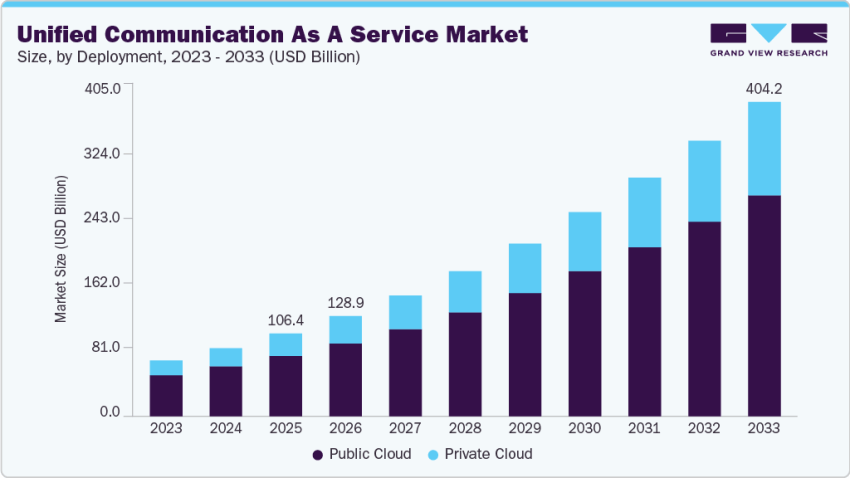
Grand View Research forecasts a 17.7% annual growth for UCaaS. Its 2026 market value is estimated to be $128.91 billion.
When finding the most suitable provider, start by clarifying what matters most to your business. Then, check the table below, which highlights the key differences among the seven top Crexendo alternatives.
| Provider | Best for | Key strengths | Potential drawbacks |
|---|---|---|---|
| Nextiva | Best overall | Unified voice, video, SMS, AI receptionist, contact center, and 99.999% proven uptime | May offer more than very small teams need |
| Dialpad | AI integration | Real-time transcripts, call summaries, and coaching | AI features focus more on call intelligence than front-desk lead capture |
| 8×8 | Internationally distributed teams | Global calling and collaboration tools | Can feel more complex for U.S. and Canada-focused businesses |
| Zoom Phone | Zoom-first teams | Easy fit for companies already using Zoom | Less complete as a full customer experience platform |
| GoTo Connect | Simple setup | Phone, meetings, messaging, and customer engagement tools | AI-delivered client insights require subscription to higher tiers |
| Ooma Office | Traditional small businesses | Easy setup and hardware-friendly Voice over Internet Protocol (VoIP) | Limited for fast-scaling teams |
| Vonage | API (application programming interface) flexibility | UCaaS, contact center, and communications APIs | Better fit for teams with technical resources |
Nextiva: The Best Overall Alternative
Companies considering Crexendo alternatives want a less cluttered system and fewer menus. Nextiva’s business phone service overcomes those challenges with its all-in-one customer experience platform. Its clientele spans more than 100,000 businesses handling billions of interactions annually.
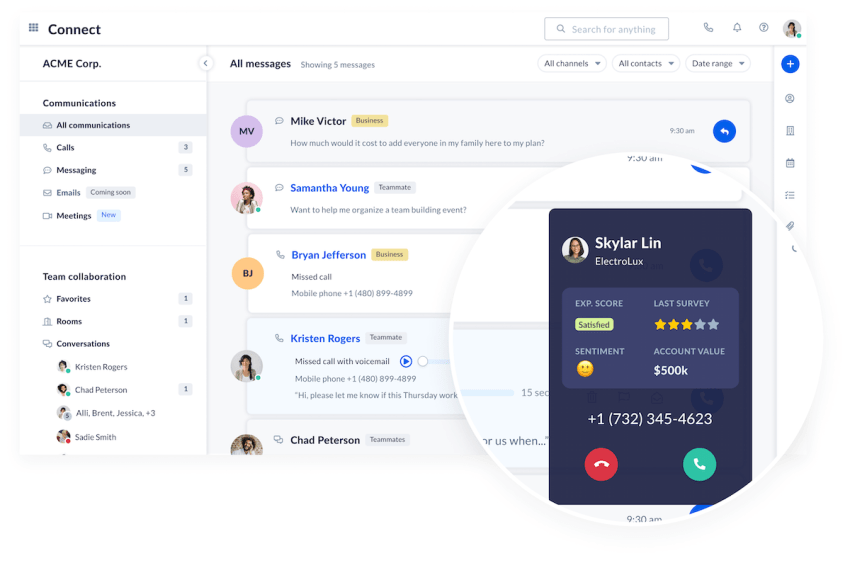
With its phone component, Nextiva Business Voice, you can reply to every call and message from any device. You can also easily switch between desktop and mobile phone for live calls with one click. Beyond VoIP basics, its broader UCaaS platform brings messages from various channels into a single inbox. This saves time jumping from one tool to another to check message content or client profiles.
This simplicity was the biggest benefit for one operations head in the retail sector.
“Nextiva helped us move from a fragmented system to one that just works across every device.”
— Operations Manager, Mid-Market Retail
Nextiva’s XBert AI receptionist can keep businesses responsive when live staff is unavailable, helping reduce missed calls. It can handle incoming calls and live web chats. Its multichannel management covers sending SMS and social media messages. XBert is more than a standard auto attendant capable of completing tasks within the interface without integrations. It can qualify leads, update your customer relationship management (CRM), book appointments, and process payments.
XBert’s self-customization positions you for growth. Its routing feature transfers calls to live agents with a full transcript and context. This avoids asking customers to repeat themselves, reducing call handling time. The AI can also be trained to provide real-time coaching to human staff on live calls.
Managing remote work teams is easy with the admin portal, which lets you add users and adjust call settings without contacting IT. It also has a built-in video for online meetings and webinars.
For businesses looking for proven 99.999% uptime and 24/7 in-house support, Nextiva is the unified communications platform to consider. Despite its enterprise-grade infrastructure, you can maintain your Private Branch Exchange (PBX) via Session Initiation Protocol (SIP) trunking.
Together, these benefits make Nextiva a strong fit for businesses seeking a Crexendo alternative.
Dialpad: AI-Focused Communications for Modern Startups
Dialpad’s AI integration has made it one of the most popular startup phone systems. It can generate real-time transcription and sentiment analysis. The platform can also create post-call summaries with action points.
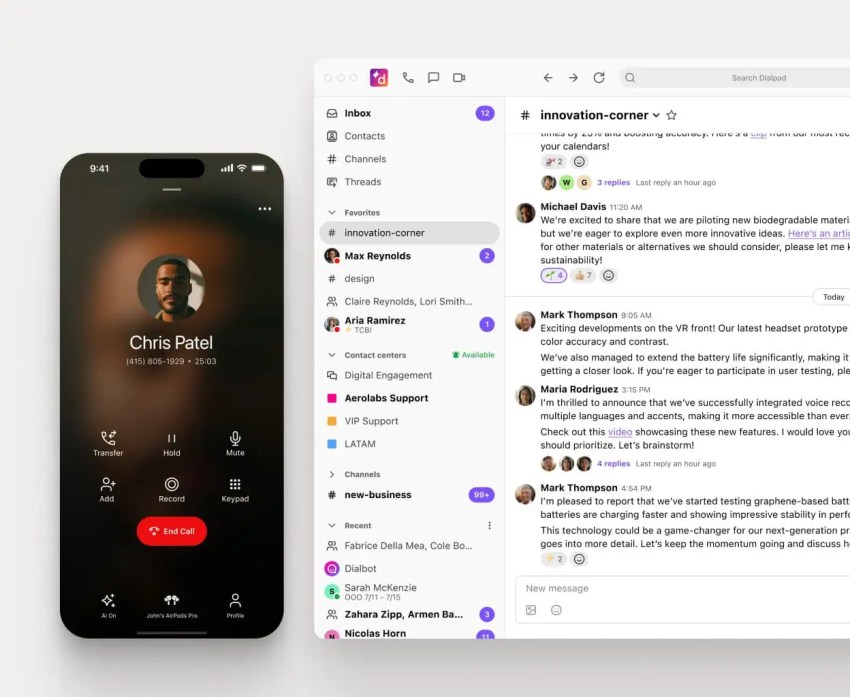
Its AI Live Coach Cards display on agent screens to assist with call handling. Dialpad assists with coaching needs by identifying patterns and trends across calls. Team leaders can then use these insights for coaching agents. You can also set agent criteria to run evaluation and customer satisfaction scoring, which can be fed directly to your CRM software.
Dialpad’s simple interface is attractive to startups and businesses with growing service-led teams. But you may want to evaluate service options carefully if you prioritize hands-on support.
While Dialpad AI features focus on analyzing conversations, Nextiva takes a broader approach. It can capture lead information, transfer calls, and complete appointment bookings on its own when you set up automations. This helps reduce missed opportunities from unanswered inquiries.
8×8: Best for International Team Collaboration
8×8 is a leading player in VoIP for overseas teams. It combines chat, voice, video conferencing, and contact center features in a single hub. Integration with tools like Microsoft Teams is also available, allowing staff to work together from almost anywhere.
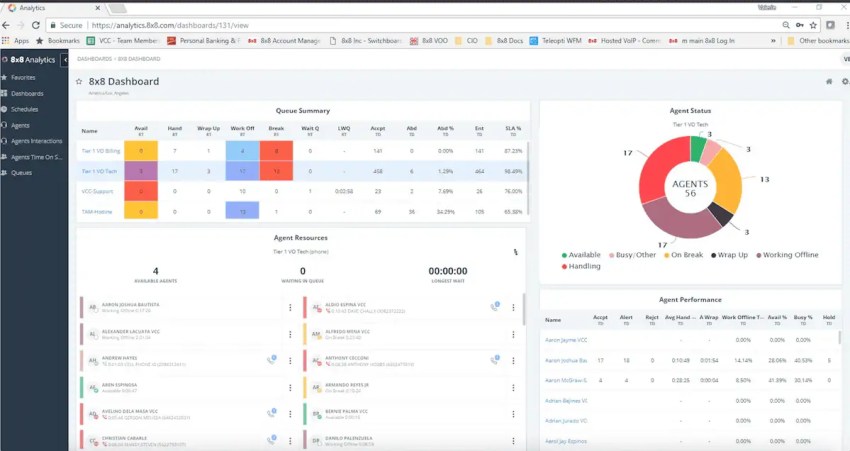
This global communications platform is a good fit for companies with customers abroad. 8×8 offers local phone numbers in more than 50 countries and provides inbound support in over 100 countries.
Reviews are mixed regarding ease of use and mobile use. Some say that the enterprise-grade admin portal is broad and harder to learn. Consistency in call quality is another issue, especially for 8×8 international calling using the mobile app.
If you have a U.S. or North American clientele, you may not need a complex, global-focused solution. Nextiva offers unlimited domestic calls in the U.S. and Canada, and the platform’s reliable SIP trunking service bridges legacy phones and VoIP solutions. No calls are missed, even during an internet outage, thanks to Nextiva’s turnkey automatic failover.
Zoom Phone: Best for Teams Already Using Zoom
If you already use Zoom for meetings, Zoom Business Phone becomes a natural choice for internal call management. The cloud VoIP feature is added as an intuitive tab (phone) on your Zoom account.
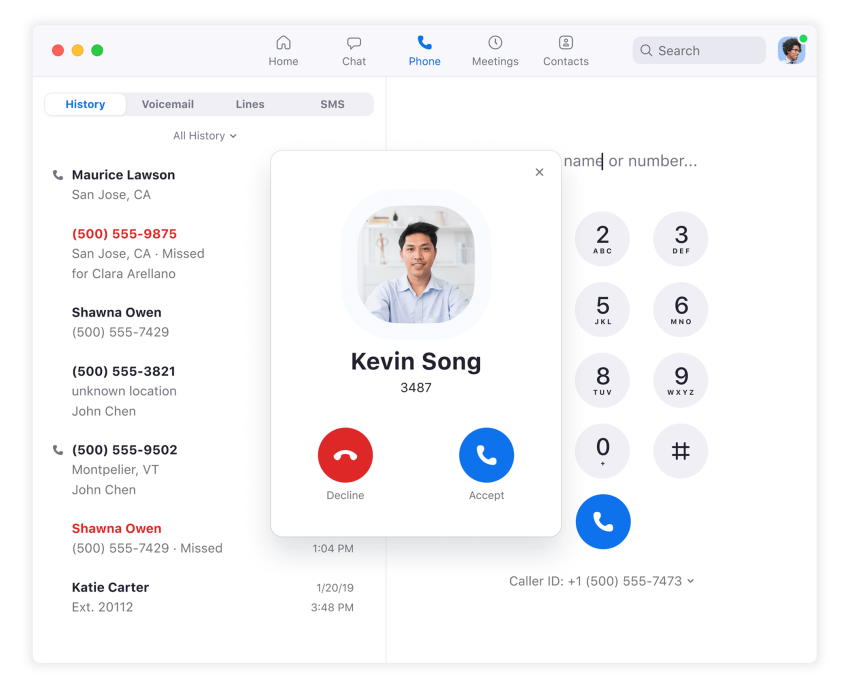
You can transition from a voice call to a video conference or screen sharing on multiple devices without dropping the call. Because the dashboard feels familiar, users can begin work quickly.
For more advanced customer communication workflows, consider Nextiva as an alternative to Zoom Phone. It offers omnichannel inboxes and intelligent routing. Its AI-driven lead capture and extensive CRM integrations make client context more accessible. These features equip sales and support teams to improve entire multichannel customer journeys.
GoTo Connect: Best for Simple Cloud Phone Setup
GoTo Connect excels among unified platforms for small to mid-market teams with single or multi-location sites. It handles two-way SMS, MMS, native WhatsApp messaging, and other socials via integrations. For video meetings, up to 250 participants can join in one session.

GoTo Connect appeals to businesses seeking to transition from a traditional system to a cloud PBX, as users can keep their existing phone numbers. Admins can create call routes and ring groups using a drag-and-drop editor. Higher-tiered plans include AI call summaries and chat sentiment analysis.
When caller demand increases as you grow, you’ll need more than a small business phone system. Nextiva has a natural-sounding AI receptionist that does more than transcription and analytics. Businesses can improve relationships using the solution’s AI for lead generation and calendar syncing.
Ooma Office: Best for Traditional Small Businesses
Ooma caters to small storefronts and home offices that want to replace traditional landlines but retain the basic way people communicate. Its base stations include ports for connecting analog phones and other legacy equipment via an adapter.
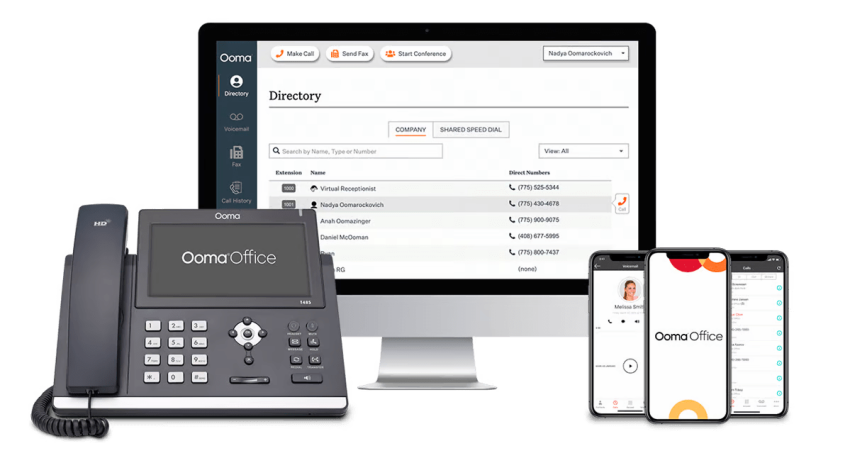
Reduce your team’s manual effort with Ooma’s virtual receptionist for call routing and voicemail transcription. Managing calls and messages while away from the office is easy with Ooma’s mobile app.
The platform’s flexible per-user monthly contracts with zero per-line minimums also align with the budgets of small business VoIP users. As businesses expand, though, teams may start looking for more advanced functions like client conversation tools and AI-powered automation.
Nextiva can be the right Ooma Office alternative for those who want to capture more opportunities systematically. Nextiva’s broader CRM integrations and more in-depth call analytics improve customer insights.
Vonage Business Communications: Best for API Flexibility
Vonage is known for its APIs, which allow direct texting, calling, or live streaming from a business portal. Instead of building VoIP APIs from scratch, businesses can choose from Vonage’s suite of APIs.
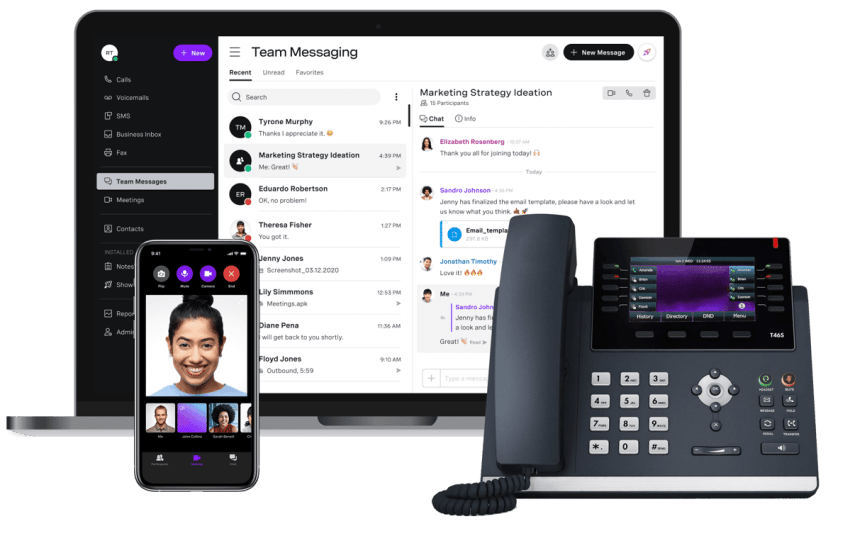
Its communication APIs and omnichannel contact center solutions attract mid-market enterprises and BPOs in regulated and high-growth sectors. These industries include telehealth, finance, healthcare, and e-commerce, which typically have unique requirements. This includes embedding secure cloud communication features in apps or websites. Teams with developers can tailor the platform to align with their workflows.
Smaller businesses without dedicated technical resources may need more effort in determining how to maximize user-defined settings. For those searching for a ready-to-use UCaaS platform, Nextiva’s approach may be a better fit. Onboarding and management are easier with its built-in customer support and engagement tools that require less technical overhead.
Lesser-Known Crexendo Alternatives Worth Considering
The platforms above are the seven leading alternatives to Crexendo for most businesses. But the biggest providers aren’t necessarily the best for narrower use cases. Some teams need more specialized communication, support, or deployment requirements.
Here are some lesser-known VoIP providers that also deserve attention, depending on your needs.
Quo (formerly OpenPhone): Solo operators and startups that need shared numbers and rely heavily on mobile collaboration may appreciate this cloud phone system. Quo’s AI integration creates call summaries and transcriptions. Team members can leave private notes for each other on any call or text message without the client seeing them.
CloudTalk: Growing outbound sales and support teams may find this call center software a strong fit. CloudTalk’s specialized auto-dialers help sales reps move through lead lists more quickly. Advanced call routing features include a visual drag-and-drop interface with deep CRM integration.
Aircall: Entities already using major CRMs may find Aircall a top choice due to its 200+ integrations. This conversational CRM solution allows users to make, receive, and log calls and text messages within the customer data platform.
Phone.com: Micro-businesses and solopreneurs may find Phone.com’s pay-as-you-go structure a good fit for their needs. Companies only pay for the exact number of users and minutes used. Phone.com also offers live receptionist services alongside AI Connect, both of which can be tailored to fit daily operations.
Talkroute: Freelancers and consultants may benefit from Talkroute’s dedicated business number and mobile-first call forwarding. Its direct-dial extensions and auto-attendant also make it one of the top small business phone alternatives. The platform allows video meetings (up to 100 people) with screen sharing, call recording, voicemail transcription, and analytics.
Intermedia Unite: Regulated industries may benefit from Intermedia Unite’s real-time file sharing, backup, and restoration through its SecuriSync feature. In addition to documents, Intermedia Archiving can store chats, calls, and meetings. This UCaaS solution offers advanced functions for Microsoft Teams users. AI features include interaction insights and workflow automations.
3CX: Tech-savvy companies and IT staff have the freedom to either self-host on-premises (Windows or Linux) or on private cloud servers such as Google Cloud, Azure, or AWS. As an open-platform PBX, it lets users choose from SIP trunk providers and third-party SIP desk phones, such as Yealink and Fanvil, to manage their telecom bills.
Most platforms above make effective startup phone systems, especially for basic call management needs. Others, such as Intermedia Unite and 3CX, serve companies that need compatibility with specific tech stacks.
For those handling rising demand, Nextiva’s extensive toolkit may give you more power to scale. Its AI-powered call handling, from lead acquisition to retention, supports your growth plans and satisfies customers.
How to Choose the Right Crexendo Alternative for Your Business
Finding the right provider to deliver business communication ROI doesn’t depend solely on comparing prices. Tedious administration and misalignment with your priorities can cost more than a premium subscription. Before comparing providers, decide whether your business needs SIP trunking, a UCaaS platform, a contact center, or all three.
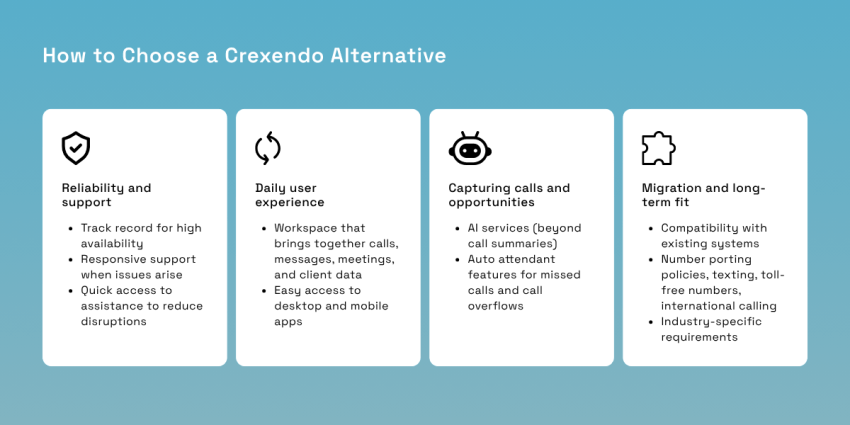
A cloud phone system migration from Crexendo should also balance several key factors. Below are four decision categories to consider:
1. Reliability and support
Although subscription rates matter, service stability is doubly important. A communication outage creates extra work for your team and frustrates customers. Research whether the platform has a track record for high availability and responsive support when issues arise. Quick and easy access to assistance can reduce disruptions and help employees refocus on serving clients.
2. Daily user experience
Since communication tools should help your team complete tasks, learning them shouldn’t take long or be difficult. Your chosen platform should have a workspace that brings together calls, messages, meetings, and client data. Verify whether it allows easy access to and switching between desktop and mobile apps. Your remote or on-the-go workers will thank you for it.
3. Capturing calls and opportunities
Providers vary in their AI services, with some only offering call summaries. Look for platforms that can route inquiries and collect information from potential customers. Auto attendant features are a must if you want fewer missed calls, especially outside business hours or during call overflows. Nextiva’s XBert, for example, can capture after-hours calls, qualify leads, and route inquiries automatically.
4. Migration and long-term fit
Before transferring to a new platform, ensure compatibility with your existing daily work systems. Also, consider how it will perform when call volumes change or if you add service channels. Examine number porting policies, texting capabilities, toll-free numbers, international calling, and your industry-specific requirements. This considers your total ownership cost, not just the coverage of your monthly subscription.
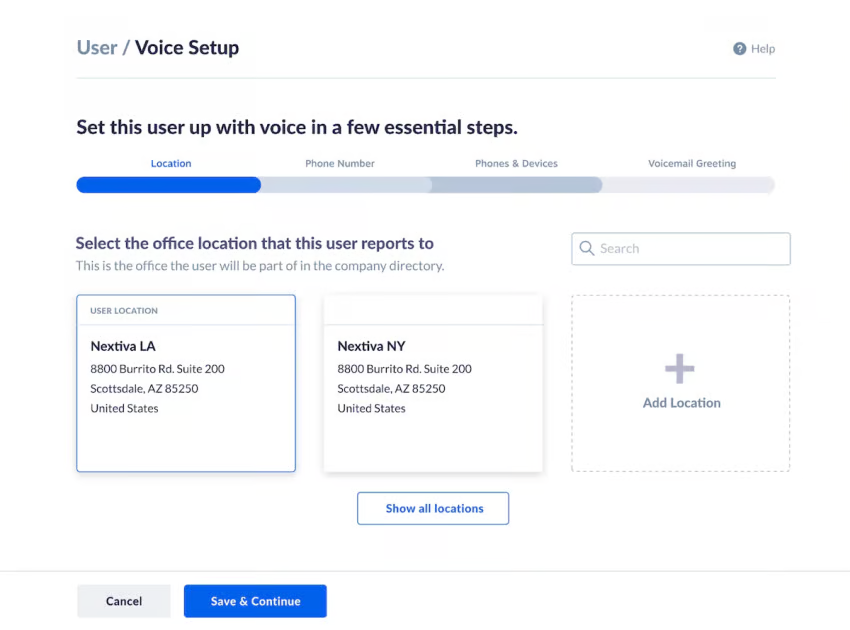
Look beyond monthly pricing. When going through your checklist for choosing a VoIP provider, consider the effort (including any additional tools or workarounds) required to operate, support, and expand the platform over time. Consistent performance, flexibility, ease of management, and room to grow deliver the strongest long-term value.
For companies and teams exploring options beyond their current setup, Nextiva is a practical path forward. Its AI-powered tools can help you capture more calls and improve system-wide administration to achieve your growth goals. User reviews on Trustpilot have highlighted Nextiva’s commitment to professional onboarding and exceptional customer support.
Ready to switch from Crexendo? See how Nextiva can help your team answer every call, capture more leads, and manage customer conversations in one workspace.
Switch to the #1 Rated Cloud Phone System
Move on from your old PBX and upgrade to the industry’s highest rated hosted VoIP system. Get flexible, reliable cloud communications anywhere your team works.
FAQs
Yes. Crexendo can work well for MSP-managed phone deployments, but Nextiva offers a more unified customer experience platform with lead-capture tools and built-in AI through XBert.
Look for proven 99.999% uptime, mobile and desktop apps, unlimited calling in the U.S. and Canada, SMS, video meetings, easy admin controls, number porting support, and AI-powered call handling. Nextiva brings these features into one unified app.
Cloud phone systems help teams add users, locations, and features without major hardware upgrades. They also support remote work, mobile calling, SMS, video, and faster customer response. Nextiva SIP Trunking connects existing PBX systems to a cloud voice service.
Yes. Most top Crexendo alternatives support number porting. Businesses should keep their Crexendo service active until the port finishes. Nextiva support can help guide the porting process to reduce downtime and avoid missed calls.
The monthly price matters, but downtime and missed leads often cost more. A provider like Nextiva can help offset switching costs by improving reliability, simplifying management, and using XBert AI Receptionist to capture leads 24/7.
Nextiva is the strongest choice if you want an AI receptionist that can answer calls, book appointments, and capture leads. Dialpad offers strong AI transcription and summaries, but Nextiva XBert focuses more on front-desk coverage and lead capture.
8×8 is a strong option for companies with frequent international calling needs. For teams focused on the U.S. and Canada, Nextiva offers a stronger overall mix of reliability, support, AI, and unified communications.