
 Business Communication
  Blog
Blog  Customer Experience
  Leadership
  Marketing & Sales
  Nextiva News
  Productivity
  VoIP
VoIP 

Small business owners need calls answered, contact info captured, and customers connected to the right team members. That is precisely where AI voice agents can help. The best AI voice agents handle the first layer of customer support without making callers feel abandoned.
The best inbound setup is not the flashiest demo. It is the one your support team can trust whenever it gets busy or after hours, has strong voice quality, clean handoffs to human agents, and useful follow-up tasks in the tools your team already uses.
This guide goes in depth on AI voice agents, provider comparisons, and more through a small business lens.
Inbound Calls Drive Business Growth
When people have an imminent need for a product, they want it now. They don’t want a call back or to play voicemail tag. Whether it’s a busted water heater, a flat tire, or a broken air conditioner — there’s real revenue to be closed via incoming calls.
Nextiva’s recent customer experience research found that 39% of customers prefer contacting companies by phone, and 66% had spoken with a brand by phone. That matters for any business where a call can become a booked job, a new patient, a signed contract, or a saved account.
Not everyone looks forward to inbound calls. To some, they can be a hassle. To everyone else, they represent a customer seeking help and a willingness to open their wallet. These inbound calls are gateways to buying intent.
Someone has stopped what they are doing and asked your business for help. They could call any other business, but they’ve called yours.
Don’t let that moment slip away.

Missed calls are missed opportunities
Missed calls rarely show up neatly on a balance sheet.
A caller may leave a voicemail, but many do not. They call the next company, book with a competitor, or decide the service is too hard to reach.
For local service businesses, this is a familiar pattern. The owner is on-site. The receptionist is helping a walk-in customer. The support team is already on the phone, and dropped calls become tomorrow’s recovery work. Meanwhile, three phone calls arrive at once.
AI voice agents can answer those calls, ask what the caller needs, and either resolve the request or route the call to the right person. That does not replace the support team. It protects the support team from avoidable interruptions.
What AI voice agents do for small businesses
AI answering services are useful when they reduce friction rather than add another layer. Agentic voice solutions should answer, clarify, route, and record the next step. When they can’t help, human agents should take over quickly.
AI voice agents use conversational AI to speak with callers in natural speech. Strong AI voice agents respond naturally when the caller changes direction. A caller can say, “I need to move my appointment,” “Do you serve Scottsdale?” or “Can I talk to billing?” The AI-powered phone system interprets the request and decides what to do next.
Older phone menus ask callers to press buttons. Newer AI voice agents listen for intent. That can make the interaction personal without pretending a person is on the line.
Voice agents handle customer support tasks
Most small businesses receive the same questions again and again:
- Hours and location: “Are you open Saturday?” or “Which office should I visit?”
- Appointment booking: “Can I schedule for next week?”
- Service area: “Do you come to my ZIP code?”
- Billing questions: “Can I update my card?”
- Basic troubleshooting: “Why is my account not working?”
These prompts are great candidates for voice automation and help owners automate customer service without hiding the support team.
The customer gets an answer faster, the support team gets fewer routine calls, and the business can automate customer service where the answer is clear.
Voice agents qualify and route leads
Inbound AI voice agents can support lead qualification without turning the call into an interrogation.
A short flow can capture the caller’s need, timeline, location, and budget range. Then the agent can send qualified prospects to the sales team or create follow-ups for later. Handling these leads quickly is imperative so you can close them before your competitors do.
Lead qualification is especially useful for contractors, law firms, clinics, real estate offices, and other teams that receive high-intent inbound requests. The goal is not to replace human reps or the sales team. The goal is to give human reps cleaner notes and better timing.
AI-powered voice agents take action
Unlike auto attendants and IVRs, AI voice agents take action, such as booking appointments, pushing contacts into your CRM, and triggering additional actions.
Follow-ups are where many inbound systems break down. A caller asks for a quote, the team writes a sticky note, and the detail gets lost.
AI voice agents can summarize the conversation, tag the call reason, send a confirmation, and create follow-ups in your CRM or help desk. Better systems send the full context to the support team so a person can continue the conversation without having to ask the caller to repeat everything.
Key Features to Look for in an AI Phone Agent Platform
Voice quality
Voice quality affects trust in the first few seconds. A good system hears the caller, handles background noise, and responds without strange pauses.
Test voice quality with real phone calls, not solely web demos. Call from a parked car, a busy lobby, and a quiet office. Ask staff to interrupt the agent. Strong AI voice agents use voice-activity detection to stop speaking when the caller talks over them.
Low latency
Low latency matters since callers notice delays quickly. Sub-second response times help voice AI feel natural, especially when callers ask short questions.
A system can look smooth in a demo and still feel slow in production once CRM lookups, calendar checks, and telephony routing are added. Ask vendors to test your actual call paths so awkward pauses do not surprise you after launch.
CRM and calendar integration
AI phone assistants should integrate with CRM tools to push structured data after the call and fit into your existing systems. Stronger systems also use real-time two-way sync, so voice agents can access customer history during the call.
For small teams, deep integrations are not about technical polish. They help connect the AI voice agents to the business tools already in use. They reduce manual work. If logging calls still happens by hand, the automation is only halfway done.
Human handoff
AI agents cannot solve every issue, and AI agents should never hide the path to a person. Complex customer support issues, payment disputes, urgent medical questions, and angry callers often require human agents.
A good human handoff includes the caller’s name, phone number, request, transcript, and what the AI already tried. That gives the employee all the context before speaking. It also keeps a consistent tone from AI to person.
Security and compliance
A dental office, law firm, financial advisor, or insurance agency should not buy voice AI on voice alone, especially in regulated industries. The compliance posture matters.
Ask vendors about SOC 2, ISO 27001, HIPAA eligibility, PCI DSS, GDPR, call recording, data retention, encryption, audit logs, and whether a business associate agreement is required.
Pricing that matches call volume
Some voice agent platforms charge per minute, and transparent pricing should explain what counts before the bill arrives. Some charge per conversation, per agent, or by unique caller. Some separate voice engine, language model, telephony, and compliance charges.
That matters for small businesses and helps reduce vendor lock-in before the contract is signed. A five-minute appointment call and a 30-second wrong-number call should not be modeled the same way. Ask how the vendor counts calls, transfers, texts, and follow-ups.
Minute-based pricing or flat rate, there are pros and cons to each, but most notably is the predictable costs backed by customer support.
Best AI Voice Agent Provider Comparison
At a glance, here’s a roundup of the top providers for AI-powered inbound voice agents.
| Vendor | Best fit | Pricing | Limitations |
|---|---|---|---|
| XBert AI | Small businesses that want managed inbound coverage | $99/month for 100 conversations; $0.99 overage | Not ideal for full-stack developers and international businesses. |
| Synthflow AI | No-code teams that want custom call paths | $0.09/min voice engine plus LLM and additional telephony costs | Costs rise with call volume and model choice, no live support. |
| Retell AI | Developers building custom voice agents | $0.07–$0.31/min for AI voice agents with variable pricing for LLM models, infra, and telephony. | Requires testing and technical ownership |
| Goodcall | Local businesses that want quick setup | $79–$249/month per agent, unique-caller allowances | Less ideal for complex workflows, 7 days of call data, 100 customers monthly |
| JustCall | Teams with global calling needs | $0.99/min or bundled plans at $99 and $249 | Inbound-only agent; add-on to existing plan |
| Lindy AI | Internal AI assistant workflows | Plus plan listed at $49.99/month | Not a dedicated AI voice agent |
| Vapi | Developer teams assembling a custom stack | $0.05/min platform fee, plus model and telephony costs | Not fully managed; cost varies, and technical skills required |
| Bland AI | High-volume call automation teams | $0.14/min Start; $299/month + $0.12/min Build; $499/month + $0.11/min Scale | Stronger for technical and outbound-heavy teams |
| PolyAI | Developers creating contact centers | Per-minute, not disclosed on website | Technical skills required to build AI voice solution |
| ElevenLabs | Engineers buildin voice AI stacks with high customization | ElevenAgents is priced from $6/month for 75minutes of calls, up to 6 concurrent calls; $22/month for 275 minutes, plus Gemini AI 2.5 Flash token costs. | Voice layer is strong; phone operations require additional setup |

XBert AI
Best for owners who want a managed front line
XBert AI from Nextiva is best for teams that want a managed AI receptionist for inbound phone calls, texts, and chats. It fits medical offices, dental practices, law firms, home services, restaurants, and multi-location franchises.
It can answer questions, support qualifying leads, schedule appointments, capture lead details, and transfer complex calls. It also gives the support team transcripts and analytics, which help owners review what customers ask about most.
Customer perception
Nextiva has an average rating of 4.6/5 stars from 27,182+ business reviews, 100,000+ businesses served, and 1 billion+ interactions handled by its network each year.
Where XBert might not be a great fit
Nextiva is not the best choice for teams that want to build every component from scratch. Developers who want to swap every speech, model, and telephony layer may prefer Retell AI or Vapi.
For most small businesses, that trade-off is not a problem. Fewer technical docs to dive into means you can focus on delivering superior customer experiences.
Try the best AI answering service free for 14 days
XBert AI answers questions and captures leads. Add your 24/7 answering service in minutes.
Synthflow AI
Best for no-code customization
Synthflow AI is a no-code builder for voice agents. It supports no-code agent customization and can work for teams that want to design call flows visually. Its pricing page lists a $0.09/min voice engine, plus LLM charges and telephony charges.
Synthflow AI is a good option when the owner or operations lead wants more control over flows but does not want to code. It supports multiple languages, multilingual calls, and teams serving international customers; it is often mentioned on voice agent platform lists for no-code builders.
Where Nextiva has the edge
Synthflow can be adaptable, but owners still need to maintain prompts, test paths, manage usage, and connect business tools. For a small team that prioritizes front-desk coverage over platform building, XBert AI is often simpler.
Retell AI
Best for technical teams
Retell AI is a developer-friendly AI voice agent platform. Its public pricing lists usage-based AI voice agents at $0.07–$0.31 per minute, with $10 in free credits, pre-built templates, call analytics, transcripts, webhooks, API access, simulation testing, and 20 free concurrent calls.
Retell AI is worth noting since it gives teams complete control over custom workflows. Developers can tune call flows, test prompts, and integrate APIs to implement specific business logic.
Where Nextiva has the edge
Retell AI can be capable, but it expects more technical ownership. A small business with no in-house developer may find the setup and fine-tuning more work than expected.
For inbound reception, Nextiva’s fully managed approach is easier to operate.
Goodcall
Best for fast deployment
Goodcall agents can be launched in minutes, and the company positions its product for small businesses that need phone coverage without engineering delays. Its public pricing lists Starter, Growth, and Scale plans at $79, $129, and $249 per agent per month, with unique monthly customer allowances.
Goodcall can work well for salons, local services, and small offices that need simple after-hours coverage.
Where Nextiva has the edge
Goodcall is simple, but XBert AI has more room to grow when phone service, SMS, web chat, routing, analytics, and customer support operations need to work together.
JustCall AI
Best for international calling
JustCall offers an AI Voice Agent for inbound call handling. Its help center lists a 50-minute trial, usage-based pricing at $0.99 per minute, Agent Lite at $99 per month for 100 minutes, and Agent Max at $249 per month for 300 minutes.
JustCall can answer FAQs, pre-qualify leads, book appointments, and transfer calls. It also offers templates for several industries.
Where Nextiva has the edge
JustCall’s per-minute model can become expensive if calls run long. XBert AI’s conversation-based pricing may be easier for owners who think in terms of customer interactions instead of minutes.
Vapi
Best for developer-built voice stacks
Vapi appears on many 2026 lists of voice agent platforms since it gives developers control over the voice stack. Its public pricing lists Vapi hosting at $0.05 per minute, plus at-cost model expenses for speech-to-text, large language models, text-to-speech, and telephony. It includes 10 call concurrency slots, with extra concurrency at $10 per line per month.
This is useful for technical teams that want to choose every vendor in the stack and keep the existing stack under their own control. It supports both inbound and outbound calls.
Where Nextiva has the edge
Vapi is not a fully managed receptionist for nontechnical owners. It is a toolkit. Costs can vary based on the services you choose, and the team must own monitoring, testing, and support.
If your goal is inbound customer support coverage without building an AI voice agent platform from parts, Nextiva is the simpler fit.
Bland AI
Best for larger-scale engineering teams
Bland aims to reach enterprises seeking voice AI automation. Its pricing page lists: Start at $0.14/min; Build at $299/month plus $0.12/min; Scale at $499/month plus $0.11/min; and custom Enterprise pricing.
Bland AI includes LLM, speech-to-text, text-to-speech, and telephony in its per-minute rate. It also supports transfers, knowledge bases, and enterprise options such as BAA, SSO, data residency, and on-prem or VPC deployment.
Where Nextiva has the edge
Bland AI is a good fit for engineering teams seeking to develop agentic call handling capabilities. For small businesses that mainly need an AI receptionist, the platform fee plus per-minute model may be more than they need, even when advanced features look appealing.
If you want to deploy a full-featured contact center with AI capabilities, look to Nextiva Contact Center. For some, building is preferred, and Bland might be a worthwhile option. Otherwise, XBert AI is a better, easier choice for business owners who want calls handled, summaries sent, and follow-up tasks created.
PolyAI
Best for enterprise contact centers
PolyAI is an enterprise voice AI company for large contact centers. Its pricing page says ongoing use is priced per minute and includes ongoing performance improvements, maintenance, and 24/7 support. It also lists a 99.9% uptime SLA for phone lines.
PolyAI is worth noting for enterprise self-serve and complex customer support use cases. Some public materials describe high containment performance for large deployments.
ElevenLabs
Best for voice-quality-first builders
ElevenLabs is known for running the latest voice models along with low-latency responses. Its pricing page lists Creator at $22/month, Scale at $299/month, Business at $990/month, and custom enterprise plans. However, for a phone agent, you need ElevenAgents, which starts at $6 per month for 75 minutes, plus other Gemini AI LLM costs.
ElevenLabs can be attractive when the voice model is the main driver.
Advantages of XBert AI
How does Nextiva’s XBert AI stack up against the latest AI voice agents? Here’s where Nextiva’s XBert AI has a clear lead.
1) Built for inbound coverage
Nextiva XBert AI answers calls, texts, and chats around the clock. It can handle FAQs, qualify leads, book appointments, create follow-ups, and route callers to a person with full context. As a ready-to-use option, you don’t have to code anything or bring additional hosting or infrastructure.
That makes it a strong fit for small businesses that want a fully managed system instead of a developer project. It integrates nicely with our Business Phone Service, although it’s not required to access all available features. Available standalone or as an add-on.
2) Clear packaging for small businesses
XBert AI starts at $99 per month for 100 conversations, with $0.99 overage per conversation. A phone call counts when it lasts over 30 seconds. A text or chat thread counts when it has three or more interactions.
That pricing is easy for owners to understand. It also fits the way many small teams think: “How many customer conversations can this handle?” instead of “How many model minutes, voice minutes, transfer minutes, and tokens will this use?”
3) Proven business voice platform
Nextiva serves 100,000+ businesses, reports 99.999% proven uptime, and handles more than 1 billion interactions across its network each year. For over 18 years, Nextiva has been exclusively focused on providing businesses with reliable business communications.
A scalable voice setup requires the phone network, AI layer, and routing rules to work together. Voice AI is not solely an AI problem, and AI voice agents are not solely software.
4) AI voice for the rest of us
XBert AI is available standalone or as an add-on to any Nextiva plan. It includes custom AI training, calendar integration, 24/7 call answering, transcripts and analytics, SMS and web chat, natural language understanding, appointment scheduling, intent-based routing, warm transfer, lead capture, and CRM workflow triggers.
That list is long, but the point is simple: Nextiva is a ready-to-use solution for companies that do not want to build an AI voice agent platform in-house. You can keep strategy and approval in-house, while Nextiva handles setup and deployment.
Bottom Line: Nextiva is a smart choice for AI voice
Several other platforms are impressive, and some voice AI agents are excellent for narrow use cases. Some are faster to prototype. Some give developers complete control. Some focus on enterprise contact centers.
Small and medium-sized businesses without large engineering teams still want to manage inbound calls at scale. XBert AI has a clear advantage in making AI employee agents easy to use and practical for every business’s needs, with live support available anytime you need it.
Hear why XBert AI is the best AI receptionist
XBert AI receptionist handles customer questions, captures leads, and books appointments. Try it free for 14 days.
Best Practices for AI Phone Agents
When starting out with AI phone agents, here are four best practices that I’ve seen among successful implementations.
- Start with repeatable inbound questions – The safest first calls are predictable. Start with hours, appointment booking, service area, pricing ranges, insurance questions, order status, and callback requests. Check your customer support team, email inbox, and even social media for sources of customer intel here. Avoid starting with complaints, cancellations, legal advice, payment disputes, or anything that needs judgment.
- Use AI for triage, not isolation – AI voice agents should not wall off your team from customers. They should triage. That means the agent handles routine calls and quickly transfers complex ones to human agents. This approach makes customer support better, not colder.
- Ensure your website or Google Business Profile is well-maintained – An updated website or Google Business Profile (if you serve customers locally) that is easily accessible by AI and web crawlers ensures that the latest information is used to provide accurate answers. Popular Voice AI platforms, like Nextiva XBert AI, are customizable with your own datasets, but in general, it’s wise to keep your site up to date with verifiable, current business information.
- Hold off on AI voice for outbound – Many state and federal laws prohibit the use of AI for outbound calls, so ensure that you have explicit consent for these scenarios. Outbound outreach can be useful for appointment reminders, quote follow-up tasks, and lead qualification. But outbound outreach needs consent rules, quiet-hour logic, and message review.
Steps to Add an AI Phone Agent For Your Business
Adding an AI phone agent is way easier than you’ve seen before. Here it is in four steps:
1) Visit Nextiva.com/join and provide your web address or Google Business Profile.
This is needed so the AI voice agent can learn about your brand and business, including your business hours, location, address, and other products and services you offer. All you need to provide is the web address or the name of your business.
2) Configure your AI voice agent’s name and voice.
You can change it and add more later, but it will be the first impression of your business when people call. You can also adjust how the call handling works so it only handles after-hours calls or serves as overflow from your existing phone system.
3) Try out your AI receptionist.
Give it some common questions and see how it does. For additional refinement, you can provide more information in the XBert AI portal when you sign in. Additional support can be available, but it’s easy enough for many business owners and team leaders to manage. You can also set additional call routing and escalation rules, as well as integrations, at any time.
4) Purchase your XBert AI plan.
Most new users enjoy a free trial, and you can start using your AI receptionist immediately. You can add your new XBert AI phone number to immediately handle incoming calls on your business phone number.
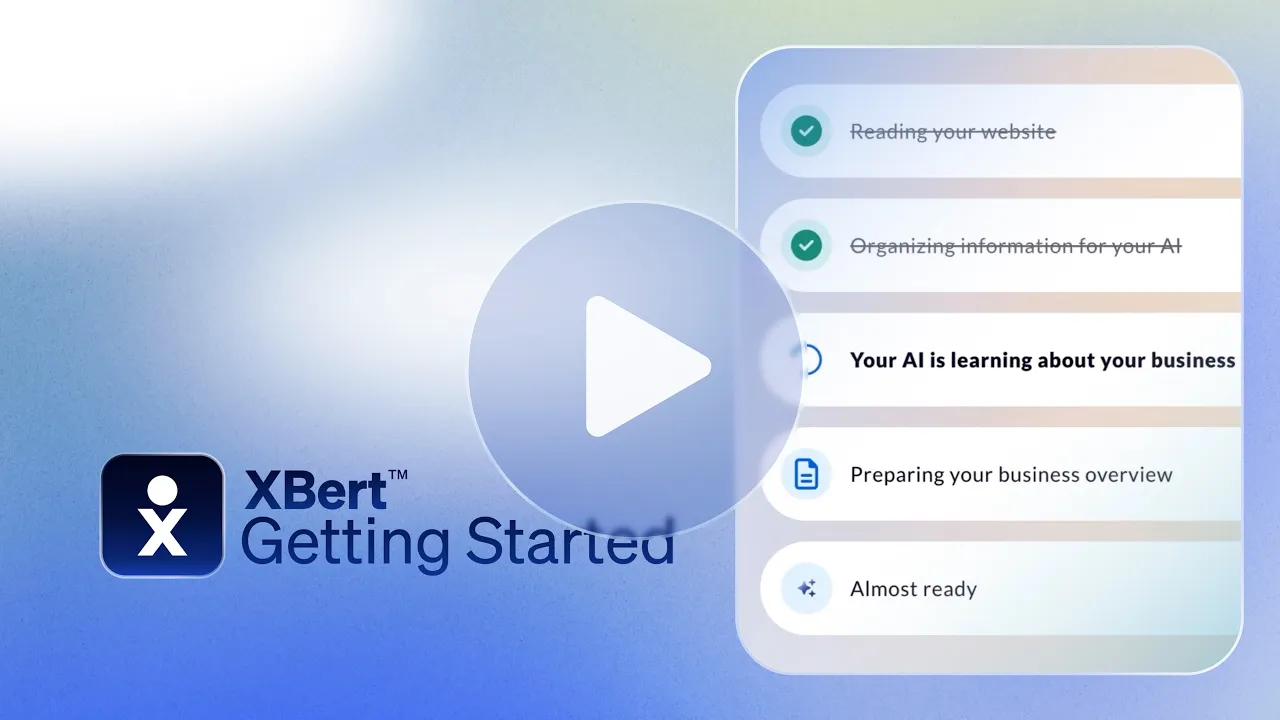
For more details, including specific implementation steps, read this XBert AI help article.
Handle Incoming Calls 24/7 With XBert AI
Inbound voice automation works when it starts with the customer’s problem and ends with a clear next step. That might be an answer, a booked appointment, a routed call, or a task for the support team.
Nextiva XBert AI is the strongest option for small businesses that want a practical, fully managed AI receptionist. It brings together AI-powered answering, scheduling, lead capture, transcripts, analytics, and phone workflows without requiring owners to build their own voice stack.
Test any platform with real calls before you decide. Interrupt it. Ask complex questions. Transfer to a person. Review the notes. The right voice agents should make customer support feel better, not more distant.
FAQs
For small business inbound calls, Nextiva’s XBert AI is the strongest fit for teams that want an AI receptionist, assisted setup, phone coverage, scheduling, lead capture, and follow-up tasks in one communications platform.
Developer teams may prefer Retell AI or Vapi. No-code builders may consider Synthflow AI or Goodcall.
In this market, buyers often compare four types of AI voice agents: managed business phone tools such as Nextiva XBert AI, no-code builders such as Synthflow AI, developer platforms such as Retell AI or Vapi, and enterprise contact center tools such as PolyAI.
For personal productivity, people often compare ChatGPT, Google Gemini, Microsoft Copilot, and Anthropic Claude. Those are general AI assistants, not business phone voice agents.
The best AI agent depends on the job. For inbound customer support and front-desk coverage, Nextiva XBert AI is a strong choice for small businesses. For custom developer builds, Retell AI and Vapi stand out. For enterprise contact centers, PolyAI is often evaluated.
Choose based on call volume, integrations, security needs, pricing model, and the level of technical ownership your team wants.