
 Customer Experience
  Blog
Blog  Business Communication
  Leadership
  Marketing & Sales
  Nextiva News
  Productivity
  VoIP
VoIP 

Your IVR might be doing exactly what you designed it to do and still frustrating your customers.
That’s not a reflection on poor configuration, though. It’s a major flaw in how IVR systems are designed.
Sure, you can route callers loosely in the vague direction they want to go. But how often do you achieve first call resolution (FCR)? Not as often as you’d like, I bet.
A touch-tone menu can route a caller to the right department. It can collect an account number, offer a few self-service options, and keep simple requests away from your agents. But routing isn’t resolution.
That’s where AI voice agents make a difference. Instead of asking callers to navigate a predefined menu, they can understand what someone is trying to accomplish, access information from connected systems, and complete approved tasks during the conversation.
Now, I’m not saying you should rip out every IVR queue and replace it with an AI agent (though some will do so and benefit majorly).
What I am suggesting is to compare traditional IVR, conversational IVR, and AI voice agents to see which will bring you the best balance of caller experience, containment, and resolution.
What Is a Traditional IVR?
IVR is the automated phone system that answers a call and asks the caller to select from a predefined set of options: “Press 1 for sales. Press 2 for support.”
Underlying that simple menu is a deterministic decision tree. The system waits for a dual-tone multi-frequency (DTMF) input, matches it to a predefined option, and sends the caller to the corresponding destination.
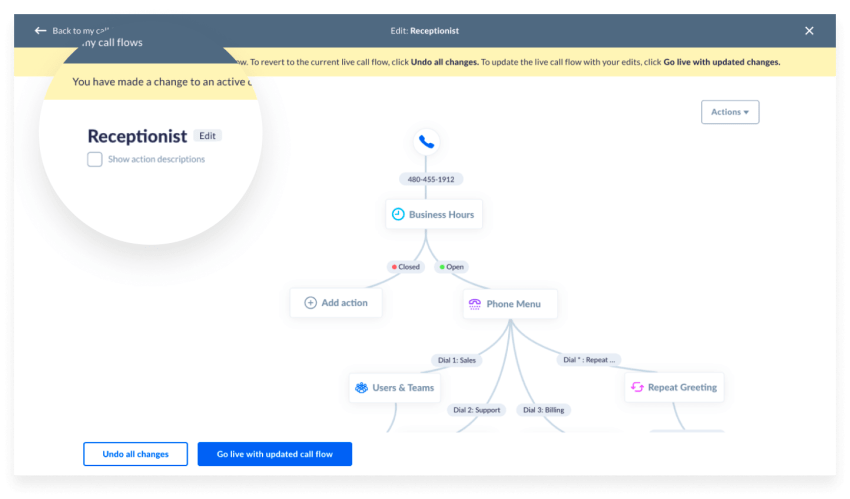
Traditional IVR can also collect information like an account number or language preference before a transfer. That can save an agent from asking the same basic questions once the call connects.
The limitation is that the system can only follow the paths someone has designed. If a caller’s request doesn’t fit neatly into one of those paths, they may have to repeat options, work through several menu levels, or eventually ask to speak to an agent.
Where traditional IVR still works well
All this doesn’t make legacy IVR useless. It still works well when the decision is simple and predictable, such as with:
- Language selection
- Department routing
- Binary choices not requiring an AI model to interpret what the caller means
IVR can also play an important role in regulated workflows where deterministic input is preferable, including secure keypad payment collection.
The problem comes when you expect the same technology to resolve conversations that require context, information from multiple systems, or a series of decisions.
At that point, you’re no longer asking the IVR to route a call. You’re asking it to understand and resolve the caller’s request. That’s where conversational IVR and AI voice agents take a different approach.
What Is an AI Voice Agent?
An AI voice agent is a conversational system that can understand spoken language, determine what a caller wants, and take action during the conversation.
Instead of waiting for a caller to select from a fixed menu, the agent can interpret a request in natural language and respond accordingly. The conversation can continue across multiple turns, allowing the caller to explain what they need without restarting the interaction each time.
Behind the conversation is a combination of speech recognition, AI reasoning, and text-to-speech technology:
- Speech recognition converts the caller’s voice into text.
- The AI model interprets that text and determines what should happen next.
- Text-to-speech then converts the response back into spoken language.
The important difference is what happens between those stages. A modern AI voice agent can connect to business systems through APIs, retrieve information, update records, and trigger approved workflows. That means the conversation doesn’t have to end with another transfer to a human agent.
For example, a caller could ask about an order, provide their account details, and receive an update without navigating through multiple menus. The AI can also capture the interaction and pass relevant context to a human agent when escalation is required.
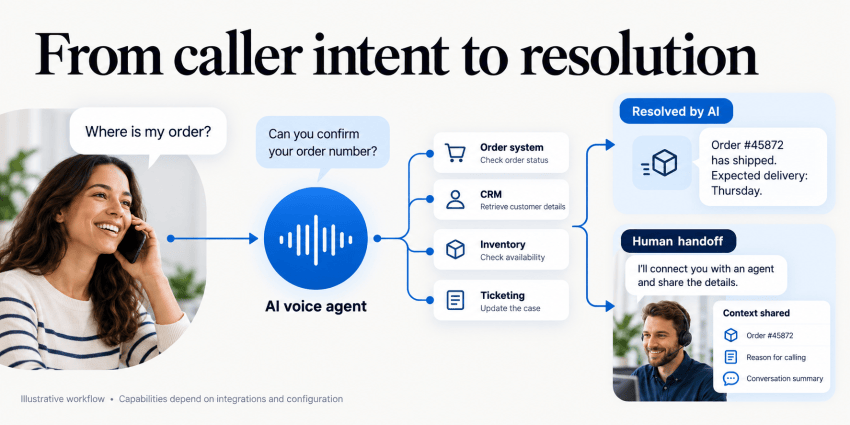
Nextiva’s AI voice capabilities are designed around this model, with continuous transcription, connected data sources, and CRM integration supporting conversations that go beyond simple call routing.
The result is a phone experience that can understand the intent behind a call rather than simply identify which menu option the caller selected.
AI Voice Agent vs. Traditional IVR: Key Differences
The difference between an AI voice agent and an IVR comes down to what happens after the caller starts talking.
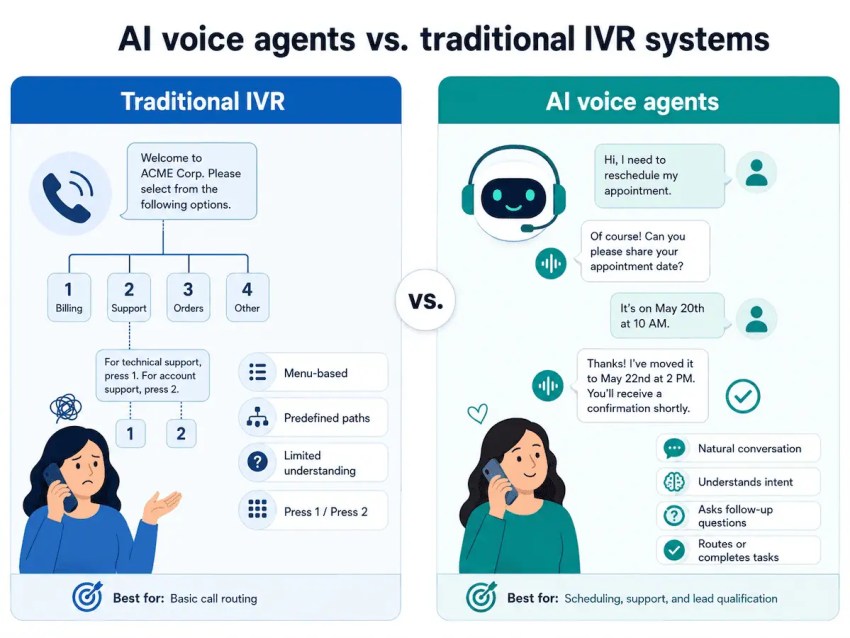
A traditional IVR is designed to route the caller through predefined options. An AI voice agent can understand the request, maintain context, access connected systems, and take action before deciding whether a human is needed.
| Traditional IVR | AI Voice Agent | |
|---|---|---|
| Caller interaction | Presses menu options | Speaks naturally |
| Understanding | Recognizes keypad selections | Understands intent and context |
| Conversation | Predefined paths | Multi-turn conversation |
| Decision-making | Fixed rules | AI-driven reasoning within guardrails |
| Data access | Is limited or workflow-specific | Can access connected systems through APIs |
| Self-service | Handles predefined requests | Can complete approved tasks |
| Context | Limited | Maintained throughout the conversation |
| Escalation | Transfers the call | Transfers with caller context and interaction history |
| Best suited to | Simple, predictable routing | Complex requests and end-to-end resolution |
The 3 Tiers of Voice Automation
Not every automated phone system that understands speech is an AI voice agent.
There are three broad approaches to voice automation, and the difference comes down to how much the system can understand and how much it can do.
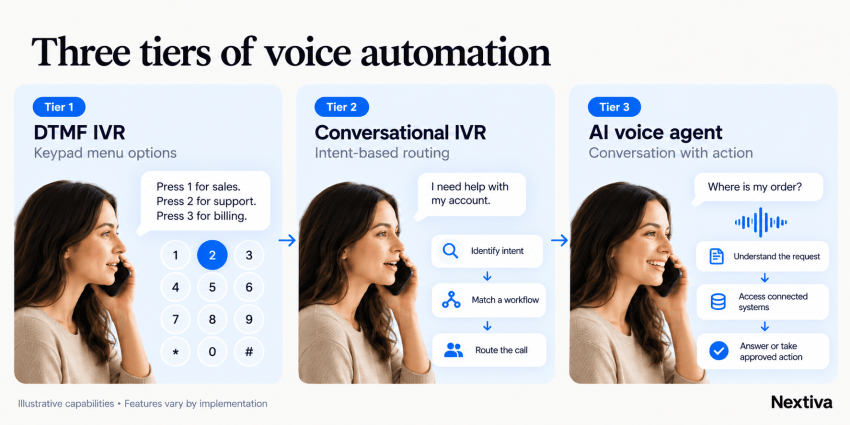
Tier 1: DTMF keypad IVR
This is the traditional model. Your caller listens to a menu and presses a number on their phone keypad. The system follows a predefined decision tree and routes the call based on the selection.
It’s predictable and easy to control, but the caller has to fit their request into the options you’ve provided.
Tier 2: Conversational IVR
Conversational IVR replaces the keypad with natural language input. Instead of pressing 1 for sales, the caller might say, “I’d like to speak to someone about upgrading my account.”
The system uses natural language understanding (NLU) to identify the caller’s intent and map it to a predefined workflow.
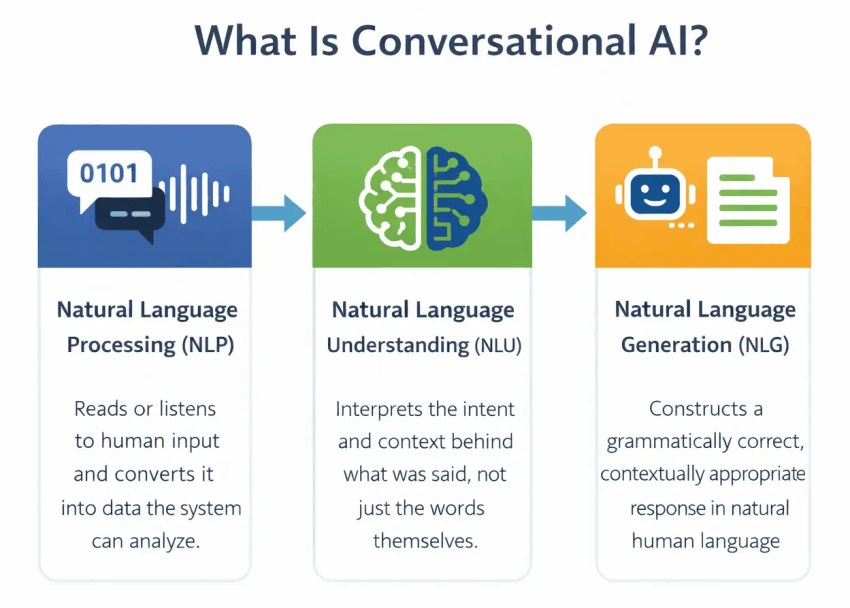
That makes the experience more flexible than DTMF. But the underlying logic can still be relatively rigid. This system generally matches what the caller says to intents and routes that have already been configured.
Tier 3: Generative AI voice agents
Generative AI voice agents take the next step by using large language models (LLMs) to interpret the conversation and determine what should happen next.
Your agent can maintain context across multiple turns, reason about the request, and use connected systems or APIs to perform approved actions. That means the workflow doesn’t have to end with routing.
An AI voice agent might identify why someone is calling, retrieve information from a CRM, update an order, and then decide whether the request has been resolved or needs to be passed to a human agent.
The distinction isn’t simply whether the system uses a voice interface. It’s how much responsibility the system can take once the caller starts talking.
Key Differences in Caller Experience and Resolution
The technology matters because it changes what the caller can accomplish without waiting for an agent:
- A traditional IVR is primarily designed to move callers through a routing process.
- An AI voice agent can take that interaction further by understanding the request and attempting to resolve it within the same conversation.
For this comparison, measure successful containment as the percentage of incoming calls resolved within automation without a human transfer. Track abandoned calls and repeat contacts separately so they do not inflate the apparent success rate.
- Traditional IVR systems often resolve only a small share of calls because they limit self-service options to predefined workflows.
- AI voice agents can support a broader range of requests, as they can interpret natural language and interact with connected systems.
Customers have limited patience for delayed support. In Nextiva’s Customer Patience Benchmark, a survey of 400 people, 56% said they would try another support channel after a missed response window, while 28% would abandon the product or service entirely.
These findings make timely help a priority. When comparing IVR and AI voice agents, measure whether callers get their issue resolved, not just whether the system answers quickly.
What’s more, that first bad experience could be your only chance. Some 28% of customers will abandon a brand after their first negative interaction.
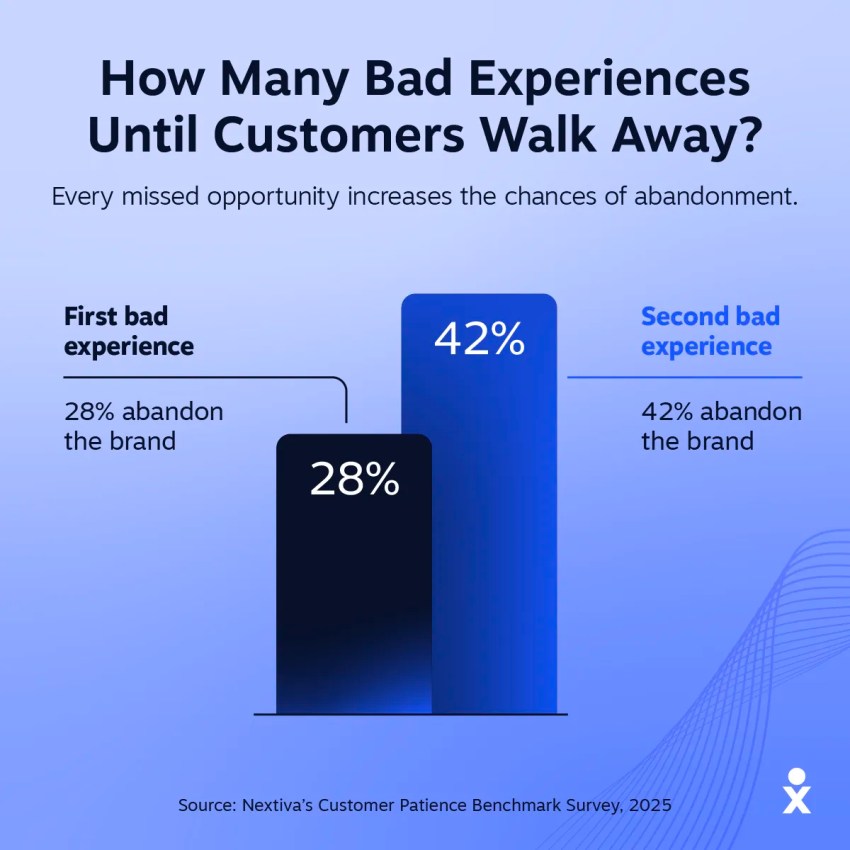
This puts pressure on contact centers to do more than simply answer calls quickly. The goal is to move the caller toward a resolution as efficiently as possible, whether that means AI self-service, a well-routed human interaction, or a combination of both.
Therefore, the important metrics aren’t just how quickly an automated system answers. The game has changed, accounting for:
- How often you resolve a request
- How often you need to escalate
- Whether the caller needs to repeat information when that escalation happens
The Cost Equation: IVR vs. AI Voice Agents
Comparing IVR and AI voice agents on a per-minute rate can be misleading. As with most technology migrations or upgrades, you’re no longer comparing apples with apples.
A cheap automated system isn’t necessarily cheaper if most callers still end up with a live agent. The real cost depends on how many calls the technology resolves, how many it transfers, and what each human interaction costs.
A simple way to compare variable handling costs is:
Estimated cost per incoming call = average automation cost per call + (human-transfer rate × average cost per transferred call)
Consider a hypothetical setup where each incoming call uses three minutes of automation and each transferred call adds $5.50 in live-agent handling costs.
- IVR: At $0.02 per automated minute and a 60% human-transfer rate, the estimated cost is $0.06 + (0.60 × $5.50) = $3.36 per incoming call.
- AI voice agent: At $0.12 per automated minute and a 25% human-transfer rate, the estimated cost is $0.36 + (0.25 × $5.50) = approximately $1.74 per incoming call.
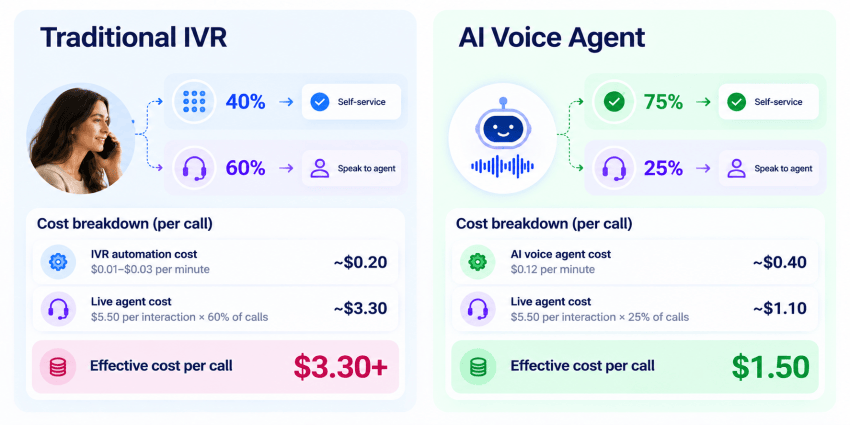
These are hypothetical inputs, not Nextiva prices or industry benchmarks. The example assumes equal automation time and equal handling costs for transferred calls. Actual results depend on your workflows, call durations, transfer rates, and pricing model.
For a complete comparison, also include implementation, integrations, platform fees, ongoing maintenance, and repeat contacts. Track cost per successfully resolved issue alongside cost per incoming call.
The broader point is more important than the exact numbers:
- An AI voice agent can justify a higher automation cost if it resolves substantially more calls without human intervention.
- A low-cost IVR can become expensive when it’s primarily acting as a gateway to the contact center.
When evaluating the two technologies, look beyond the automation rate. Measure containment, transfer rate, average handle time (AHT), and the cost of the human interactions that remain.
That’s how you find out whether automation is actually reducing the cost of serving customers.
Estimate your savings: Use Nextiva’s AI Receptionist ROI Calculator to explore potential savings based on your call volume and staffing costs.
Implementing AI Voice Agents Alongside Your Existing Phone System
Here’s some good news: You don’t need to replace your entire phone system to start using an AI voice agent.
The more practical approach is to identify the calls where conversational automation can create the most value, connect the AI to the systems it needs, and introduce clear escalation rules before expanding its scope.
1. Audit your call logs
Start with the calls you’re already receiving. Look at your call logs, transcripts, and disposition data to identify the most common reasons people contact your business. Focus on the high-frequency requests that follow a relatively consistent process.
These are usually the best candidates for initial automation because you can define what the AI should be allowed to do and when it should hand the conversation to an agent.
2. Connect AI to your telephony environment
The voice agent needs a way to receive calls and communicate with the systems behind them. Depending on your architecture, that can involve SIP trunks or VoIP telephony, along with integrations into your CRM and other business systems.
The objective isn’t simply to put an AI voice on the front of your phone number. It’s to give the AI access to the information and actions it needs to resolve approved requests.
3. Build warm transfers
Some calls will always need a human response. When that happens, don’t make the caller start again from the beginning. We all know how irritating that can be.
A warm transfer can pass information about the caller, the reason for the call, and the conversation so far to the receiving agent. The human agent can then pick up with the relevant context already available.
This is one of the biggest differences between simply transferring a call and building an AI-assisted contact center workflow.
4. Define guardrails and failover
The AI needs clear boundaries. Otherwise, you leave the door open to unwanted mistakes.
- Define which tasks the AI can complete, what information it can access, and which situations require human intervention.
- Program deterministic rules that can handle specific scenarios where AI reasoning shouldn’t be used.
- Create a failure path.
If your AI voice agent can’t understand the caller, encounters an unavailable system, or reaches the limits of its approved workflow, the call should have a clear route to a human agent.
Remember, the best implementations don’t start by asking how many calls AI can handle. They start by asking which calls to automate, what the AI needs to resolve them, and when a human should take over.
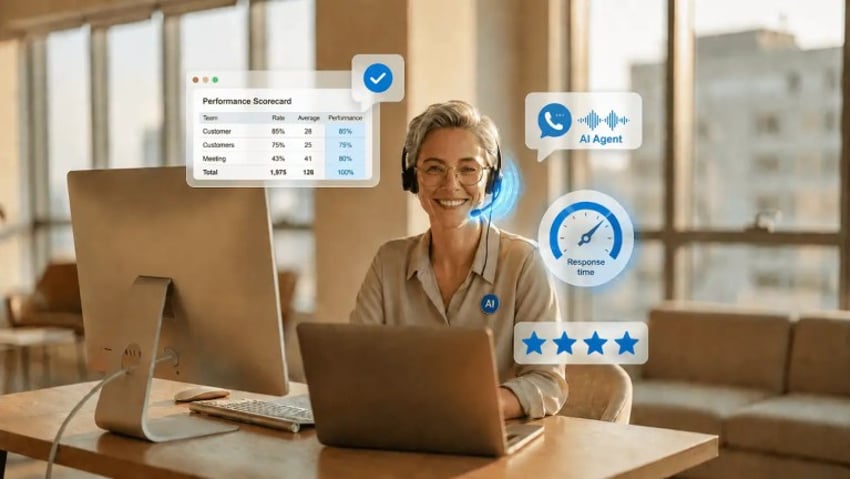
Move Beyond IVR Routing With AI Voice Agents
Traditional IVR still has a place in the contact center. But if your phone system mainly moves callers between queues, there’s an opportunity to do more.
AI voice agents can understand what callers are trying to achieve, access connected systems, and complete approved tasks.
But the right approach isn’t to replace every IVR workflow with AI. It’s to identify where conversational automation can resolve more calls, reduce unnecessary transfers, and give your agents better information when they do need to get involved.
Nextiva brings AI voice capabilities, cloud telephony, contact center functionality, and CRM integrations together on one platform, designed to strive for 99.999% uptime.
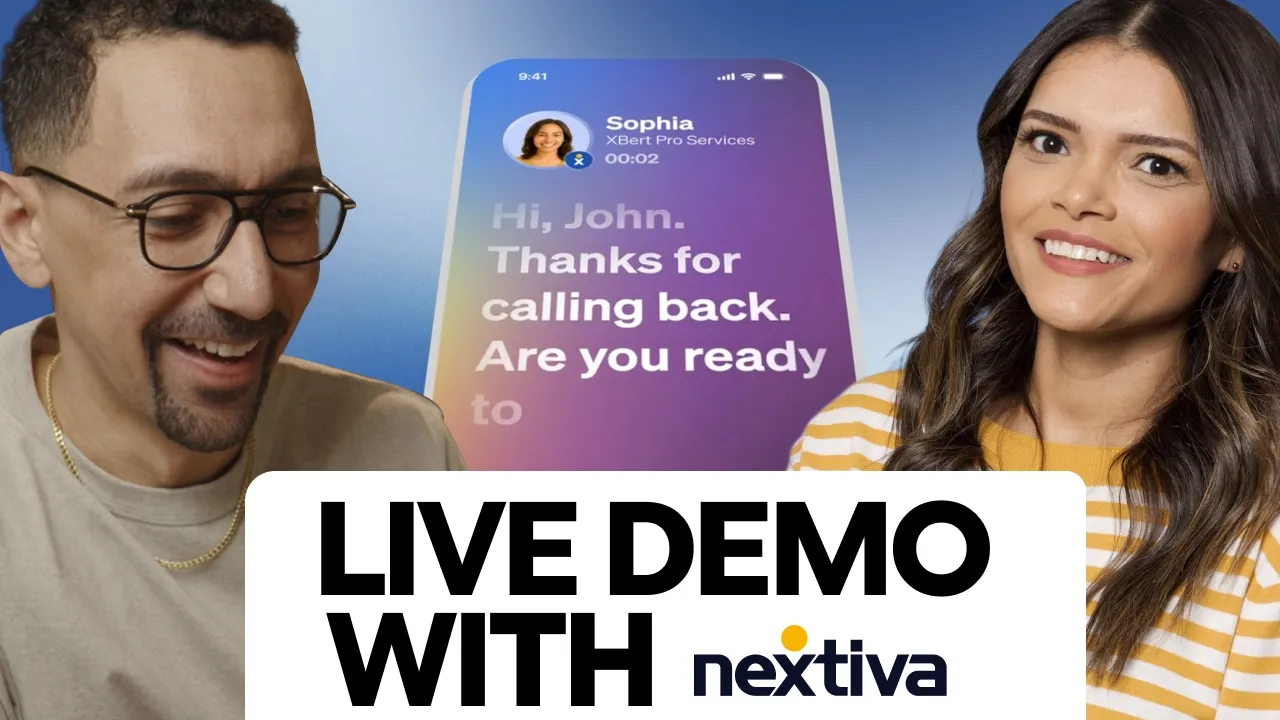
If you’re ready to see what an AI voice agent can do for your contact center, it’s time to try Nextiva’s XBert AI tool.
You don’t need to rebuild your phone system to get started. Nextiva gives you the voice, contact center, and AI capabilities to move beyond basic call routing and start resolving more customer interactions automatically.
You can start with the workflows creating the most call volume, see how AI handles real customer interactions, and expand from there.
Ready to take the next step?
Listen to XBert AI voice-agent call examples to hear how it handles inquiries, appointment requests, and routing.
Your always-on voice agent that automates calls 24/7.
XBert AI is a customizable voice agent handles inbound calls with natural-sounding conversational AI. Answer questions, route calls, and qualify leads so your team can focus on their best work. Set it up in just 5 minutes.
AI Voice Agent vs. IVR FAQs
Pricing varies by provider, call volume, call duration, integrations, and the level of automation required. Per-minute pricing alone doesn’t tell you the true cost. You also need to consider containment, transfer rates, and the cost of the human interactions that remain.
Deployment depends on the complexity of the workflows and integrations involved. A focused implementation covering a small number of high-volume requests is generally simpler than attempting to automate an entire contact center. Starting with a defined set of workflows also allows you to measure performance before expanding the AI voice agent’s role.
Yes. AI voice agents can be introduced alongside existing telephony infrastructure through integrations like SIP or VoIP infrastructure. The important consideration is whether the AI can connect to the CRM and other systems it needs to complete the workflows you’re trying to automate.
All calls should follow a predefined escalation path to a human agent. A well-designed AI agent-to-human handoff can include the caller’s details, reason for calling, and conversation history so the agent can continue the interaction without asking the caller to repeat everything.