
 Customer Experience
 Blog
 Business Communication
 Leadership
 Marketing & Sales
 Nextiva News
 Productivity
 VoIP
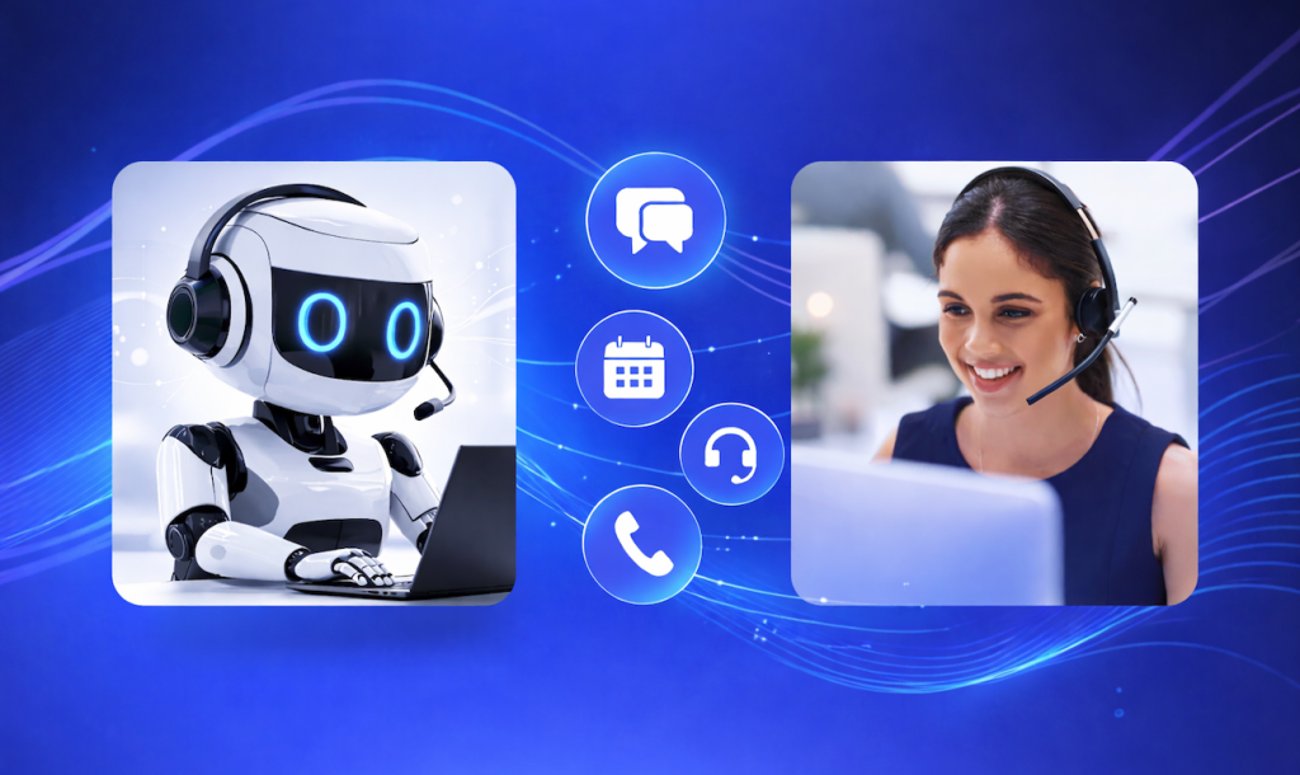

When call volumes increase, the obvious solution is often to add more people. But what if I told you there was a more scalable solution? And one that doesn’t increase your costs every time?
AI answering services can answer inbound calls immediately, capture caller details, and handle routine inquiries without placing customers in a queue.
This creates a different cost and capacity model than outsourced call handling. Instead of paying for human agents to cover every call, you can automate routine conversations and reserve human support for situations that need it.
The choice isn’t simply between AI and people. AI can handle repetitive inquiries at scale, while human agents bring judgment, specialist knowledge, and empathy when a conversation needs more than a straightforward answer. More often than not, it’s about balancing how much artificial intelligence you implement with how much you reserve for human skill.
In this guide, we’ll compare AI answering services with outsourced call centers across cost, response times, and scalability. We’ll also look at the technical requirements of each approach and how a hybrid model can combine automated call handling with human support.
Understanding the Core Differences Between Voice AI and Outsourced Call Centers
AI answering services and outsourced call centers both handle inbound calls, but they operate differently.
An AI answering service uses conversational software to answer callers, understand their requests, and complete predefined tasks. Depending on its integrations and configuration, it can book appointments, answer common questions, and pass calls to a human when needed.
An outsourced call center uses human agents employed by a third-party provider. These agents can work from shared or dedicated teams, following your business’s scripts and processes to handle customer queries.
The table below compares AI answering services and outsourced call centers across key differences in how they handle customer calls.
| Comparison | AI Answering Service | Outsourced Call Center |
|---|---|---|
| Call handling | Uses conversational AI to answer calls and manage routine tasks | Answers calls and follows your business processes |
| Availability | Can provide 24/7 call answering without shift scheduling | Depends on the provider’s staffing model and contracted hours |
| Response time | Answers immediately, without placing callers in a human queue | Depends on agent availability and call volume |
| Scalability | Handles multiple concurrent calls without adding staff | Typically requires additional agent capacity to handle higher call volumes |
| Routine questions | Answers common questions and captures caller information | Handles queries using scripts, knowledge bases, and training |
| Appointments and follow-up | Can book appointments, log details, and trigger notifications when integrated with relevant systems | Can complete these tasks manually or through connected systems |
| Complex issues | Can collect information and transfer calls when a request exceeds its capabilities | Can investigate exceptions and work through more involved problems |
| Customer interaction | Provides consistent, automated conversations | Offers human judgment, empathy, and personalized support |
| Cost structure | Typically uses a software subscription or usage-based pricing | Typically involves agent-hour, per-minute, or contracted service fees |
| Setup and maintenance | Requires configuration, integrations, and ongoing updates to its knowledge and call flows | Requires agent onboarding, training, quality assurance, and script maintenance |
The fundamental difference is the type of work each model is designed to handle:
- Voice AI is suited to routine call handling and structured tasks.
- Human agents are suited to manage conversations that require judgment, complex problem-solving, or a personal touch.
The right choice depends on your call volume, the complexity of customer interactions, and the level of human support you need.
Cost Comparison: Subscription Models vs. Per-Agent BPO Labor
The cost difference between an AI answering service and an outsourced call center depends on how you pay for capacity.
- AI answering services typically use a software subscription or usage-based pricing.
- Outsourced call centers charge for human staffing, often through hourly rates, per-minute fees, or contracted service packages.
That distinction becomes more significant as call volumes grow. With AI, a business can handle more routine calls without necessarily adding staff. With a business process outsourcing (BPO) call center, higher demand can require more agent hours or a larger service commitment.
To compare the two models accurately, look beyond the headline price. Consider setup fees, minimum commitments, and the cost of maintaining coverage during evenings and weekends.
Flat-rate voice automation pricing
A subscription-based AI answering service makes monthly costs easier to forecast. The software can answer calls outside business hours and manage routine inquiries without requiring additional shifts or overtime.
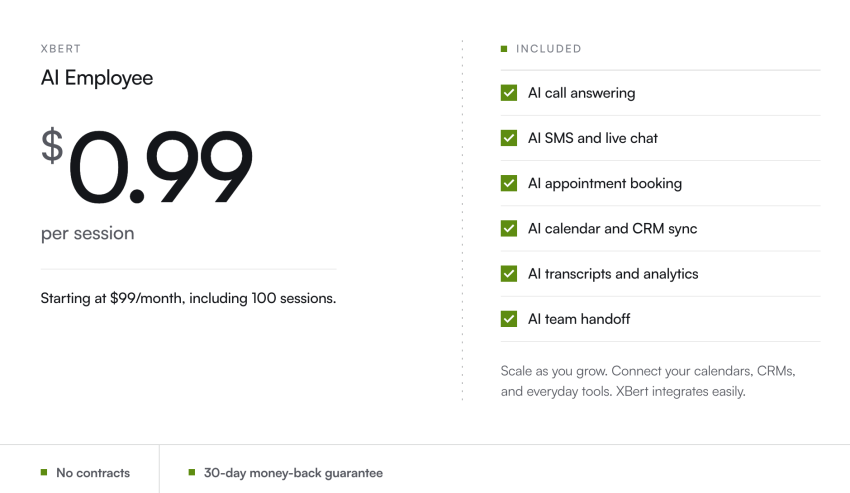
Some services also include integrations that support appointment booking, caller data capture, and follow-up notifications. These capabilities can reduce manual work after the call, depending on the systems you use and how the service is configured.
Before choosing a plan, check whether the price includes your expected call volume or whether additional usage fees apply.
Hourly rates, per-minute fees, and hidden BPO staffing overheads
Outsourced call center pricing can include more than the time agents spend speaking with customers. Depending on the contract, businesses might also pay for onboarding, script development, or minimum monthly usage.
Per-minute plans require particular attention. A low advertised rate can become less attractive if the agreement includes minimum commitments, extra charges during demand spikes, or unused minutes that expire.
For a fair comparison, calculate the total cost of handling your expected monthly call volume, including setup and ongoing service fees.
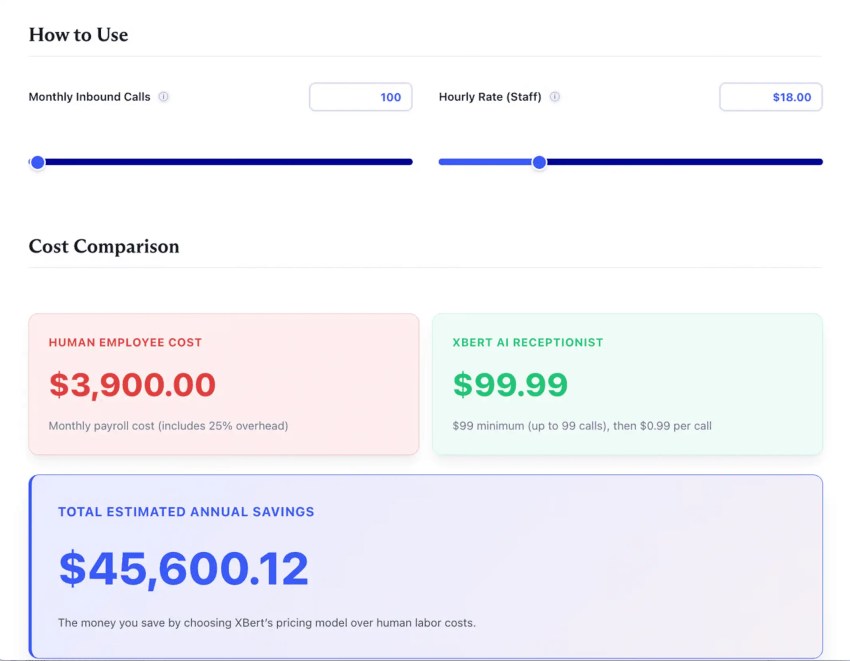
AI Receptionist ROI Calculator
See how much your business could save with the XBert® AI Receptionist ROI Calculator. Just enter your call volume and staffing costs to find out how quickly an AI assistant can pay for itself and start freeing up your time.
Operational Capabilities: Call Speed, Concurrency, and Complexity
Cost is only one part of the decision. You also need to consider how quickly each service answers, how many calls it can manage at once, and whether it can resolve the issues customers bring.
AI answering services can respond immediately and handle multiple conversations simultaneously. Overflow answering services are especially useful during busy periods, when callers might otherwise encounter a queue or reach voicemail.
Outsourced call centers provide human support for more involved conversations. However, their capacity depends on agent availability, staffing levels, and the number of calls arriving at the same time.
The right model depends on the balance between call volume and call complexity. Routine questions are often suitable for automation, while sensitive or complicated issues can require a human agent.
Zero hold time and unlimited concurrent call scaling
An AI answering service can handle multiple inbound calls at the same time without requiring a separate agent for each conversation.
This capacity is especially useful during seasonal peaks, marketing campaigns, or unexpected increases in demand. Instead of placing callers in a queue, the service can answer immediately and begin collecting the information needed to help them.
For businesses that rely on inbound inquiries, faster answering also reduces the risk of calls going unanswered outside normal business hours.
Handling complex workflows, exceptions, and high-empathy calls
Not every customer conversation follows a predictable path.
A caller might have a complicated complaint, need an exception to a policy, or require help with a technical issue involving several steps. These situations require judgment and flexibility beyond a predefined, automated workflow.
Human agents are also important when callers are upset or dealing with sensitive matters. An AI answering service can collect initial details and route the call, but a trained person can take responsibility for the conversation and work toward a resolution.
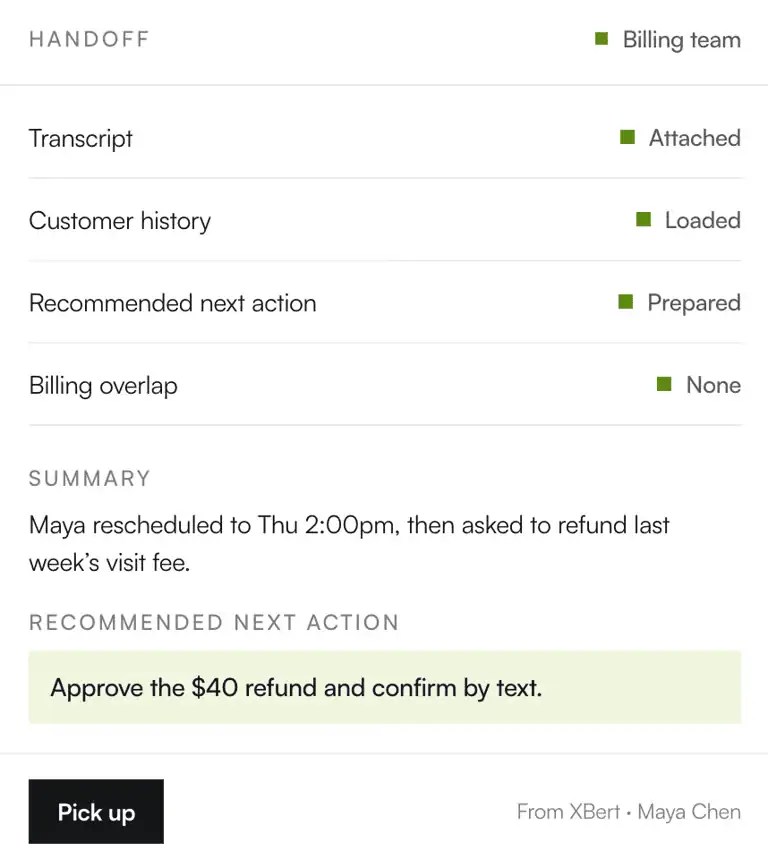
A practical approach is to automate routine inquiries while making it easy for callers to reach a human when their needs become more complex.

Deployment Timeline, Technical Setup, and Maintenance
AI answering services and outsourced call centers require different levels of preparation before they’re ready to handle customer calls.
An AI service can often be configured within 24–72 hours, depending on the complexity of the call flows and integrations. Outsourced call centers typically take longer, with setup requiring several weeks for agent recruitment, training, and quality assurance. After all, these are humans learning new processes — ones you’ve deemed important to follow.
The work doesn’t end at launch. AI systems need their knowledge and workflows maintained, while BPO providers require ongoing agent training and performance reviews.
Fast software onboarding with CRM and calendar integrations
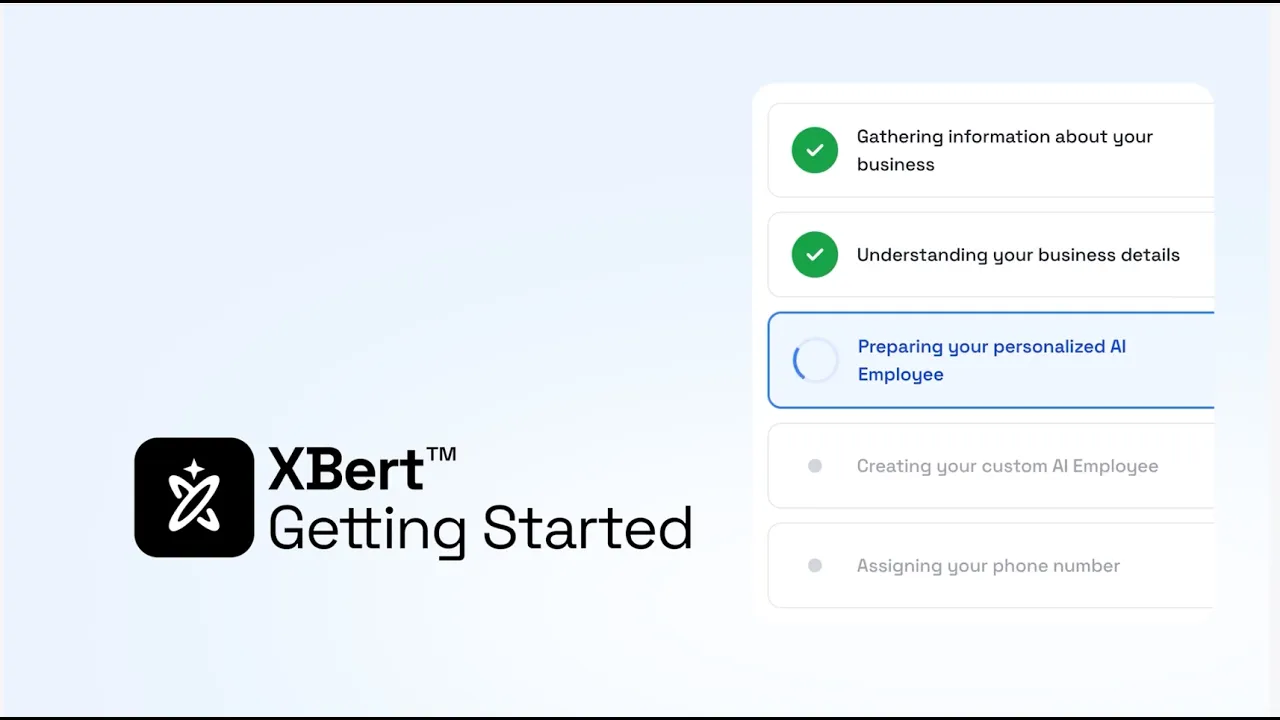
Setting up an AI answering service typically involves defining how calls should be handled, connecting the relevant business systems, and testing common caller scenarios.
For example, a service business might connect its AI receptionist to a calendar so callers can book appointments during or outside business hours. CRM integration can also help capture caller details and keep customer records up to date.
Before going live, configure business hours, call transfers, and fallback rules. Test common requests and exceptions to ensure that the AI directs callers to the right place when it can’t complete a task.
Agent hiring, training cycles, and quality assurance
Outsourcing call handling involves preparing a team to represent your business accurately and consistently.
The provider needs to understand your products, customer policies, and escalation procedures. Training materials and standard operating procedures help agents follow the same process when handling common problems.
Ongoing quality assurance is also important. Call reviews, performance scorecards, and regular script updates help identify where agents need additional support or where processes should change.
Choosing the Right Model or Combining Both in a Hybrid Approach
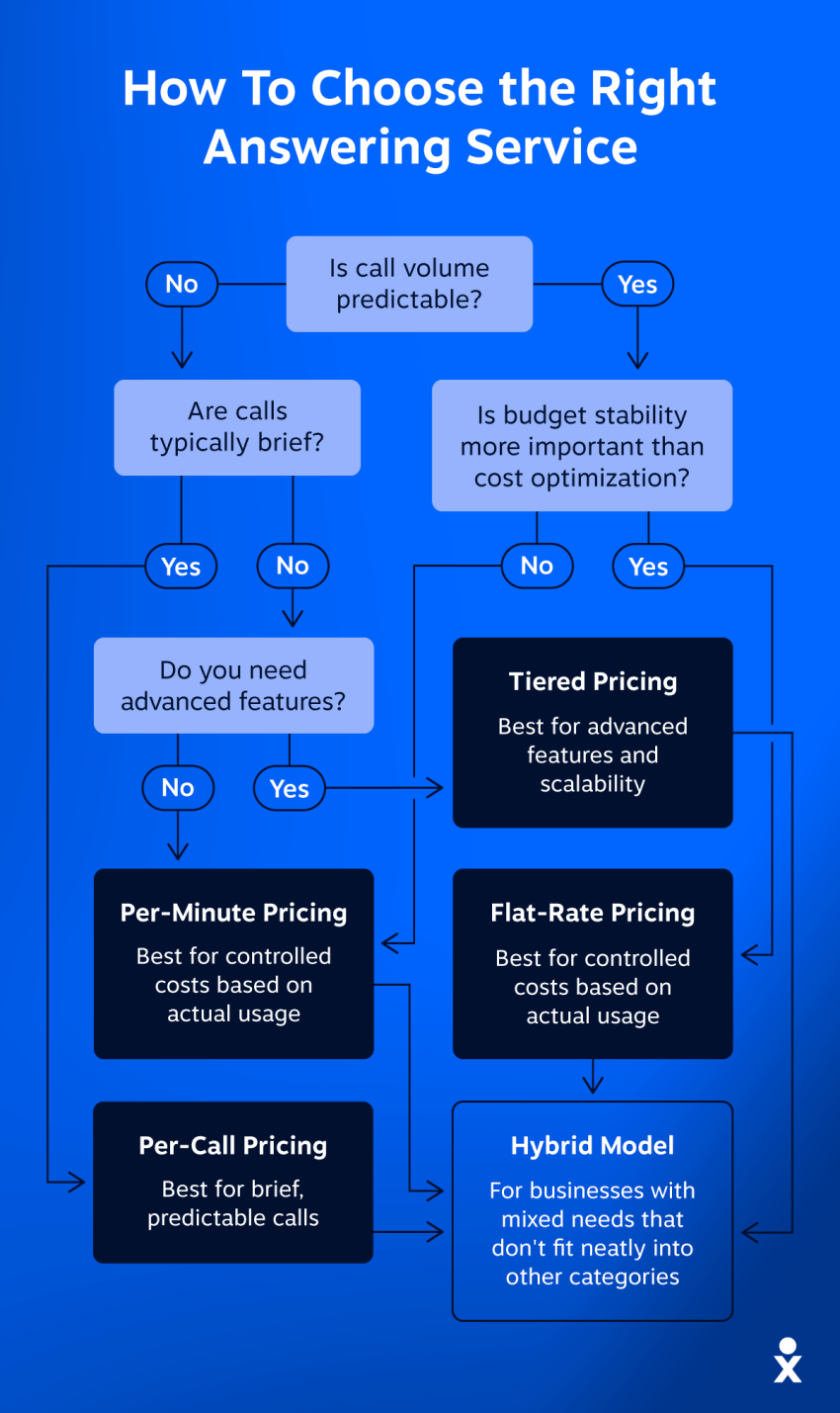
The right choice depends on the types of calls your business receives, how much demand fluctuates, and how much human support each interaction requires.
- AI answering services suit businesses that handle a high volume of routine inquiries, need reliable after-hours coverage, or want to capture leads without staffing every call.
- Outsourced call centers are useful when conversations require specialist knowledge, complex problem-solving, or sustained human interaction.
You don’t have to choose one model exclusively. A hybrid approach uses AI to answer calls and collect initial information, then transfers callers to human agents when they need further support.
When AI answering makes the most sense
AI answering services are particularly useful for businesses that need to capture inquiries and complete straightforward tasks without delay.
Common use cases include:
- Service businesses that need 24/7 lead intake and appointment scheduling.
- Companies that regularly miss calls during busy periods.
- Businesses that want to provide after-hours coverage without hiring additional receptionists.
AI can handle routine interactions consistently while giving staff more time to focus on work that requires their attention.
When full BPO support is required
An outsourced call center is more appropriate when customer interactions involve complex processes or require a high degree of human judgment. This can include multi-step technical troubleshooting, complicated retention conversations, and outbound campaigns that depend on human interaction.
Some regulated services also require qualified human reps to handle specific customer interactions. In these cases, confirm the provider’s capabilities and compliance arrangements before outsourcing.
Combining front door AI triage with human agent escalations
A hybrid model uses AI as the first point of contact rather than expecting it to resolve every inquiry.
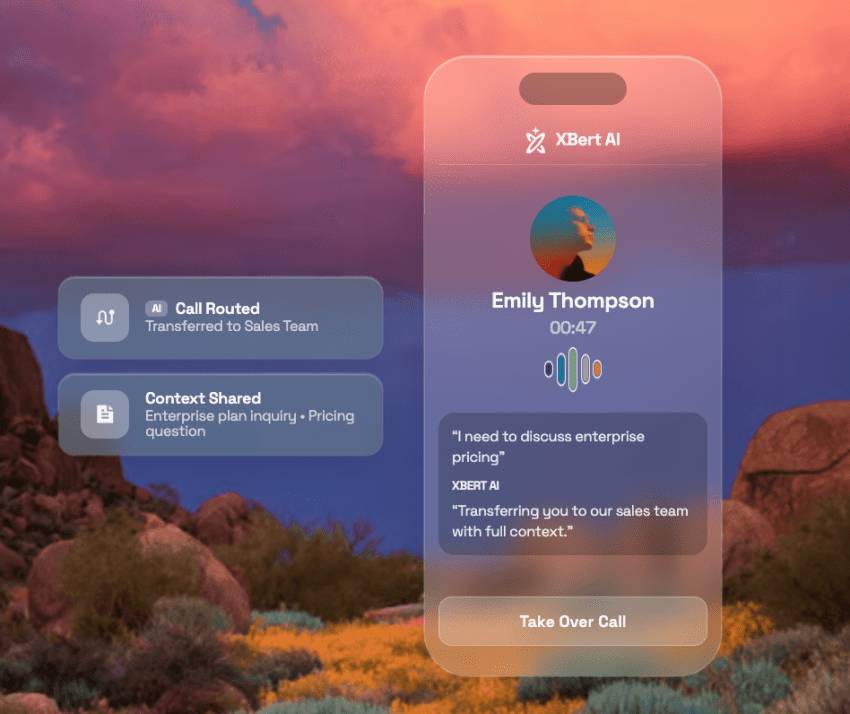
Your AI can identify the caller, understand the reason for the call, and collect relevant details. If the request requires human support, it can transfer the conversation to an agent with the information already gathered.
This helps avoid callers repeating themselves and gives agents useful context before they take over. It also allows businesses to automate routine call handling while keeping human support available for more complex interactions.
Nextiva’s XBert AI Receptionist and Contact Center support this approach by combining automated call answering with human-led customer support.
Tata Play, for example, now handles five million routine customer requests monthly using AI agents alone and, in doing so, has reduced support costs by an impressive 40%. Tata now has more time for its human agents to deal with more technical and complex queries.

“Nextiva worked with us to develop real-time listening, integrated the multiple channels into a singular customer support interface, and improved our first response time by integrating WhatsApp as a communication channel in our customer service.”
~Dwarka Srinath
Make the Right Call for Your Business
Choosing between an AI answering service and call center outsourcing comes down to the calls you need to handle, the level of support customers expect, and how much you want to spend on coverage.
AI answering services provide a practical way to answer routine inquiries, capture leads, and maintain around-the-clock availability. Outsourced call centers bring human judgment and specialist support to conversations that need more attention.
For many businesses, combining the two offers flexibility. AI handles the first interaction and straightforward requests, while human agents step in when callers need more personalized help.
Nextiva brings AI-powered call answering and cloud contact center capabilities together, helping businesses build a call-handling approach around their customers and operations.
Ready to test AI answering services?
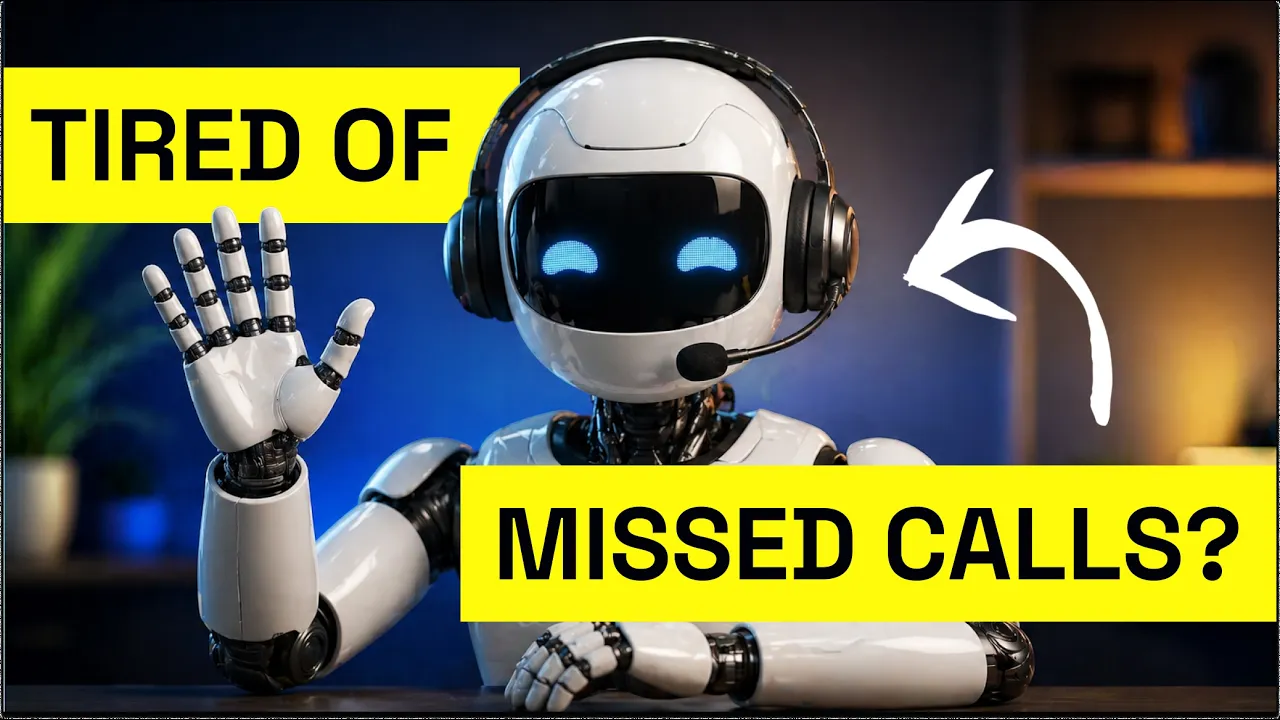
Watch our 4-step checklist video to get a sense of what’s possible.
Never miss another call, text, or chat with XBert AI Receptionist
XBert greets customers, books appointments, and captures leads automatically, turning missed connections into new opportunities.