

 Customer Experience
 Blog
 Business Communication
 Leadership
 Marketing & Sales
 Nextiva News
 Productivity
 VoIP


High call volume isn’t necessarily a staffing problem. It’s a capacity problem.
When hundreds of calls arrive at once, adding another agent doesn’t help the people already waiting. Traditional phone systems put callers into queues, while live answering services and BPOs often charge by the minute, making every volume spike more expensive.
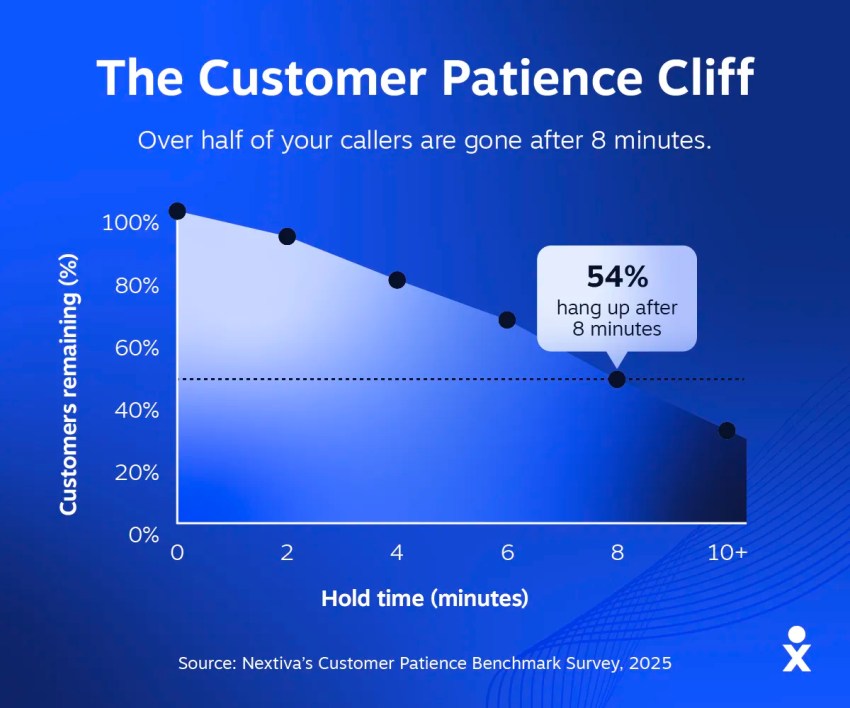
What’s more, callers aren’t particularly patient. Nextiva’s Customer Patience Benchmark survey found that 72.3% of phone callers expect an answer within five minutes, while 56.3% will switch channels or hang up when wait times become too long.
AI answering services change the equation by handling multiple calls simultaneously, responding immediately, and completing routine requests without putting every caller into a human queue.
In this guide, I’ll explain how AI answering services handle high call volumes, where the economics start to make sense, and what to look for when evaluating a provider.
The High Call Volume Problem: Why Traditional Setups Break
High call volume is manageable when demand is predictable. The problem is what happens when it isn’t.
A marketing campaign, seasonal rush, or service disruption can send more calls into your phone system than your available agents can answer. Those callers enter a queue, then wait for an available person or abandon the call before anyone picks up.
The major problem here is that traditional phone systems are built around the capacity of the people answering them. When demand exceeds that capacity, the queue grows.
You then have two choices:
- Staff for the busiest possible hour and carry the labor cost during quieter periods.
- Staff for average demand and risk losing calls when traffic spikes.
Okay, there’s a third choice, too. Outsourced answering services can provide extra coverage, but per-minute pricing increases costs alongside call volume. During a major spike, the business may be paying more precisely when its phone operation is under the greatest pressure.
Hidden costs of queue wait times
A long queue costs more than just the time a caller spends waiting. A caller who can’t reach your business may abandon a purchase, contact a competitor, or switch to another channel.
For sales teams, that can mean losing a high-intent lead. For support teams, it can mean a customer with an unresolved issue and a poorer experience.
The longer callers have to wait, the greater the risk that the interaction ends before your team has a chance to help. Nextiva’s Customer Patience benchmark survey validated this, finding that 56.3% of consumers switch channels or hang up when wait times become too long.
Sure, callbacks can reduce that friction by allowing callers to request a return call instead of remaining on hold. But callbacks still require available staff to complete them, and they don’t remove the underlying capacity constraint.
The operational objective is to reduce the number of callers who have to wait for a human to handle a request that could have been resolved automatically.
How Much Do Missed Calls Cost You?
See how much lost revenue you can reclaim with Nextiva XBert® AI answering service. Compare different scenarios to grow the bottom line.
The linear scaling trap of human agent staffing
Traditional staffing scales in a linear way. If call volume increases, you need more agents to answer the extra calls. That means recruiting, onboarding, and managing capacity around demand that may fluctuate by hour or season.
Staffing for peak demand can leave paid capacity underused during quieter periods. When staffing is based on average demand, the team can become overwhelmed during spikes.
There is also a human cost. When agents spend much of their day answering repetitive tier 1 questions, the work can become monotonous and leave less time for complex conversations that benefit from human judgment.
Adding more seats may increase the number of calls your team can handle, but it doesn’t necessarily make the operation more flexible.
High-volume contact centers need a way to absorb sudden increases in demand without relying entirely on adding people to the queue. That’s the capacity problem AI answering services are designed to address.
AI Receptionist ROI Calculator
See how much your business could save with the XBert® AI Receptionist ROI Calculator. Just enter your call volume and staffing costs to find out how quickly an AI assistant can pay for itself and start freeing up your time.
How Voice AI Solves High Call Volume at Scale
AI answering services change the capacity model. Instead of assigning one agent to each conversation, an AI voice agent can handle multiple calls at the same time.
This means callers don’t have to wait for the next available person to answer their routine questions, book their appointments, or complete other support tasks.
That makes the technology particularly useful when demand is unpredictable. A business can absorb a sudden increase in inbound calls without having to recruit and schedule enough people to cover every possible peak.
The AI listens to the caller, interprets their request, and responds in natural language. Behind the conversation, speech recognition converts the caller’s words into text, a language model determines an appropriate response or action, and speech synthesis turns that response into audio.
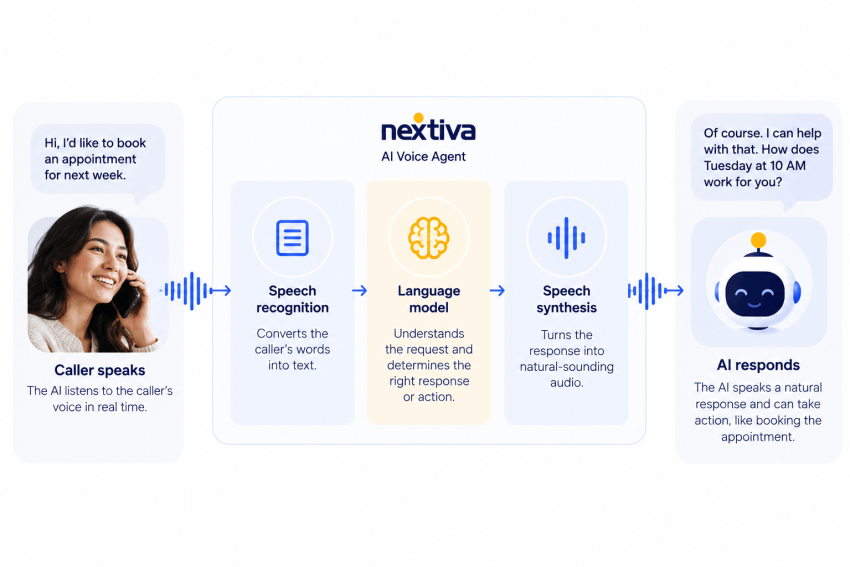
The result is an answering service that can do more than collect a name and promise a callback. With the right integrations and permissions, it can complete routine interactions while your human team focuses on requests that need personal attention.
Nextiva’s XBert AI receptionist is designed for this type of workload, with 24/7 automated answering across voice, SMS, and chat. You also get unlimited concurrent calls and proven uptime, giving your business a way to handle demand outside normal staffing hours.
High concurrency without the traditional queue
A traditional phone queue forms when the callers outnumber the agents that are available to answer them.
AI answering services reduce that bottleneck by handling multiple conversations concurrently. So rather than placing every caller into a queue, the system can respond to each incoming call as it arrives.
This is valuable during unplanned surges, like service disruptions. Instead of requiring the business to add enough agents for the busiest moment, AI provides additional capacity for the routine interactions it can resolve.
The experience still depends on how quickly the system responds and how naturally it manages the conversation. Latency, interruption handling, and the ability to recognize when a caller has finished speaking all affect whether the interaction feels like a conversation rather than a phone menu.

When evaluating providers, look for evidence of performance under concurrent load, not just a claim that the service supports high call volumes.
Real-time CRM integration and workflow execution
As any call center manager knows, there’s a whole lot more involved than answering an incoming call.
An AI answering service becomes more useful when it can take action during the conversation. With supported integrations, an AI agent can check availability, capture caller details, and update business systems without requiring an agent to re-enter the information later. For example, a caller could request an appointment, have the AI check an available calendar slot, and receive confirmation during the same interaction.
This can reduce manual follow-up and help keep customer records current. It also means the AI can gather useful context before escalating a call so a human agent has the caller’s request and relevant details when they take over.
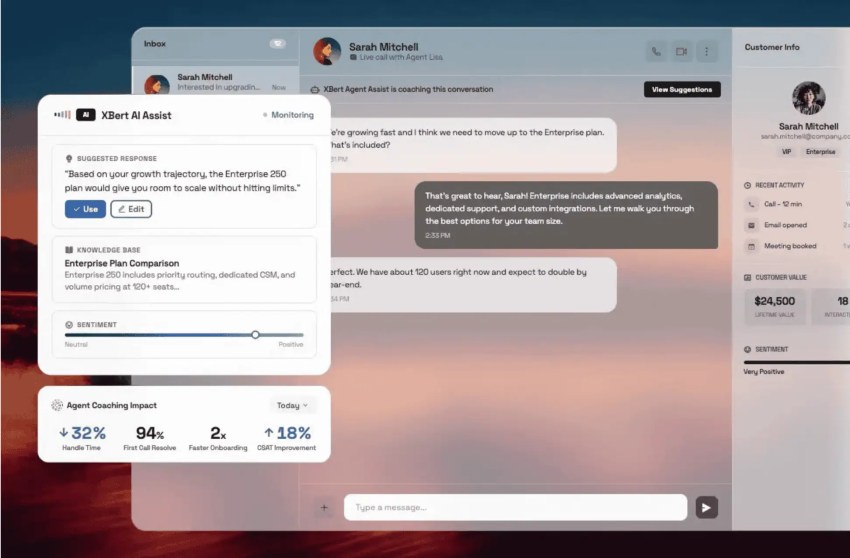
For high-volume businesses, the operational value is not simply answering more calls. It’s resolving more routine requests at the point of contact while keeping the information needed for the next step connected to the customer.
How AI-to-Human Escalation Keeps Complex Calls Moving
AI answering services don’t have to handle every conversation from beginning to end.
Some callers need a human. They may have a complex issue, a sensitive request, or a problem that requires judgment beyond the AI’s configured capabilities. The goal here is to resolve routine calls automatically while making it straightforward for callers to reach a human when they need one.
A well-designed escalation process identifies when a call should be transferred, routes it to the right team, and passes along the context gathered during the conversation. Callers shouldn’t have to repeat their name, explain their issue again, or start from the beginning because the AI couldn’t complete the request.

Sentiment- and intent-based routing
An AI voice agent can use the caller’s words and conversational context to identify when a request needs human attention.
For example, it might recognize that a caller is becoming frustrated, has a complex billing issue, or is asking for help with a transaction the AI isn’t authorized to complete. Instead of continuing with an unsuitable automated response, it can initiate an escalation.
Routing can also reflect the caller’s intent and priority. A routine appointment request may be handled automatically, while a time-sensitive service issue can be directed to an appropriate team.
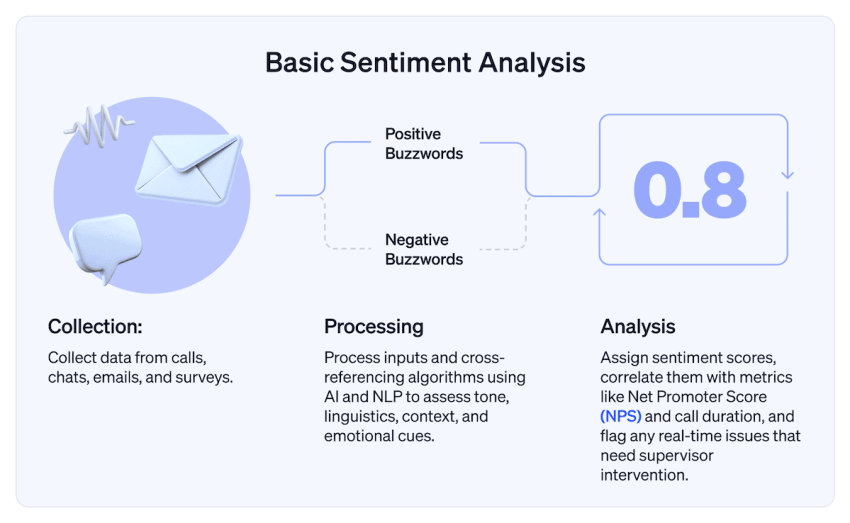
Businesses can configure escalation rules around their own workflows, including when to transfer immediately and when to offer a callback or another next step.
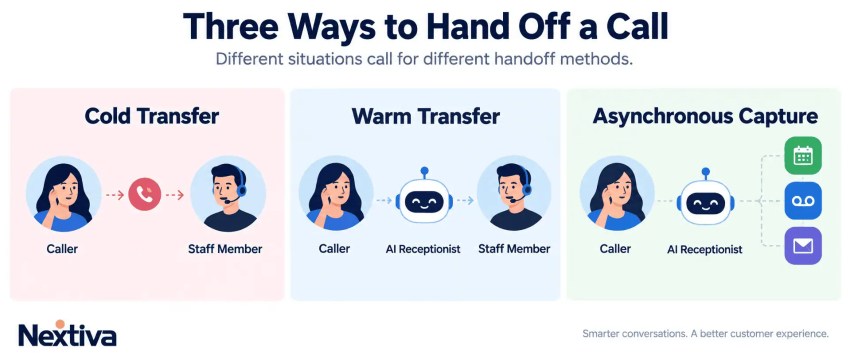
Contextual screen pops and warm transfers
A warm transfer should give the receiving agent enough information to continue the conversation without making the caller start over.
Before transferring, the AI can capture the caller’s intent, relevant details, and a summary of what has already been discussed. Where integrations support it, your AI agent can also receive customer information from connected systems. That context can appear alongside the incoming interaction, helping the agent understand why the caller is being transferred and what has already been attempted.
The AI can then introduce the caller or provide a brief handoff before leaving the conversation. The human agent takes over with the relevant details already available, reducing repetition and helping the interaction move forward.
For high-volume businesses, call transfer services create a practical division of work: AI handles routine requests at scale, while human agents focus on conversations that need their experience and judgment.
The Unit Economics of AI Answering Services
The cost of answering calls changes when you stop thinking about every conversation as a staffing requirement.
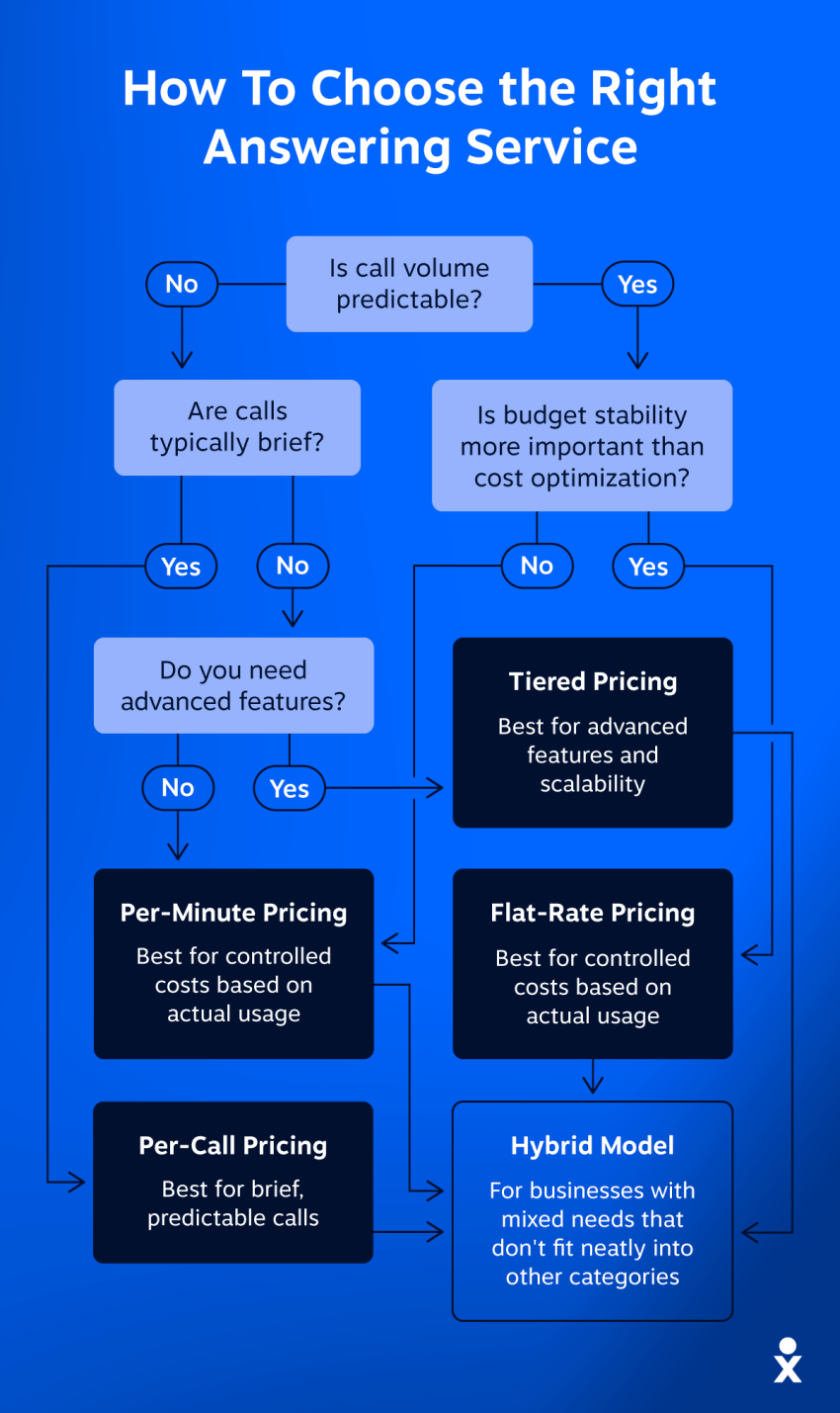
Traditional live answering services usually charge per minute or require businesses to pay for enough agents to cover expected demand. AI answering services, on the other hand, can introduce a different cost structure, with pricing based on usage, subscriptions, or a combination of both.
The right comparison isn’t simply the monthly price. You need to look at the total cost of handling your expected call volume, including the capacity required during peak periods.
For a high-volume business, model the cost at different levels of demand, like 5,000, 20,000, and 50,000 calls per month. Then compare the resulting cost against your current staffing or outsourced answering model.
Flat-rate versus per-minute pricing
Per-minute pricing is straightforward when call volume is predictable. The problem comes when demand increases.
More calls mean more billable minutes. So the cost of your answering service rises at the same time as demand.
A flat-rate AI service can make costs more predictable, particularly when it supports high concurrent call volumes. Instead of paying more when dozens of callers arrive at once, you can have extra capacity when you need it.
That doesn’t automatically make a flat-rate model cheaper. The right choice depends on your call volume, the average call duration, and how much of the interaction the AI can resolve without human intervention.
The important comparison is the cost per successfully handled interaction, not simply the advertised monthly price.
ROI goes beyond reducing labor costs
Labor savings are only one part of the business case.
An AI answering service can capture calls outside normal business hours, respond during demand spikes, and handle routine inquiries that might otherwise reach voicemail. Each of those interactions creates an opportunity to resolve a request or move a potential customer toward the next step.
Speed matters too. A caller who gets an immediate response has less reason to abandon the interaction or look for another way to contact the business.
The value can therefore come from three areas:
- Reducing the cost of routine call handling
- Increasing the number of calls your business can handle
- Capturing opportunities that would otherwise be missed
That makes the ROI calculation broader than replacing a receptionist or reducing the number of contact center agents. The more useful question is how much additional business your phone operation can handle without increasing costs at the same rate.

What to Look for in an AI Answering Service
Not every AI answering service is built for high call volume. A provider may demonstrate a convincing conversation in a product demo but struggle when dozens of calls arrive simultaneously.
Before choosing a solution, test how it performs under realistic demand and how easily it fits into your existing phone operation. Use this checklist to evaluate whether a service can support your call volume without creating new bottlenecks.
Capacity and telephony reliability
- Concurrent call capacity: Confirm how many calls the service can handle simultaneously and whether that capacity changes with your plan or usage.
- Telephony resilience: Ask how calls are connected and what redundancy is in place if a carrier or connection fails.
- Performance during spikes: Test the service with realistic bursts of inbound calls, not just a steady stream of individual conversations.
Conversation quality and response time
- Low latency: Delays between a caller’s speech and the AI’s response can make conversations feel unnatural. Ask for measured response times under load.
- Interruption handling: Check whether callers can interrupt, clarify, or change direction without having to wait for the AI to finish its response.
- Natural turn-taking: Test how accurately the AI recognizes when a caller has finished speaking and when it should respond.
Security, escalation, and support
- Data protection: Understand how caller information is stored, processed, and protected. Confirm whether the provider meets the security and compliance requirements relevant to your business, including any applicable SOC 2 or HIPAA requirements.
- Human escalation: Verify that the service can transfer calls to the right team and pass along useful context, rather than simply forwarding the call without explanation.
- Service commitments: Review the provider’s uptime commitment, support arrangements, and service-level agreement. Check what the commitment covers and what happens if it isn’t met.
A provider’s headline features are only part of the evaluation. Test the caller experience, confirm the integration requirements, and understand the service commitments before moving high-volume calls onto the platform.

Handle High Call Volumes Without Building Bigger Queues
When call volume spikes, adding more agents isn’t always the answer. AI answering services give businesses another way to manage demand by answering multiple calls simultaneously, resolving routine requests, and passing complex conversations to the right person with useful context.
The key is choosing a solution that fits your call patterns, integrates with your existing systems, and makes escalation straightforward for callers and agents alike.

Nextiva’s XBert AI receptionist helps businesses provide 24/7 automated call handling across voice, SMS, and chat. With unlimited concurrent calls and integrations for common business workflows, it can help your team respond to more callers without relying entirely on additional staffing.
Explore Nextiva’s AI answering service to see how it can support your call volumes and customer experience goals.
Stop missing calls. Use the best AI answering service.
XBert AI gives your business 24/7 coverage—handles calls, texts, and chats, books meetings, and escalates urgent calls so customers never have a bad experience.
Frequently Asked Questions About AI Answering Services
An AI answering service uses speech recognition to understand what a caller says, a large language model to interpret the request, and speech synthesis to respond in natural language. Depending on its configuration and integrations, it can answer common questions, schedule appointments, or transfer the conversation to a human agent.
Yes. AI answering services can handle multiple conversations concurrently, allowing businesses to respond to incoming calls without placing callers into a traditional queue. Check your provider’s concurrency limits and performance under load before choosing a service for high-volume call handling.
Yes. AI answering services can be configured to escalate calls when a request needs human attention. A warm transfer can include the caller’s intent and a summary of the conversation, helping the receiving agent continue without asking the caller to repeat everything.
Pricing depends on the provider and whether the service charges a subscription fee, usage fees, or a combination of both. Nextiva’s XBert AI receptionist starts at $99 per month. Compare the total cost against your call volume, average call duration, and the amount of human support still required.
Prioritize concurrent call capacity, reliable telephony, and fast response times. Also evaluate how the service handles interruptions, integrates with your business systems, and escalates calls to human agents. The right feature set depends on the types of calls your business receives and which requests you want the AI to resolve independently.
Callers may recognize an AI voice, particularly if the conversation includes delays or unnatural turn-taking. A well-configured service should respond naturally, handle interruptions, and make it easy to reach a human when needed.
Be clear about how the AI introduces itself and what it can do. The objective is to help callers complete their request, not to make them navigate another phone menu.