

 Business Communication
  Blog
Blog  Customer Experience
  Leadership
  Marketing & Sales
  Nextiva News
  Productivity
  VoIP
VoIP 

The phone call you miss could be a sale you never get another chance to make.
Inbound callers are already raising their hand. They might be ready to buy, need help with an existing account, or have a problem that needs resolving now. The challenge is making sure your phone system can handle that demand when multiple people call at once.
That means more than having a business phone number and answering it most of the time. You need intelligent routing, reliable telephony, and a way to handle inbound phone calls when your team is busy or unavailable.
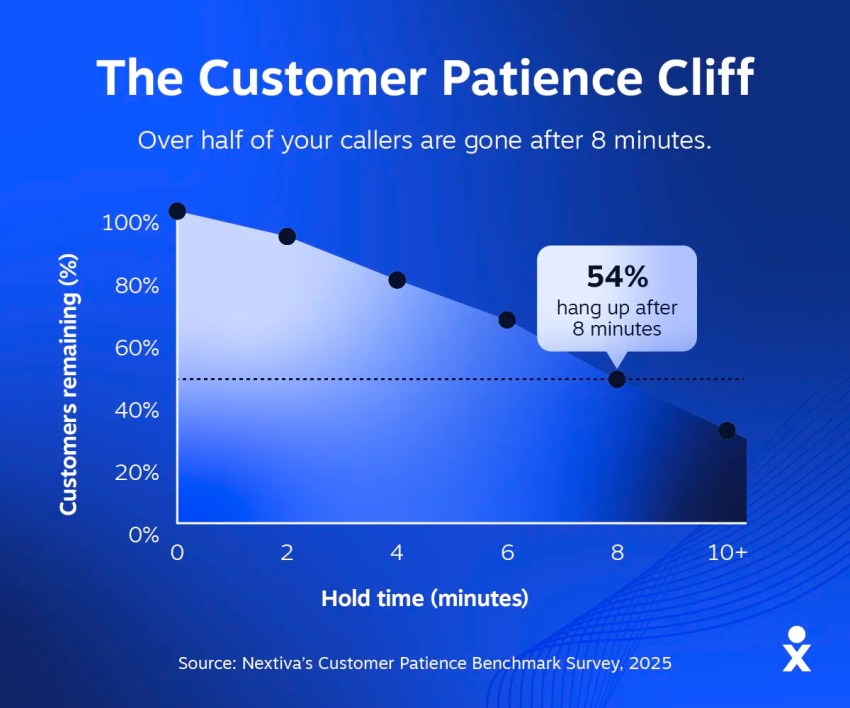
According to Nextiva’s Customer Patience Benchmark, 72.3% of consumers expect a response to a phone call within five minutes, with 54% hanging up after eight minutes. In busy call centers, this paints an obvious picture of the clear reason to prioritize inbound calling.
In this guide, I’ll explain how inbound calling works, how to build better call flows, which metrics to track, and how AI receptionists can help capture calls your team can’t answer.
What Is an Inbound Call?
An inbound call is a telephone call initiated by someone outside your business and directed to your organization. It could be a prospective customer asking about a product, an existing customer looking for tech support, or someone calling to make an appointment or resolve a billing issue.
Unlike outbound calling, where your team starts the conversation, inbound calling is driven by someone who has already decided to contact you. That makes the experience on the other end of the phone particularly important. If the caller reaches the wrong department, sits in a long call queue, or can’t get through at all, the business risks losing the opportunity before anyone has a chance to help.
To make this process efficient, modern inbound calling systems use interactive voice response (IVR), automatic call distribution (ACD), and customer relationship management (CRM) integrations to get callers to the right person with the right context.
The mechanics might be technical, but the objective is simple: Make it easy for someone who wants to talk to your business to reach it.

Common types and examples of inbound calls
Inbound calls fall into a few broad categories, depending on what your caller needs:
- Sales and product inquiries: A prospect wants pricing, product information, or help deciding what to buy.
- Customer support: An existing customer needs help with a product, service, order, or technical issue.
- Billing and account management: A customer needs to make a payment, update account information, or resolve a billing question.
- Appointments and reservations: A caller wants to schedule, change, or cancel an appointment or reservation.
A sales inquiry may represent immediate revenue by way of lead generation. A technical support call may be important for retention. A simple account question might be resolved through self-service or an automated workflow.
Your inbound call strategy should account for those differences rather than treating every caller the same. That becomes particularly important when call volume spikes. In automotive dealerships, for example, Demand Local reports that around 65% of inbound callers connect with staff, meaning roughly one in three callers doesn’t reach a qualified person.
For any business, the lesson is straightforward: Generating inbound demand is only half the job. You also need the capacity and routing infrastructure to capture it.
Inbound vs. Outbound Call Centers: Key Differences Explained
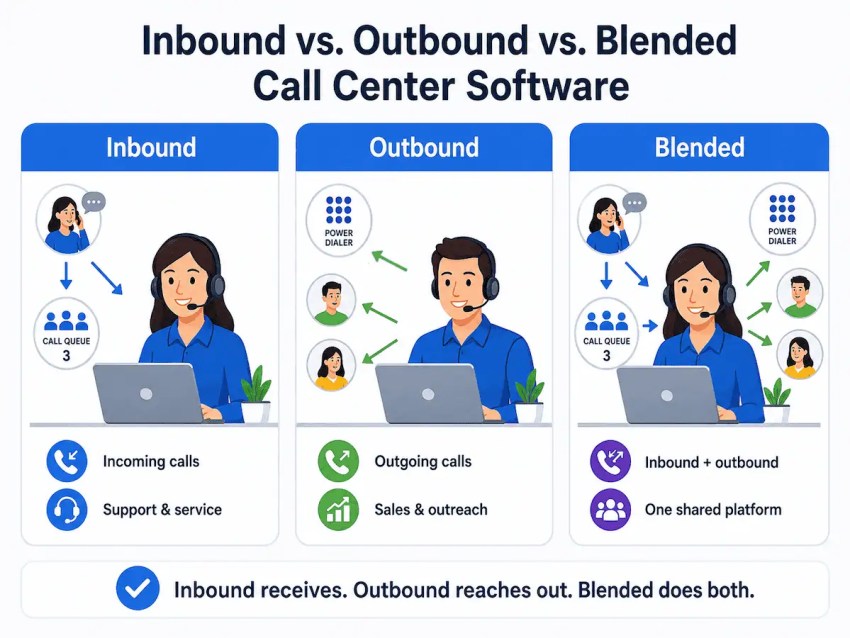
Inbound and outbound calls use the same basic telephone infrastructure. But the operational goals are very different:
- Inbound calls start with the customer: Your job is to respond quickly, understand why they’re calling, and get them to the right person or outcome.
- Outgoing calls start with your team: The objective is usually to create an opportunity, follow up with an existing prospect, or complete a proactive customer interaction.
That difference affects the technology, workflows, and metrics you need to manage.
| Inbound calling | Outbound calling | |
|---|---|---|
| Who initiates the call? | Customer or prospect | Agent or sales representative |
| Primary objective | Resolve an existing need or capture active demand | Generate demand, follow up, or proactively engage customers |
| Typical technology | Interactive Voice Response (IVR), Automatic Call Distribution (ACD), skills-based routing | Predictive dialers, power dialers, calling lists |
| Routing | Routes incoming callers based on intent, skills, availability, or priority | Assigns outbound contacts to available agents |
| Key metrics | Average Speed of Answer (ASA), abandonment rate, First Call Resolution (FCR), Average Handle Time (AHT) | Connect rate, contact rate, conversion rate, calls per agent |
| Main operational challenge | Handling unpredictable demand without creating long waits | Maximizing productive conversations without wasting agent time |
The distinction doesn’t mean businesses need completely separate phone systems. Sales teams may receive inbound customer inquiries and follow up with outbound calls. Customer service teams may need to make proactive calls after an inbound support interaction. You may operate blended teams that handle both directions. The technology should support that flexibility without making callers or agents navigate disconnected systems.
For businesses deciding between inbound, outbound, or blended call center operations, the right setup depends on where customer demand originates and what your teams need to accomplish once a conversation starts.
The Real Business Cost of Poorly Managed Inbound Calls
When inbound calls aren’t managed proactively, you miss them. It’s as simple as that.
What’s more, a missed inbound call isn’t just a missed conversation. It can mean a lost sale, a frustrated customer, or a support issue that takes longer and costs more to resolve.
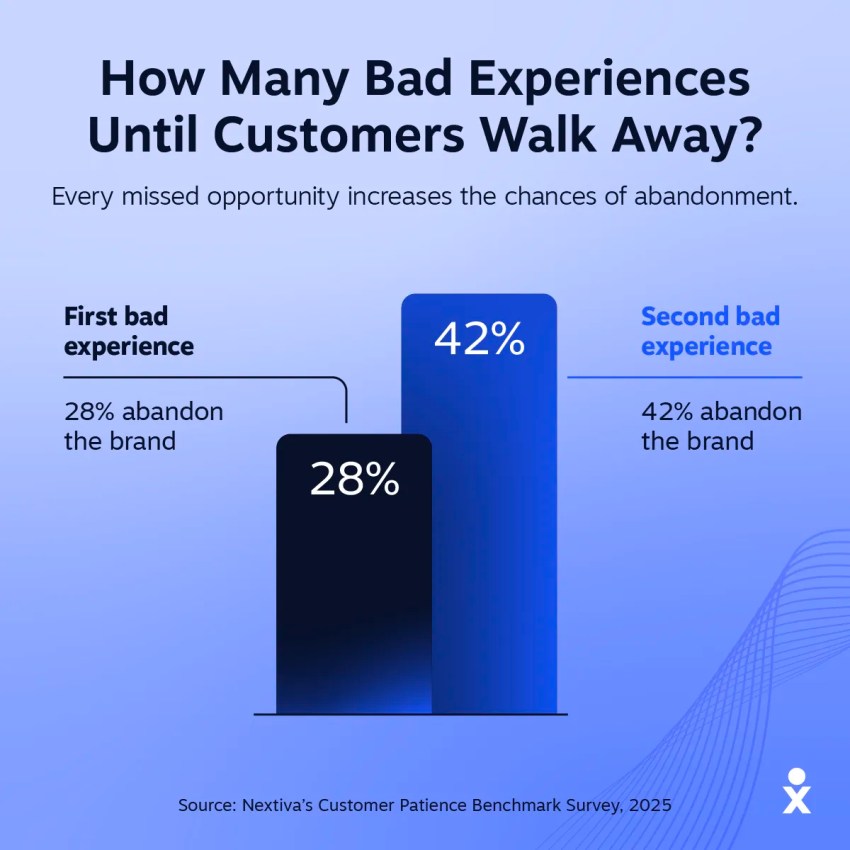
Letting that call ring a little long, go to voicemail, or go unanswered because you’re busy never has a positive outcome. Nextiva’s Customer Patience Benchmark found that 56% of consumers will try another channel when a business responds slowly. Furthermore, 28% say they’ll stop using the service, and 18% may leave a negative review.
After-hours coverage creates another gap. NextPhone’s analysis of more than 1.4 million business calls found that 28.5% arrived outside standard business hours, with another 12.4% coming in on weekends. That means a business operating strictly around its staffed hours could be unavailable for a significant share of incoming demand.
Long hold times follow this. So I’m afraid the bad news continues if you’re struggling to handle calls in a timely manner. 75% of callers prefer a callback once hold times exceed five minutes.
Ask yourself this: Does your phone system currently offer a callback service? It’s simple features like this, alongside more sophisticated call handling, that can reduce the number of frustrated, waiting customers and resolve your inbound call management issues.
Essential Technology and Requirements for Inbound Call Operations
Once call volume grows, you need technology that can decide where calls go, identify who’s calling, and keep the conversation moving when your first-choice agent isn’t available. At a minimum, I’d look for four capabilities.
| Technology | What it does |
|---|---|
| Cloud VoIP telephony | Provides the underlying voice infrastructure, with the reliability, scalability, and failover needed to handle inbound traffic without depending on on-premises phone hardware. |
| Interactive Voice Response (IVR) | Gives callers self-service options and collects information before routing them. A well-designed IVR should reduce unnecessary transfers rather than force callers through a long menu. |
| Automatic Call Distribution (ACD) | Routes calls to the right team or agent based on rules like skills, availability, or priority. This prevents calls from simply being sent to whoever happens to be free. |
| CRM integration | Connects the phone system to customer records so inbound call center agents can see relevant caller information as the call arrives, rather than asking the customer to repeat information already held by the business. |
Across all four of these technologies, reliability underpins your inbound calling experience. A sophisticated IVR doesn’t help if the underlying phone service can’t handle a traffic spike. Modern organizations increasingly target four or five nines of availability for critical communications infrastructure. It’s no longer acceptable to tell your customers you couldn’t answer their call because your phone system went down.
Assuming you’re answering the vast majority of customer calls, the expectation has changed too. It’s no longer enough to simply answer the call. Every customer expects you to connect them to the right employee for the task and for that staff member to have all the information they need in one workflow.
Sometimes, that staff member might not be human. Let’s talk about AI voice agents and AI receptionists to see how they alleviate the pressure on human agents.
The role of AI voice agents and receptionists in inbound calling
AI agents add another layer to your inbound calling workflow. Instead of simply routing a call like an IVR, an AI receptionist can understand what the caller wants, answer routine questions, collect information, and complete approved tasks before a human agent gets involved.
That makes AI particularly useful during peak periods and outside normal business hours.

The capacity advantage is important. A human receptionist or agent can only handle one conversation at a time. An AI receptionist can handle multiple conversations concurrently, which means a sudden increase in call volume doesn’t automatically create a longer queue.
It can also take repetitive requests out of the queue entirely. If someone is calling to check business hours, book an appointment, or ask about an order, there’s little value in making them wait for an available employee if you can safely automate the workflow.
AI receptionists can also provide a useful handoff when a human is necessary. Rather than transferring a caller with no context, the AI can pass information about the reason for the call and the interaction so far to the receiving agent. That means the agent can start with context instead of making the caller explain everything again.
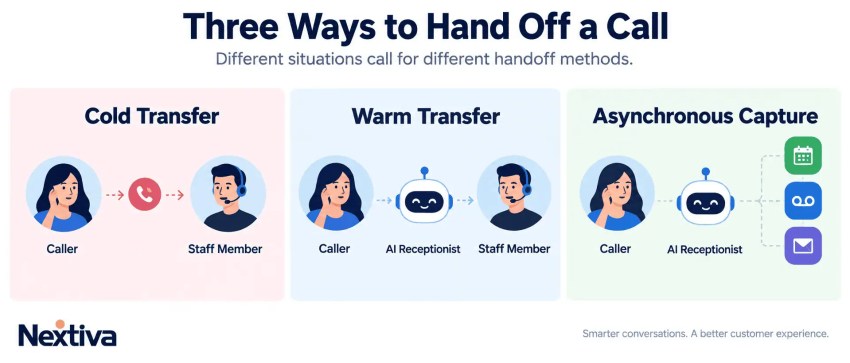
For inbound teams, that’s where AI becomes more than an answering service. It’s another layer of capacity between the incoming call and the human expertise that needs to handle it.
Key Strategies for Effective Inbound Call Management
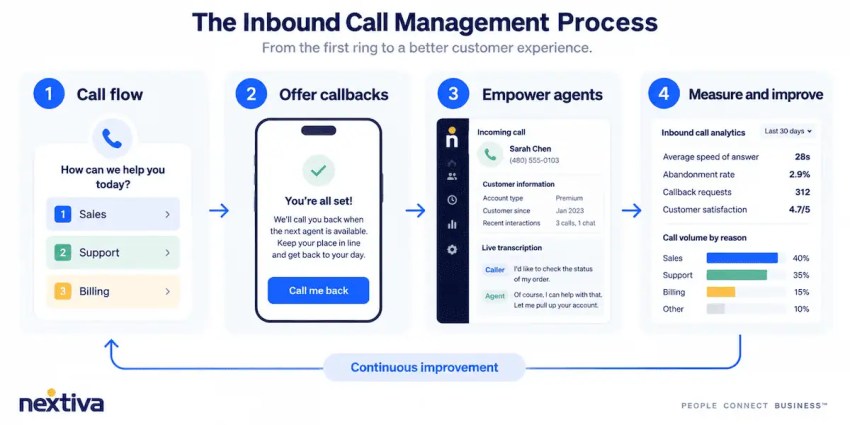
Good inbound call management isn’t about making callers work their way through a complicated phone system. It’s about removing friction between the reason someone calls and the outcome they need:
- Start with the call flow: Your IVR should give callers a small number of clear options and route them based on what they’re trying to accomplish. If a caller needs sales, your support team, or billing help, they shouldn’t have to navigate several layers of menus to get there.
- Introduce callbacks: Instead of forcing callers to stay on hold, a queue callback lets them keep their place in line and receive a call when an agent becomes available.
- Empower your agents with information: CRM screen pops can surface the caller’s account and interaction history, while real-time transcription can help agents follow the conversation and reduce the amount of information they need to capture manually.
- Measure what happens after the call: Continuous quality assurance can identify recurring problems with inbound call handling, while analytics can identify the points at which callers abandon their enquiries, which queues are creating delays, and which call flows need to be redesigned.
For businesses handling high inbound volume, those small improvements compound. A shorter queue, a faster handoff, and less post-call administration can give your team capacity without simply adding more agents.
Tracking and Attributing Inbound Call Revenue
An inbound call shouldn’t disappear from your marketing data the moment someone picks up the phone. Receiving a call is only part of the process. If a prospect finds your business through Google, a paid ad, or an organic search and then calls, you need to know where that call came from and what happened next.
That’s where call attribution comes in. Dynamic number insertion (DNI) can display different tracking numbers based on the campaign, keyword, or referral source that brought someone to your website. When that number receives a call, the source connects back to the interaction.
The next step is connecting call data to your CRM. You shouldn’t record a call simply as an inbound interaction. If the caller becomes a qualified lead, creates an opportunity, or eventually buys, those outcomes should connect to the original call. That gives marketing and sales a way to measure revenue rather than just call volume.
You can then compare call quality, duration, conversion rates, and revenue across marketing channels to understand which campaigns are generating calls that matter.
What you need is a system that does all this in a single interface and without continuous app switching. Nextiva supports call analytics, campaign attribution, conversion tracking, and CRM integrations that connect call activity with customer records. Its analytics platform can also report on campaign performance alongside call and conversation data.
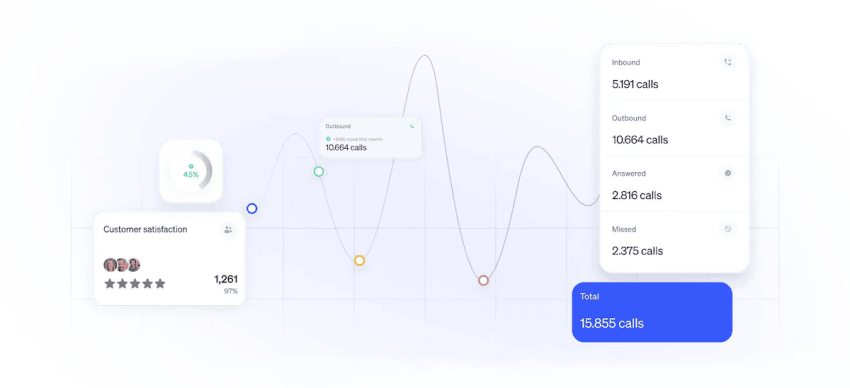
The objective isn’t to track every phone call for the sake of having more data. It’s to connect the first marketing touchpoint to the conversation, the outcome, and ultimately the revenue it generated.
Critical inbound call center metrics and KPIs to monitor
Once you’re tracking calls, you need a consistent set of metrics to understand whether your inbound operation is performing.
| Metric | What it tells you |
|---|---|
| Average Speed of Answer | How quickly callers reach an agent. |
| Call Abandonment Rate | How many callers hang up before reaching an agent. |
| First Contact Resolution | How often you resolve an issue during the first interaction. |
| Average Handle Time | How long agents spend handling each call, including talk time and related work. |
| Customer Satisfaction Score (CSAT) | How customers rate the experience after the interaction. |
| Cost per Call (CPC) | How much it costs the business to handle each inbound call. |
Don’t optimize these metrics in isolation. They might be impactful, but they become powerful when measured together and acted upon for better customer outcomes.
For example, a lower AHT isn’t necessarily better if agents rush callers into repeat contacts. A high FCR isn’t useful if callers wait too long to get through in the first place. The goal is to find the balance between speed, resolution, customer experience, agent performance, and cost.
Turn Inbound Calls Into a Competitive Advantage
Inbound calls are often the moment when customer intent is highest. The challenge is making sure your business is ready to handle that intent when the call arrives.
A modern inbound calling operation combines reliable cloud telephony with intelligent calling routing, CRM context, and automation. This gives callers a faster path to the right outcome and gives your team the information and capacity they need to handle conversations that require a human.
Nextiva brings those capabilities together across Business Phone Service, Contact Center, and XBert AI Receptionist.

Whether you need to improve everyday business calling, manage a high-volume contact center, or provide 24/7 automated call answering, the right setup starts with understanding where your current inbound workflow breaks down.
Look at your missed calls, wait times, abandonment rate, and conversion data. Then, identify which parts of the journey you can route, automate, or improve.
Your phone system shouldn’t just answer inbound calls. It should help you turn them into better customer experiences and measurable business.
Never miss another call, text, or chat with XBert AI Receptionist
XBert greets customers, books appointments, and captures leads automatically, turning missed connections into new opportunities.