

 Customer Experience
  Blog
Blog  Business Communication
  Leadership
  Marketing & Sales
  Nextiva News
  Productivity
  VoIP
VoIP 

The success and failure of Agentic CX depend on its adoption path. Gartner predicts both outcomes. It sees success in agentic AI autonomously resolving 80% of common customer service issues by 2029, cutting operational costs by 30%. On the flip side, the analyst firm also predicts that more than 40% of agentic AI projects will be canceled by the end of 2027.
This article will guide you through the prerequisites and adoption path for agentic CX so your implementation is set up for success when it reaches production. It looks at how artificial intelligence moves from answering questions to running customer journeys from end to end.
What Agentic CX Means
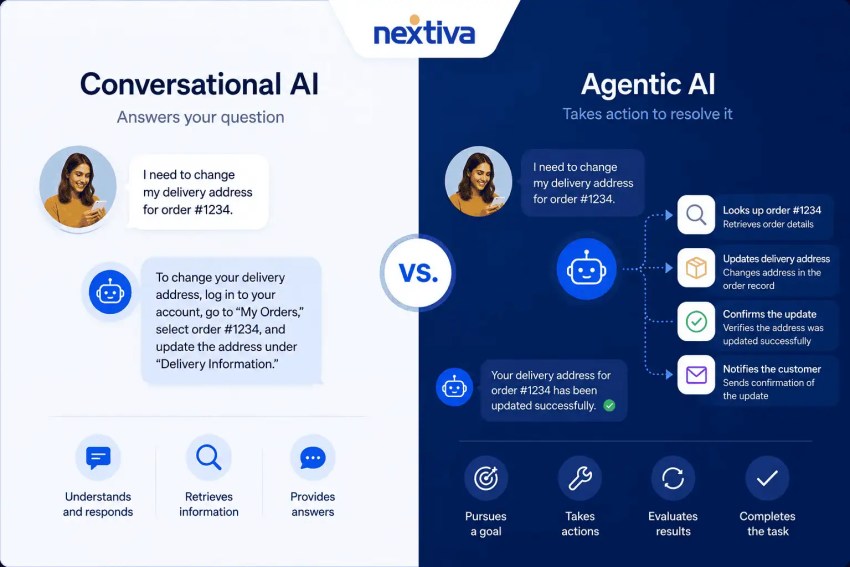
Agentic CX is a model where AI systems perceive a customer’s intent, plan a course of action, and execute it across back-end systems. It helps resolve issues without a human agent. The result is customer experiences that end in resolution.
The system changes the state of an order, an account, or a booking, rather than simply describing what a human can do. It handles execution, going beyond what a simple chatbot would do with suggestions.
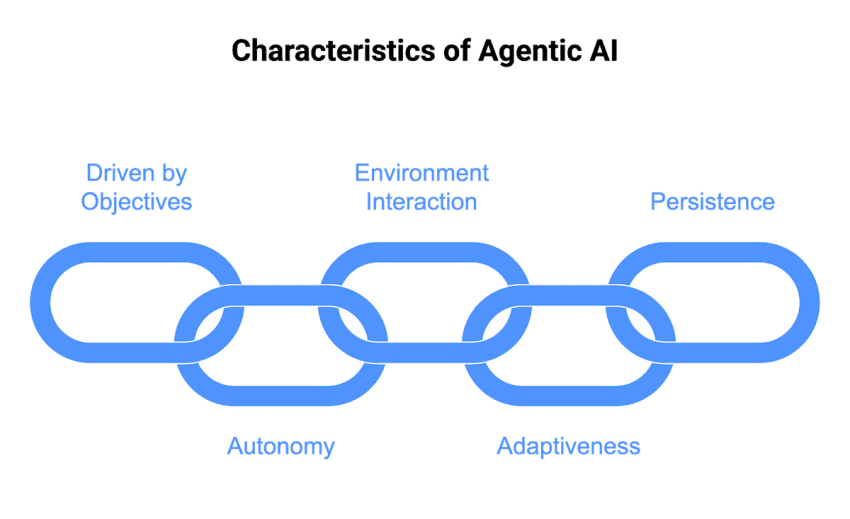
Most customer service requests don’t require human judgment. McKinsey finds that 50% to 60% of customer interactions remain transactional despite the rising complexity. These interactions need completion. If a system can finish them at any hour, it changes the economics of a service operation.
What agentic CX isn’t It’s not a smarter chatbot or a rebranded conversational AI assistant. A chatbot would understand and respond. But an agentic system carries authority to act inside your system. If a vendor’s demo doesn’t touch a live backend record, you might just be looking at an old category with new branding.
How an agentic system works: An example
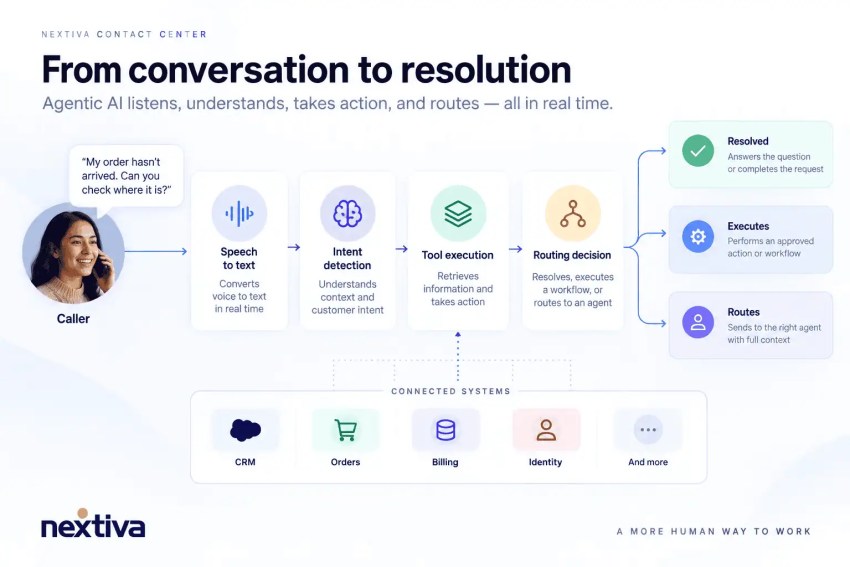
Here’s what an agentic CX system would do upon receiving a request like “Change the shipping address on an order going out tomorrow”:
- Perceive: The system parses the intent and resolves who is asking. Not “a customer wants an address change,” but “this authenticated customer, this order, shipping tomorrow.”
- Reason: It checks the order state against the carrier cutoff. Is the label printed? Has the package left the warehouse? The answer determines whether the request is even possible. This is agentic reasoning in action.
- Plan: It sequences the work if it’s possible. It updates the address in the order system, notifies the carrier, confirms with the customer, and logs the change in the CRM.
- Act: It calls the APIs and reports back.
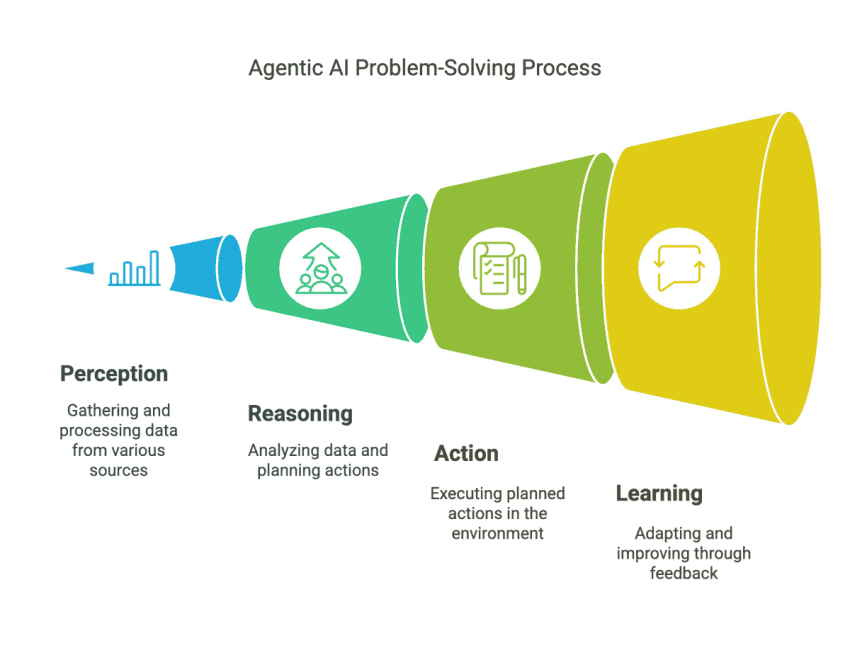
If you’re on a demo, ensure that the agent checks whether the action succeeded and replans if it didn’t. The agent also needs to verify whether the carrier accepted the update or the API returned a stale confirmation. To get a clearer idea of what you’re buying, go through the comparison below to distinguish an agentic CX platform from a traditional or AI chatbot.
Agentic CX system vs. chatbots
Before AI chatbots were a thing, traditional chatbots still existed. They followed the if/then trees. Then AI chatbots came with text-generation capabilities and produced fluent text. Next came agentic systems, which used tools to change the state of a backend system.
| Scripted chatbot | Generative chatbot | Agentic system | |
|---|---|---|---|
| How it decides | Follows a predefined decision tree | Predicts the best response from a language model | Reasons over live data, plans, and selects tools |
| What it produces | Canned answers and menu options | Fluent, contextual text | Completed actions in backend systems |
| Failure mode | Dead-ends when the tree runs out | Confident, wrong, or unactionable answers | Wrong actions taken with confidence, if ungoverned |
| Typical metric | Containment or deflection rate | CSAT on the conversation | Autonomous resolution rate |
If you need a result that you can guarantee will run the same way every time, a rule-based system built on deterministic logic would work. An agentic system makes more sense where requests arrive in natural language, and no tree can anticipate every path. The choice between agentic and deterministic AI comes down to how predictable the incoming requests are.
Before you implement anything, consider these numbers in Parloa’s research. It ran the largest AI-led benchmark of enterprise CX to date, testing how AI-powered self-service experiences perform in the wild. It had AI discovery agents review more than 10,000 enterprise websites and conducted nearly 4,000 secret-shopper interactions across more than 800 companies in 27 industries:
- Just 8.9% of chat interactions resolved the customer’s stated goal.
- Only 10.1% of escalation attempts reached a human.
- The digital front door was closed at 43.3% of the websites analyzed, which showed neither a visible support number nor a chat option.
- Only 1% of enterprises were structurally prepared for agent-to-agent interactions.
This evidence clearly shows that even if enterprises wear a label, their system may still lack the capabilities needed to support a truly agentic system. These aren’t a blocker to an agentic system, but you need to consider them and know what has to be true for the agentic system to work.

What It Takes to Build an Agentic System
There’s an intent to go agentic, and encouragement from leadership fuels the ambition. Adobe’s AI and Digital Trends research, run by Oxford Economics, surveyed 3,000 executives and practitioners. They found that 62% of companies plan to use agentic AI for conversational customer engagement in the next 18 months. For customer support specifically, 78% of organizations expect agentic AI to handle interactions directly in that window, the highest of any interaction type measured.
But there are a few caveats:
- Only 39% have a shared customer data platform capable of supporting widespread agentic adoption.
- Only 44% have clear data management rules for it, suggesting infrastructure is a hurdle to agentic implementation.
Mark Ajzenstadt, founder of Limestone Digital, also cites infrastructure as the reason behind Gartner’s prediction that 40% of agentic projects will be canceled. He audited 14 agent projects and found that teams couldn’t answer who approved the last prompt change or how much one customer query cost to serve. In addition, Adobe’s research found data integration and quality (75%), talent gaps (71%), and unclear ROI (68%) as implementation challenges.
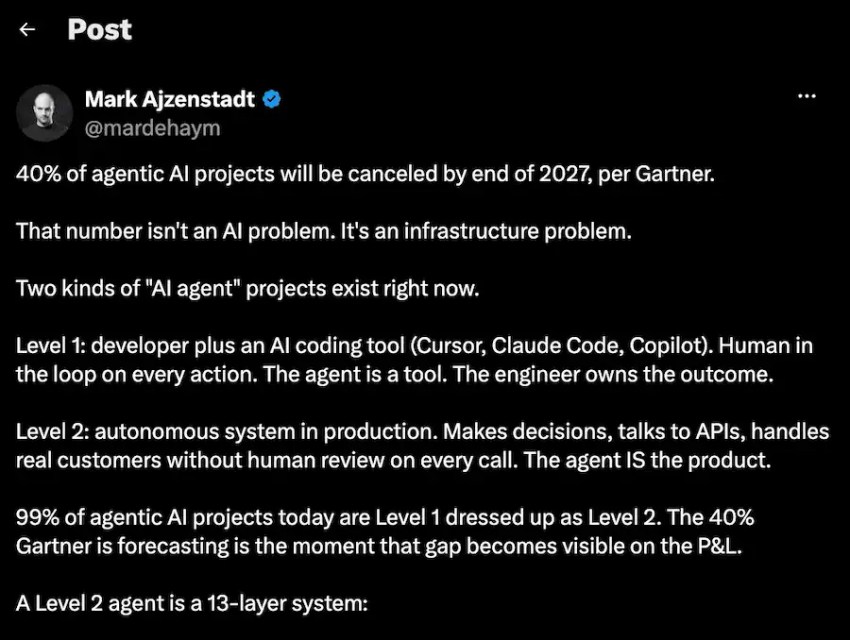
Taken holistically, you’ll see that an agentic implementation requires infrastructural changes. You need to address the data problem at a structural level to make it ready to build an agentic system.
Nextiva found that around 86% of companies use multiple tools for customer interactions, averaging 6.3 distinct platforms, with 13% running more than 10. Among companies with multiple tools, 86% report siloed data, and 81% say CX would improve if that data lived in one system of record. It’s preventing agentic systems from reaching production.
| What leaders expect | What readiness data shows | What it means for a rollout |
|---|---|---|
| Handle support interactions within 18 months | Only 39% have a shared customer data platform to support it | The agent launches against fragmented data and acts on partial context |
| Autonomous resolution across every channel | Siloed data across an average of 6.3 platforms | Identity breaks between channels; the agent treats one customer as three strangers |
| AI-led cost reduction at scale | Data integration and quality is the top implementation challenge | Budget goes to plumbing before it ever reaches the agent |
Data silos let you drive fragmented insights, where your systems conflict with each other before they make any sense, and they exist for several reasons. Sometimes it’s just organizational bottlenecks. Zendesk’s Vice President, Jonathan Barouch, said that he had met leaders who loved the agentic approach, but their IT teams can’t expose an API. When this is the case, agents don’t get to authenticate a customer, let alone run a multistep process.
Even when the identity isn’t resolved, the agent still acts confidently on partial information, recurring through wrong execution throughout the loop. This is what might lead to the 40% bucket that Gartner predicts will result in cancellation. You need to have good plumbing within your infrastructure before you even think agentic.

Exploring the Architecture Underneath an Agentic System
You don’t need to build this architecture yourself. You just need to know it well enough to see if the AI platforms you’re evaluating offer it.
There are three layers that collectively define whether an agent can take an action instead of describing one. This maps closely to broader contact center architecture, but the agentic pieces deserve their own inspection.
The context layer
Two problems collectively make a context problem: identity and conversation state. If your system can’t recognize that the person who called five minutes ago is the same person texting, the agentic execution will simply bombard the customer with questions they have already answered.
Then there’s the conversation state. It’s about knowing what was already tried, promised, or refunded. The agent shouldn’t offer a credit that was issued an hour ago.
Real-time retrieval across CRM, telephony logs, order systems, and the knowledge base would solve both these problems. Treat it as a live sync. You need to focus on its “real-time” aspect because if context arrives after the agent has answered, it’s of no use. This context layer should be able to read across your CX systems in place.
Tool calling and action execution
The model needs to have a set of functions it can invoke based on the inputs it gets, with an explicitly defined scope. For example, if you’d like to build a system that processes refunds based on past behavior and customer profiles, it should be able to autonomously fetch the customer ID, the amount, and their profile to assess their refund history and behavior.
If a customer repeatedly requests refunds, the agent should route them to human support. The agent should be able to process refunds up to a certain value if evaluations indicate their behavior is genuine.

Pilots don’t stall on the model; they stall at the integration surface. You need to ask the vendor how many systems the agent can write to on day one. Look for a specific answer.
Failure handling and replanning
APIs can time out or return stale data, which isn’t exceptional. You need to seek answers to what the agent does next.
A well-built agent retries with backoff, falls back to a secondary path, or escalates to a human with the full transcript and context attached. It ensures customers never repeat themselves. It’s best to ask what happens the first time the agent is uncertain, then verify it in a live demo.
Where Agentic CX Makes Sense
Here, we explore some common tasks that agentic CX systems can easily and profitably take on.
End-to-end transaction resolution
With more than half of customer interactions being transactional, it makes sense to deploy agentic systems to manage them end-to-end. For example, for a refund on a damaged item, the agent will:
- Authenticate the customer
- Pull the order, check refund eligibility, and the return policy against the purchase date
- Create a ticket in the CRM
- Trigger the refund through the payment gateway
- Confirm with a reference number
It resolves the case in minutes. Lifelong, a consumer brand, has moved to a similar resolution-based automation.
Scheduling and capture across voice, text, and chat
Scheduling is another use case. Here, the transaction is bounded within a few systems, and the cost of a missed interaction is quantitative.
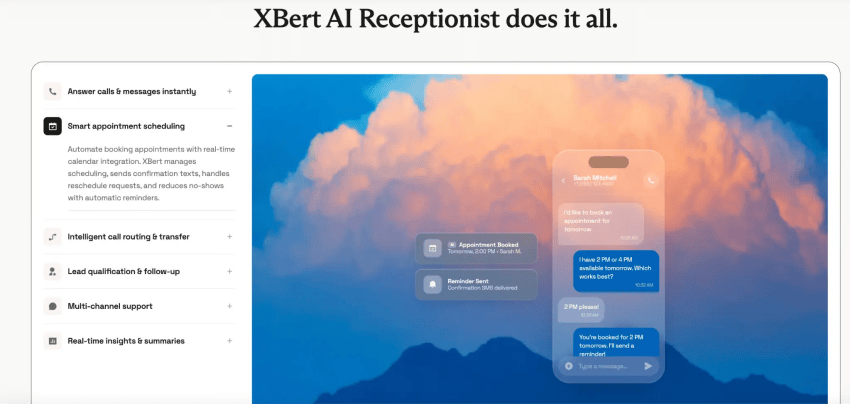
In this case, the agent checks the calendar, books the slot, writes the record to the CRM, and sends a text confirmation. The intake logic stays similar whether the request arrives via phone, SMS, or web chat. Consistency is what keeps voice and digital experiences from feeling like they come from different companies.
This isn’t speculative. Production voice agents are running MCP today to book appointments and check order status. On the phone channel, text-to-speech and speech recognition use the same underlying logic.
For businesses that want to take after-hours calls, Nextiva’s AI receptionist, XBert, applies this pattern as a product. It answers calls 24/7, qualifies, and books them. It has a unified data foundation that helps the agent get the context it needs to perform reliably.
What Guardrails to Set Within an Agentic CX System
See this as what you need to ask the vendor to ensure your agentic play reaches production and delivers output you can rely on. These guardrails prevent AI agents from inventing facts or claiming authority they don’t have.
Permissioned action limits
Every tool the agent can call needs a scope and a ceiling. For example, the agent can refund up to a defined dollar threshold; anything above it gets routed to a human.
In addition, you need checks on:
- Payment method
- Role-based access controls
Design in governance before you grant complete autonomy.
Escalation design
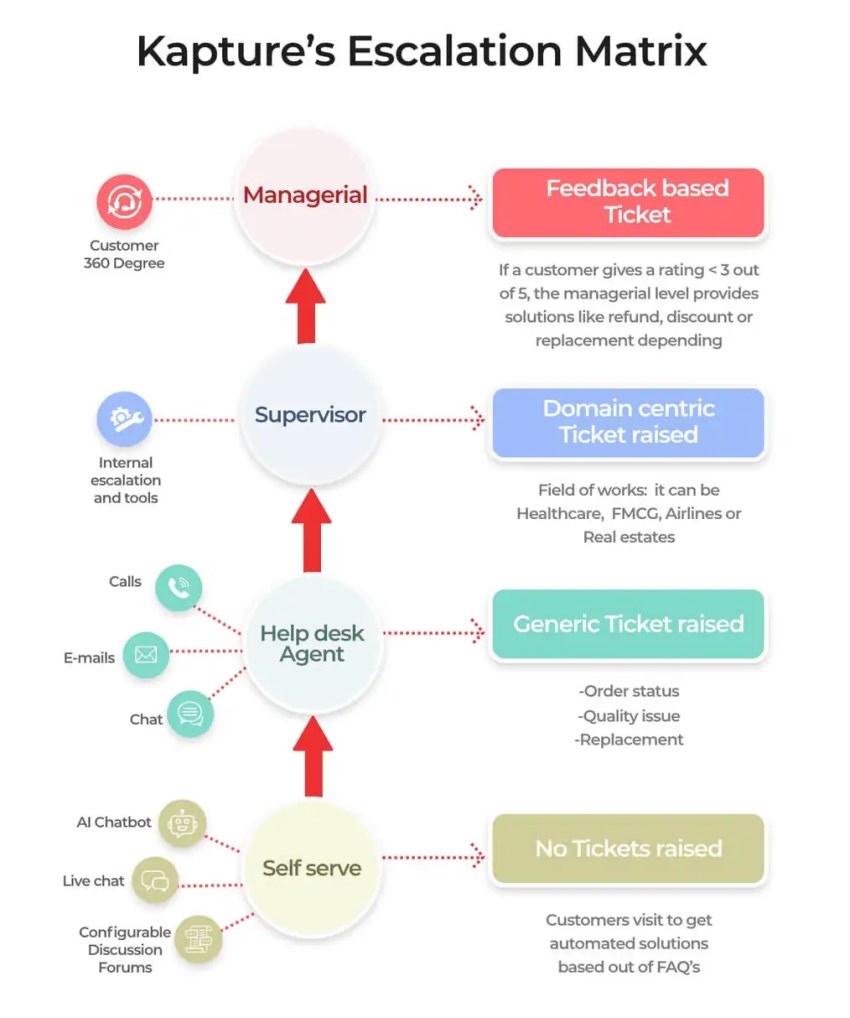
Your customer should be able to reach a human when they want to. Design the escalation path in such a way that you’re able to achieve this. Routing rules decide when the agent keeps a conversation and when a person takes over.
In customer interactions, if you observe a negative sentiment or an explicit customer request for a human, the transfer must happen with a full transcript and context. If your human handoff makes a customer start over, it’s more than an AI failure; it directly shapes how customers perceive the brand.
There is also a regulatory current here, and it runs toward the customer. Gartner predicts that by 2028, regulatory changes related to AI will increase assisted service volume by 30% as customers exercise a right to opt out of AI. Customer sentiment increasingly points toward a setup that gives them a chance to talk to a human. Around 41.5% of consumers would pay a premium to reach a real person.
So you need to build a setup that helps you manage scale while keeping what customers want in mind.
John Paladino, Head of Client Service at InterSystems Corporation, said in a LinkedIn post, “If a bot can give a customer an answer in seconds — by pointing them to the right documentation or online course, for instance — that can be a lifesaver. If a customer wants to speak to a human being, that option should always be available, too. So we make sure it is.”
You might want to design the opt-out now as a courtesy. When regulations become more stringent, it might be more expensive to retrofit it.
Security and auditability
The baseline for an agentic setup depends on your vertical. Common checks include:
- SOC 2
- HIPAA capability, where your vertical requires it
- Encryption in transit and at rest
- An audit log that records what the agent did, under what permission, and why
You need to set controls to deal with prompt injection and agent hijacking. Content flowing into an agent, even an email, can attempt to steer its tool calls. As an operating rule, you need to ask for an audit report.
For reference, Nextiva publishes its own posture, striving for 99.999% uptime with SOC 2 attestation, HIPAA-compliant plans with signed BAAs, PCI DSS, ISO/IEC 27001, and TLS/SRTP encryption on every call, with a full security report available on request. Hold every platform on your shortlist, Nextiva included, to that same show-me standard.
| Guardrail | What it prevents | Question to ask the vendor |
|---|---|---|
| Scoped, typed tool permissions | The agent taking actions beyond its mandate | “Show me the full list of functions the agent can invoke, with input types and scope for each.” |
| Action ceilings and RBAC | A single bad decision compounding into material loss | “What is the refund ceiling, who sets it, and what happens at the threshold?” |
| Escalation triggers with context transfer | Customers trapped in loops, or restarting from zero with a human | “Trigger an escalation live. Does the transcript travel with it?” |
| Per-action audit log | Unexplainable actions and failed compliance reviews | “Pull the audit trail for one action from last week. Can I see the reasoning?” |
| Third-party attestation | Marketing claims standing in for security posture | “Send the SOC 2 report and the HIPAA BAA terms, not the trust page.” |
| Supervision and uncertainty handling | Confident wrong actions in a non-deterministic system | “What happens the first time the agent is uncertain? Show me, not slides.” |
How to Measure the Impact of Agentic CX Implementation
If you’re in customer service or an experience role, you’re likely measuring first contact resolution (FCR) to see how many issues are closed in one contact. While it’s a good measure, it counts a contact the same whether a human or a machine closes it.
Autonomous resolution rate (ARR) measures the impact of an agentic CX system more accurately. It explores the share of issues that were closed with no human involvement at any point, including invisible back-office touches.
ARR = (No. of issues resolved by AI without human involvement ➗ total no. of issues handled by AI) x 100
FCR and ARR are independent, and you need both. FCR rises when ARR sits at zero because your human team got better. ARR rises while FCR falls because the agent closes easy issues on contact one and mishandles hard ones into repeat contacts.
In addition, you need to measure a few metrics that keep ARR honest:
- Execution accuracy: Of the actions the agent took, how many were the right action, verified against outcome rather than intent?
- Post-containment CSAT: Satisfaction gets measured only on conversations the agent closed. If you have a rising ARR with falling post-containment CSAT, it means the agent is closing conversations and not solving problems. These customers surge your repeat-contact rate later.
- Latency to action: This is the time from stated intent to completed action. Autonomy that takes longer than a human queue is not an availability win.
- Cost per autonomous containment: This is the full cost, tokens, integration upkeep, and supervision included, divided by issues truly closed without a human.
Gartner predicts that by 2030, GenAI cost per resolution will exceed $3, higher than many B2C offshore human agents. This cost is increasingly driven by data centers and AI vendors pivoting from subsidized growth to profitability. However, organizations can’t solely rely on offshore teams either. Lifelong Online Retail reports that, of the interactions humans handled two years ago, around 80 of every 100 are now managed by AI.
Build the Foundation Before You Build the Agent
The adoption of agentic CX isn’t constrained by a model’s capability; you need a reliable infrastructure. It depends on the integration surface and how effectively you’re able to bridge the data silos.
You need to think about consolidation before your ambition for agentic takes the driving seat in execution. Nextiva delivers a solution that fits cohesively into your existing stack and gives you a unified layer to support agentic CX.
When Emergia, a multinational BPO, moved its multilingual operations onto Nextiva Contact Center, monthly voice interactions rose from 32,478 to 82,680, a 154% increase in voice channel efficiency. It consolidated fragmented interaction handling into one omnichannel environment.
With this, the agentic layer stops being a leap. XBert already answers, qualifies, and books 24/7 on top of the unified record, and the broader set of AI customer service tools extends from there.

Check out Nextiva’s XBert to adopt agentic CX and make a strategy that drives your service autonomously.
Never miss another call, text, or chat with an AI Receptionist.
XBert greets customers, books appointments, and captures leads automatically, turning missed connections into new opportunities.