
 Customer Experience
  Blog
Blog  Business Communication
  Leadership
  Marketing & Sales
  Nextiva News
  Productivity
  VoIP
VoIP 

Digital employee experience (DEX) is one of the most misunderstood priorities in business today. I’ve seen this firsthand working with companies across industries: teams drowning in disconnected apps, convinced that adding one more tool will fix the problem — when what they really need is to tear the stack down and rebuild it around how their people actually work.
On any given day, employees at a typical mid-sized company toggle between a phone system, a video conferencing tool, a team messaging platform, an email client, a CRM, a project management app, a knowledge base, and a file-sharing service. Context switching eats up hours, and messages fall through the cracks. Customers and agents experience frustration, while customer support teams face disengagement and declining output.
Yet most leadership teams never connect these problems to the digital work environment.
In this guide, I’ll break down what exactly digital employee experience means, the factors that shape it, how to measure it, and what to do to improve it.
What Is Digital Employee Experience?
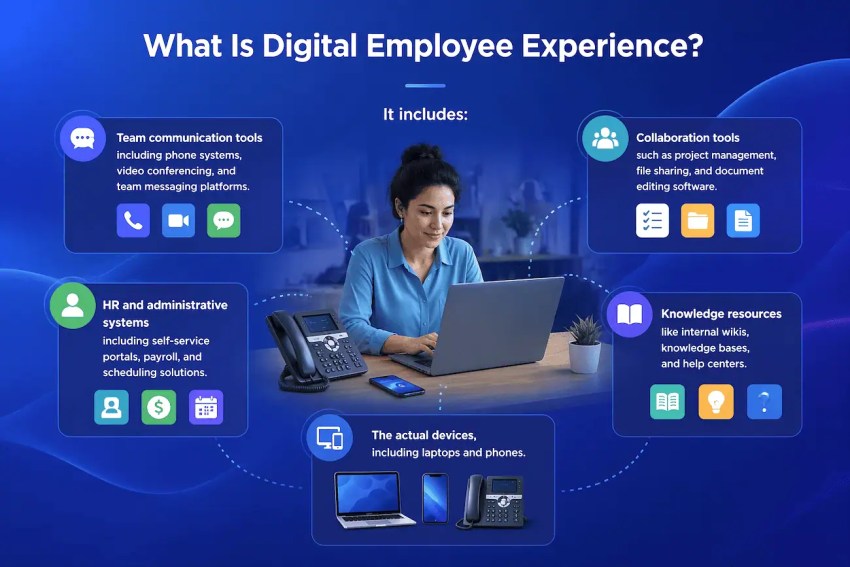
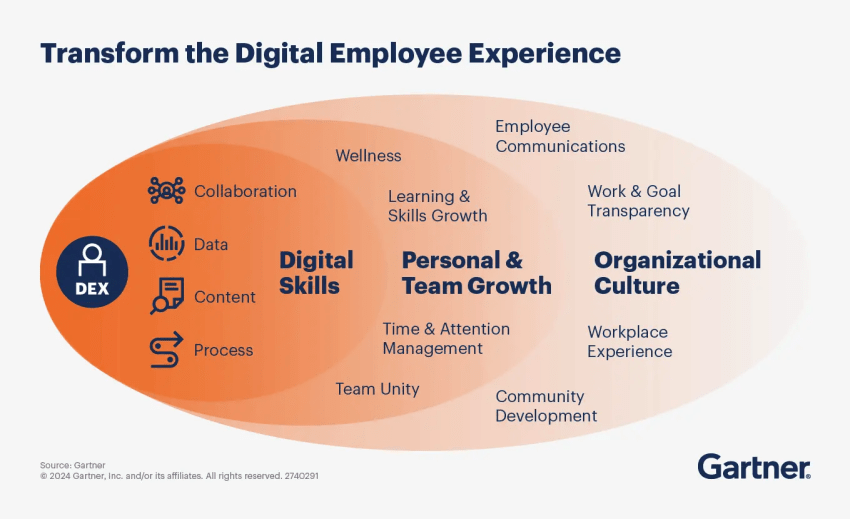
Digital employee experience is the quality of employees’ interactions with the tools and technologies they use to do their jobs.
This includes:
- Team communication tools, including phone systems, video conferencing, and team messaging platforms.
- Collaboration tools such as project management, file sharing, and document editing software.
- HR and administrative systems, including self-service portals, payroll, and scheduling solutions.
- Knowledge resources like internal wikis, knowledge bases, and help centers.
- The actual devices, including laptops and phones.
Keep in mind that DEX is the digital layer of the broader employee experience. While employee experience covers culture, leadership, physical workspace, and growth opportunities, DEX focuses specifically on how technology helps or hinders your staff’s everyday tasks.
A Nextiva AI employee experience strategy also spans the entire employee lifecycle. It starts with onboarding, impacting first-day setup, access provisioning, and getting the right tools configured. From there, it impacts daily work and goes all the way through to offboarding. Every touchpoint in between shapes how employees feel about working at your company.
Let’s look at an example.
A customer service rep at one company operates in a single unified communication platform that has access to multiple messaging features, CRM integration, and an internal knowledge base. When helping customers, the agent can pull up a client’s history and answer a complex billing question in 30 seconds, delivering a personalized response.
Meanwhile, a rep at a second company is drowning, trying to keep up with three different disconnected tools. They’re manually searching across systems, taking several hold breaks, and up to five minutes to deliver a less-than-complete (and non-personalized) answer.
Two similar companies with different tech stacks can have vastly different experiences for both the employee and the customer.

Why Digital Employee Experience Matters
Unfortunately, I’ve led teams where poor digital tools weren’t a theoretical concern and instead had become a daily tax that weighed down performance. Here’s what poor DEX actually costs when it’s not addressed:
- Productivity: Gartner found that persistent digital friction from slow apps, fragmented workflows, or repeated logins can hinder employees’ ability to get work done.
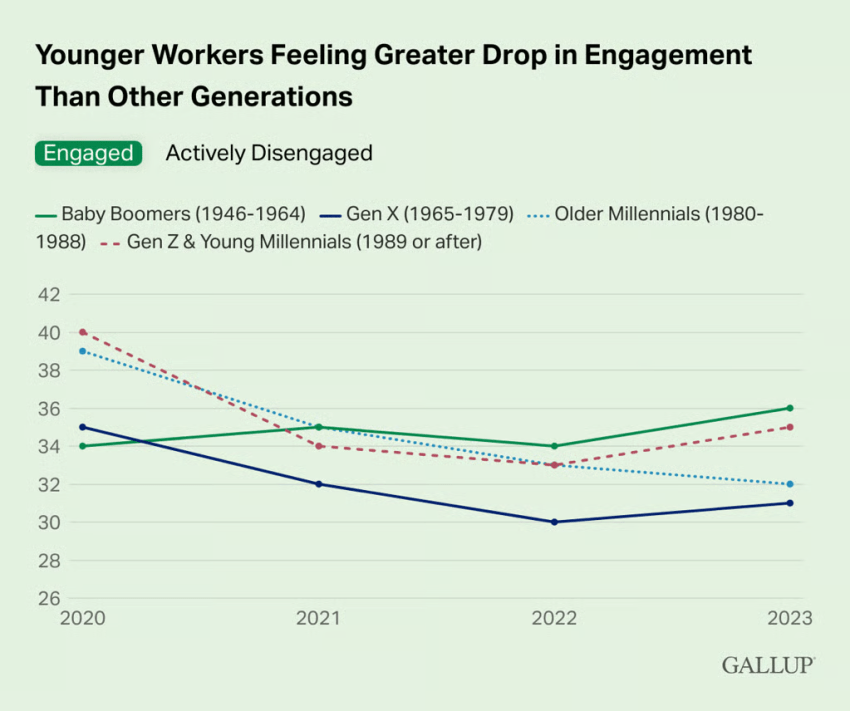
- Employee engagement and retention: Employees who are frustrated by their tools disengage faster. In competitive talent markets, a poor digital experience can push top talent to jump ship.
- Customer experience: Employee experience and customer experience are deeply connected. When agents and frontline workers have seamless tools, they respond faster, make fewer mistakes, and can offer more personalized service.
- Cost efficiency: Tool sprawl is expensive, often resulting in redundant licenses, overlapping platforms, and integration workarounds that can drain IT budgets fast.
- Security and compliance: Fewer, well-managed platforms are easier to secure than a large tech stack that becomes unwieldy to manage.
Poor DEX is the number one driver of shadow IT. When your official file-sharing tool is slow, or your messaging app is clunky, employees start using their personal WhatsApp or Dropbox accounts to get the job done. This creates a massive security blind spot. In 2026, a great digital experience is your best defense against data leaks and unmanaged software sprawl.
Key Factors That Affect Digital Employee Experience
When I’m assessing a company’s digital workplace and how it impacts business communications, there are a few variables I look at. Each one either builds up or breaks down the quality of the employee experience. Let’s take a look at each.
Tool sprawl and fragmentation
Organizations often end up with tech stacks so complex that they are difficult to navigate. A 2026 report found that the average organization manages some 305 SaaS applications, so it’s not surprising that tool sprawl can impact customer support and teams.
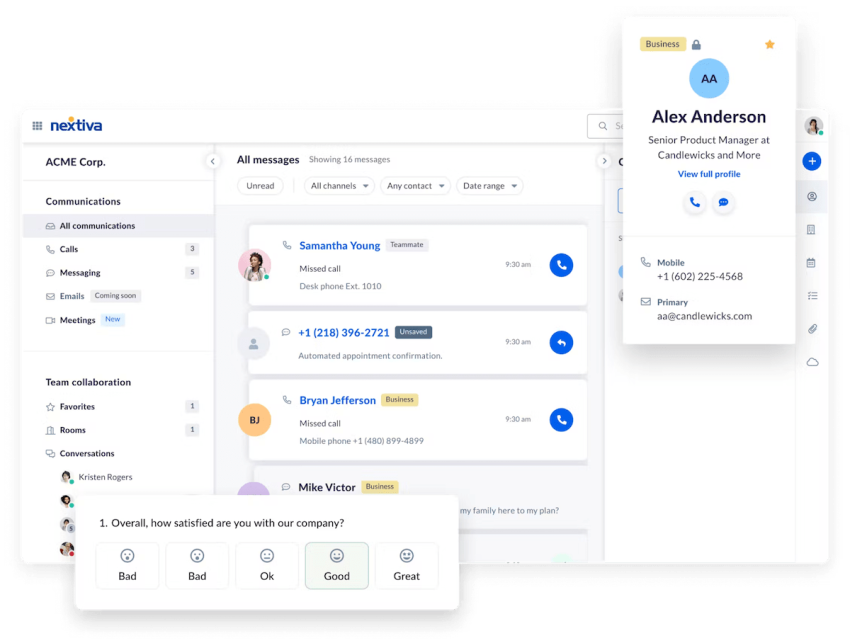
When communication, collaboration, and customer data live in separate silos, employees are stuck toggling between apps. They lose context constantly, which drains productivity and can increase the risk of errors.
Unified workplace communications platforms that consolidate voice, video, messaging, and collaboration into a single system are the most direct cure for this problem.
Usability and interface design
If your tools aren’t intuitive, even your most productive employees will underutilize them or build workarounds that create new problems.
Modern end-user experience (UX) expectations are higher than ever, and your DEX platforms should be easy to adopt, even for workers who aren’t tech-savvy. Employees expect workplace communication tools to be as easy to navigate as the apps they use in their personal lives.
Reliability and performance
Downtime can mean lost revenue and damaged relationships. Slow load times, frequent crashes, and unreliable connectivity erode trust in digital tools fast. Uptime SLAs like 99.999% matter in ways that only become obvious when systems fail.
Performance consistency across office and remote environments is equally critical for hybrid work teams who need the same experience regardless of where they’re working.
Integration and interoperability
While the goal is always to simplify your tech stack, you’ll still have multiple tools in addition to your enterprise collaboration system — for example, a CRM, HR system, and project management platform.
And here’s the thing: You need your communication platform to integrate with all those systems. DEX solutions that don’t connect to your CRM, HR systems, and project management platforms force employees to serve as the integration layer themselves.
Native integrations and open APIs ensure information flows between platforms. Without them, every handoff between departments requires manual effort, and that effort adds up fast.
Mobile and remote accessibility
With remote work and hybrid work now standard for most knowledge workers, employees need full-featured mobile apps. They don’t want or need stripped-down versions that push them back to a desktop for core functions.
Mobile-first accessibility is a DEX requirement and needs to be treated as such.
Onboarding and training
The first digital impression sets the tone for everything that follows. That’s true for customers checking out your website or placing an order, and it’s just as true for your employees when they first start on your payroll.
If a new hire spends their first week fighting IT provisioning, incomplete access, or confusing tool setups with outdated workplace technology, the experience starts in a hole.
A strong digital onboarding experience that includes ongoing training and self-service resources pays dividends in terms of faster employee productivity and stronger early engagement. This can empower employees to adopt new tools faster and get the most out of existing ones.

IT support responsiveness
How quickly and effectively IT resolves issues is a core component of DEX. Long troubleshooting cycles and slow remediation compound frustration.
Self-service options, AI-powered help desks, and proactive issue detection reduce the burden on both employees and IT teams. When end-user problems get resolved fast, confidence in the digital environment stays high.
Personalization and configurability
Employees work differently depending on their role, department, and preferences. A one-size-fits-all approach will fall short. Platforms that support customizable dashboards, flexible notification settings, and configurable workflows let teams tailor the environment to how they actually work.
How to Improve Digital Employee Experience
Here’s the framework I use when working with organizations to improve DEX. These steps are in sequence for a reason, so don’t skip the audit and jump straight to buying new tools.
1. Audit your current technology stack
Before you can fix the problem, you need to understand it. Document every tool your organization uses for communication, collaboration, project management, and information sharing. Identify overlaps, redundancies, and gaps.
Then, do something most organizations skip: ask your employees. Survey them on what tools they use daily, what frustrates them most, and what workarounds they’ve invented. The gap between what IT thinks the stack looks like and what employees actually use is almost always significant.
Map the employee journey from onboarding through daily workflows to identify the highest-friction touchpoints. Those are your starting points.
2. Consolidate around unified platforms
Before consolidating your data, conduct a context switching analysis. Ask your team to follow a single customer ticket from start to finish.
How often did they have to leave the conversation to find an answer? If they were switching back and forth between the phone, spreadsheet, and wiki, and finally sending a Slack message to the manager, you’ve identified a context tax. Reducing this is the fastest way to achieve a return on your DEX investment.
Also, look for platforms that combine multiple functions — voice, video, messaging, and team collaboration — into a single system.
NextivaONE does exactly this, bringing voice, video, SMS, team chat, and CRM integration into one app, starting at $15 per user per month.
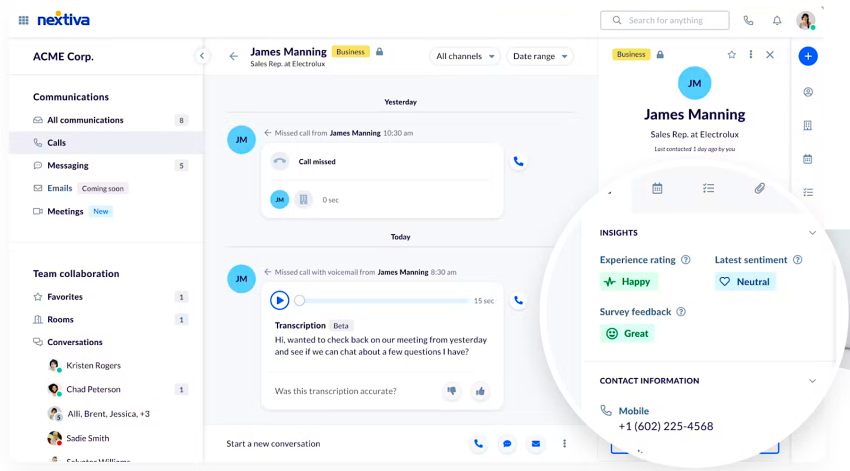
The best part is, consolidation doesn’t mean compromise. The right unified platform should match or exceed the functionality of the point solutions it replaces while adding the integration benefit those tools never had.
This is where digital transformation moves from a talking point to a real change in how people work.
3. Prioritize communication and collaboration
Communication is the connective tissue of every organization. If your phone system, video conferencing, messaging, and email are fragmented, everything downstream suffers — decision-making slows, information gets lost, and team members spend more time searching for context than doing actual work.
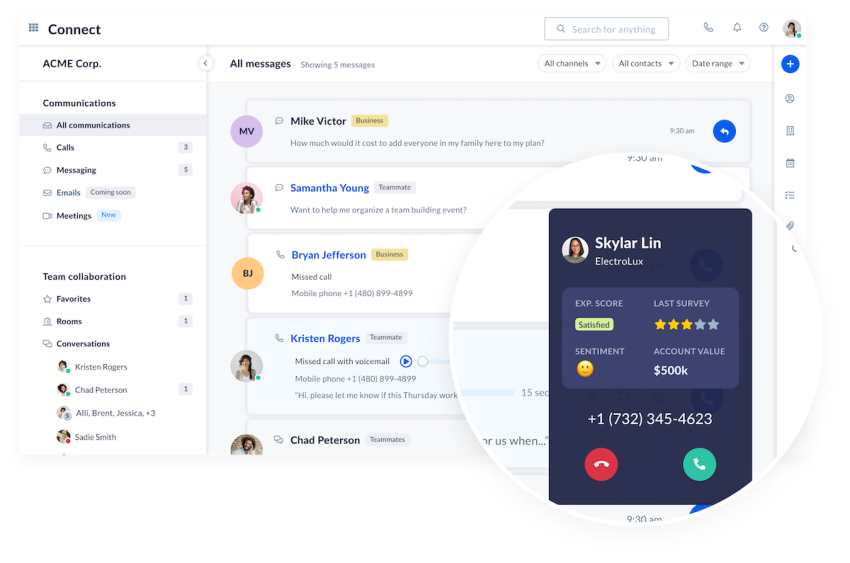
Ask yourself whether your current tools support both internal collaboration and external customer communication in one platform. Nextiva connects internal team collaboration with customer-facing communication so employees always have full context without the need for switching apps.
4. Fix onboarding first
New hires should have their accounts, devices, and tools configured before day one, and not on day three after IT digs through a backlog. Getting this right sets a strong tone early and reduces the time it takes new employees to become productive.
Beyond initial setup, ongoing training matters. Short video tutorials, self-service knowledge bases, and internal champions in each department who can answer peer questions keep employees getting more from the tools they already have.
5. Measure DEX continuously
Don’t rely on annual engagement surveys. By the time that data comes back, the problem has been compounding for months.
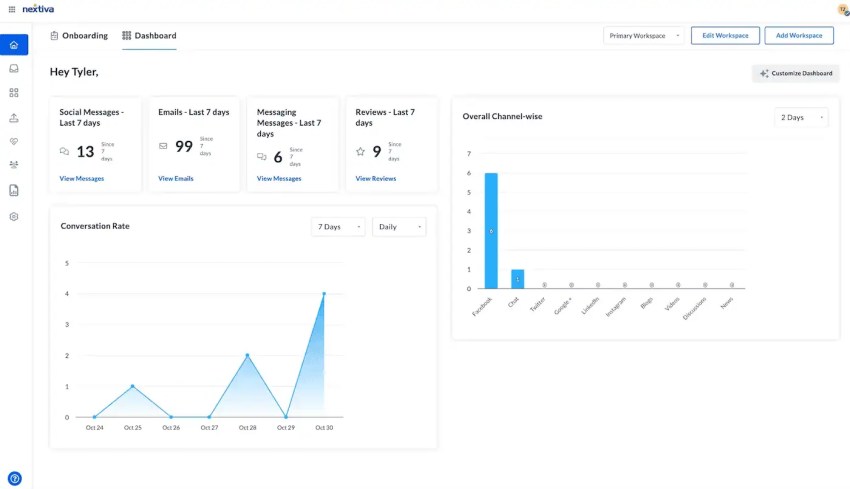
Use pulse surveys, in-tool employee feedback mechanisms, and usage analytics to track employee sentiment in real time. Combine operational metrics — like uptime, ticket resolution time, and adoption rates — with experience data like employee satisfaction scores and qualitative feedback on specific tools.
Set specific targets, like “reduce IT ticket resolution time by 40%,” “reach 80% platform adoption within 90 days,” and “improve technology satisfaction scores by 15 points.”
6. Use AI and automation to reduce friction
AI-powered tools can automate repetitive tasks, surface relevant information proactively, and remove the manual effort that quietly drags down the digital experience.
Here are a few examples of what this looks like:
- AI voicemail transcription eliminates the need to listen to every message in full.
- Smart call routing gets customers to the right person on the first try.
- AI-powered chatbots handle routine IT support questions around the clock.
- Automated onboarding workflows ensure new hires complete the right steps without manual follow-up.
Nextiva integrates AI across its platform, with advanced features like AI voicemail transcription, intelligent call routing, and an AI receptionist (XBert) that handles inbound calls 24/7. These features streamline automatable tasks and free employees to focus on work that requires human judgment.

7. Keep security usable
Security measures that are too cumbersome push employees toward shadow IT, which creates a real security risk. The goal is security that’s invisible and avoids disruptions whenever possible.
Prioritize tools with features like:
- Single sign-on, multi-factor authentication that doesn’t require repeated logins throughout the day.
- Role-based access controls, which improve security while keeping the experience smooth.
- Self-service password reset, which reduces IT ticket volume.
Choose platforms with enterprise-grade security, relevant compliance certifications like HIPAA and SOC 2, and published uptime SLAs.
The Role of Unified Communications in Digital Employee Experience
Communication tools are the most frequently used digital tools in any organization. Just think about how often you have a Slack message pinging your phone, an email from a coworker popping up in your inbox, or another meeting request showing up on your calendar.
This makes the communication layer the highest-leverage point in any DEX strategy — and the most damaging when it’s broken. If employees are juggling separate tools for voice, video, messaging, and team chat, the friction starts there and ripples into everything else.
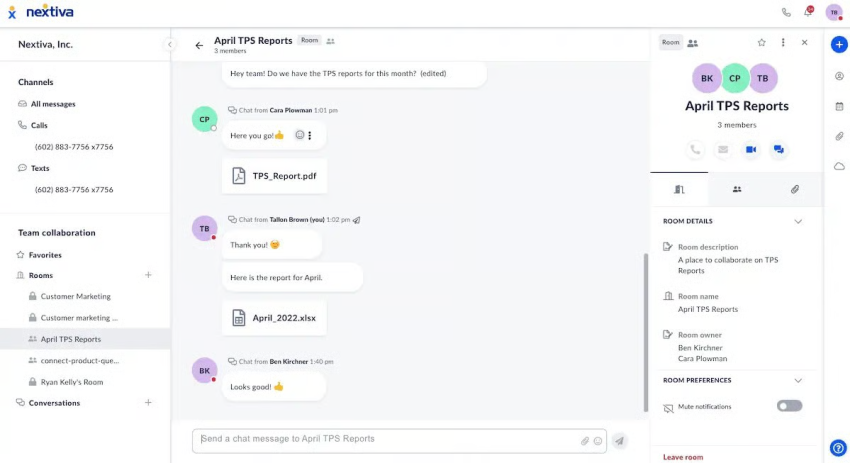
The top corporate communication tools solve this by consolidating voice, video, messaging, SMS, and team collaboration into a single interface. Less context switching means better information flow, faster response times, and fewer things falling through the cracks.
The business case is clear. In a 2024 Forrester study, 38% of organizations reported that ineffective internal collaboration costs them business. Unified communications directly addresses this issue by giving employees one place to communicate, regardless of channel or audience.
Today, unified communications is primarily based on conversation intelligence. Your communication platform should analyze customer history, transcribe the current conversation in real time, and simultaneously suggest the relevant knowledge base article to the employee. This is the standard for a new-age digital workplace.
Nextiva takes this a step further by unifying internal and enterprise team collaboration with external customer communication in the same platform. Employees aren’t running one tool for colleagues and another for customers. Everything is all in one place, with full context on every interaction.
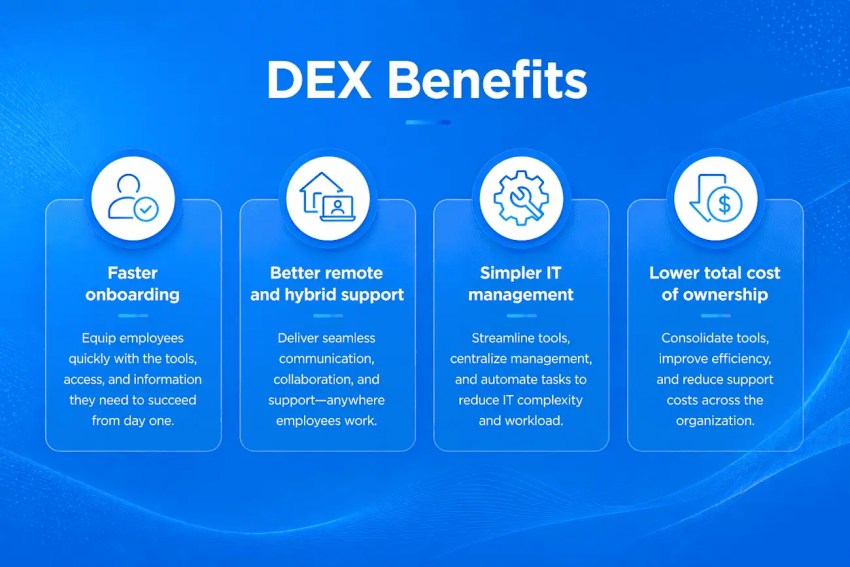
The DEX benefits are practical and immediate:
- Faster onboarding: One platform to learn means new hires get productive faster and IT spends less time provisioning access across multiple systems.
- Better remote and hybrid support: A full-featured mobile app means employees get the same experience whether they’re in the office, at home, or on the road.
- Simpler IT management: A single admin console reduces the overhead of managing multiple vendor relationships, contracts, and support escalations.
- Lower total cost of ownership: Consolidating to one platform eliminates redundant licensing and the integration costs that come with stitching point solutions together.
For growing businesses, Nextiva scales from a small team to an enterprise without requiring a platform migration. This matters because migrations are high-friction events that set DEX back every single time.
Digital Employee Experience Metrics to Track
Measurement is where most DEX initiatives fall apart. Companies launch initiatives and deploy tools, but no one ends up tracking whether any of it worked.
Here’s how to build a practical measurement framework.
| Metric Category | What to Measure | Why It Matters |
|---|---|---|
| Operational | App uptime, load times, crash rates, ticket resolution time | Tells you whether systems are performing as expected |
| Adoption | Active users, feature utilization rates, login frequency | Shows whether employees are actually using the tools provided |
| Satisfaction | Employee technology satisfaction scores, NPS for internal tools, qualitative feedback | Reveals how employees feel about their digital experience |
| Productivity | Time to complete common tasks, context-switching frequency, meeting efficiency | Measures whether tools are enabling or hindering work output |
| Support | IT ticket volume, first-contact resolution rate, self-service success rate | Indicates the health of IT support and self-service resources |
| Security | Shadow IT usage, security incident frequency, compliance audit results | Flags whether poor DEX is driving employees to unsanctioned tools |
Keep in mind that the best programs combine operational data (what’s actually happening in your systems) with experience data (how employees feel about it). One without the other gives you an incomplete picture.
For example, low ticket volume can mean your tools work great. However, it can also mean employees have given up reporting problems because the tools are so frustrating to work with.
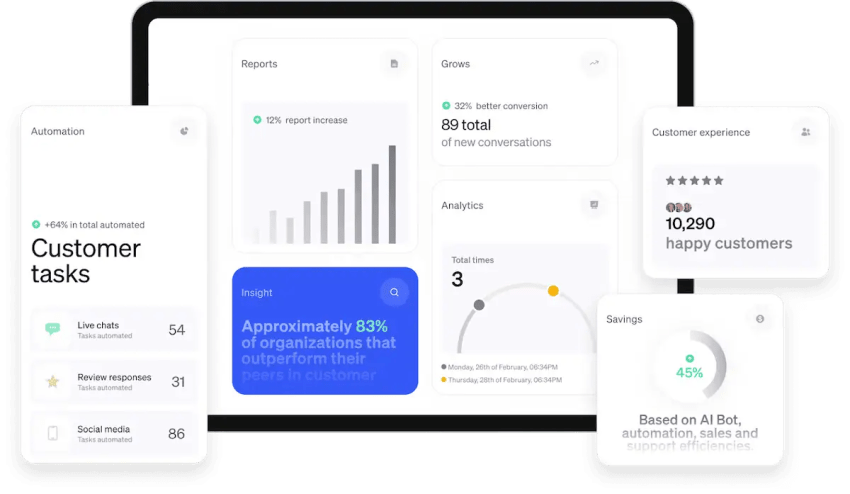
That’s where communication analytics come into play. Nextiva’s built-in dashboards surface communication performance and adoption data from a single platform, so you’re not stitching together reports from five different tools just to understand how your digital employee experience management is performing.
Getting the Right Tools, Not Just More Tools
Digital employee experience is a critical part of a comprehensive business strategy. It directly determines how effectively your team works, how long your best people stay, and what your customers experience every time they interact with your organization.
Every organization I’ve seen get DEX right has done the same thing. Instead of layering another app on a fragmented stack, they made the decision to consolidate.
Following this approach, they were able to bring communication, internal collaboration, and customer interactions into a single platform where everyone works with full context (and without needing to switch apps and context to get there).
Nextiva’s unified communications platform was designed with this exact problem in mind.
Voice, video, SMS, team chat, and CRM integration functionality are all available in a single system, with Nextiva’s transparent pricing starting at $15 per user per month. And unlike the nickel-and-dime model you see from some UCaaS vendors, you’re not paying extra to unlock the advanced functionality your team needs to do their jobs well. You get everything you need for true unified communications and a platform that can scale alongside your business needs.
If your team is losing time because of disconnected tools, it’s time to simplify. Book a demo with Nextiva today and see a unified digital work environment in action.
AI-Powered Contact Center
Create amazing customer experiences with AI-powered contact center software. Scalable contact center platform built for omnichannel customer conversations.
Frequently Asked Questions About Digital Employee Experience
Still have questions? Here are answers to the questions I hear most often when working with organizations on their DEX strategy.
Digital employee experience is the quality of every interaction an employee has with the technology they use to do their job. This ranges from office communication apps and collaboration tools to HR portals, knowledge bases, and the devices employees work on.
DEX encompasses reliability, usability, integration, and how well those tools support the way employees actually work.
Digital employee experience is a subset of employee experience, focused specifically on the technology layer.
Employee experience covers the full picture, including culture, leadership, physical workspace, benefits, and growth opportunities. DEX is the part that determines how well technology enables or hinders daily work, and it’s a prerequisite for strong EX in any organization where employees depend on digital tools to do their jobs.
Poor DEX can directly cost you productivity, retention, and revenue. When the digital work environment is fragmented and frustrating, employees disengage, performance suffers, and top talent leaves.
When executed well, DEX is seamless and unified. People work faster, collaborate more effectively, and deliver better business outcomes for customers and the business.
The main factors that impact digital employee experience include:
– Tool sprawl and fragmentation
– Usability and interface design
– System reliability and uptime
– Platform integration and interoperability
– Mobile and remote accessibility
– Onboarding quality
– IT support responsiveness
– How well tools can be configured to fit different roles and work styles
Any one of these can drag the experience down, and most organizations have problems across several of them simultaneously.
DEX is best measured across five categories:
– Operational metrics (uptime, crash rates, ticket resolution time)
– Adoption metrics (active users, feature utilization)
– Satisfaction metrics (employee surveys, tool NPS)
– Productivity metrics (task completion time, context-switching frequency)
– Support metrics (ticket volume, self-service success rate)
The key is combining what’s happening in your systems with how employees feel about it, since one without the other gives you an incomplete picture.
One of the benefits of unified communications is that you can directly reduce the context switching that creates the most day-to-day friction for support teams.
UCaaS platforms consolidate voice, video, messaging, SMS, and collaboration into a single interface. This means employees learn one system instead of many, IT manages one platform instead of several, and everyone gets a consistent experience across devices, whether they’re in the office or collaborating remotely.
The highest-impact investment is a unified communications platform that eliminates tool sprawl at the communication layer.
Beyond that, integrated CRM, AI-powered IT support, self-service knowledge bases, and analytics platforms that surface how tools are actually being used all make a meaningful difference. The goal is fewer, better-connected tools — not more tools overall.
Digital employee experience and customer experience are directly connected. Fragmented internal tools create fragmented customer interactions. When employees have seamless tools, they can respond to customers faster, with more context and fewer errors.
Organizations that invest in strong DEX consistently see measurable improvements in response times, resolution rates, and customer satisfaction scores. If you want a customer experience transformation, this is where you should start.