
 Customer Experience
  Blog
Blog  Business Communication
  Leadership
  Marketing & Sales
  Nextiva News
  Productivity
  VoIP
VoIP 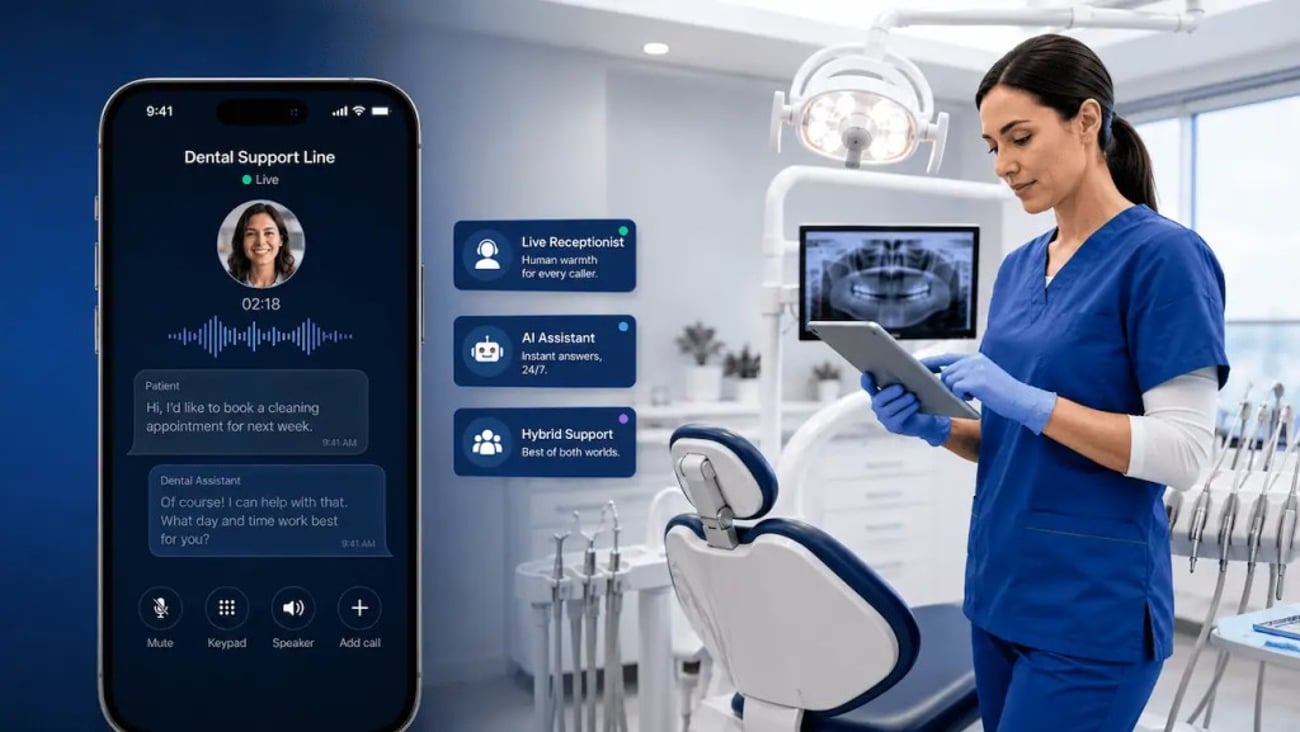
Picture this: One team member is checking a patient in, running a card, and fielding a question from the back. The phone rings, then it rings again, and the second call goes to voicemail. Nobody logs that call, so it simply never happened as far as your practice knows.
This is a frequent scenario in a dental clinic, and it eventually becomes expensive. What could have been a chance to serve a patient in need becomes a lost opportunity that drives them to another clinic for care. A dental answering service fixes this leak.
This guide covers dental answering services in detail and outlines everything you need to choose a service reliably.
Try the best AI answering service free for 14 days
XBert AI answers questions and captures leads. Add your 24/7 answering service in minutes.
What Is a Dental Answering Service?
A dental office answering service handles patient calls, texts, and chats on behalf of your practice. It uses live operators, AI, or a mix of both, and it can run around the clock. The point is consistent, professional communication on every call.
Think of it as an extension of your front desk, not a separate department. Appointment scheduling is the center of the job. A reliable service handles appointment scheduling, cancellations, and changes. It routes dental emergencies to on-call staff and qualifies new patients before they reach your team.
Listen to XBert AI take a call at a dental office:
A reliable dental answering service will recognize the vocabulary of your practice. For example, it should know about crowns, root canals, extractions, implants, and simple cleaning. If your script doesn’t make each service clear, the answering service could book a cleaning appointment as an emergency.
When you evaluate an answering service for dental work, ask about vocabulary first. Make any vendor demonstrate it with your own dental terminology before you sign. Nextiva’s guide to answering service pros and cons breaks down the structural trade-offs between human and automated models in more detail.
What a dental answering service is not
A dental answering service isn’t a voicemail box. A message sitting in your inbox at 8 a.m. on Monday has already lost most of its value. Also, it’s not automatically compliant. Plenty of general-purpose call answering service providers will happily take your business without ever mentioning a business associate agreement (BAA).
How Answering Services Benefit Patients and Dental Offices
From a patient’s perspective, an answering service makes it easier to get an appointment based on the severity of their condition. Nextiva’s XBert AI receptionist asks relevant questions to understand whether it’s an emergency or a regular check-up and helps arrange a visit accordingly.
For dental offices, a reliable answering service helps in various ways, as discussed below.
Hear why XBert AI is the best AI receptionist
XBert AI receptionist handles customer questions, captures leads, and books appointments. Try it free for 14 days.
Protects revenue leakage from missed calls
Missed calls are opportunities that never show up in a report. What could have been a patient appointment remains idle time for a doctor in a clinic. As of Q1 2026, one-third of dentists report they’re not busy enough, according to a report on The State of the U.S. Dental Economy.
Then there’s the math on revenue leakage, which causes immediate revenue loss and reduces what a clinic would have earned over the lifetime of the relationship. Missed calls are people who need care and are trying to reach you. When they can’t reach you, it breaks their trust and eventually their relationship with your clinic.
Consider this situation: A patient tries to reach their dental clinic and gets a prompt to leave a message. They’re in pain and need care as quickly as possible. Due to an unreliable answering service, they’re forced to search for emergency care elsewhere while still in pain.
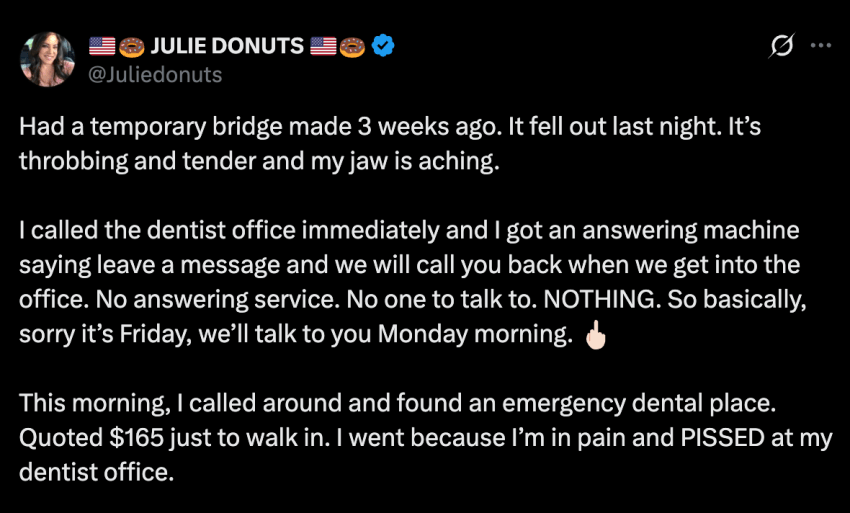
The next time they need dental care, do you think they’ll reach out to the same clinic without second thoughts? This is the cost of a missed call: a missed relationship.
Gives back the focus that front desk staff need
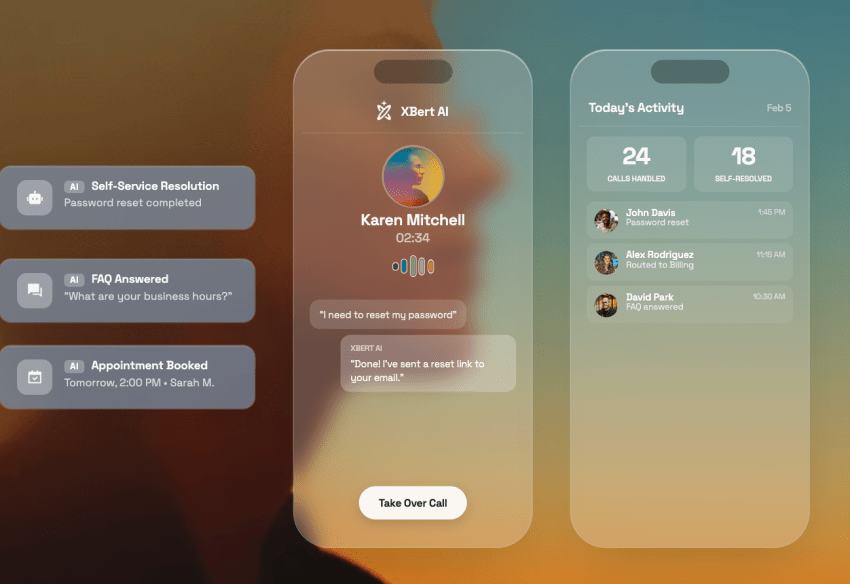
The structural problem is attention, not effort. Your front desk staff can’t check in a patient, verify insurance details, and answer a ringing phone at the same time.
Handing off the work of answering phone calls reduces administrative burden. Your office staff can then focus on patient care. This approach gives an operational efficiency gain that then becomes a revenue gain.
Covers overflow and after-hours calls
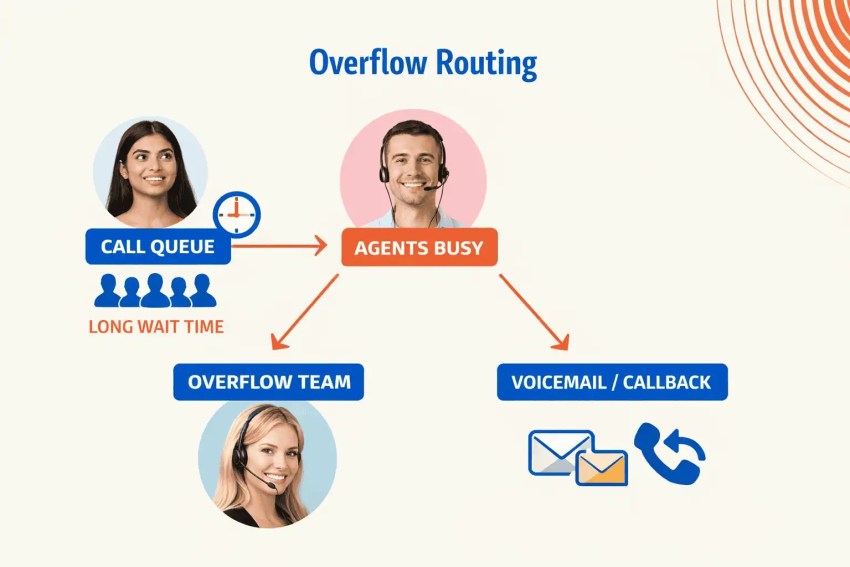
These are two different problems, and many practices need coverage for both. An overflow answering service catches calls while you’re open but slammed. Peak hours are usually late morning and just before lunch. Staffing for that peak means overstaffing the rest of the day.
After-hours support covers nights, weekends, and holidays. It lets patients book appointments when they’re ready, regardless of whether your dental office is open. You can also set up a flow that escalates emergency calls to a caregiver when a patient is in dire need. This lets dentists honor their pledge to assist patients in emergencies.
Helps prevent no-shows
Automated reminders are the quiet win here. Send them 72 hours prior to appointments and again 24 hours prior. Text, email, and voice all work, and each gives patients an easy way to confirm or reschedule appointments.
Two-way messaging matters more than the reminder itself. A patient who can reply and reschedule the appointment is less likely to miss it. Nextiva’s guide on how to reduce patient no-shows covers this topic in depth.
Requirements for Selecting a Service for Dental Offices
This is the section buyer guides skip often, and it’s the one that should decide your shortlist. Three requirements gate everything else.
HIPAA compliance and BAAs
Any vendor that creates, receives, maintains, or transmits protected health information (PHI) on your behalf is a business associate under HIPAA. The designation carries a non-negotiable obligation: They must sign a BAA.
The agreement is not a formality. Per HHS guidance, a BAA must establish permitted uses of PHI, require appropriate safeguards, and require the vendor to report breaches. A business associate is directly liable under the HIPAA rules and can face civil and, in some cases, criminal penalties.
Dental and medical offices carry the same obligation to protect patient privacy. Don’t negotiate on this one. But it’s a common misconception that signing a BAA makes a service compliant. The signature starts the obligation, but it doesn’t discharge it.
Real compliance usually costs you convenience. On a HIPAA-compliant plan, Nextiva switches several features off on purpose: voicemail transcription, voicemail-to-email, visual voicemail, and voicemail playback in the mobile app. The platform also blocks faxing from email, though you can still view incoming faxes through a secure link.
If a vendor promises full HIPAA compliance and voicemail transcripts landing in your inbox, ask them to put it in writing. In the case of SMS, Nextiva allows SMS on a HIPAA account only when no one sends or receives PHI through text. For AI tools, ensure you don’t enter any PHI unless a signed BAA covers that tool.
Practice management software integration
Ask one question: Does the service write into my calendar, or does it email my team to re-key the appointment? Real seamless integration means a booking lands in your practice management system without a human needing to retype it.
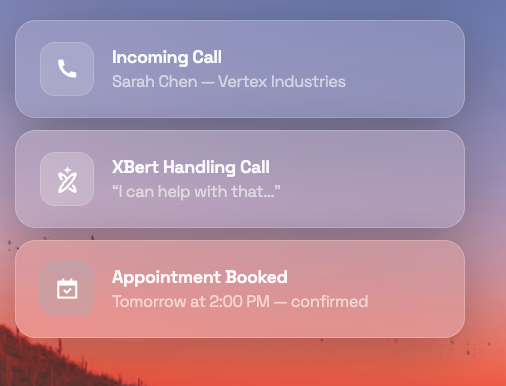
Verify each vendor, by name, against your existing systems. Some offer calendar and CRM integration rather than integration with dental practice management software specifically. Nextiva’s integration marketplace lists Google Calendar, Outlook Calendar, Calendly, Cal.com, and CRM platforms. It also covers healthcare EHRs, including Epic, ModMed, and eClinicalWorks.
Dental emergencies and escalation
Your script needs a clear threshold. Severe swelling, uncontrolled bleeding, and trauma go to the on-call dentist immediately. A chipped filling waits until Monday.
Keep the scope tight, especially with AI. Design the system for recognition and routing, leaving assessment to your clinicians.
Bilingual support and access
If a meaningful share of your dental patients speaks Spanish, bilingual support is a capture lever rather than a nice-to-have. Several providers now include it, including Nextiva.
Here’s an example of Nextiva XBert conversing in different languages to effectively address queries:
Comparing Live Agents and AI Models for Answering Service in a Dentist’s Office
Three models compete for this job. Here’s an overview of how live agents, AI receptionists, and hybrid models function as an answering service:
| Factor | Live agents | AI receptionist | Hybrid |
|---|---|---|---|
| Availability | Staffed hours or paid 24/7 | 24/7, answers instantly | 24/7, AI answers first |
| Anxious or complex patients | Strong empathy and judgment | Limited empathy, should hand off to a human | A human takes these calls |
| Speed at high call volumes | Queues at peak, busy signal risk | Takes every call at once | No busy signal |
| Best for | High-touch intake, complex insurance | Routine bookings, after hours, overflow | Most practices |
Live agents bring judgment. A nervous patient describing pain needs to speak to a person, and trained agents handle that far better than any script. The cost is that they queue at peak hours and usually bill per minute. AI answers every call at once and never gets tired. Intelligent automation wins on consistency, not warmth. It gives the same answer to the same question at 2 p.m. and 2 a.m.
It’s best to automate the transaction while keeping the relationship human. This makes hybrid models a suitable solution for most practices. AI takes the routine load, the after-hours calls, and the overflow, while a person takes the frightened patients and the insurance verification questions that never have a simple answer.
What each model costs
Verify prices before you sign because pricing in this category drifts every quarter.
The cost of an in-house team starts with wages. The Bureau of Labor Statistics put median receptionist pay at $17.90 per hour in May 2024 and $18.47 per hour in healthcare and social assistance. Once you add taxes, benefits, paid time off, and turnover, it becomes a substantial cost.
Live services may seem inexpensive at first, but their cost increases significantly with volume. Then, you must consider the per-minute billing, which scales up in busy hours. This practice reduces the predictability of your final bill.
On the other hand, AI providers mostly bill flat rates. Nextiva’s XBert AI receptionist is $99 per month for 100 interactions, then $0.99 per interaction.
If you want to get to the real cost, use this AI receptionist ROI calculator to get an estimate of what each service would cost and what sort of ROI you can expect.
AI Receptionist ROI Calculator
See how much your business could save with the XBert® AI Receptionist ROI Calculator. Just enter your call volume and staffing costs to find out how quickly an AI assistant can pay for itself and start freeing up your time.
| Did you know? NextivaONE gave Heaton Eye Associates a single place for email, calls, and the calendar. Ten staff members use the desktop app and more work from mobile. Adding the next person takes no more thought than adding the last one. |
Where each model breaks down
There are some failure points you should consider when selecting an answering service for your dental office. A reliable service is one whose limits you understand. For example, in a live services queue, when every agent is busy, your patient waits or lands in voicemail anyway. Quality also drifts between agents and shifts. Most bureaus give you thin visibility into recordings and metrics unless you demand it in the contract.
On the other hand, AI might struggle with complex requests and emotional calls. However, with current developments, AI is getting better at managing frustrated customers, helping them navigate the escalation path. For example, Nextiva’s AI receptionist gives an accessible pathway for people to register their complaints.
Nextiva’s AI answering service guide walks through how to build the routing logic.
How to Set Up an Answering Service for Your Dental Practice
When setting up an answering service, follow these steps:
- Review your call traffic: Pull at least four representative weeks of call logs. Identify your high-volume hours, your after-hours pattern, and your average hold time. Separate business hours from lunch, evenings, and weekends so the real coverage gaps become visible. Most practices are surprised by what they find because missed calls don’t announce themselves.
- Set your rules: Write the routing logic, the scripts, and the exact escalation threshold before you launch. Define which calls the service handles end-to-end and which go straight to a person. Record and review the first weeks of calls so you can hear both sides of the conversation.
- Connect your systems: Link your practice management software, calendar, and messaging tools so bookings and notes sync without re-keying. Test a real booking end-to-end before go-live. Then test an emergency escalation at night the way a patient would.
It’s advisable to start with a narrow scope. You can begin with after-hours coverage, learn from it, then expand. Practices that try to automate everything at once might miss critical details that may lead to failure.
Nextiva’s onboarding configures custom call flows and automated receptionist routing. Its contact center platform handles overflow routing and patient communications as you add chairs and locations or grow into a large multi-dentist practice.
What Dental Teams Should Measure After Launch
Most practices launch a service and never check whether it works. If you want to improve your workflow with the system in place, it’s best to measure these metrics:
- Inbound answer rate: The share of calls your team picks up quickly. It’s best to target above 98%.
- New-patient conversion: The share of new-patient calls that end in a booked appointment.
- After-hours capture: How many bookings arrive outside business hours. A zero here means your after-hours coverage is decorative.
- Escalation accuracy: How often a true emergency call reaches the on-call dentist, and how often a routine question wakes someone at midnight. Both errors would cost you.
Review these monthly through the first quarter. Patient retention and patient experience climb once the phone stops behaving like a lottery. You’ll only notice them if you measure them.
Give Every Patient a Reason to Book
Wait times for new patients have fallen to about 12.4 days, which means there’s room in most schedules. In this environment, the practices that see more patients are the ones that answer.
Nextiva’s XBert AI receptionist lets you pick up those calls at a flat cost of $99 per month for 100 interactions. It answers unlimited calls around the clock, books appointments automatically, and hands the call to your team when a patient needs a person. It sits on a HIPAA-compliant, SOC 2-audited platform backed by a signed BAA.
A patient in pain on a Friday night has already decided to call someone. Explore Nextiva and make sure it’s you.
AI Voice Agent Built for Dental Offices
XBert AI voice agent answers every patient call, handles urgent cases, and provides after-hours support so your practice never misses a new patient.
Frequently Asked Questions About Dental Answering Services
Prices vary by model. AI options generally start near $99 per month. Nextiva’s XBert starts at $99 per month for 100 interactions.
Not automatically. The provider must sign a BAA and protect PHI on every channel. Nextiva executes a BAA and disables features like voicemail transcription on compliant plans.
Some can. Confirm it by name against your own system before signing. Ask whether the service writes to the calendar or emails your team to re-key it.
Emergencies are handled through custom scripts you define. Severe swelling, bleeding, or trauma triggers escalation to the on-call dentist. Routine issues wait for business hours.
Most practices do best with both. AI covers routine booking, overflow, and after-hours calls. A person takes anxious patients and complex insurance questions.
It should hand the call to your team with context. Nextiva’s XBert includes a smart handoff to team members for exactly this situation.