

 Customer Experience
 Blog
 Business Communication
 Leadership
 Marketing & Sales
 Nextiva News
 Productivity
 VoIP


In Gartner’s October 2025 survey of 321 customer service and support leaders, 91% reported pressure from executives to implement AI in 2026. If you’re preparing a support budget, that finding may sound familiar: The expectation to adopt AI has arrived, and you’re responsible for deciding where it belongs.
Before committing the budget, you need answers to a few operational questions. Which customer problems should AI handle? How will we know those problems were resolved? And when someone needs a human, what happens next?

These questions set the direction for this guide on AI customer service trends. For each trend, we’ll separate what production evidence supports today from what remains a forecast. We’ll examine the research behind autonomous resolution, look at the case for agent copilots, and consider where voice AI fits into your service operation.
We’ll also work through the decisions behind a hybrid model, including which actions need human approval and what information should accompany an escalation.
The aim is to help you build a 2026 AI strategy you can explain in a budget meeting and evaluate after launch. You’ll have a basis for choosing what to fund, what to test, and which assumptions need evidence before you expand.
The Pressure Is Real; the Results Are Uneven
Gartner’s forecasts give support leaders reasons to invest in AI and to question the savings attached to it.
In March 2025, Gartner predicted that agentic AI would resolve 80% of common customer service issues without human intervention by 2029, reducing operational costs by 30%. That’s a substantial opportunity. It’s also a forecast about common issues, with a deadline several years away. It doesn’t establish how much work your AI agents can reliably handle today.
In February 2026, Gartner also predicted that half of companies that attributed staffing cuts to AI would rehire people for similar work by 2027, although the job titles would change. The same release reported a more modest picture of actual adoption: In its October 2025 survey of 321 service and support leaders, only 20% had reduced agent staffing because of AI. Most were serving more customers without changing headcount.
Gartner also projected in 2026 that the cost of resolving a customer service issue with GenAI will exceed $3 by 2030, potentially making AI more expensive per resolution than some offshore live agents.

Read together, these findings suggest a distinction worth taking into your budget meeting. Increasing the workload a team can handle can lead to a different outcome than eliminating the need for that team. Programs aimed at improving customer effort and availability can create value without assuming that AI will replace human agents. Meanwhile, programs built primarily around headcount reduction face a less certain business case as AI costs and human staffing needs persist.
The forecasts allow for both greater customer service automation and a continuing need for human support. The numbers give you a reason to test whether the business case survives higher AI charges and continued human staffing.
| The common claim | What the evidence shows | What to do about it |
|---|---|---|
| AI will cut support headcount | Only an estimated 20% of leaders have cut headcount for AI, and half of those who did are projected to rehire by 2027. | Plan for role change, not reduction |
| Automation lowers cost per contact | Generative AI cost per resolution is projected to be above $3 by 2030. | Build the case on availability and effort |
| Chatbots already handle tier one | 8.9% of enterprise chat sessions reached the customer’s stated goal in 2026 testing. | Measure resolution, not deflection |
| The model is the hard part | 60% of AI projects unsupported by AI-ready data will be abandoned. | Fund the data layer in the same budget |
Tier One Self-Service Moves From Deflection to Resolution
Tier one support is where the promise of AI customer service tools meets a practical test: Can customers finish what they came to do? Before expanding self-service, look at which requests it can handle from start to finish and how you’ll verify the issue stays resolved.
How much volume is actually automatable
Start with the routine work still reaching your team. McKinsey analyzed millions of interactions across more than 30 organizations and found that up to 60% remained transactional despite rising call complexity. At one European bank, questions about recent transactions, bill payments, and similar tasks accounted for roughly half of total call volume.
That gives you a defensible starting point for assessing automation opportunities. It doesn’t mean half your contacts can disappear next quarter. Review those interactions by intent, then check whether your systems can supply the information, permissions, and actions needed to finish each task.
The production picture is considerably less reassuring. Parloa’s 2026 research included approximately 4,000 mystery-shopper chat interactions across enterprise websites. Just 8.9% achieved the customer’s goal, while only 10.1% of escalation attempts reached a human.

The studies describe the work of arriving at and testing the service customers receive. Together, they point to an implementation gap: The 8.9% result measures deployed experiences, not a technology ceiling. Parloa specifically identifies rigid decision trees, chatbots without memory, and handoffs that lose context.
For your own rollout, choose a narrow intent and define completion before launching. When changing an appointment, success is defined by the new booking being confirmed in the scheduling system. AI chatbots that only provide instructions for changing an appointment don’t actually complete the task and would create a bottleneck in the booking system.
Why deflection is the wrong headline metric
Deflection counts contacts that avoid a human agent, while resolution measures how many problems get solved. Treating the two as interchangeable creates a reporting blind spot.
Think about a customer who asks about a missing refund. The chatbot supplies a policy link, the customer closes the window, and no agent joins. That interaction might count as deflected. If the customer calls the following day with the same question, then their concern wasn’t actually addressed.
Parloa’s findings illustrate why containment-focused measurement can conceal unsuccessful customer journeys. A session that appears to end successfully may actually reflect abandonment.
Pair every deflection figure with a downstream customer satisfaction score and a 30-day repeat-contact rate for the same intent. Track those repeat contacts across channels so a failed chat followed by a phone call stays visible.
When deflection improves but repeat contacts rise, investigate before claiming a resolution gain. Review the transcripts, check whether the requested action happened, and ask customers whether they solved their problem. Include abandonment and customer churn in the wider review. Silence alone is weak evidence of success.
Agent Copilots Are the Least Controversial Win
Copilots offer a practical starting point because an agent can review the AI’s output. Conversation summaries, suggested responses, and real-time knowledge retrieval fit into an existing service workflow without requiring the system to make every decision independently.

That creates a narrower failure mode when human approval is enforced. An agent can reject an unsuitable suggestion before it reaches the customer. For a first deployment, that’s a more manageable scope than authorizing AI agents to change live accounts. Governance still matters, but the review can focus on specific questions, such as what information the copilot can access, what it recommends, and what requires approval.
The prerequisite is connected customer context. Nextiva’s CX research found that 95% of companies used multiple customer interaction tools, averaging 6.3 per company, and 86% reported siloed data.
Imagine a copilot drafting a billing reply without seeing the credit another agent promised yesterday. Even a well-written answer would be incomplete. Require a unified view of relevant conversation history, account information, and approved knowledge before expanding its responsibilities. A single pane of glass only helps when the information behind it is connected.
Nextiva Contact Center provides a concrete application through AI transcription, summarization, and conversation analysis. Used alongside its agent assist capabilities, these tools help capture the interaction and reduce manual post-call documentation.
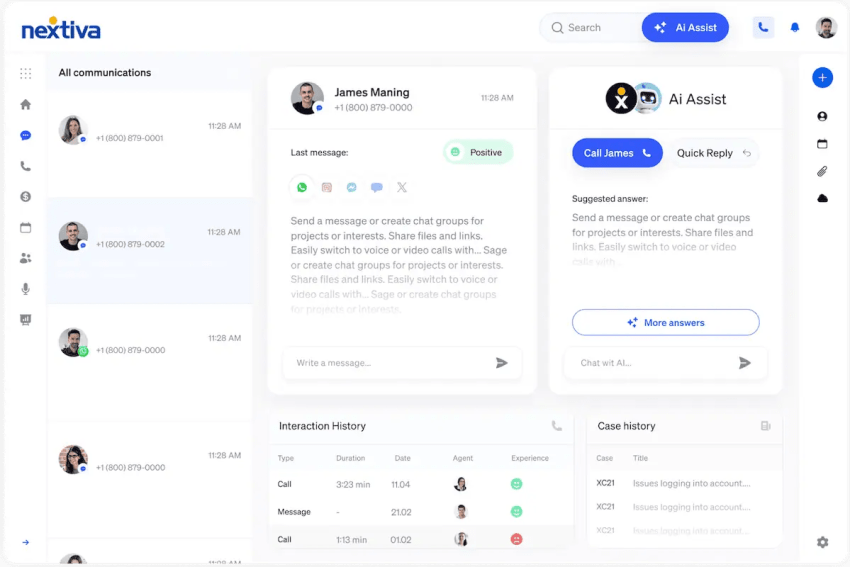
For example, after a billing dispute, the agent can review the generated summary, verify the customer’s concern, agree on the next step, and correct any omissions before saving. Measure the result using average handle time and documentation quality. Faster notes are useful only if the next agent can trust them.
NEBA, a financial services firm, improved answer rates by 20% using Nextiva Contact Center’s automated wrap-up and optimized call handling. The result illustrates the value of improving agent-supported service rather than relying on headcount reduction.
Voice AI Finally Leaves the IVR Behind
The meaningful change in voice AI is what callers can accomplish. The goal is to move beyond touch-tone menus and rigid prompts toward stating requests naturally, completing routine tasks, and reaching a person with the conversation context intact. According to Parloa, natural-sounding voice interfaces can still rely on rigid decision trees and handoffs that erase context.
The priority should be speed. In its Customer Patience Benchmark survey of 400 people, Nextiva reports that 54% leave within eight minutes on hold, while 75% hang up after eight or more minutes. When responses take too long, 56% say they immediately try another channel, and 28% abandon the product or service entirely.
The same research gives teams a response-time ladder to design routing against:
| Channel | Expected response window |
|---|---|
| Chat | Within one minute |
| Phone, SMS, and support tickets | Within five minutes |
| Within 30 minutes |
These are survey-based expectations, so use them as planning targets alongside your own queue data. The study also found that 75% prefer scheduled callbacks or want that option. Build the callback path into overflow routing before customers exhaust their patience. For a front-desk implementation, XBert, Nextiva’s AI receptionist, can answer around the clock, handle routine questions, book appointments, and transfer calls with context.
Unified Routing Beats Adding Another Channel
Adding SMS won’t fix a service operation where the phone team can’t see yesterday’s chat. When the channels exist but the customer’s history doesn’t move between them, that’s an architectural problem.
Nextiva reports that 86% of companies using multiple CX tools have siloed customer data. Meanwhile, 81% of CX leaders say consolidating interaction data into one system of record would improve the customer experience.
Before buying another point solution, trace one unresolved issue across your existing channels. Can each agent see what the customer requested, what was promised, and what still needs to happen? Does the case retain its owner when the customer switches from chat to phone?
That continuity matches what customers expect. Zendesk reports that 70% expect anyone they interact with to understand the full context of their situation. Its CX Trends 2026 report, based on more than 11,000 respondents across 22 countries, found that 88% of customers expect a quicker response than they did a year ago. Meanwhile, 74% expect service to be available around the clock.

Build omnichannel support around a shared customer record and routing rules that account for intent, urgency, and agent skills. A billing dispute should reach someone authorized to resolve it, with the relevant history attached, regardless of where the conversation began.
Proactive outreach removes the contact entirely
Some service requests are opportunities to provide information sooner. Send shipping updates when delivery dates change, outage notices when an incident is confirmed, and appointment reminders before customers need to check the details themselves.
This issue connects directly to the patience problem. Nextiva’s benchmark found that 56% of respondents try another channel when a response takes too long. An accurate update delivered before the customer asks can remove the need to enter that queue.
An outage message, for example, should explain who’s affected, what’s known, and when the next update will arrive. If there’s no reliable restoration estimate, say so. Give customers a way to request help when their situation needs individual attention.
Measure these programs through changes in related inbound contacts and customer feedback. Preventing avoidable questions and having proactive customer service are important to customer retention.
The Hybrid Model Is the Steady State, Not a Transition

Plan human support as a permanent part of your AI customer service automation to improve the customer service experience. The budget decision, therefore, is about which work to automate and where human judgment must remain available.
McKinsey’s analysis supports this approach because it identifies human agents as a control on AI errors. Machines also study them to capture emotional intelligence and build on their sentiment analysis for customer engagement. Treat those responsibilities as work that needs to be staffed, trained for, and measured.
Draw the boundary by customer intent and action risk. The channel alone tells you little about either. A billing dispute arriving through chat still involves money, while an order-status request arriving by phone may require only a lookup. The future of customer service rests on ensuring every action receives the appropriate follow-up or issue resolution.
Use the following as a starting routing policy:
| Intent category | Who handles it | Why |
|---|---|---|
| Order status, hours, balance, tracking | AI, end-to-end | Read-only, high-volume, verifiable answer |
| Appointment booking and rescheduling | AI, end-to-end | Bounded action with a clear success state |
| Refunds and account changes | AI within defined limits | Automatable up to a threshold, escalate above it |
| Billing disputes and contract changes | Human, AI-assisted | Judgment call with financial and legal exposure |
| Complaints, churn risk, distress | Human, immediately | Empathy and authority the AI doesn’t have |
Make escalation part of the resolution path. When AI hands an issue to a human, carry the conversation history, customer intent, actions already attempted, and relevant account details with it.
It’s also important to build a clear path to human support now rather than retrofitting one later under regulatory or customer-expectation pressure. The EU AI Act, for instance, reflects a broader push for human oversight of AI. Under Article 14, high-risk AI systems must include appropriate human oversight.
What Has to Be True Before Any of This Works
Data readiness and quality determine how much of your AI customer service plan can move into production. Before expanding automation, establish whether the system can retrieve a current answer, identify the right customer, and stay within its authority.
Gartner predicts that through 2026, organizations will abandon 60% of AI projects unsupported by AI-ready data. That prediction applies specifically to projects lacking suitable data. It doesn’t mean 60% of all AI projects fail. The same release reports that 63% of organizations lack, or are unsure whether they have, the right data management practices for AI.
Run this checklist against the workflows you intend to automate:
- Clean, deduplicated knowledge base: Remove outdated policies, resolve conflicting answers, and assign someone to maintain each source.
- Explicit retrieval boundaries: Restrict retrieval to approved content and permitted customer records. Require the system to escalate when it can’t support an answer, and test that behavior.
- Identity resolution across channels: Connect verified customer identities across phone, chat, SMS, and email so the conversation follows the correct account.
- Role-based action limits: Define what each AI agent can read or change (whether it be routine inquiries or actionable queries). Enforce permissions in the connected systems, with human approval for restricted actions.
For context, here’s the standard AI chatbot workflow:

Give every unchecked item an owner before expanding the pilot. A successful demonstration should lead to questions about how the workflow behaves when information is missing or contradictory.
The platform also needs to meet your reliability and security requirements. Nextiva strives for a 99.999% uptime service-level agreement, alongside SOC 2 attestation, HIPAA-compliant plans with signed business associate agreements, and end-to-end call encryption. Bring that documentation into governance review and confirm its scope against the channels, integrations, and data your deployment will use.
Build the 2026 Plan on Nextiva
A defensible 2026 plan starts with work you can measure today. Fund copilots that reduce documentation effort and voice availability that helps customers outside staffed hours. Test autonomous resolution through a single bounded pilot for a frequent customer request, with clear success criteria and a working human handoff for better workforce management.
Repair the supporting data in parallel. Each rollout should have an owner for knowledge quality and permissions, alongside the person accountable for service results. Expand when resolution, customer satisfaction, and repeat-contact data justify it.
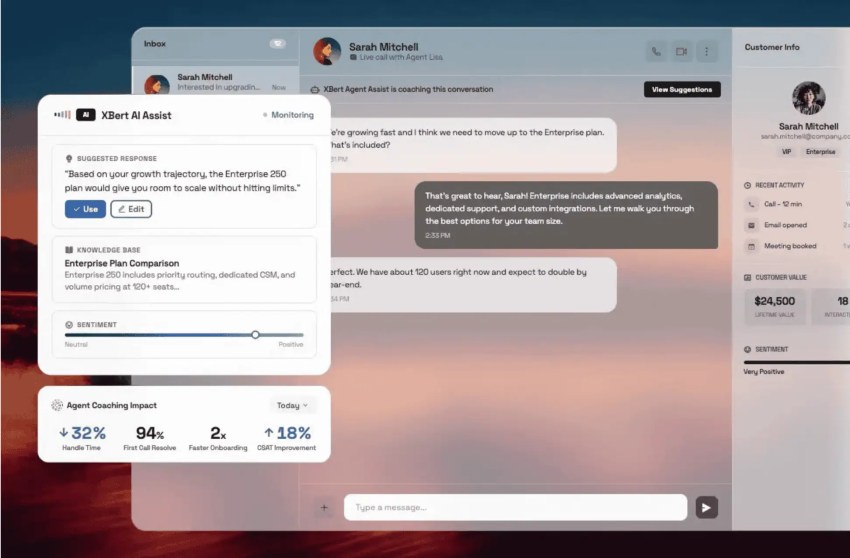
Nextiva Contact Center brings voice, chat, SMS, email, and social conversations into a unified platform, with integrations that connect customer records across your existing systems. That shared context provides the foundation for routing, agent assistance, and automation. XBert extends front-desk coverage around the clock across calls, texts, and chat with top-tier quality assurance.
Bring your highest-volume intent and current handoff workflow to the evaluation. Explore Nextiva Contact Center to build the connected foundation your roadmap needs.
Your AI-Powered Contact Center
Create amazing customer experiences with AI-powered contact center software. Scalable contact center platform built for omnichannel customer conversations.