

 Business Communication
 Blog
 Customer Experience
 Leadership
 Marketing & Sales
 Nextiva News
 Productivity
 VoIP


Scalability doesn’t come naturally as you grow. You might have had record-breaking revenue in a week, but also several calls that nobody returned. This is a scaling problem, which is exactly what we solve in this article.
For me, “how to scale a small business” is more a design problem than a motivation problem. A scalable design unlocks new revenue you miss when you grow without structure while keeping you far from burnout.
This article covers specific advice that you can act on this quarter. You get a five-point readiness scorecard, systems to build first, and a plan for keeping customers as volume rises.
Growing vs. Scaling: What’s the Difference?
Growth adds revenue at the same pace you add resources. Scaling means adding revenue at a much greater rate than cost.
| Differences | Growing | Scaling |
|---|---|---|
| Revenue and cost | Simultaneous rise of revenue and cost | Faster rise of revenue than cost |
| How capacity is added | More people doing the same work | Systems, automation, and delegation |
| Owner’s role | Execution of work and approval of everything | Design of the system and review of the numbers |
| Typical example | One new hire for every few new clients | One process that serves twice the clients with the same team |
Pushing rapid growth without structure in place is how businesses grow but don’t scale, and they end up losing focus and margins at the same time. So before you get too excited about your growth phase, it’s better to check if you’re scalable enough to accommodate that growth. You can use this scorecard as a rough measure of your readiness.
A 5-Point Scorecard for Your Scaling Plan
Before you hire, open a location, or buy another company, run the business through this scorecard. Every threshold here is a standard guideline. Every later decision you make is going to sit on this foundation.
| Checkpoint | What Ready Looks Like | How to Check |
|---|---|---|
| Repeatable demand | Customers buy and return without heroic effort; you know which channels produce them | Revenue by channel and repeat-purchase rate |
| Unit economics | Customer lifetime value (LTV) comfortably exceeds acquisition cost | LTV ÷ customer acquisition cost (CAC) and months to recover CAC |
| Healthy margins | Gross margin holds steady as volume grows | Gross margin trend over the last 12 months |
| Cash runway | Enough cash exists to cover the gap between paying costs and collecting revenue | Cash conversion cycle (CCC) and months of runway |
| Documented delivery | Someone other than the owner can deliver the core service to standard | Written SOPs and a test run without the owner |
To be ready to scale, you need:
- Product-market fit (PMF) and then go-to-market fit: Mark Roberge, HubSpot’s founding CRO and now a Harvard Business School senior lecturer, puts it bluntly that PMF isn’t about revenue. The best measurement is customer retention. If customers don’t come back, more marketing will show more revenue, filling a leaking bucket faster. Make sure your repeat business rate holds before you touch the unit economics row.
- 3:1 unit economics: Your LTV should ideally be at least three times the CAC. However, this is a general guideline or principle rather than a strict rule. Research has found that customer unit economics are well below the 3:1 value-to-cost ratio, suggesting that you have more leeway to grow while being mindful of profits. You can also look at the CAC payback period. For SaaS, the median CAC payback is 16 months. Top-quartile companies achieve it in six or fewer months.
- Healthy margins: For U.S. public companies in business and customer services, margins are around 33%; similarly, for application software, it’s about 72%. If you see the percentage drifting with rising volume, it suggests that costs are growing faster than revenue and you’re growing rather than scaling.
- Cash runway: These are the months you can cover with cash on hand. It’s best to keep enough cash in reserve to cover six months of expenses.
- Documented delivery: Check if someone else can deliver your core service to standard if you took a month off. Or whether you would be in trouble if part of your business depends on a key person or a few people in the office, and they were to leave. If that’s you, you need SOPs and systems before you hire more people.
The Money Side: Margins and the CCC
Scalability is about driving more revenue faster than cost. This mechanism depends on your cost structure and the gap between paying for work and getting paid for it.
Fixed vs. variable costs
Fixed costs don’t change when you add a new customer, at least in the short run; for example, software, rent, or a manager’s salary. Variable costs rise with each job, including material costs, per-job labor, and transaction fees. Scale comes from fixed costs spread across more revenue. But if every new customer needs the same hours from your most expensive person, no matter how much software you bring in, revenue and costs will march in step.
The cash conversion cycle
A profitable business can run out of money while growing. The CCC helps you measure that risk. J.P. Morgan defines it as the number of days it takes to turn inventory and receivables into cash, with a formula: CCC = DIO + DSO – DPO, where
- DIO refers to days of inventory outstanding.
- DSO refers to days sales outstanding (how long customers take to pay you).
- DPO refers to days of payables outstanding (how long you take to pay suppliers).
As per J.P. Morgan, a DSO of 30 days or less is standard for most B2B trade. The sooner your customer pays, the better it becomes for you to scale.
Funding future growth
Most businesses seek venture capital. However, it depends on your industry. I’d rather work in this order:
- Customer-funded first: Deposits, prepaid packages, retainers, and faster invoicing shorten the cycle at zero cost of capital.
- Debt second, starting with SBA programs: The SBA 7(a) program lends up to $5 million, including for working capital. For smaller needs, the microloan program lends up to $50,000, with an average loan of about $13,000.
- Equity last: It’s expensive, slow, and usually unavailable at this size. If a growth step needs it, the step is probably too big for where the business is. Sustainable growth at this stage is funded by customers and cash flow, with debt as the bridge for new opportunities that pay back inside the cycle.
Avoid funding growth with your personal credit.
Build the Business Processes Before You Need Them
Many advise on documenting your processes, but they won’t tell you which ones to start with or what a good one looks like. You get those details here:
Write SOPs for the work that repeats
Start with the five routine tasks that happen most often and cause the most callbacks or rework. A good SOP is a checklist that someone new can follow from day one and deliver to standard.
When you’re planning to improve, scale, or add new people, every new person adds complexity to existing processes. You need to document reality first, and then improve it. Owners who try to write the ideal process before the current one usually write nothing.
Once these SOPs are set, you need to give each an owner and a reason to exist. It makes adoption easier, and your business stops depending on heroes.
Maintain a single source of customer data
Tool sprawl is a scaling tax. Every disconnected app adds a step to every customer interaction, and steps are what you’re trying to remove. Nextiva’s State of Customer Experience 2025 research found that CX teams use between six and seven tools on average just for customer interactions. Also, 86% of companies with multiple CX tools report siloed data.
For a small team, the system of record is usually a person’s memory. When a customer calls, whoever answers either knows the history or asks the customer to repeat it. But this system falls apart as you scale. The same person can’t take 10 different calls simultaneously.
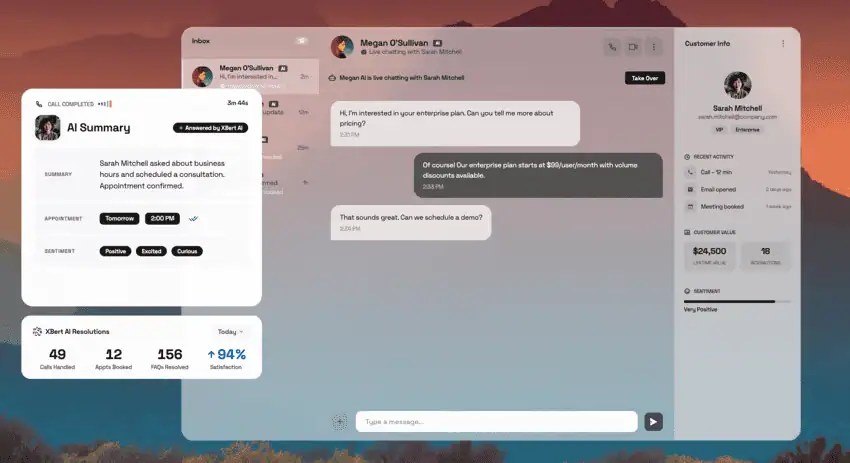
One place where every call, text, email, and note lands is what lets a new hire pick up a customer without you in the room. The practical move is to consolidate conversations before you consolidate everything else. Phone, texting, email, and the notes from each should live in one view, tied to the customer.
Nextiva’s small business customer management setup is built around that idea: phone, text, email, video, and a built-in CRM in the same app. The person answering sees past conversations and open issues before they say hello.
Automate the front door
When businesses scale, the volume of incoming inquiries increases. Sometimes, it’s just too much to take on. That’s when companies start missing inbound inquiries.

This creates major pipeline leakage at the first stage. And customers don’t wait. Nextiva’s research found that customers expect a phone, SMS, or ticket response in five minutes, and a chat response in a minute. When a business misses that window, customers immediately switch to another channel or walk away from the product or service entirely.
An AI receptionist can answer calls when you’re not around. It’s more scalable. It can handle calls and inquiries at the same time, helping customers book appointments even after hours and on holidays. These receptionists can transfer the call to a human agent if the inquiry is complex or when the caller specifically asks to speak with a human.
This is how I’d set up XBert, Nextiva’s AI receptionist. It answers calls, texts, and web chats 24/7, qualifies intent, books or reschedules appointments, and routes calls to the right team. You decide what it can do, what it cannot do, and when it must hand a conversation to your team.
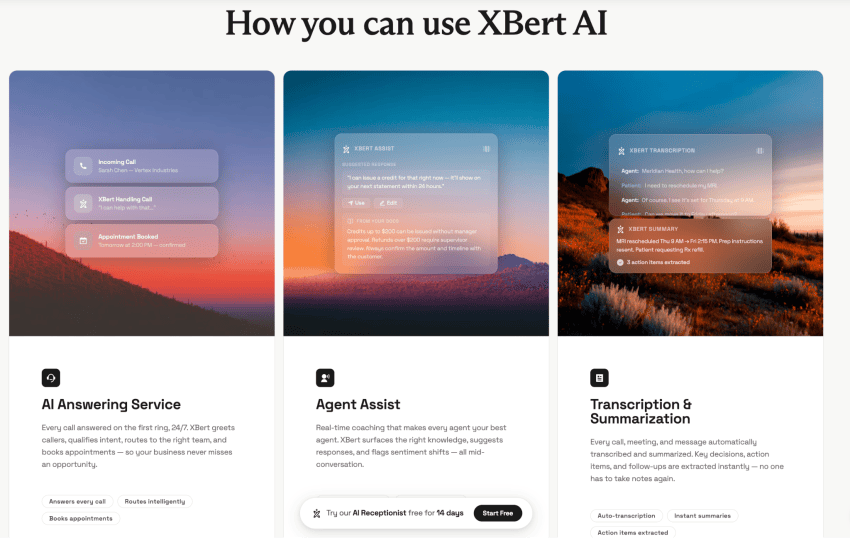
Configure it for the overflow and after-hours model first, track booking rate alongside answer rate, and widen its scope as the data earns it.
Scaling a Small Business Through Different Stages
Make decisions about hiring or delegating tasks as you scale a business. These decisions depend on the stage you’re in and your main focus.
| Stage | Owner’s Focus | Hire or Delegate Next |
|---|---|---|
| Owner-operator | Selling and delivering | Front desk coverage (often an AI receptionist first) and bookkeeping |
| First team | Hiring and training | A lead in delivery who owns quality; part-time operations help |
| Managed team | Building managers | An operations manager; a sales lead with pipeline accountability |
| Leadership team | Strategy, finance, and culture | Department heads with their own KPIs and budgets |
Hiring decisions aren’t one-size-fits-all. It depends on the scale you want to achieve, whether you need more ICs or managers, how you want to delegate or outsource, and how effectively you weave automation into your day-to-day processes. Here’s a map that helps you avoid hiring mistakes when scaling up:
Build decision guardrails to protect long-term goals
If you approve everything, you are the queue. Guardrails let the team move without you while keeping the decisions that should stay yours. Set spending limits by role, so a manager can approve a $400 repair without asking but must seek authorization for a $4,000 one.
Keep a short written list of decisions only the owner makes, such as pricing changes, hires, and anything that commits the company for more than a year. This ensures you aren’t a bottleneck for decisions that don’t require you. But it gives you control to make important decisions for your business’ long-term goals.
Hire for the bottleneck
Track where work waits. Hire for the queue that keeps growing, and let the documented SOP define the role. The sequence keeps hiring tied to a measured constraint instead of an org chart you expect to need.
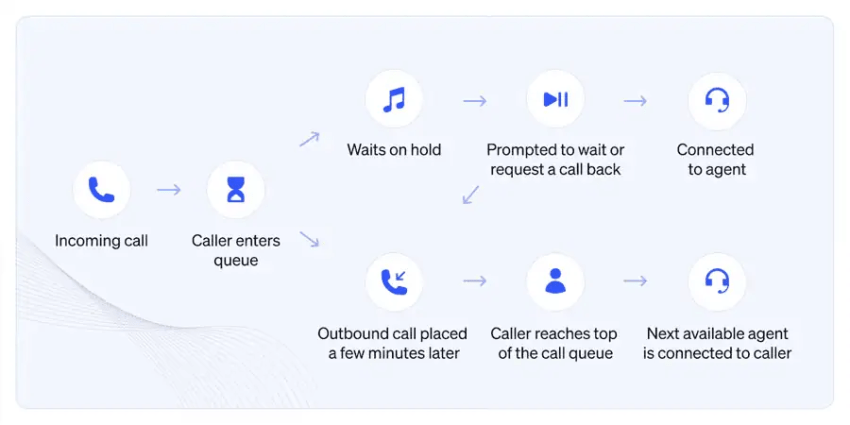
If the queue is your approvals, the fix is guardrails and documentation. If the queue is hours of delivery work, the fix is a hire.
Think about whether hiring makes sense or whether the task is just something you don’t want to do. If you haven’t established a sales process that works, delegating it becomes the biggest mistake you can make.

Protect the shared values as the team grows
The last thing to delegate is culture. As a business owner, protect the culture and make sure you’re letting the right people in. This matters for scaling because every new employee you add, without you in the room, is a bet on shared values doing the supervision you used to do.
Write down the values next to the SOPs, hire against them, and train skills afterward. Treat a culture mismatch as a cost problem.
Scale Acquisition and Retention Together
Volume growth fails if new customers leak out the back as fast as they come in the front. Here’s how you scale sustainably.
Build a repeatable sales pipeline
When you know that having “X” leads in the top funnel drives “Y” revenue, you have built a repeatable sales pipeline. Until you replace “X” and “Y” with numbers, your pipeline isn’t ready to hand off.
Build it in three parts, and consider it to be a machine that turns qualified leads into booked work. Define each stage of your pipeline, and perform a weekly review of what moved and what stalled.
Retention, reviews, referrals, and follow-ups
Timing is everything. Ask for the review, the referral, and the next booking at the moment customers are happiest, which is usually right after the job. More than a marketing tactic, this is a scaling lever. Reviews and referrals are growth channels whose cost per customer falls as you grow.
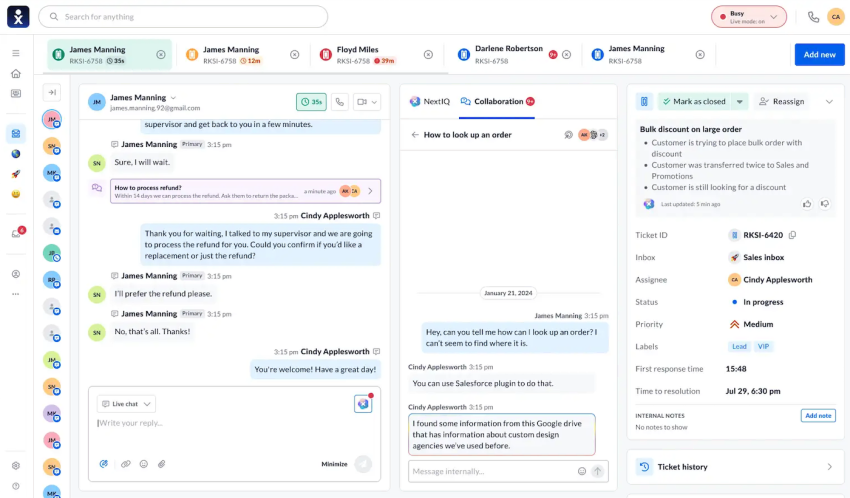
Automate follow-ups using the customer records built in the unified source of customer data. This also lets you offer exceptional customer service at the right moment, every time.
Build reliability as you grow
Customers notice missed calls more than new features. As volume rises, a minute failure rate becomes a visible number of people every week. However, as teams grow into queues, Nextiva customers report a 50% reduction in agent wrap-up time with AI-powered assist and summarization.
With more time, the same agents get to handle more conversations because after-call work gets shorter. For a complete picture of how growing companies set up this layer, growing from SMB to mid-market, and the stages of business growth, these are the two guides I’d read next.
Scale Customer Conversations With Nextiva
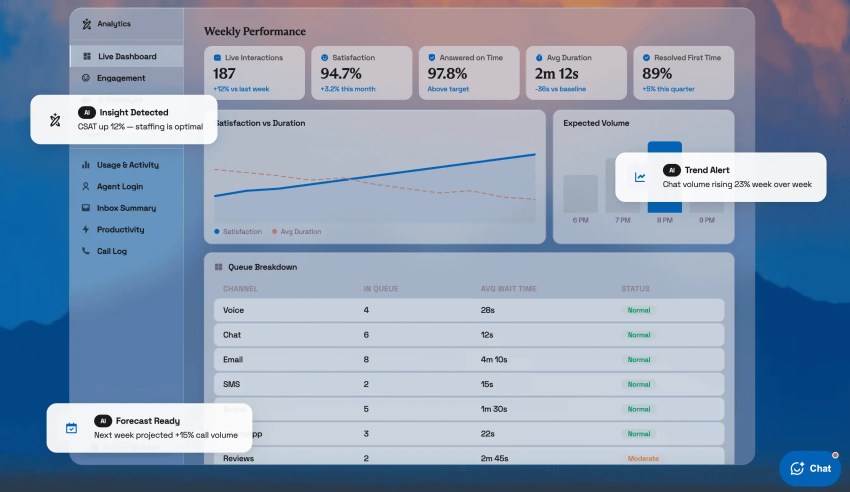
With Nextiva’s AI receptionist accommodating the scale of incoming inquiries, you don’t miss calls, text messages, or chats. No matter how many inquiries come in or when they arrive, Nextiva handles every interaction to the same standard, improving your booking rate and acquisition metrics. Nextiva’s role is the communication layer:
- Business phone for calls, texts, and video in one app
- XBert for the AI front door
- Contact center when the queues grow into something a team manages
A customer’s record travels with them from the first call to the hundredth. Over time, that continuity helps new employees sound like they’ve known the customer for years.
Explore Nextiva Business Phone and build the front door that scales before you need it.
The small business VoIP phone system for modern work.
Bring business phone calls, video meetings, messaging, AI, and your team together on one platform that remembers the conversation and helps your business act on what happens next. Easy to set up. Built for your budget. Trusted by millions.