
 Customer Experience
  Blog
Blog  Business Communication
  Leadership
  Marketing & Sales
  Nextiva News
  Productivity
  VoIP
VoIP 
When a customer is dealing with a franchise, they expect a similar experience at each location. However, the phone breaks that expectation, as each unit has a different owner, staff, and hours of operation.
One unit might answer a call at the first ring, while another quietly forwards the line to someone’s cell. Nobody planned it that way. But it happens when owners handle calls their own way. An AI receptionist for franchises solves this issue by delivering a consistent communication experience to your customers.
The IFA data predicts about 845,000 US franchise locations in 2026. Successful single-unit franchises are increasingly investing in additional locations. They’re transitioning into multi-unit operators, seeking scale. In this case, when one franchisee runs five locations, a missed-call problem multiplies by five.
To solve this issue, an AI receptionist handles an incoming call with conversational skills tuned to your brand, guiding the interaction toward lead capture or query resolution. This evidence is beyond suggestive. IFA President and CEO Matt Haller also ties the 2026 franchising outlook to investment in AI to propel brand growth, among other things.
If you’re interested, this guide provides a complete overview of what an AI receptionist does and how to roll it out to deliver a consistent communications experience for your customers.
Try the best AI employee free for 14 days.
XBert AI answers questions and captures leads. Add your 24/7 answering service in minutes.
What an AI Receptionist Does for a Franchise System
An AI receptionist answers business calls in natural, human-like language, understands caller intent, and takes action without a human on the line. At a franchise unit, that means picking up on the first ring, answering questions about hours and location, qualifying the caller, booking into that unit’s calendar, and escalating urgent calls to the right person.
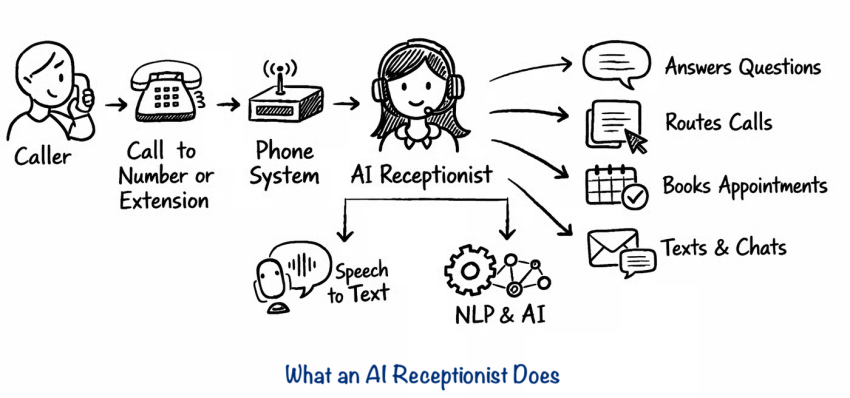
The same software goes by other names: AI voice agent, AI phone receptionist, or AI answering service. The label matters less than what it handles at each location.
This is different from an auto-attendant, also called a phone tree or interactive voice response system. An auto-attendant routes incoming calls, but an AI receptionist resolves those calls and the different queries that come with them. For example, a caller pressing through a menu still needs a human to answer the question, while a conversational AI answers it and books appointments in the same call.
Nextiva’s comparison guide breaks down where each fits.
Outsourcing your calls to an answering service has its problems. People are new and keep on changing. They might not understand your brand well enough to handle customer communications with your goal and purpose in mind.
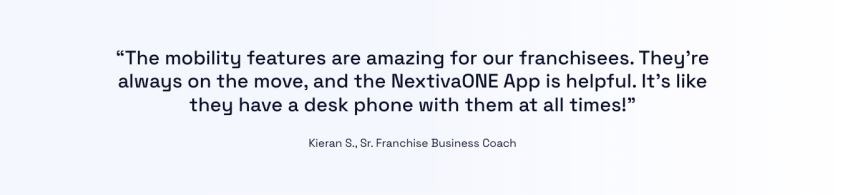
David Owasi, a former College Pro Painting franchisee, says, “Call centers have a high turnover. You get someone who’s in the job for about five days. They don’t understand your brand as well.”
AI covers calls staff cannot take, including those at night, on weekends, and when everyone on shift is already with a customer. These receptionists are configured to reach a goal that matters for your business. Calls that still need a human reach live agents through warm transfers.
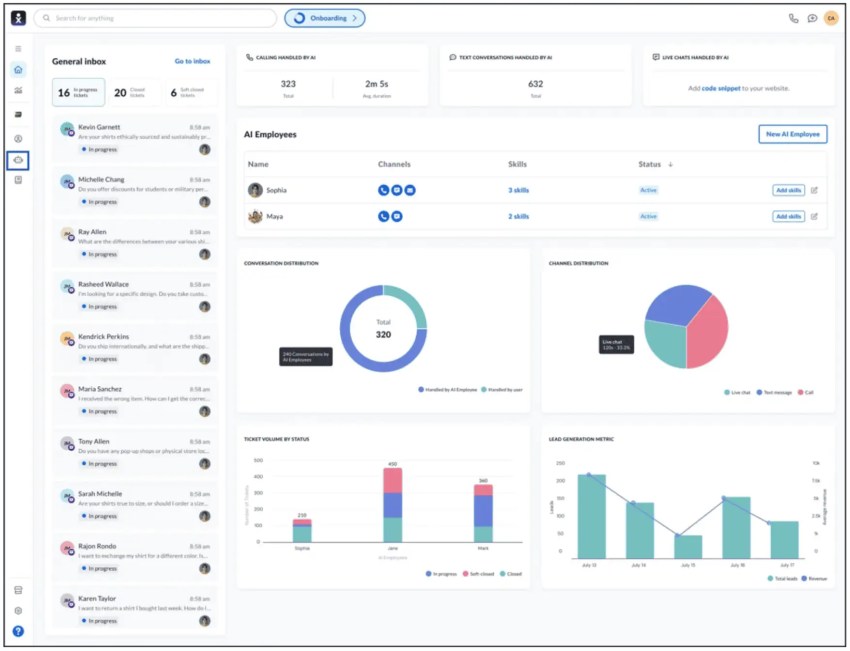
For multi-unit systems, Nextiva’s XBert is the relevant option. It delivers 24/7 call handling, plus texts and chats. Its multi-location capabilities include location-based routing, centralized conversation history, and cross-location analytics. In practice, that means one configuration standard across the system with per-location behavior underneath it. A caller reaches the right unit, and headquarters sees the whole board.
Who Controls What the AI Receptionist Says: Corporate or the Franchisee?
This question separates a franchise deployment from an AI receptionist for a small business. A single owner answers to themselves; a system has to decide who governs what. An AI receptionist answering in the brand voice represents the brand at every unit, hundreds of times a day.
It makes it more of a brand-standard matter than an IT purchase. Before any system-wide mandate, check how your franchise agreement treats brand standards, and raise the question with franchise counsel.
This isn’t legal advice, but a question a franchisor should ask before the mandate. The precedent for getting this wrong already exists.
Did you know? In May 2026, Chaac Pizza Northeast, a franchisee operating 111 Pizza Hut restaurants, sued Pizza Hut for over $100 million. Allegedly, the chain breached its franchise agreement by mandating an AI-powered delivery platform that didn’t fit the franchisee’s operating model. This is a delivery-logistics case, not a receptionist one. Treat it as an analogy rather than a like-for-like.
This case shows that a mandated AI system that speaks or acts for the brand, imposed without room for local reality, is a franchise-agreement risk. Both parties need to agree on how to share the responsibility. A script that cannot reflect local hours, local pricing, or this week’s promotion might be quietly bypassed.
The way forward is not more control or less control. An AI receptionist should be designed to prevent local freedom from creating a fragmented customer experience. It is crucial because customers don’t experience individual systems; they experience a brand.
Here’s a baseline to help you set up the control of an AI receptionist:
| Setting | Franchisor locks | Franchisee sets |
|---|---|---|
| Greeting and brand name | Yes | No |
| Voice and tone | Yes | No |
| Required disclosures | Yes | No |
| Hours and holiday closures | No | Yes |
| Address and service area | No | Yes |
| Local pricing and promos | No | Yes |
| Transfer targets and on-call | No | Yes |
| Complaint escalation path | Yes | No |
| Reporting rollup | Yes | Views own unit |
What corporate should lock
Lock the things that make the brand recognizable and keep it out of trouble:
- The greeting and brand name, so every unit answers as the same company.
- The voice and tone, so a caller in Tampa and a caller in Tacoma hear the same brand.
- Required disclosures, because a misstated disclosure is a liability that attaches to the franchisor.
- The complaint escalation path, so a bad experience reaches someone accountable instead of dying in a local voicemail.
- The reporting rollup is necessary because a franchisor that cannot see answer rates across the system has no way to know whether the standard is being met.
What the unit needs to own
Everything that changes when you cross a county line stays with the unit.
For example:
- Hours and holiday closures
- Address and service area
- Local pricing and this month’s promotion
- Staff names and transfer targets, including who takes the after-hours emergency call
You don’t need to see them as concessions to keep franchisees happy. It creates an accuracy layer so that AI can tell callers whom to reach out to in testing situations for a fix.
Franchisees might see the reporting rollup as a surveillance layer. But it’s a layer that both franchisor and franchisee need for visibility when they’re supporting multiple locations at the same time.
Ken Goodrich, former CEO/Chairman of Goettl Air Conditioning & Plumbing, managed his locations on per-unit call goals. A cross-location answer-rate scoreboard is what turns a brand standard from a document into a managed metric.
Data, compliance, and who sees what
Every call the AI answers produces transcripts, call summaries, caller details, and booking records across the system. In medical, dental, or financial verticals, that documentation also includes regulated information. None of the parties want their proprietary information going into a public learning model.
Two checks settle it. First, the platform’s certifications: Nextiva’s security standards include SOC 2, ISO/IEC 27001, PCI DSS, and HIPAA-compliant plans with signed business associate agreements. Second, the access model: Corporate sees the cross-location picture; a franchisee sees their own unit.
Proof that this balance works at the franchise scale comes from Nextiva’s own phone-system side. Buzz Franchise Brands, a home-services franchisor covering more than 250 territories, runs its system on Nextiva. A Franchise Business Coach at headquarters provides lines for franchisees, coaches them using call recordings, and tags unique numbers to direct-mail postcards so every campaign is measurable.
The company grew from 160 lines of service to more than 300. Although this is a phone system deployment, the governance shape is the same. The brand maintains central control, and local units have autonomy where needed.
How Much Does an AI Receptionist Save You on Missed Calls?
A percentage figure on savings with no methodology behind it helps no one. It gives you a number to remember. But you wouldn’t be able to swallow it, as it doesn’t solve the math in your mind.
Nextiva’s missed-call research is honest about the category’s problem: Voicemail and missed-call statistics vary, and many are vendor-published, which makes definitive facts hard to offer. So build your own number based on benchmarks you can check.
| Franchise vertical | Average inbound call value | Monthly impact at 100 missed calls |
|---|---|---|
| Restaurants | $25 to $30 | $1,300 to $1,500 |
| Home services | $300 to $400, sometimes over $1,200 | $15,000 to $20,000, up to $60,000 |
| Professional services | $300 to $700 | $15,000 to $35,000 |
| Medical practices | $100 to $200 | $5,000 to $10,000 |
| Retail | $40 to $60 | $2,000 to $3,000 |
| Fitness and wellness | $15 to $25 | $800 to $1,300 |
| Hotels | $450 to $550 | $22,500 to $27,500 |
| E-commerce | $145 to $155 | $7,300 to $7,800 |
A complete example includes the following: A home services unit fields 400 calls a month. At a 25% miss rate, 100 of those go unanswered. At $300 to $400 of average value per call, the monthly exposure is $15,000 to $20,000. Not every missed call means a lost job. Some callers might try again; some might be just noise. Even at a tenth, one recovered job a month more than covers the cost of an AI receptionist.
Try now: Nextiva’s missed-calls calculator lets you run the same arithmetic with your own call volume.
How Much Do Missed Calls Cost You?
Try our missed calls calculator and see how much lost revenue you can reclaim with Nextiva XBert® AI answering service. Compare different scenarios to grow the bottom line.
Nextiva’s survey data indicates that 82% of callers won’t leave a voicemail and will call a competitor instead. The damage from that experience does not attach to one owner. It attaches to the brand every other unit operates under.
Your answer rates depend on the system’s design. An AI receptionist is the most direct design change available that can largely influence the answer rates.
Who pays for it?
It depends on the business. The brand keeps customer experience consistent across all units, while the franchisee keeps the recovered revenue from missed calls. It benefits both.
Corporate can pay for AI automation and fold it into the package for the franchisee. Whichever model you pick, you need to decide before the pilot.
Use Cases by Franchise Vertical
What the AI does on a call differs by vertical, and so does the payback logic:
- Home services: The AI triages the 11 p.m. burst-pipe call, dispatches it to the on-call tech, and handles lead qualification and scheduling for the quote requests that come in while plumbers are under sinks and crews are on roofs.
- Restaurants: Hours, location, and takeout questions make up most of the volume, with catering inquiries and large-party reservations as the high-value calls you shouldn’t miss. Implementing restaurant systems can free staff during busy periods.
- Fitness and wellness: Class bookings, trial sign-ups, and cancellations are individually small at $15 to $25 per call. The AI pays for itself through volume and after-hours coverage, since members book when studios are closed. SMS follow-ups on those bookings help cut no-show rates.
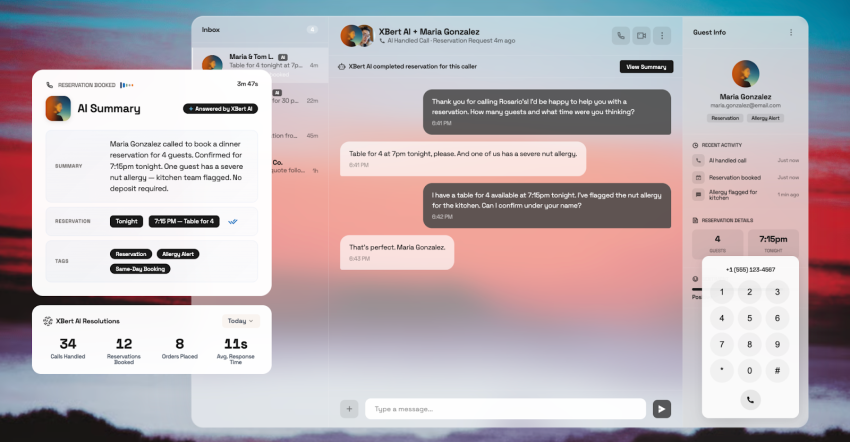
The higher the value of one booking, the faster the AI pays for itself. Professional services franchises, including real estate, follow the same logic: fewer calls, higher stakes on each one. Lower-value verticals get there too, just on throughput rather than ticket size.
How to Roll Out an AI Receptionist for Franchises
Franchisees talk to each other. If the first rollout is bad, it becomes system folklore that outlives the bug that caused it. Follow the steps below to ensure a seamless rollout.
Step 1: Write the master script and the local variable list
Draft the locked layer (greeting, tone, disclosures, and escalation), build the knowledge base of approved answers the AI draws from, and define every field a unit must fill in: hours, pricing, staff names, transfer targets, and service area. The variable list operationalizes the governance model.
Step 2: Pilot with willing franchisees
Pick two or three volunteers, ideally respected operators who others already call for advice. Measure each pilot unit against its own before numbers: answer rate, after-hours bookings, and calls recovered. Their results, in their words, will move the system further than any corporate memo. If the system has a Franchise Advisory Council, that is the pilot’s natural home.
Step 3: Handle the setup mechanics per unit
Each location keeps its existing number, with calls forwarded to the AI on the schedule the unit chooses: all calls, after-hours only, or overflow when the line is busy. You can connect the local calendar for appointment scheduling, set up the CRM integration (Nextiva connects with Salesforce, HubSpot, and other major CRMs), set the transfer targets, and run test calls before going live.
Nextiva’s setup guide recommends three to five realistic test calls per unit, including at least one question the AI should refuse, to check the guardrails before a customer finds them. If your units serve bilingual markets, confirm multilingual support before the pilot.
Step 4: Expand on results, and make adoption easy
Simple standards are necessary for mandated tools. If turning on the AI takes a franchise more than an afternoon, the rollout plan becomes a problem. New units may require additional assistance to simplify the adoption process.
Franchises need the most support when they produce the least in royalties. A general manager turnover in the first 30 to 60 days of a new unit’s operation marks the period when the unit is least staffed and most watched by the rest of the system. Turning the AI on at opening, as part of the launch package, covers the phones through the churn. It provides the new owner a before-and-after scenario from day one.
For systems that standardize more than the receptionist layer, the same sequencing applies to the underlying multi-location phone system. Pilot it first, then scale based on measured results.
Answer Every Unit’s Calls With Nextiva XBert
Technology isn’t the hard part to decide; the control model is. If you can effectively split what Corporate locks and what the unit owns, the rest of the rollout can follow seamlessly.
Franchisees adopt a system that respects their local reality. As a franchisor, you get a consistent brand voice and a cross-location scoreboard, and callers stop discovering which units answer their phones.
Nextiva XBert is built for that type of problem. It answers every unit’s calls, texts, and chats 24/7. It books into local calendars and transfers urgent calls to the right person with context. On the system side, the franchisor gets location-based routing and cross-location analytics. Pricing is published and per-unit computable: $99 per month for 100 AI conversations, then $0.99 per additional conversation, with no long-term contract.
Compare that to your row in the call-value table, and the decision prices itself. You get one brand, many owners, and a phone that finally sounds like the promise the franchise agreement made.
Explore Nextiva’s AI receptionist and give every unit the same first ring.
Never miss another call, text or chat with XBert AI Receptionist
XBert greets customers, books appointments, and captures leads automatically, turning missed connections into new opportunities.