
 VoIP
VoIP  Blog
Blog  Business Communication
  Customer Experience
  Leadership
  Marketing & Sales
  Nextiva News
  Productivity

Every quarter, I watch sales and CX leaders evaluate cloud communications platforms. When they’re on CloudTalk and Aircall, their calm composure often turns into a chaotic comparison.
Yes, you’re not alone in trying to look at Cloudtalk vs. Aircall, unfiltered. Despite fine demos and transparent pricing, something feels out of place. Then someone opens a spreadsheet, and the comparison stops being clean.
Here’s where the chaos likely originates:
- CloudTalk bills per user. Aircall bills per license, with a three-seat minimum you can’t talk your way out of.
- AI is a flat add-on for one of them and gated to the top tier for the other.
The headline price most buyers anchor to rarely survives the first round of math. When the math iterates, it becomes messier. This comparison goes into the fine details of that math to help you choose what works for you in real life.
*CloudTalk and Aircall sit alongside RingCentral, Dialpad, Talkdesk, and JustCall in the broader market. This guide caters to buyers who have narrowed it to these two.
What Is CloudTalk?
CloudTalk is a cloud-based call center software platform built in 2016. It runs on VoIP and offers local phone numbers across several countries, which is the main reason most outbound teams consider it.
Its pricing structure has four tiers, all billed annually. The Lite plan is $19 per user per month. Essential bumps to $29, and Expert is $49 with a three-user minimum.
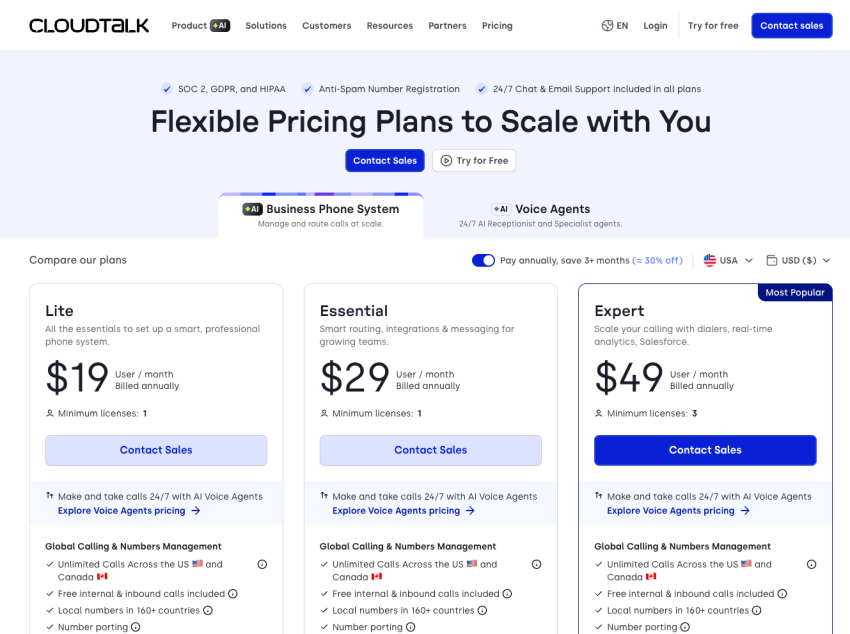
CloudTalk offers features like interactive voice response (IVR), skill-based routing, call recording, call forwarding, queues, real-time analytics, and the call flow designer, although some are only available in the higher tiers.
The dialer stack is where it gets interesting.
- Power dialer is free with Expert or a $15-per-user add-on for other tiers: The parallel dialer, which runs up to 10 simultaneous lines, costs $39 per user per month, layered on top.
- AI is its own line item entirely: AI Conversation Intelligence runs $9 per user per month and covers call summaries, call transcription, sentiment analysis, topic extraction, and call scoring.
- CeTe is a different product altogether: It’s an AI voice agent built on advanced AI and call automation that handles autonomous inbound and outbound calls in multiple languages, starting at $99 per month for 200 minutes.
CloudTalk offers breadth at a low entry price. What it doesn’t do well is hide its gating. You might want to ponder its user reviews to get to the crux of actual customer experiences.
A Trustpilot reviewer reported that 70% of the 50 U.S. numbers they purchased from CloudTalk were flagged as “Spam Likely.” For an outbound team, that’s not a complaint. That’s the platform breaking the one job you hired it for. The same reviewer flagged that the parallel dialer’s voicemail drop wasn’t working as advertised either.
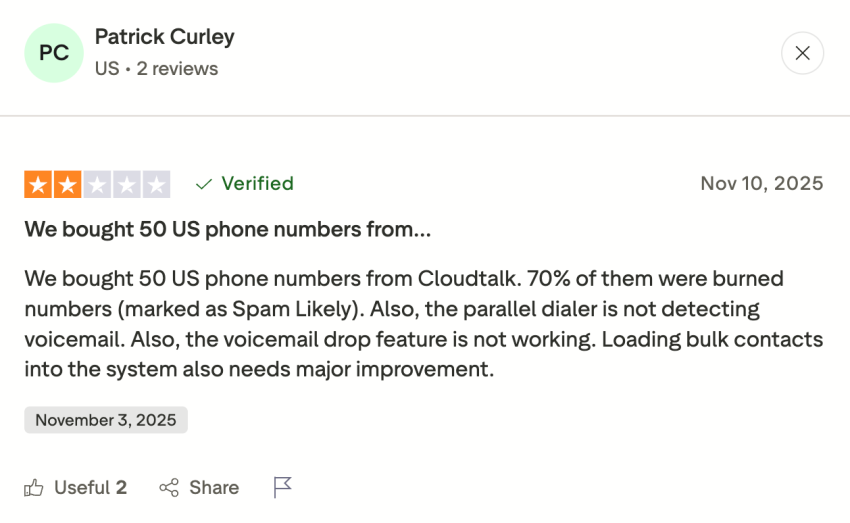
Even if we consider it a one-off scenario, the trends that these review platforms show are sufficient to make buyers cautious.
What Is Aircall?
Aircall is a cloud phone system founded in 2014. If CloudTalk’s center of gravity is international dialing, Aircall’s is a CRM workflow. It has a broad integration library with native bidirectional connectors for HubSpot, Salesforce, Zendesk, and Microsoft Teams. Additionally, there’s a public API for teams that need to push data into a custom helpdesk or warehouse.
Its pricing plan structure looks simple at first glance. There are two core tiers on annual billing: Essentials at $30 per license per month and Professional at $50. Both require at least three licenses.
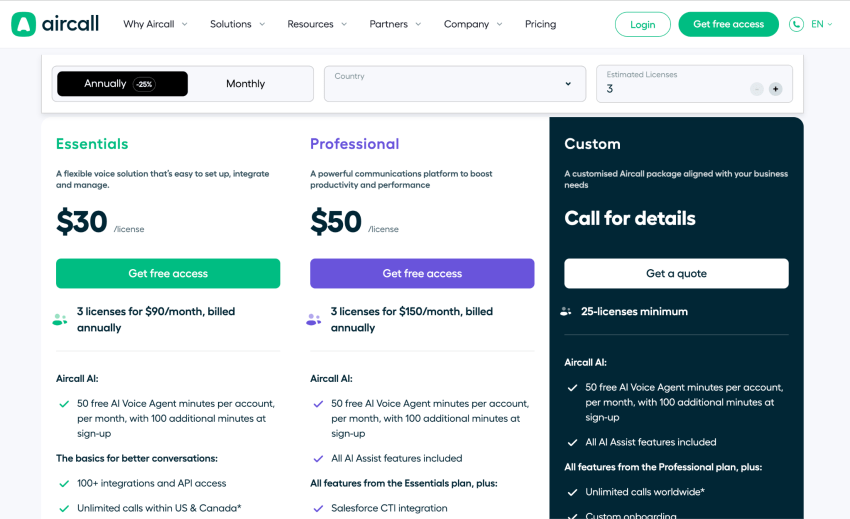
This license floor matters more than it sounds. The smallest possible Aircall bill, even on the cheapest plan, is $90 per month.
For features, you get:
- Unlimited domestic calling in the US and Canada
- IVR, ACD-style intelligent call routing, call recording, a shared call inbox, and live call monitoring on Professional
- AI Assist, including post-call summaries, sentiment, and topic detection, as a $9-per-license add-on
- AI Assist Pro at $49 per license per month
- Analytics+ for $15 per license if you need dashboards beyond the standard six-month retention window
Aircall’s strengths are genuine and consistently show up in reviews. Desktop and mobile apps are user-friendly and forgiving. CRM integrations behave the way teams hope. SDRs ramp on day one rather than on day five, which keeps customer interactions consistent during the first month of a new hire.
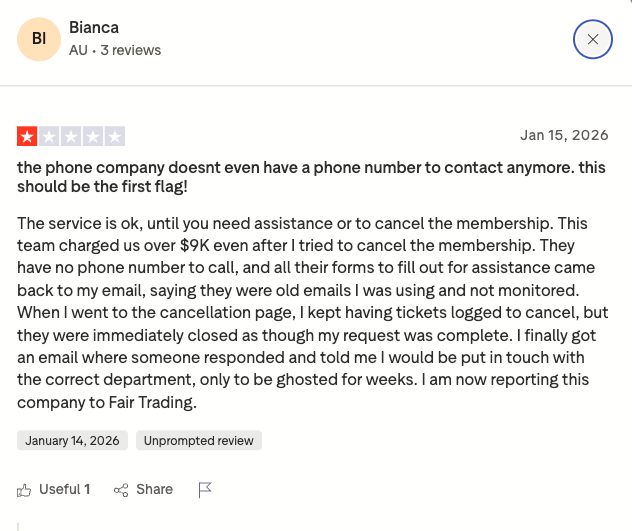
What hits you is what happens after the sale closes. The dominant theme inside reviews has nothing to do with product quality — it’s account management.
One reviewer described being charged over $9,000 after attempting to cancel. It might be helpful to check their cancellation policy before taking any call.
CloudTalk vs. Aircall: Pricing
Headline pricing for these two looks close. CloudTalk’s Lite plan is $19 per user; Aircall’s Essentials plan is $30 per license. But that isn’t sufficient to determine how your total bill will look.
Here are some additional details on CloudTalk and Aircall pricing to make a fair comparison:
| Features | CloudTalk Lite | CloudTalk Expert | Aircall Essentials |
|---|---|---|---|
| Headline price (annual) | $19/user/mo | $49/user/mo | $30/license/mo |
| Seat minimum | 1 user | 3 users | 3 licenses |
| Smallest possible bill | $19/mo | $147/mo | $90/mo |
| AI features | Add-on ($9/user) | Add-on ($9/user) | Add-on ($9/lic) |
| Power dialer | Add-on ($15/user) | Included | Professional only |
| Salesforce | Expert plan only | Included | Professional only |
| Advanced analytics | Essential plan+ | Included | Add-on ($15/lic) |
Now, the realistic scenario. Take a 10-person team that needs AI summaries and a power dialer:
- CloudTalk Lite: 10 users: $190 per month + $9 per user AI ($90) + $15 per user power dialer ($150) = $430 per month
- Aircall Professional: 10 licenses: $500 per month (AI Assist and power dialer included)
*We’re comparing it with Aircall Professional, and not Essential, because the former has power dialer included, but the latter doesn’t.
CloudTalk wins by $70 a month in this scenario. Add AI Assist Pro to the Aircall side at $49 per license ($490), and the gap inverts violently in CloudTalk’s favor. Strip AI Assist Pro back out and assume an inbound team that doesn’t need a dialer, and Aircall would still be $110 costly than CloudTalk for a 10-person team.
The bundle dictates the answer. Different teams have different needs. If this made you curious, Aircall’s pricing breakdown will satiate your curiosity. And for a broader category view, feel free to look into the VoIP cost. It covers line items that most buyers underestimate.
For an outbound-heavy team needing AI summaries and a power dialer, CloudTalk’s add-on stack quietly outruns Aircall’s all-in number. For an inbound calls-only team that needs neither, CloudTalk remains cheaper.
CloudTalk vs. Aircall: Features
Feature counts matter less than where the line falls between included and available.
| Feature | CloudTalk | Aircall |
|---|---|---|
| Starting price | $19/user/mo | $30/license/mo |
| Seat minimum | 1 user (Lite/Essential) | 3 licenses (all plans) |
| Pricing model | Per user | Per license |
| Unlimited domestic calling | Included (U.S., CA) | Included (U.S., CA) |
| International numbers | 160+ countries | 100+ countries |
| CRM integrations | 100+ (Salesforce on Expert only) | 200+ (Salesforce on Professional+) |
| Power dialer | Expert plan or $15/user add-on | Professional plan only |
| Parallel dialer | $39/user add-on | Not available |
| AI call summaries | $9/user add-on | $9/license add-on (Pro: included) |
| Real-time AI coaching | Not available | $49/license add-on (AI Assist Pro) |
| Video conferencing | Not included | Not included |
| Business SMS | Available in the Essential plan | Included in the Essential plan: 250 outbound SMS and 50 outbound MMS per user, per month before messaging rates apply. |
| Call recording | All plans | All plans |
| Live call monitoring | Expert plan | Professional plan |
| Uptime SLA | 99.99% | 99.95% |
| 24/7 customer support | Priority add-on | Not on Essentials |
A few things in that table deserve more than a glance.
- Video conferencing is missing on both: If your team needs voice, video, SMS, and team chat under one roof, you’re buying a second product on top of either platform.
- Both are call center tools by design: Neither is a unified communications platform.
CloudTalk pulls ahead on international reach and dialer flexibility. Local-presence dialing across several countries noticeably improves pickup rates for outbound teams running European, APAC, or LATAM campaigns. Aircall pulls ahead on integration depth and UX.
Both platforms gate AI behind add-ons or higher tiers. This dynamic deserves its own section.
CloudTalk vs. Aircall: AI capabilities
AI is where these two products have made the most divergent bets.
CloudTalk’s AI features
CloudTalk’s AI Conversation Intelligence add-on is $9 per user per month.
It gives you:
- Automated call summaries
- Searchable transcripts
- Sentiment analysis
- Topic extraction
- AI-generated notes
A Gartner Peer Insights reviewer specifically cited sentiment analysis and AI-generated summary notes as their main reasons for using CloudTalk, since they no longer have to re-listen to recordings after every call.
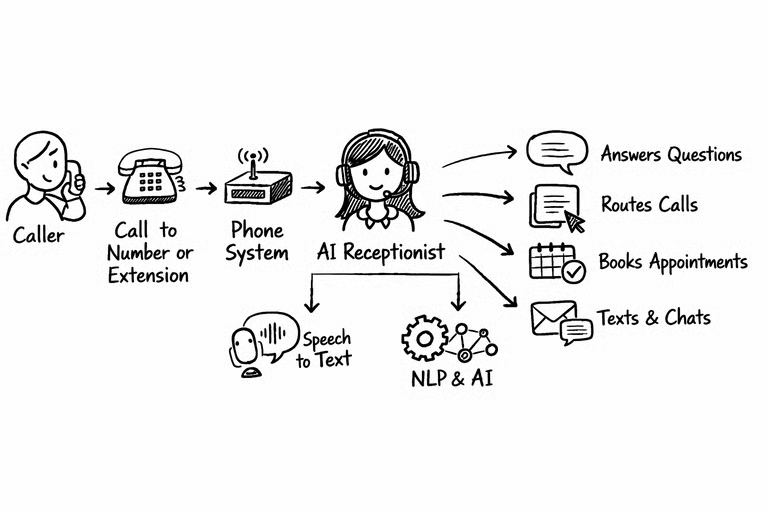
The more interesting bet sits with the CeTe AI voice agents. They handle inbound and outbound calls while scheduling a callback. You have the option of a human handoff when conversations go beyond the scope. The AI receptionist costs $99 per month with 200 minutes included. The cost goes up to $199 when the minutes scale to 500.
The catch here is simple: The more value you extract from CloudTalk’s AI, the faster your monthly invoice grows.
Aircall’s AI features
Aircall splits its AI into two layers. However, the gaps in between are significant.
- AI Assist costs $9 per license per month. It’s free on Professional and handles call summaries, sentiment detection, and topic recognition.
- AI Assist Pro ($49 per month)is an entirely different conversation. This tier handles real-time agent coaching, automated call scoring, and live transcription during the call rather than after it ends.
Real-time coaching is where Aircall’s AI is genuinely differentiated. CloudTalk doesn’t offer it at any price.
For sales organizations where agent ramp speed and call quality monitoring drive the QBR, AI Assist Pro is the better fit by a meaningful margin. The price tag is the price tag, though. AI Assist Pro on a 10-person team costs an extra $490 every month on top of the base subscription.
It’s worth pausing on the bigger pattern here. Both vendors treat AI as a revenue line rather than a baseline capability. The competitive part of this market has begun moving the other way.
Nextiva, for instance, includes features like smart call routing in its Engage plan. Teams that want full AI call handling get to layer XBert AI Receptionist on top to take calls 24/7, book appointments, qualify leads, and route complex inquiries, starting at $99 per month.
Our guide to AI receptionists gets into how this category is shaping up.
CloudTalk vs. Aircall: What the Reviews Say That the Demos Don’t
The useful signal for a realistic comparison of CloudTalk and Aircall sits in the gap between vendor demos and user reports after 12 months of use. To get that perspective, I reviewed ratings across multiple platforms, including G2, Capterra, and Aircall. On G2, the platforms have the same ratings.
A few specific findings from the research stood out to me and deserve more weight than they usually get. CloudTalk’s most-flagged caution on G2 turned out to be call and connection issues. Aircall also follows the same trend, while some reviewers reportedly call out missing features and dialer issues. It’s not a small footnote for products designed to reliably make and receive calls. However, this could be an anomaly not known to many users, or simply a one-off.
For a more holistic analysis, I went to Trustpilot, where CloudTalk holds a 4.0 rating and Aircall sits at 3.0. The gaps aren’t because of product quality; it’s about what happens after a sale. Aircall’s account management, billing, and cancellation experience generated several complaints. Furthermore, the outages in 2024 added to the review feedback and contributed a meaningful share of churn in their direction.
A few smaller details that tend to get missed:
- MMS messaging in Europe isn’t available on CloudTalk and Aircall. For European outbound teams running SMS campaigns, this is a hard ceiling.
- Aircall’s contract requires 30 days’ written notice to cancel accounts with 11+ seats. Multiple Trustpilot reviewers report being charged for months past their stated termination date because they missed this clause.
- Aircall’s SMS activation on U.S. numbers takes weeks rather than days for some accounts. One reviewer reported a three-month delay before they could text customers from a number they were already paying for.
- Account security on Aircall has been flagged in at least two Trustpilot reviews, citing unauthorized access, including one user who reported the breach occurred despite having 2FA enabled. This is worth raising with their security team if you’re in healthcare, legal, or financial services.
This information comes from the following sources: Capterra, Aircall, Trustpilot, and other Trustpilot reviews.
None of this is meant to disqualify either platform. But it helps you gain perspective, which you can use in sales negotiations to get the utmost clarity when purchasing either service.
If you’re evaluating either one, here are two questions worth asking on the demo call: What does the cancellation process actually look like in writing, and what’s the outage history for the last 12 months? The answers will tell you more than the feature comparison does.
For teams who want to broaden the search beyond these two, our CloudTalk alternatives roundup covers the broader field.
The Limitations of CloudTalk and Aircall
Pull back from the head-to-head, and a different picture comes into focus. What both products lack tells you more about the buying decision than what either one does well.
- No unified communications: Both are call center products through and through. Team messaging, internal collaboration, and video either don’t exist or live in third-party tools.
- AI as an add-on, not a default: AI features like voicemail transcription or sentiment analysis, sit behind add-ons or higher tiers on both sides.
- No video conferencing: Neither platform includes video. Teams running internal standups, customer calls, or training sessions are layering Zoom, Microsoft Teams, or Google Meet on top to handle their video meetings.

Both serve SMBs and mid-market well. Large enterprises with complex routing, workforce management, and omnichannel needs tend to outgrow their platform within a few years and end up replatforming to one of the larger CCaaS providers.
Why Nextiva Is the Better Alternative to Both
After comparing CloudTalk vs. Aircall, you see that Nextiva offers an all-in-one communication solution. Since I work with Nextiva, I have my biases. However, I’d love for you to explore and do your research. I’ll just guide you toward information and insights you should be looking at when onboarding a new communications software.
Nextiva offers voice, video, SMS, team messaging, email, social media, and CRM integration all in one cloud-based phone system. You get a single support contact who helps you across a range of issues.
There are a few things that show Nextiva delivers better value compared to what you pay for at CloudTalk or Aircall.
- Transparent pricing: Nextiva Core starts at $15 per user per month on annual billing. That includes voice, video, SMS, team chat, the NextivaONE mobile app, and integrations with Outlook, Google Contacts, HubSpot, and Salesforce. The pricing page offers more details.
- AI built in, not bolted on: Smart call routing comes standard in the Engage plan. For teams that want a full AI receptionist, XBert layers on top, taking calls 24/7, booking appointments, qualifying leads, and routing complex inquiries.
- Reliability that holds up: Proven uptime is backed by redundant data centers. Set that against the verified user reports of dropped calls and connection failures across both CloudTalk and Aircall, and the difference is something your team feels every week, not just on a spec sheet.
- Scalability without migrations: Nextiva scales from a single user to enterprise contact centers with thousands of agents on a single underlying platform.
- Support on every plan: 24/7 phone, chat, and email support is offered across the board, with dedicated onboarding and migration assistance included. Compare that to Aircall’s pattern of post-sale billing complaints or CloudTalk’s reports of multi-hour chat wait times, and it stops being a close call.
- Omnichannel and contact center depth: Once teams need a full contact center solution, Nextiva includes omnichannel routing, workforce management, AI-powered agent assist, and a visual call flow designer in the same ecosystem as the core contact center platform. Custom pricing is available for larger deployments.
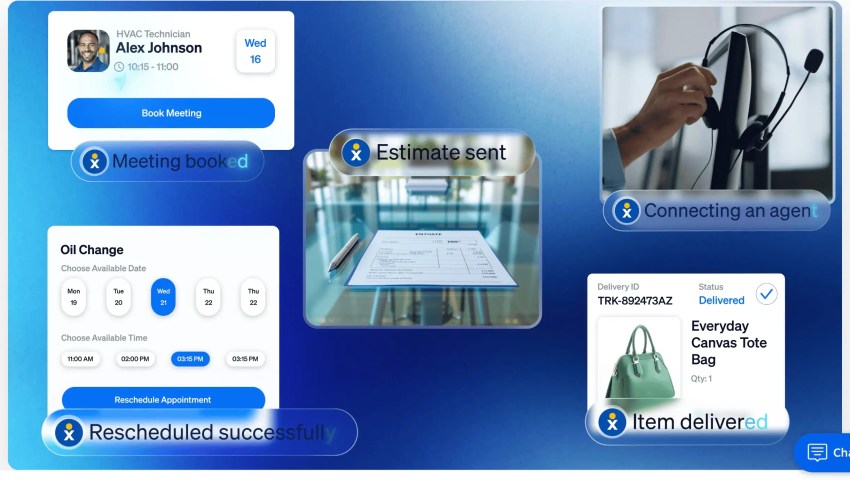
CloudTalk and Aircall are competing for the dialer slot in your tech stack. Nextiva replaces the dialer, video tool, team chat, SMS provider, and CRM connector with a single platform.
CloudTalk vs. Aircall vs. Nextiva: Side-By-Side Comparison
Let me put the platforms objectively on the table to give you a clear choice:
| Feature | CloudTalk | Aircall | Nextiva |
|---|---|---|---|
| Starting price | $19/user/mo | $30/license/mo | $15/user/mo |
| Seat minimum | 1 user | 3 licenses | None |
| Video conferencing | Not included | Not included | Included (all plans) |
| Team messaging | Not included | Not included | Included |
| Business SMS | Include in all plans | Included (capped) | Included |
| AI features (base plan) | None included | None included | AI voicemail |
| AI receptionist | CeTe ($99/mo for 99 min) | AI voice agents start at $0.19/min | XBert ($99/mo for 99 min) |
| International numbers | 160+ countries | 100+ countries | U.S., CA, U.K.+ |
| Power dialer | Expert or add-on | Professional only | Contact Center plans |
| Uptime SLA | 99.99% | 99.95% | Strives for 99.999% |
| 24/7 customer support | Priority add-on | Professional+ | All plans |
A few takeaways are worth pulling out.
Nextiva’s $15-per-user Core plan delivers more out of the box than either CloudTalk’s or Aircall’s base plans.
- Lower starting price
- No seat minimums to navigate
For a direct head-to-head, our CloudTalk vs. Nextiva breakdown gets into the specific feature gaps. If you need to, get to the details for what each Nextiva tier offers. The Nextiva cost guide will help explain the pricing structure in much more detail.
Nextiva’s Business Phone System Solution
Both products deserve credit for what they do well. CloudTalk is the better pick when your team runs outbound campaigns across global markets on a tight budget. Aircall is the better pick when your team lives inside HubSpot or Salesforce and integration depth matters more than dialer breadth. Either platform will serve some teams genuinely well.
The choice underneath that choice is the one most buyers miss when they’re heads-down in a comparison spreadsheet. Both platforms are dialers by design, and they dial well within their respective lanes.
If a dialer is what you need, pick whichever one fits your stack and move on. But if what you actually need is voice, video, SMS, team chat, AI, and a CRM connection working as a single system, neither platform gets you there without a second contract, a third contract, and an add-on stack that compounds month over month. This is what pushes most teams to compare CloudTalk and Aircall, widening the search to unified VoIP alternatives instead.
Nextiva’s Core plan starts at $15 per user per month with everything you need to run a modern business phone system. Plus, a complete contact center is waiting whenever your team is ready to scale into one.
See how Nextiva compares for your team.
Your AI-Powered Contact Center
Create amazing customer experiences with AI-powered contact center software. Scalable contact center platform built for omnichannel customer conversations.
Frequently Asked Questions About CloudTalk vs. Aircall
Here are the questions people frequently ask when comparing CloudTalk vs. Aircall.
On the headline number, yes. Lite is $19 per user per month vs. Aircall Essentials at $30 per license. The picture flips quickly once you start adding what Aircall Professional includes by default. For an outbound team needing both AI and a power dialer, CloudTalk’s add-on stack can push the total above Aircall’s. For an inbound team that needs neither, CloudTalk remains cheaper for your use case.
CloudTalk is better in most outbound scenarios. The parallel dialer running up to 10 simultaneous lines, the smart dialer for list-based outreach, and the 160+ country footprint all matter at outbound scale. Aircall’s power dialer is solid but only on Professional, and its international reach is meaningfully narrower.
No, neither does. Teams needing video are layering Zoom, Teams, or Google Meet on top as a separate contract. Nextiva includes video conferencing as part of the package.
CloudTalk’s AI is post-call (summaries, sentiment, transcription) at $9 per user per month. There’s a separate CeTe AI Agent product for autonomous call handling on top. Aircall offers AI Assist (post-call) at $9 per license per month and AI Assist Pro (real-time coaching, live transcription) at $49 per license per month. Both vendors treat AI as an add-on rather than a built-in capability.
For teams needing more than a dialer, yes. Nextiva combines voice, video, SMS, team chat, AI, and CRM in a single platform for $15 per user per month. XBert AI Receptionist adds 24/7 AI call handling at $99 per 99 interactions and then $0.99 per interaction after.
Yes. Nextiva supports number porting from both platforms with no service disruption during the transfer window.
CloudTalk has the lowest barrier of the two, since Lite has a one-user minimum rather than a three-license floor. Aircall’s three-license requirement makes it awkward for solo founders and two-person teams. Nextiva, with no seat minimum and a $15 entry price, tends to be the better fit for very small businesses that still want a complete communications stack with the essential features baked in (voicemail, call forwarding, transcription) rather than locked behind add-ons.
The best CloudTalk alternatives for high call volume are Aircall (if CRM depth matters more than international reach), Nextiva (if you want unified communications instead of just a dialer), or one of the larger telephony platforms like RingCentral, Dialpad, Talkdesk, or JustCall. The right pick depends on how much of the caller experience you want to control end-to-end vs. how much you’re willing to stitch together from separate tools.