
 Business Communication
  Blog
Blog  Customer Experience
  Leadership
  Marketing & Sales
  Nextiva News
  Productivity
  VoIP
VoIP 

Business communication is the system a company uses to share information, coordinate work, make decisions, and build relationships with employees, customers, partners, and other external stakeholders.
It includes everyday conversations between coworkers, managerial communications from leaders, customer phone calls, business writing, instant messaging, presentations, reports, marketing campaigns, press releases, and even the nonverbal cues people use during face-to-face conversations.
Strong business communication does more than move information from one person to another. It creates the context people need to understand what is happening, who owns the next step, which communication methods to use, and how their work supports organizational success.
That challenge grows as companies add more tools and communication channels. From our customer experience (CX) research, 95% of companies reported using multiple tools for customer interactions, with an average of 6.3 tools per company. At the same time, 81% of CX leaders said the customer experience could improve if customer data from every interaction point were consolidated into a single system of record.
For business leaders and IT teams, effective business communication is partly a people challenge and partly a systems challenge. Communication skills matter, but so do communication processes, channel selection, documentation, and technology.
This guide covers the major types of business communication, why they are important, the skills that support successful communication, common communication methods, and practical steps to improve communication across your organization.
See why 100K+ brands use Nextiva.
Get your business phone, messages, video meetings, contact management and notes in ONE powerful app.
What Is Business Communication?
Business communication is the process of sharing information, ideas, and messages between people inside and outside a company. Its main goal is to help an organization run smoothly, solve problems, and achieve its targets through clear, professional communication.
It shapes how employees and management interact, how decisions are made, how work gets coordinated, and how customers experience the company. Business communication can be formal or informal, internal or external, verbal or written, synchronous or asynchronous.
A manager assigning work, a sales team sharing new business ideas, a customer calling support, an IT team documenting technical communication, or an executive announcing a policy change are all examples of business communication. So are instant messaging between coworkers, contracts, reports, marketing campaigns, and press releases.
The goal of good business communication is to create clear and efficient communication that helps people understand what matters and act on it.
Why Is Business Communication Important?
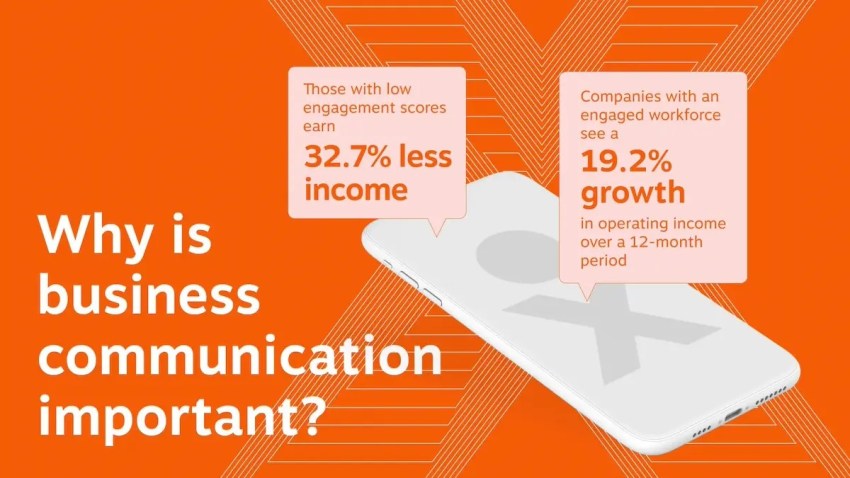
Business communication dictates the flow of information and decision-making across an organization.
When communication works, employees understand expectations, teams stay on the same page, leaders gain visibility into operations, and customers receive more consistent service. When poor communication takes hold, information gets duplicated, lost, delayed, or misunderstood.
That can affect employee engagement, customer satisfaction, team collaboration, productivity, employee satisfaction, project delivery, company culture, and organizational success.
Effective communication enhances collaboration and helps break down information silos. It also creates a more supportive environment in which employees can ask questions, encourage feedback, and surface problems early.
For customers, good communication means timely responses, clearer expectations, and a smoother experience across channels. Nextiva’s Customer Patience Benchmark found that 56.3% of consumers try another support channel when a company takes longer than expected to respond, while 28% stop using the product or service.
That makes communication effectiveness more than an internal operational concern. It can directly influence how customers behave and whether they continue doing business with a company.
Types of Business Communication Patterns
The four primary patterns of business communication are upward, downward, lateral, and external.
These categories explain how information moves through and beyond the organization.
1. Upward Internal Communication
Upward communication flows from employees to managers and business leaders.
It includes performance reports, project updates, employee feedback, escalations, suggestions, survey responses, and requests for resources or approvals. Upward internal communication helps leadership understand what is happening closer to customers and frontline operations.
This type of internal business communication matters because executives cannot directly observe every process, customer problem, or operational risk. Employees often see emerging problems first. Organizations that encourage employees to communicate those issues upward give leadership more opportunities to respond before small problems become larger ones.
Creating a channel for feedback, however, is only part of the equation. Employees also need to feel comfortable using it. Harvard Business School professor Amy Edmondson describes psychological safety as “a climate in which people are comfortable expressing and being themselves.” In practice, that kind of environment makes upward communication more effective because employees are more likely to raise concerns, challenge assumptions, and contribute ideas without fear of embarrassment or retaliation. Read the source from Harvard Business School.
2. Downward Communication
Downward communication flows from management to employees.
Goals, assignments, policies, instructions, company updates, performance expectations, and process changes are all forms of downward communication. Good downward communication gives employees both direction and context.
For example, a manager should not simply announce that a workflow is changing. Effective communication also explains why the change is happening, when it takes effect, what employees need to do differently, and where they can ask questions.
Strong managerial communications help teams translate strategic priorities into daily work.
3. Lateral Communication
Lateral communication, also called horizontal communication, occurs between people or departments at similar levels of the organization.
It includes team meetings, cross-functional projects, peer feedback, instant messaging, shared documents, and department-to-department handoffs.
Horizontal communication becomes especially important when several teams contribute to the same outcome. A customer issue, for example, may involve sales, customer support, billing, product, operations, and IT before it is fully resolved.
Nextiva’s CX research found that 85% of CX leaders believe their organizations need more shared responsibility for the customer experience, while 73% include back-office teams in delivering CX. Emerging customer trends also highlight how AI and data integration are reshaping the way teams collaborate on CX. That makes lateral communication and connected systems central to good business communication.
4. External Communication
External communication includes communication between the company and people outside it, including customers, prospects, suppliers, investors, partners, journalists, regulators, and the public.
External business communication can take the form of phone calls, social media accounts, marketing campaigns, sales conversations, press releases, contracts, support interactions, and public announcements.
Effective external communication helps build brand reputation and stakeholder trust. Because customers experience the company through these interactions, external communication is also a major part of customer experience.

Internal vs. External Business Communication: Key Differences
The distinction between internal and external business communication is more than “who you’re talking to.” It changes the communication style, the communication methods, and how you measure communication effectiveness.
Internal business communication prioritizes speed and teamwork. The goal is to help connected employees move fast without creating bottlenecks. Shortcuts are fine when everyone shares the same context.
External business communication prioritizes clarity and professional communication. Your audience doesn’t know your acronyms. And a confusing message can cost you a deal, a customer, or public trust.
| Factor | Internal Communication | External Communication |
|---|---|---|
| Primary goal | Alignment and team collaboration | Reputation and relationship building |
| Tone | Informal to semi-formal | Professional and polished |
| Common channels | Instant messaging, email, virtual meetings | Email, phone calls, social media accounts |
| Feedback loop | Fast and iterative | Slower, often structured |
Where organizations often struggle is at the boundary. Customer-facing teams need strong internal communication to deliver consistent external messages. A support agent who isn’t aware of a product change will give the wrong answer to a customer.
The two types of business communication are interconnected, and smart companies manage them as a single system. Understanding the four business communication styles and how to work with them helps bridge internal communication and external communication more effectively.
Effective Communication Benefits for Businesses
Effective business communication is a cornerstone of successful organizations. It drives clarity, collaboration, and trust across all levels of a company. Here are five key benefits that highlight its importance:
- Improved Employee Engagement: Clear communication ensures employees understand their roles, expectations, and how their work contributes to company goals, leading to higher motivation and commitment.
- Enhanced Collaboration: By breaking down information silos, effective communication fosters teamwork and smoother cross-departmental coordination.
- Increased Productivity: Studies show that organizations with strong communication practices can boost employee output by up to 25%.
- Better Customer Relationships: Transparent, timely communication builds customer trust, reduces misunderstandings, and improves satisfaction and retention.
- Lower Employee Turnover: A culture of open communication fosters feedback and psychological safety, helping retain talent and reduce costly turnover.
Types of Communication Methods & Examples
There are several ways to classify communication, but in a business setting, seven useful forms are verbal, nonverbal, written, visual, upward, downward, and lateral communication.
1. Verbal communication
Verbal communication uses spoken words. Meetings, phone calls, presentations, interviews, and face-to-face conversations are common examples.
It is particularly useful when people need immediate clarification, back-and-forth discussion, or fast feedback.
2. Nonverbal communication
Nonverbal communication includes body language, facial expressions, eye contact, posture, tone, pauses, and other nonverbal cues that shape how a message is interpreted.
These signals can reinforce what someone says or undermine it. A manager may verbally invite feedback, for example, while closed body language or an impatient facial expression communicates the opposite.

3. Written communication
Written communication includes email, reports, contracts, policies, memos, chat messages, proposals, and other forms of business writing.
Effective written communication is especially valuable when information needs to be reviewed, referenced, or documented later. Clear structure and concise messaging make written communication easier to understand and act on.
4. Visual communication
Visual communication uses charts, graphs, diagrams, dashboards, infographics, and presentations to make information easier to understand.
It can be especially useful when explaining complex concepts, comparing performance, or showing relationships that are difficult to communicate through text alone.
5. Upward communication
Upward communication moves from employees to management. A team member submitting a project update or reporting a recurring customer issue is an example.
6. Downward communication
Downward communication moves from management to employees. A department leader communicating a new policy, target, or operating procedure is an example.
7. Lateral communication
Lateral communication moves between peers or departments. A sales manager working with a customer support manager on a handoff process is an example of horizontal communication.
External communication can use many of these forms at once. A business may communicate externally through written, verbal, visual, and nonverbal communication, depending on the audience and situation.
What Makes Business Communication Effective?
Effective business communication depends on several habits and systems working together.
Clarity and conciseness
The audience should understand the message without having to guess. Clear communication avoids unnecessary jargon, vague requests, and unclear ownership.
Concise messaging removes information that does not help the recipient understand or act. This matters especially in business writing, reports, instant messaging, and executive communication.
Context
People need to know why information matters.
Good communication gives the recipient enough context to understand what happened, what it affects, and what comes next. This becomes especially important when information crosses departmental boundaries.
The right communication channel
Choosing the right communication channel can dramatically improve communication effectiveness.
A complex discussion may require a meeting or phone call. A policy usually belongs in written communication. An urgent operational update may be better suited to instant messaging, and external outreach may call for channels such as social media or blogs, depending on the goal.
Choosing among business communication channels based on urgency, complexity, and the need for documentation helps prevent both delays and information overload.
Timely responses
Response expectations vary considerably by channel.
Nextiva’s Customer Patience Benchmark found that 85.3% of consumers expect website chat responses within 5 minutes, 73% expect SMS responses within 5 minutes, and 72.3% expect phone support within 5 minutes.
That makes a channel-specific communication strategy more useful than one universal response-time standard.
Active listening
Active listening means processing the other person’s feedback before deciding how to respond.
People who practice active listening ask clarifying questions, confirm important details, and resist the temptation to interrupt simply to prepare their own response.
Former Stanford women’s basketball coach Tara VanDerveer, speaking about leadership and communication, put the principle simply: communication “starts, number one, with listening.” For business communication, the lesson is straightforward: understanding where the other person is coming from should precede deciding what message to deliver next.
Active listening is one of the most useful business communication skills for managers, customer-facing employees, and anyone responsible for team collaboration.
Empathy and feedback
Empathy helps people adjust their communication style to the audience’s emotional state, knowledge, and needs.
Successful communication also depends on feedback loops. Teams should encourage feedback so communication remains collaborative rather than purely top-down.
The Role of Verbal and Nonverbal Communication
Verbal communication carries the explicit message, while nonverbal communication affects how that message is received.
During in-person and face-to-face meetings, facial expressions, body language, posture, and eye contact provide extra context. During phone calls, tone and pacing become more important because people cannot see those nonverbal cues.
Virtual meetings provide some visual context, but communication can still be harder to interpret than during face-to-face conversations. Delays, muted microphones, reduced eye contact, and limited body language can all change the communication experience.
Strong communication skills require attention to both verbal communication and nonverbal communication. The strongest communicators pay attention not only to what they say, but also to how their delivery affects the listener.
Problems Poor Communication Can Create
Poor communication rarely creates only one problem. It tends to compound across teams, workflows, systems, and customer interactions.
Tool and information overload
Employees often work across multiple applications. Our research found that companies use an average of 6.3 customer-interaction tools and that 86% report customer-interaction data spread across different systems.
The issue is not simply the number of tools. Problems appear when communication processes do not clearly define where information lives, how systems connect, or which application should be used for a particular purpose.
Communication silos
Silos form when important information remains trapped within one department, hierarchy, or application.
Horizontal communication may fail between teams, while upward communication and downward communication may become inconsistent. Good communication processes create intentional routes for information to move across both organizational levels and departmental boundaries.
Unclear ownership
A message can be clear and still fail if nobody owns the next step.
Good business communication should make responsibility visible. Employees need to know who is expected to respond, when action is required, and when a problem needs to be escalated.
Weak employee engagement
Consistent internal communication helps connected employees understand company priorities, changes, expectations, and decisions.
Open communication also supports employee engagement because people can ask questions, contribute ideas, and understand how their work fits into larger goals. Leaders can strengthen employee satisfaction by communicating consistently and maintaining a supportive environment for dialogue.

Customer friction
Customers do not think in organizational charts.
They expect a company to remember the context of an interaction regardless of which department handles it. When systems and communication channels are disconnected, customers often have to repeat information.
That weakens customer satisfaction and complicates external communication, underscoring the importance of customer interaction management at every touchpoint.
How to Improve Business Communication in 5 Steps
A successful communication strategy combines people, business communication practices, processes, and technology for larger organizations; that often means adopting scalable enterprise communication solutions that support complex teams, security needs, and hybrid work.
Step 1: Audit Current Communication Processes
Start by identifying where communication currently breaks down.
Look for information that is difficult to find, messages that are regularly misunderstood, overlapping tools, undocumented decisions, repeated customer explanations, or situations where employees cannot get timely responses.
Regular communication audits help organizations measure communication effectiveness rather than assuming existing habits still work.
Step 2: Map Internal and External Communication
Document who needs to communicate with whom across the organization.
That includes leadership, managers, employees, sales, marketing, IT, operations, human resources, customer support, customers, vendors, and other external stakeholders.
Mapping internal business communication and external business communication makes hidden dependencies easier to identify. It can also show where a company relies too heavily on informal communication instead of documented communication processes.
Step 3: Define Business Communication Methods
Choose communication methods based on the purpose of the interaction.
Phone calls, email, instant messaging, video conferencing, face-to-face meetings, reports, presentations, shared documents, surveys, social media accounts, live chat, and SMS can all play a role.
The key is to match each situation with the right communication channel. Urgent issues usually require faster methods, while formal communication and detailed information often benefit from written documentation.
Step 4: Choose Communication Tools Carefully
Technology should facilitate communication rather than forcing employees to search across even more systems.
Evaluate ease of use, reliability, integration, security, analytics, mobile access, searchability, customer context, AI capabilities, and the overall number of tools employees must navigate. Comparing leading business communication software platforms can help teams align features with real-world workflows.
Consolidation deserves particular attention. Our data has found that 81% of leaders said the customer experience could improve if customer information across interaction points were consolidated into a single system of record.
That does not mean every company needs one application for everything. It does mean new technology should make communication easier rather than simply create another destination for information.
Step 5: Document and Review the Process
Documenting communication processes creates organizational clarity.
Employees should know which channel to use, where information should be stored, when a meeting is necessary, how escalation works, who owns important decisions, and where previous communication can be found.
Those processes should be reviewed regularly as the company grows, tools change, and employee or customer expectations evolve.

Common Business Communication Channels
Different communication channels serve different needs.
Email is useful for detailed written communication and information that should remain accessible for future reference.
It works particularly well for formal communication, documentation, follow-up, and messages that do not require an immediate answer.
Instant messaging
Instant messaging is better suited to fast collaboration, short questions, and everyday coordination.
It can keep teams moving quickly, but important decisions made in chat should still be documented where others can find them later.
Phone calls
Phone calls are useful when immediacy, tone, or complexity makes written communication inefficient.
Voice also remains relevant among younger customers, and combining calling with business SMS helps companies meet people on their preferred channels. In Nextiva’s broader Gen Z customer service study, 76% of respondents reported using phone calls to contact customer support.
Virtual meetings
Virtual meetings enable distributed teams to have real-time conversations and provide visual context when employees cannot meet in person.
They are most useful when collaboration or discussion is genuinely necessary rather than when information could be shared more efficiently in writing.
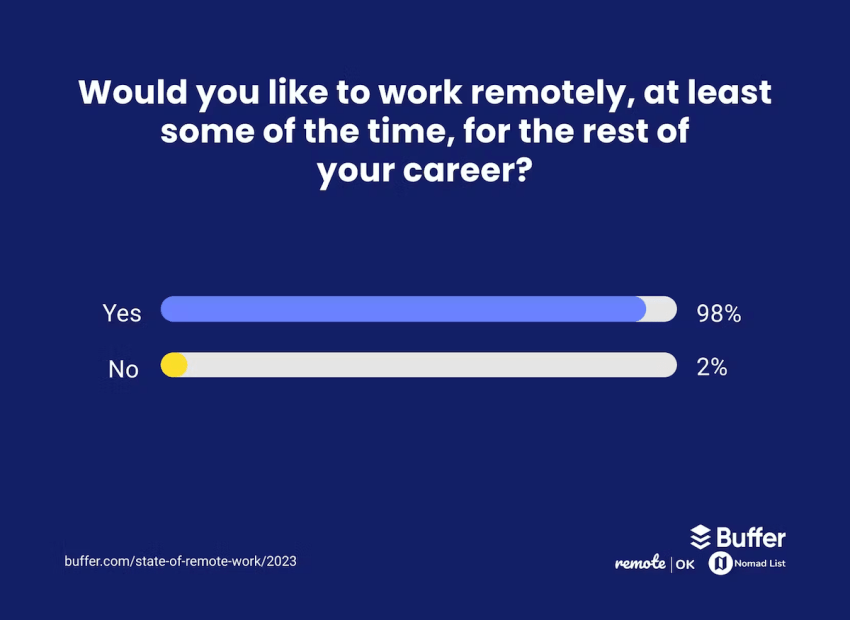
Remote work is here to stay. The State of Remote Work report from Buffer shows that 98% of employees would like to work remotely for at least some of the time:
Face-to-face meetings
Face-to-face meetings remain valuable for sensitive discussions, collaborative problem-solving, relationship building, and complex decision-making.
The effectiveness of in-person meetings still depends on having a clear purpose, appropriate participants, and documented next steps.
Reports and documents
Reports, contracts, policies, and other forms of effective written communication support accountability, consistency, and legal compliance.
They also provide a durable record that employees can revisit after the original conversation has ended.
Presentations and visual communication
Presentations combine verbal communication and visual communication to explain strategies, ideas, performance, or recommendations.
Charts, diagrams, and other visual communication formats can make complex concepts easier to process when used selectively.
Social media
Social media accounts are an increasingly important channel for external communication across marketing, customer service, reputation management, and public engagement.
Because social interactions are visible to a broader audience, businesses should treat them as part of their overall professional communication strategy rather than as a completely separate activity.

Top Business Communication Tools
Effective business communication relies on using the right tools to connect teams, streamline workflows, and keep information flowing.
Choosing the optimal mix of business communication tools that offer ease of use, reliable performance, and strong integration capabilities helps reduce tool fragmentation and information silos. By consolidating communication channels, companies empower employees to collaborate efficiently, respond quickly to customer needs, and maintain alignment across departments.
| Communication Tool | Key Features | Best For |
|---|---|---|
| Nextiva | Cloud PBX, team messaging, video conferencing, CRM integration, analytics, AI | Startups, Small Businesses, Mid-market, and Enterprises |
| Slack | Real-time messaging, channels, file sharing, app integrations | Teams needing instant collaboration |
| Microsoft Teams | Chat, video meetings, file collaboration, Office 365 integration | Organizations using Microsoft 365 |
| Zoom | Video conferencing, webinars, chat, phone system | Remote teams and customer-facing roles |
| Asana | Task and project management, timelines, workflows | Project-driven teams |
Selecting the right combination of these tools depends on your organization’s size, communication needs, and existing technology stack. Prioritizing platforms that unify communication channels can improve clarity, reduce response times, and create a more connected workplace.
Business Communication vs. Business Communication Services
Business communication is the activity of exchanging information.
Business communication services are technologies that support business interactions, such as business phone systems, VoIP, video conferencing, instant messaging, contact center software, SMS, customer communication platforms, AI, and analytics.

A company can have sophisticated technology and still struggle with communicating effectively if its communication processes remain unclear.
Technology works best when it supports a defined communication strategy rather than attempting to replace one.
What Business Communication Services Does a Company Need?
The right mix depends on company size, customer expectations, work style, and operational complexity.
The short answer is that an all-in-one business communication solution like Nextiva is a good universal fit for many companies. It covers the phone, text messaging, team chat, video meetings, and AI employees that are pros at communication.
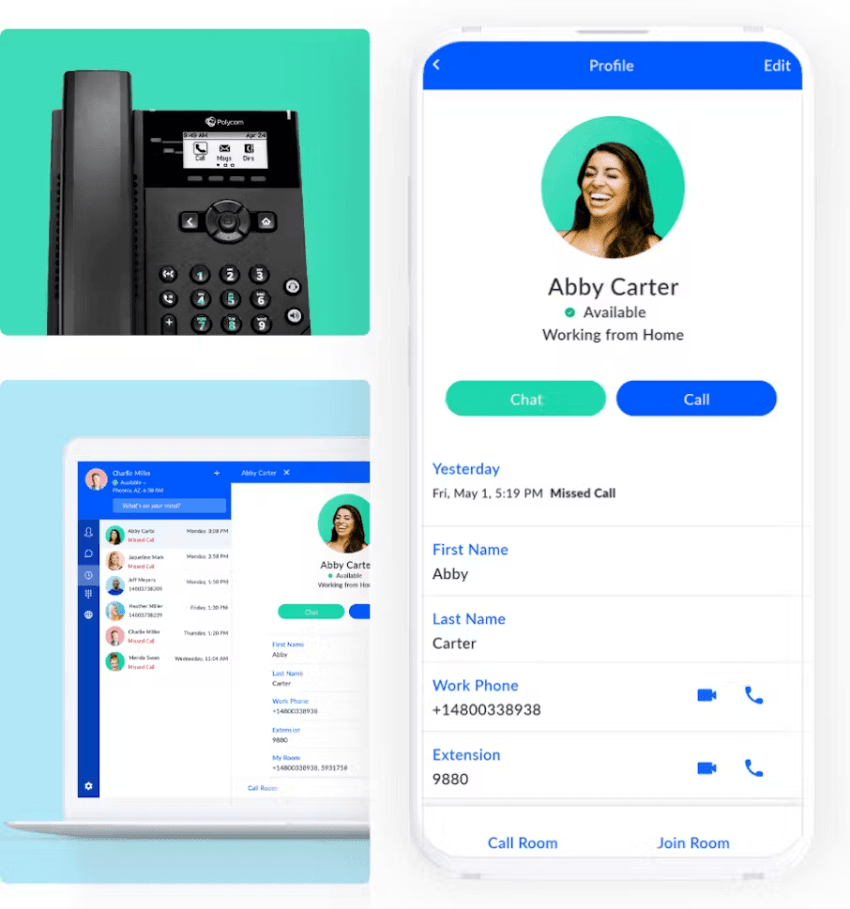
A small business might rely heavily on phone, email, messaging, shared documents, and customer management tools. A distributed organization may need stronger capabilities in cloud phones, virtual meetings, mobile communication, and shared knowledge. Larger organizations often require contact center technology, advanced routing, analytics, AI, CRM integrations, and omnichannel communication.
The goal is not to use every tool available.
Good business communication comes from creating an environment where employees and customers can move through conversations without unnecessary friction. For many small and midsize companies, an all-in-one business communication solution can simplify this by consolidating core channels into a single platform.
Before adding another platform, determine whether an existing tool already performs the same function, whether the new system integrates with core applications, whether employees will have to switch between even more tools, and whether customer context will remain available across communication channels.

The 7 C’s of Business Communication
The 7 C’s provide a practical framework for effective business communication.
- Clear communication makes the purpose easy to understand.
- Concise communication removes unnecessary information.
- Concrete communication uses specific facts and examples.
- Correct communication checks facts, wording, names, and instructions.
- Coherent communication organizes ideas logically.
- Complete communication gives the recipient enough information to act.
- Courteous communication uses respectful, audience-appropriate professional communication.
These principles apply to written communication, verbal communication, presentations, customer interactions, business writing, and everyday internal communication.
Upgrade to a More Connected Communication System with Nextiva
Business communication touches nearly every part of organizational success.
Business communication isn’t something you master once. It’s an ongoing system that shapes how fast you move, how well you collaborate, and how much trust you build with employees and external stakeholders.
Start with the basics: know the types of business communication, strengthen your communication skills, pick the right communication channels, and build communication processes that don’t rely on memory. When you do, you’ll see stronger employee engagement, enhanced productivity, and better results.
It affects how leaders share priorities, how employees coordinate work, how departments collaborate, and how customers experience the company.
Effective business communication requires both strong communication skills and well-designed communication processes. People need to communicate clearly, practice active listening, choose appropriate communication methods, document important decisions, and preserve context as conversations move between teams and channels.
Technology should support those behaviors rather than complicate them.
Nextiva helps businesses connect voice, messaging, customer interactions, and communication workflows so employees can spend less time navigating fragmented systems and more time communicating effectively.
Watch this customer story to learn why Unlimited Global Business Solutions depends on Nextiva.


Business Communication FAQs
Effective business communication shapes organizational practices by ensuring clear information flow, aligning teams with company goals, and fostering a culture of transparency and collaboration. It helps break down silos, supports employee advocacy, and creates structured processes that improve overall efficiency and decision-making.
Business communication is vital for remote employees as it keeps them connected, informed, and engaged despite physical distances. Using appropriate channels and clear messaging helps overcome challenges such as isolation, miscommunication, and delays, ultimately supporting the productivity and inclusion of the remote workforce.
The best software for business communications depends on your organization’s needs, but top solutions include Nextiva, Slack, and Asana. Nextiva offers an all-in-one platform combining voice, messaging, and customer interaction tools to streamline communication workflows. Slack excels in real-time team messaging and collaboration with integrations that boost productivity. Asana focuses on task and project management, helping teams coordinate work and track progress effectively. Choosing the right software means evaluating your communication goals, team size, and preferred workflows to find the best fit.
Clear and timely communication reduces misunderstandings, minimizes redundant work, and accelerates decision-making. Studies show that effective communication can boost employee productivity by up to 25%, leading to enhanced operational outcomes and business growth.
Many companies struggle with tool fragmentation, in which multiple platforms create confusion and information silos. Without a consolidated system, employees spend an excessive amount of time searching for information, leading to inefficiencies. Addressing this requires the strategic selection and integration of tools to streamline communication.
Regular communication audits, employee feedback surveys, and monitoring of key performance indicators such as response times and engagement levels help assess communication effectiveness. These insights enable organizations to refine strategies, improve channels, and ensure communication supports business objectives