

 Business Communication
  Blog
Blog  Customer Experience
  Leadership
  Marketing & Sales
  Nextiva News
  Productivity
  VoIP
VoIP 

An answering service used to mean someone took your messages while you were out. Now, answering services operate as full customer experience platforms and include everything from call routing and appointment scheduling to multichannel communication workflows.
The answering service trends defining 2026 build on this shift: smarter automations, deeper integrations, real-time analytics, and hybrid human-plus-AI support. In fact, these trends directly address three of the top four barriers to CX improvement identified in Deloitte’s 2025 CX study1:
- Rigid internal processes eased by AI-driven automation that makes workflows more flexible.
- Missing customer context solved through deeper integrations and true omnichannel visibility.
- Difficulty proving ROI fixed with data-driven workflows and real-time insights that show what’s working and what’s not.
In this article, we break down each of these answering service trends and explore how they drive modern support teams.
Try the best AI answering service free for 14 days
XBert AI answers questions and captures leads. Add your 24/7 answering service in minutes.
AI And Automation Are Transforming Every Interaction
Insights from our recent Leader’s Guide to CX Trends found that AI is now the top investment priority for businesses. In fact, 81% said they planned to increase their AI spending, with 38% committing to significant investments. This trend is only expected to grow in 2026 as 80% of early-stage AI adopters have already reported medium to high value.
This also raises the bar for what businesses expect from AI. Business leaders want more accurate, personalized interactions, intelligent workflows, and faster ROI. For phone answering services, this push has led to a more balanced approach of hybrid setups.
AI handles speed and scale while human agents step in for nuance, creating a system that covers each other’s gaps. For example, Cedar Financial, a debt collection agency, uses Nextiva’s AI-powered outbound dialing to place calls and route live answers to the right agent through AI-driven skill-based routing.
Smarter call routing and intent detection
Customers don’t have patience for long menus, hold music, or getting bounced between agents. This is exactly where AI answering service machines and AI receptionists shine.
Nextiva, for example, has AI sentiment analysis built into its Voice over Internet Protocol (VoIP) and Interactive Voice Response (IVR) systems to detect emotion and intent. That way, you don’t just route callers to an agent best suited to handle their concerns, but also give them an idea of what approach to take:
- A frustrated customer is automatically routed to a more senior or specially trained agent who can de-escalate the situation.
- A repeat caller is recognized and seamlessly transferred to the point where they left off, reducing friction and repetition.
- An urgent or highly emotional situation is flagged in real time and escalated immediately to ensure rapid attention.
And this is important because unhappy customers are most likely to hang up, leave poor reviews, or switch to competitors.
Predictive analytics for staffing and volume management
Predictive call center analytics can now forecast when phone calls will spike, whether it’s a campaign launch, season trends like Black Friday Cyber Monday (BFCM), or even local weather events. This gives you the breathing space to plan and staff up when you expect high call volumes.
For example, the Orange County Rescue Mission, which handles more than 5,500 calls per day, uses Nextiva’s call center analytics to understand call volume and average answer time, enabling them to scale staffing efficiently as the organization grows.
This means shorter hold times and fewer frustrated customers. And for 24/7 operations, the impact is even more profound. While overstaffing wastes money, understaffing costs you calls. Predictive analytics keeps you out of both extremes.
AI-assisted agents (not replacements)
Customers still aren’t comfortable talking to fully automated AI voices, and the “uncanny valley” is a big part of that. When an AI sounds almost human but not quite right, it can put you off. Add in the fact that self-service AI can still hallucinate, and you get a gap in trust that businesses can’t afford.
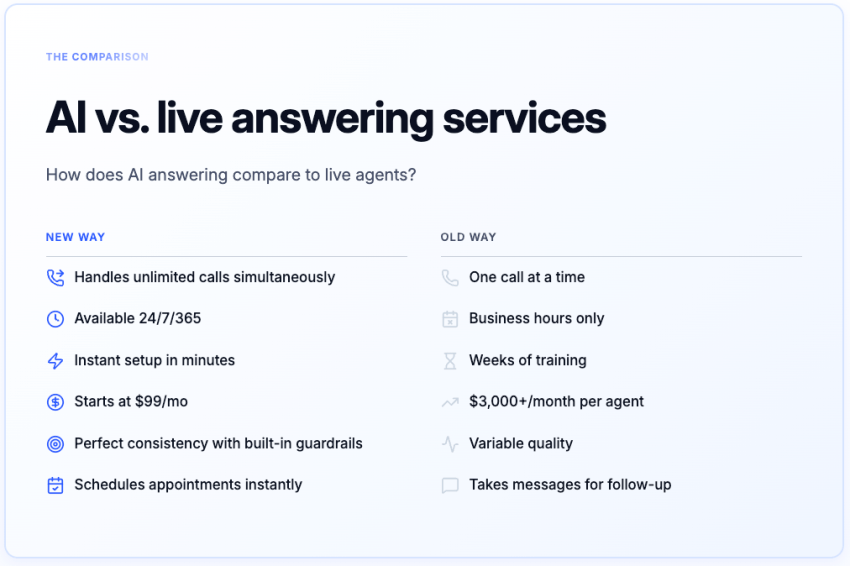
That’s why the real movement isn’t toward replacing human agents but instead about giving them a copilot. This is happening in two ways:
- Autopilot tools where AI handles parts of the interaction, with a human able to step in at any time.
- Real-time agent assist, where AI works behind the scenes to surface answers, pull up context, and guide the agent through the call or chat without taking over the conversation.
Both approaches keep humans in control while letting AI handle the heavy lifting.
Hear why XBert AI is the best AI receptionist
XBert AI receptionist handles customer questions, captures leads, and books appointments. Try it free for 14 days.
Automation That Streamlines Workflows And Reduces Costs
Answering services, especially for small businesses, are doubling down on automated workflows to eliminate the repetitive tasks that slow agents down. This includes follow-ups, ticket creation, call summaries, and routine data entry.
Human agents are expensive, and having them type up call notes or manually create tickets is a waste of their capacity. With online virtual receptionists handling the low-impact, high-effort work, your agents have more time for work that needs their input.
Plus, it improves their work-life balance. Shifting agents toward more meaningful work reduces the cognitive fatigue that comes from constant busywork. Your CX team feels more productive and more valued, which directly contributes to lower burnout and higher retention. And, according to Nextiva 2025 CX Trends Report, 33% of companies say their employees are worried AI will take their jobs. So using AI to support your agents, rather than replace them, helps alleviate that fear as well.
CRM and scheduling integrations
CRM and scheduling integrations are shifting from “premium extras” to standard expectations. Virtual answering services now connect directly to CRM systems like Salesforce, HubSpot, and booking platforms, so call details sync automatically.
This matters because when your answering service operates inside your existing workflow rather than alongside it, you don’t lose context. Everything that happens on a call becomes immediately available to your sales, support, and ops teams, and everyone’s on the same page.
Sequential Technology International, for example, has used Nextiva’s Dynamic CTI (computer/telephony integration) to connect its tech stack. As Michael Fitzpatrick, their CTO, explains:
“Being able to pull in information from a CRM that says ‘this individual is calling again’ is really helpful for us. Dynamic CTI is pulling from multiple sources and guiding the agent throughout the process.”
And CRM data is just the start. Depending on your contact center platform and industry, you can integrate far more deeply — for example, connecting to FHIR-spec databases for healthcare organizations and ERP systems for retail and logistics.
Self-service options paired with live support
More customers are usually comfortable handling simple tasks on their own. Call answering services are building out self-service flows, such as chatbots, virtual receptionists, and IVR systems, to handle routine questions without relying on agents.
But the part that actually matters in 2026 is the AI-to-human handoff. Self-service only works if the moment a caller hits a wall — or simply prefers a real person — the system hands them off cleanly, with no friction, and no loss of context.
24/7 coverage at scale
Around-the-clock availability is becoming standard, and businesses are getting there by combining global agent teams with automated systems. Instead of relying on a single overnight shift, answering services now support teams with AI that handles routine requests, triage, and after-hours intake.
This ticks all the boxes: consistent coverage, faster response times, and smaller overhead. It’s especially valuable for mid-sized companies with a global customer base, where “business hours” are blurred.

Personalization Is Now the Baseline Expectation
Customers are increasingly willing to share their data, but only if it leads to a more personalized, relevant experience. However, they also expect that personalized interactions will feel human and intentional rather than performative or invasive.
In a 2025 PwC Report, 53% say they’re okay with sharing data for personalization. But 93% say they’d leave a brand that mishandles said customer data. That’s the line brands need to walk in 2026. Creating personalized experiences that remove friction without creating new discomfort.
PwC even suggests segmenting customers by their confidence and comfort with AI:
“Segment users based on their digital confidence and preferences, then learn what appeals most to frequent AI users. Customize AI so it enhances rather than alienates, treating it not as a one-size-fits-all solution but a dynamic layer of your CX playbook.”

Data-driven caller recognition
Automated answering services rely heavily on data-driven caller recognition to provide faster, more personalized support. By pulling in caller history, past issues, preferences, and recent interactions, agents can start the conversation with context instead of asking basic questions all over again. It shortens handle times, reduces repetition, and makes the caller feel heard.
Caller recognition also helps with security. For example, you can use features such as IVR-based verification to authenticate users before connecting them to live agents, or account-matching logic to route all calls from a customer account to the same agent.
Industry-specific expertise and compliance
Answering services now need to operate with industry-level precision. That means HIPAA-compliant handling for healthcare calls, structured intake workflows for law firms, and clear, traceable processes for property management requests.
HIPAA penalties, for example, can reach up to $71,162 per violation, even if the mistake was unintentional. This means answering services need industry-specific scripts, escalation paths, and data-handling protocols built in from the start.
Bilingual and culturally aware support
Businesses are serving increasingly diverse customer bases, and a bilingual answering service is expected to match that reality with bilingual support agents, multilingual support options, and an understanding of cultural nuances that shape how people communicate.
For example, countries like Japan and China are considered high-context cultures, where communication relies heavily on subtle cues and indirect phrasing. By contrast, places like the U.S. and Germany are low-context, where people expect direct answers.
But cultural awareness isn’t about stereotyping or assuming every caller fits a script. Instead, you need to recognize patterns while staying flexible. This is another opportunity where the AI-human hybrid CX model works really well. Your agent-assist AI can summarize the customer’s background, mood, and intent, but the human agent can adjust delivery based on what’s actually happening in the conversation.
Omnichannel Support Is Becoming Standard
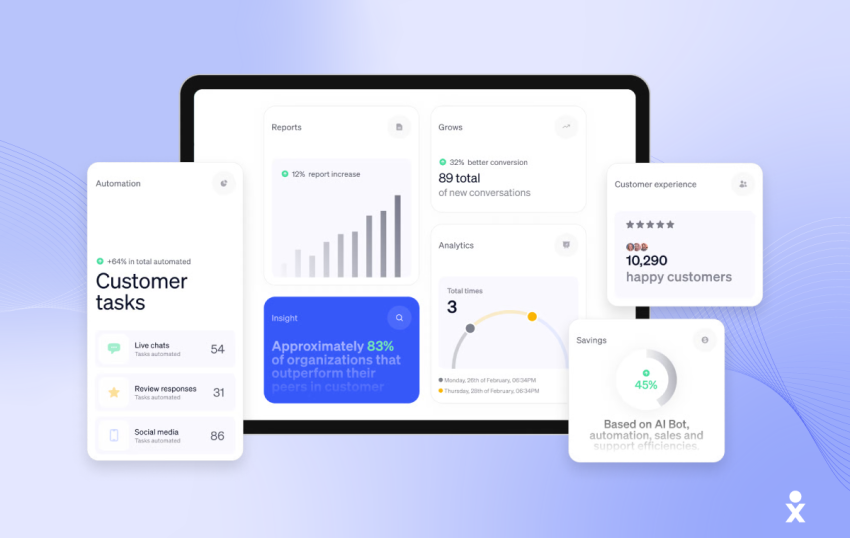
The Nextiva 2025 CX Trends Report found that companies now use an average of 6.5 tools for customer support, and 86% of them say juggling multiple tools creates data silos. Omnichannel solves this by replacing fragmented tools with one integrated platform. Every customer interaction and data point lives in the same ecosystem rather than in separate apps that don’t talk to each other.
That’s why the future of call centers is moving away from phone-only systems toward an omnichannel strategy where voice is just one part of a connected ecosystem that includes a variety of communication channels such as SMS, chat, email, and social.
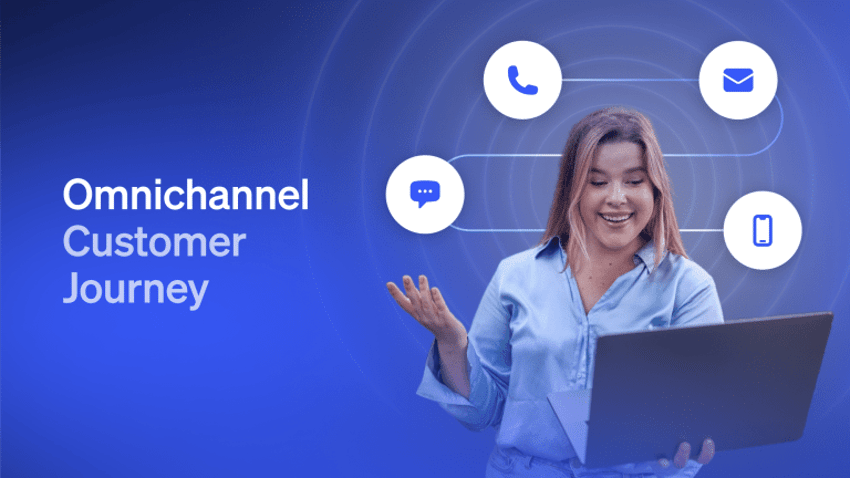
Unified communication across phone, SMS, chat, and email
Unified communication brings all channels into one system, so conversations carry over without customers repeating information. This continuity makes support easier and makes AI far more effective, as it can see the full context of your interactions with a customer across channels, not just a few isolated messages.
Because AI has full context across every channel, it can interpret data accurately and create more useful workflows. For example, it can automatically collect customer data to schedule appointments, assist with lead qualification, trigger follow-ups when a customer switches from chat to phone, or even draft FAQs based on recent tickets.
Social media and web chat handling
Customers — especially younger generations — are increasingly reaching out via Instagram DMs, Messenger, and website live chat, with Sprout Social reporting2 that 70% have contacted a brand via social media at least once in the last year.
Among other customer service statistics, Sprout Social also reports that it wants social customer interactions to feel like “white-glove services” super personalized to their needs. The report further states that 76% expect a response within 24 hours when they contact a brand on social media. Not just that, 73% also say they’d switch to a competitor if a brand doesn’t respond on social.
That’s where selecting a unified CXM platform that incorporates social media and review management becomes essential for customer satisfaction. It helps you capture every message in one place, respond quickly across channels, and maintain a consistent voice, whether the conversation starts on Instagram, your website, or a review site.
Integrations, Analytics, and Security Are Driving Better Experiences
With CX becoming a revenue driver, businesses are tightening up how their answering service systems work behind the scenes. That means deeper integrations for clearer data visibility, real-time analytics to stay ahead of service bottlenecks, and stricter security protocols to protect customers’ sensitive information.
Real-time reporting and dashboards
Real-time reporting provides businesses with instant visibility into key metrics, including call volume, wait times, abandoned calls, CSAT scores, and agent performance. So, instead of waiting for end-of-month summaries, CX leaders can see what’s working, what’s slipping, and adjust immediately.
Cloud-based platforms and enhanced data security
SaaS is now the default for customer service, and that shift raises the bar on data security. Encrypted transmission, secure cloud storage, and strict access controls are mandatory. Businesses also want audit trails, MFA, and role-based permissions to ensure only authorized staff can access sensitive call data.
Just like data security, another important factor to consider is compliance. If you’re in a regulated industry, your answering service must demonstrate compliance with standards such as HIPAA (for healthcare) and PCI-DSS (for payments).
Scalability for growing businesses
Growing businesses need answering services that can scale without hiccups. This starts with flexible plans and volume-based pricing. Call volumes aren’t static, and volume-based pricing lets companies scale up when they need more capacity and scale down when they don’t.
You also need reliable uptime, professional implementations for custom workflows, and enterprise features like SCIM provisioning to ensure the system stays stable and in sync with your internal ops as the business scales.

What Businesses Should Expect From Answering Services In 2026
Answering service features that once justified premium pricing for enterprises are now standard requirements for even SMBs. In fact, small businesses and lean teams need AI triage, integrations, data analytics, and omnichannel support more than larger brands, as inefficiencies can have a greater impact.
So if you’re evaluating providers, these should be non-negotiables:
- Hybrid support: Look for providers that excel at the AI-to-human handoff. AI should automate simple interactions and escalate to humans when tickets become complex or tense.
- Omnichannel coverage: Make sure the platform supports newer channels like social DMs, live chat, and even review responses. Customers expect to reach you anywhere, and businesses lose trust fast when messages on public platforms go unanswered.
- Intelligent call routing: Select systems that route calls based on intent, sentiment, and urgency, rather than relying solely on phone trees. This reduces transfers and directs high-value or frustrated callers to the right person faster.
- CRM and scheduling integrations: Look for deep integrations with your core tools and webhook support so you’re covered when you add more tools to your tech stack. The goal is to keep everything in sync without manual entry, especially as your business grows.
- Real-time analytics and dashboards: Fancy graphs are of no use if you can’t act on the data. Focus on systems that surface insights like staffing gaps, missed follow-ups, or rising wait times so you can act immediately, not after the damage is done.

The Future of Answering Services Is Hybrid, Human, And Always On
The trends shaping 2026 all have a common thread: answering services are becoming a complex balance of AI, automation, and human support.
- AI handles the speed, scale, and routine tasks.
- Automation ties your workflows and tech stack together.
- Humans step in where judgment or nuance is required.
This gives you agent efficiency without alienating customers with fake authenticity.
FTS, a small BPO, freed up 20% of its agents’ time for high-value work just by using Nextiva to automate the process of sending call recordings to customers. A tiny task with outsized returns, and a perfect example of where automation belongs.
Stay Ahead Of Answering Service Trends In 2026
As these answering service trends continue to reshape CX, the gap between legacy providers and modern CX platforms will only widen. Staying ahead means choosing tools that scale with your needs and support the way customers actually communicate.
We recommend trying the AI-powered answering service from Nextiva. It includes everything from agent workflows to AI-driven journeys and virtual receptionists. Exactly what you need to modernize your CX stack and meet customers where they already are.
Run your business instead of answering calls all day
Nextiva’s AI-powered receptionist is perfect for handling calls so you can focus on what matters most.