

 Customer Experience
  Blog
Blog  Business Communication
  Leadership
  Marketing & Sales
  Nextiva News
  Productivity
  VoIP
VoIP 

Those who were early adopters of AI, especially in contact centers and without appropriate guidance, may have experienced stalled adoption and erroneous results in production. This causes obvious problems with trust, service, and governance.
Contact center AI is the front line for AI risk. It’s where you meet your customers who are calling to get urgent help, report pertinent issues, and escalate matters that have gotten out of hand.
As the first point of contact moves from a traditional IVR to unpredictable AI agents, we must balance the current state of AI adoption with governance readiness.
If we fail to build a governance strategy for our contact centers, who knows what comes next? Fortunately, at Nextiva, we’ve already seen countless successful rollouts and can help you apply the foundations, ongoing management, and success planning for AI governance that optimizes your contact center from day one.
Foundations of a Modern AI Governance Framework
Before we dive into data privacy and specific AI models, it first pays to ensure your underlying platform is robust.
Underlying infrastructure
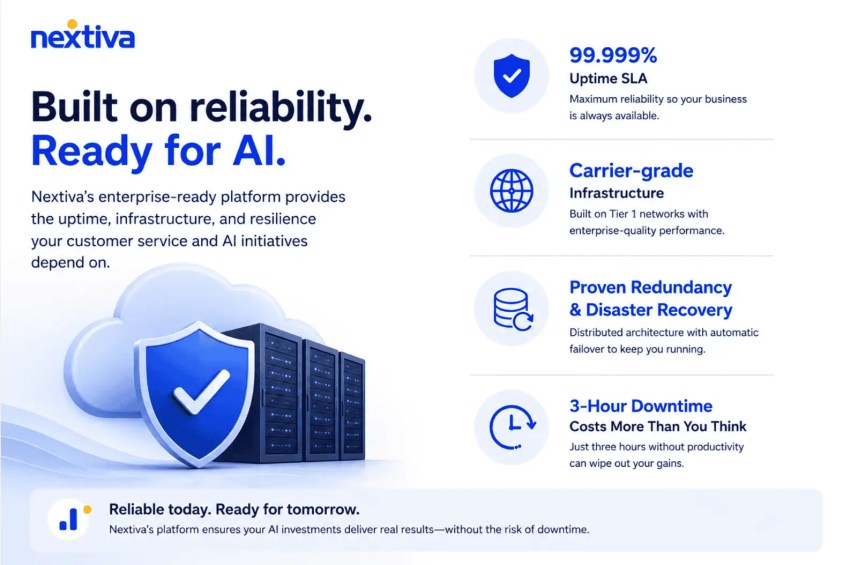
An enterprise-ready communications platform, like Nextiva, has high uptime and carrier-grade infrastructure as the baseline for a safe AI environment. Some businesses have fallen foul of trying to implement AI technologies for efficiency and skipped one of the most important procurement phases: high redundancy and disaster recovery.
If you shift your business workflows to a platform with poor reliability, all you’ve done is enable potential downtime among some productive states. You can bet three hours without productive output completely wipes out the gains you made yesterday.
Current AI use cases (automated vs. AI assistants)
Lots of businesses make the mistake of trying to automate or outsource everything to AI. One problem here is that some of these processes may benefit from automation.
In fact, sometimes manual and human-centered is better. For example, you wouldn’t push a vulnerable, elderly patient to an automated receptionist if they said they’d fallen down the stairs and needed help.
While this may be an extreme case, VIP customers and those requiring urgent repairs expect quick and easy service. You may use an automated menu to help route inquiries quickly, but the majority of the work must remain human.
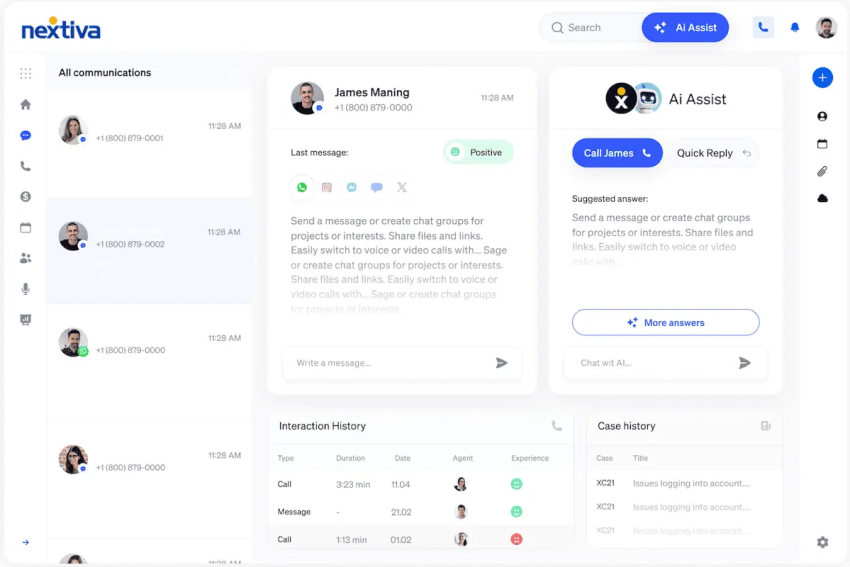
This is not to say you can’t use AI in these processes. Contact center tools like Agent Assist help human agents get answers with a single click and even prompt the next question to ask when troubleshooting.
The key takeaway is to list the types of activities your contact center agents perform and match them to appropriate AI use cases. Use the table below to match your most common tasks and see how you can best use AI.
| Contact Center Activity | Automated AI Use Case | Agent Assist AI Use Case | Human-Led Requirement |
|---|---|---|---|
| Call routing and triage | AI-powered IVR routes inquiries based on urgency, customer type, or issue category | Agent Assist surfaces customer history and recommended routing options | Escalations involving vulnerable customers, urgent situations, or VIPs |
| Password resets and account verification | Allows for self-service authentication and workflow resets | AI suggests verification steps and flags suspicious activity | Fraud investigations or identity disputes |
| Appointment scheduling | Automated bots facilitate scheduling and reminders | AI recommends optimal time slots and updates | Complex scheduling changes or sensitive customer requests |
| Billing inquiries | Automated systems facilitate balance checks, payment processing, and invoice retrieval | AI summarizes account details and suggests resolution steps | Billing disputes, complaints, or emotional interactions |
| Troubleshooting common issues | AI chatbots guide users through standard troubleshooting flows | Agent Assist recommends next troubleshooting questions and knowledge articles | Complex technical issues requiring empathy or expertise |
| FAQ handling | Conversational AI answers common questions instantly by cross-referencing internal knowledge bases | AI recommends approved answers during live interactions | Non-standard or nuanced inquiries |
| Order status updates | Automated systems facilitate notifications and tracking updates | AI provides agents with real-time fulfillment data | Delayed, lost, or high-value orders |
| Customer feedback collection | Facilitates AI surveys and sentiment analysis after interactions | AI summarizes customer sentiment and highlights escalation risks | Retention conversations or dissatisfied customers |
| Lead qualification | AI chatbots gather customer requirements and score leads | AI recommends next-best actions for sales agents | High-value enterprise opportunities or relationship building |
| Knowledge retrieval | AI search tools retrieve policies, procedures, and documentation | Agent Assist suggests contextual answers in real time | Final decision-making and personalized communication |
| Complaint intake | AI captures issue details and categorizes severity | AI drafts summaries and suggests escalation paths | Sensitive complaints or emotionally charged interactions |
| Emergency or urgent support requests | Automated systems prioritize and flag emergencies | AI alerts agents with recommended urgency handling | Immediate human intervention remains essential |
| VIP customer support | AI identifies VIP profiles and prioritizes queues | AI provides personalized customer insights and recommendations | Relationship management and white-glove service |
| Quality assurance and coaching | AI analyzes interactions for trends and compliance | AI highlights coaching opportunities and recommended improvements | Human coaching, empathy, and performance management |
| After-call documentation | AI generates summaries and disposition notes | AI drafts follow-up actions and CRM updates | Final review and approval by agents |
The role of data privacy and PII protection
AI governance quickly becomes customer trust governance in contact centers. As customer interactions often contain sensitive and personal information, your role extends to protecting this data as well as serving these customers.
GenAI increases flexibility, but it also increases governance responsibilities. Without guardrails, AI may expose or misuse sensitive customer data.
Businesses should define policies covering:
- Which data AI tools can access
- Which systems can AI retrieve information from
- How long is interaction data stored
- How sensitive information is masked or redacted
- Which employees can access AI outputs
- How much AI is allowed to access in the API ecosystem
Once defined, consult with your IT and security teams to implement role-based access controls and data minimization processes to reduce unnecessary exposure. A secure contact center is a productive contact center, after all.

Align with global standards like NIST and ISO 42001
Established frameworks simplify AI governance and risk management. Many businesses align with NIST and ISO/IEC 42001 standards, which help define:
- Risk management processes
- Human oversight requirements
- AI accountability structures
- Data governance responsibilities
- Incident response procedures
- Vendor assessment criteria
These frameworks also improve consistency across departments and AI platforms. This is especially important in regulated and compliance-heavy industries.
The goal is safe, scalable, and repeatable AI innovation. Failure to plan for these standards early on can be detrimental not only to rollout but also to ongoing adoption and stabilization.
While some of these terms can be scary for first-time contact center managers, the right platform helps you align with standards and create a reliable underlying core.
Managing Data Protection and Privacy Risks
Research shows that 95% of companies use multiple tools to both service customers and communicate internally. This, in turn, considerably complicates governance.
You’ve got:
- Fragmented customer records
- Duplicated data
- Inconsistent governance controls
It also increases the risk of exposing sensitive customer information. This risk intensifies when you throw AI into the mix — especially unsanctioned AI. This shadow AI can spread like wildfire when there’s a lack of AI governance.
The danger of shadow AI and unregulated tool sprawl
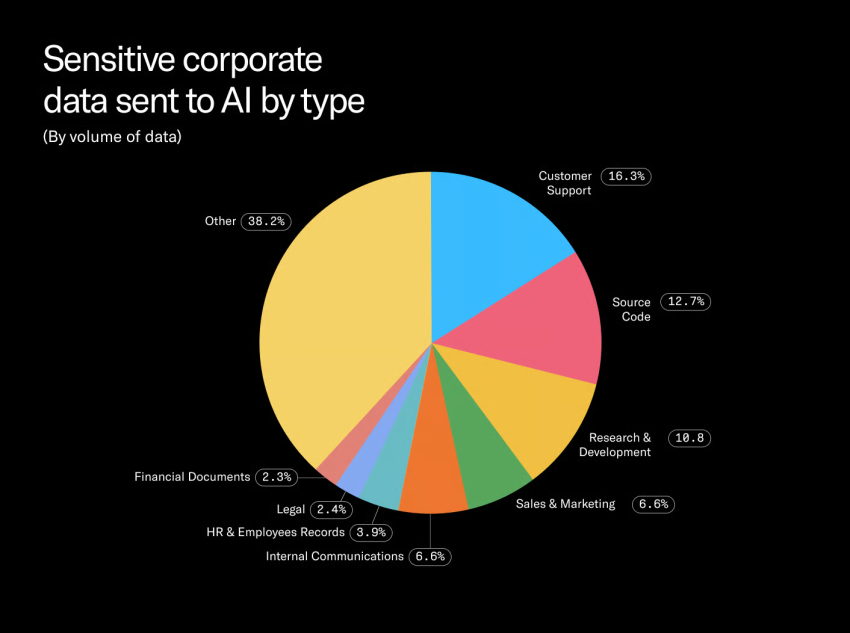
With the strongest will in the world, there’s virtually zero chance that an employee will never decide to download or use their own web-based AI tool. This creates governance blind spots across customer service operations. Without oversight, sensitive customer data may enter unauthorized AI systems. There’s a wealth of possible unknowns across your business.
Over time, businesses lose visibility into where customer data actually resides. The simple act of having a governance plan and a unified platform for customer data helps reduce this operational and governance fragmentation.
If there’s any chance of employees using their own apps, establish a process for them to request access and for IT to approve use. It’s much better to know about an app, do some research, and apply some guardrails than to only hear about it when it leaks your customers’ data.
Automatic redaction in transcripts and call recordings
AI-generated transcripts and recordings can unintentionally expose sensitive customer information. Without redaction policies, businesses may store unnecessary compliance risks indefinitely. Automatic redaction helps remove sensitive information before long-term storage.
This may include:
- Payment card information
- Account numbers
- Personal identification details
- Addresses and contact information
- Authentication credentials
Redaction policies should apply across transcripts, recordings, and AI-generated summaries. This reduces compliance exposure while improving governance consistency and ensuring adherence to policies like PCI compliance.
Managing the system of record for customer interactions
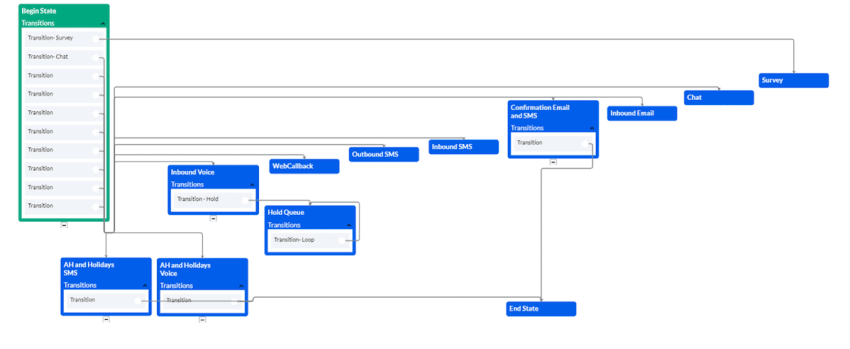
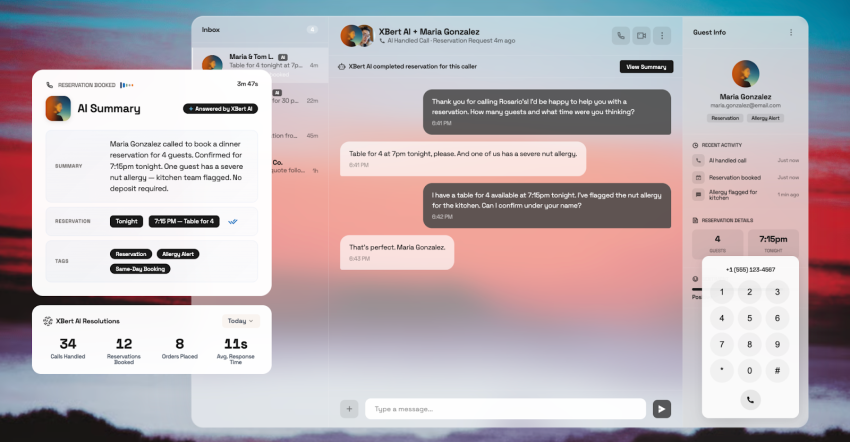
AI governance depends on maintaining a trusted system of record. Without a centralized, omnichannel interaction history, customer data becomes fragmented across platforms. This complicates governance, auditing, and customer experience management.
With a centralized interaction history, you get improved visibility across calls, chats, emails, and social media. This helps businesses apply consistent governance and retention policies.
It also improves AI accuracy by reducing incomplete or duplicated customer context. Strong governance starts with trusted, centralized customer interaction data. Without this, it’s very much hit and hope.
Operationalizing Transparency and Human-in-the-Loop (HITL)
AI governance cannot operate without human accountability. Customers still expect empathy, fairness, and explainable decision-making. This becomes especially important during high-stakes customer interactions.
For example, if AI denies a refund, escalates a complaint, or prioritizes another customer, consider why. This is the most important context your customer needs to know. And it has a knock-on effect on future queries if the AI accepts that it’s made the right decision. Machine learning is only good for business when it’s truly learning.
Businesses must be able to explain how AI reached these outcomes. This is where explainable AI becomes operationally important.
Transparent AI improves trust across customers, agents, compliance, and leadership teams. It also reduces the risks associated with unpredictable black box decision-making.
| Black Box AI | Transparent AI |
|---|---|
| Decisions lack visible reasoning | Decisions include traceable explanations |
| Difficult to audit or govern | Easier to review and validate |
| Limited agent visibility | Clear agent oversight |
| Higher compliance risk | Stronger governance alignment |
| Difficult to challenge outcomes | Easier to escalate or override |
| Reduces customer trust | Improves customer confidence |
Why every AI interaction needs an audit trail
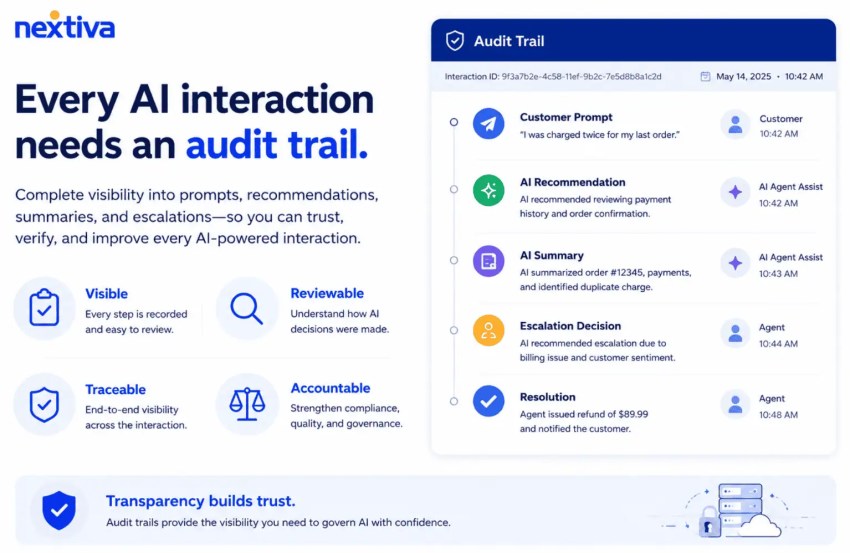
Every AI-driven interaction should be visible, reviewable, and traceable. Audit trails help businesses understand how AI reached decisions. This includes prompts, recommendations, summaries, and escalation decisions. Without auditability, governance becomes difficult during disputes or investigations.
Audit trails also improve compliance, quality assurance, and internal accountability. They create visibility across both agent actions and AI recommendations.
Implementing HITL for high-stakes customer decisions
Not every customer interaction carries the same level of risk. Low-risk automation may work well for simple administrative requests. But high-stakes decisions require human oversight and intervention capabilities.
AI should support agents rather than independently control critical customer outcomes. Businesses should define escalation thresholds for sensitive interaction types. This ensures humans remain accountable for complex or emotionally sensitive situations. Strong HITL governance also improves customer trust during difficult conversations.
Using sentiment analysis to flag failing AI interactions in real time
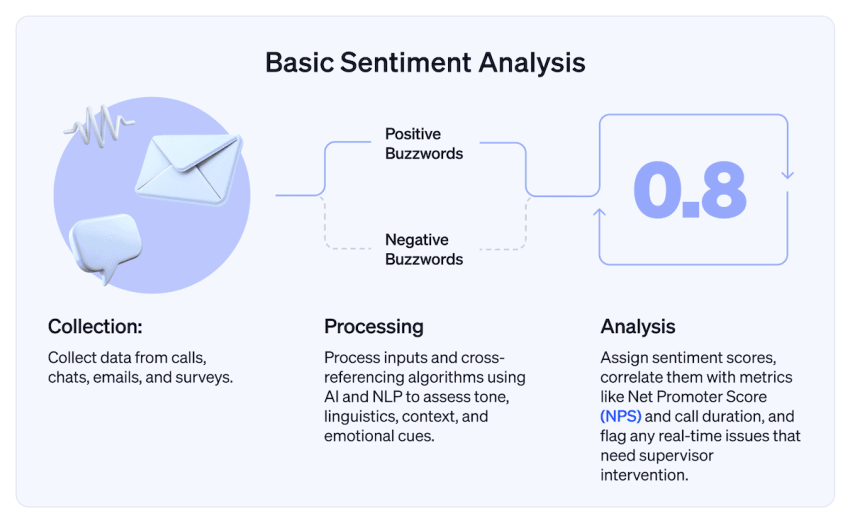
Sentiment analysis uses natural language processing to assess real-time calls and identify when customers become frustrated or confused. This allows businesses to intervene before customer satisfaction deteriorates further.
Sentiment analysis may detect:
- Frustration or negative tone shifts
- Repeated customer questions
- Escalating language or urgency
- Failed self-service attempts
- Signs of customer confusion
These signals help trigger faster human intervention when AI struggles. The result is a score per conversation, aggregated per customer over time, with the ability to escalate to a supervisor in real time.
Establishing internal AI ethics and bias monitoring
Biased training data creates biased AI outcomes. This can affect routing, recommendations, and customer interactions. AI governance requires ongoing monitoring and human oversight.
Detecting bias in skills-based routing and IVA responses
Bias may appear within routing decisions and automated responses.
Businesses should monitor:
- Escalation rates
- Resolution consistency
- Sentiment outcomes
- Routing fairness
- Complaint trends
Bias monitoring should remain continuous.
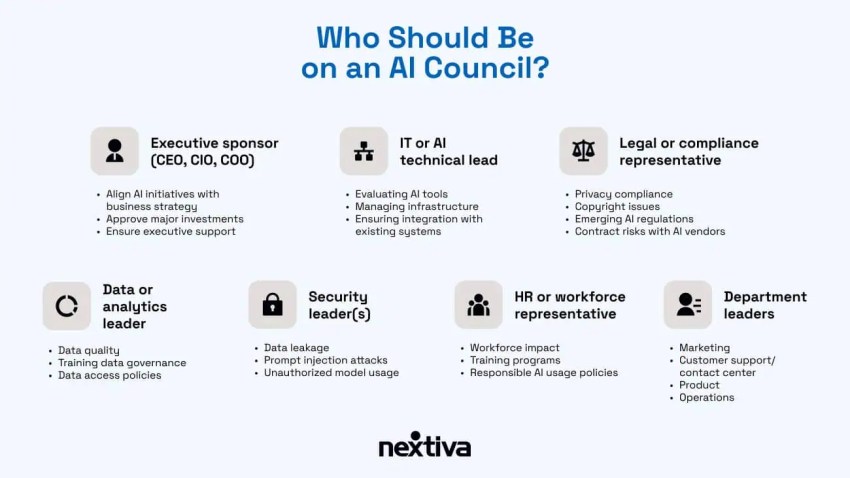
Building a cross-functional AI council
AI governance should involve IT, security, compliance, operations, and customer experience teams. Cross-functional governance improves accountability, oversight, and policy consistency across AI deployments.
Regular cadence for testing AI against diverse customer personas
AI systems should be tested against diverse customer scenarios regularly.
This should include:
- Vulnerable customers
- Elderly customers
- Non-native speakers
- Escalated interactions
- Accessibility requirements
Regular testing helps identify governance and fairness risks earlier.
The Business Case for Governed AI: ROI and Trust
AI governance is not only about compliance and risk reduction. It also directly affects customer experience, revenue, and long-term trust.
Nextiva research found 79% of business leaders view customer experience as a revenue driver. However, customer experience can’t improve if customers stop trusting AI interactions.
Poor AI experiences erode trust faster than traditional service failures. Customers expect fast, accurate responses and secure interactions every time. Governed AI helps businesses deliver these consistently.
This is why many businesses now view governance as a competitive advantage rather than a barrier. Governed AI also creates measurable business value across efficiency, retention, and risk reduction.
Businesses can automate repetitive tasks safely while maintaining human oversight:
- Reduce churn by decreasing wait times and providing more consistent customer experiences.
- Streamline operational risk by consolidating interactions into a governed platform.
This becomes especially important in industries like healthcare and retail, where trust matters most.
The businesses succeeding with AI are not treating governance as a blocker. They’re using governance to scale AI safely and build stronger customer relationships.
Are you ready to scale AI without compromising customer trust? Nextiva Contact Center helps businesses turn AI governance into a competitive advantage.
Learn more about our AI-enabled solutions here. 👇
Your AI-Powered Contact Center
Create amazing customer experiences with AI-powered contact center software. Scalable contact center platform built for omnichannel customer conversations.
AI Governance for Contact Centers FAQs
At this stage, it’s natural to have questions. You’re introducing a new technology that impacts customer service, brand appearance, and your bottom line. Here are the most common questions customers ask us.
AI governance should be a cross-functional responsibility rather than a single-department task. Contact centers often adopt AI first because they manage customer interactions directly. Governance should also involve IT, legal, compliance, and customer experience leaders. Nextiva provides centralized visibility that helps these teams collaborate effectively.
Businesses should combine encryption, redaction, and strict access controls to protect customer information. Sensitive data should never remain visible in stored transcripts or recordings. This includes payment details, passwords, and identification information. Nextiva includes built-in redaction for sensitive information like credit card numbers.
AI explainability means understanding why AI produced a specific decision or recommendation. This may include denied refunds, escalation decisions, or automated responses. Explainability improves accountability and customer trust. Nextiva Interaction Analytics helps businesses review and audit AI-driven interactions.
Businesses should regularly review training data and routing outcomes. AI responses should also be tested against diverse customer personas. This helps identify unfair outcomes and inconsistent customer experiences earlier. Bias monitoring should remain an ongoing governance process.
AI governance focuses on safety, consistency, and operational efficiency. Strong governance often accelerates deployment rather than slowing it down. It reduces legal uncertainty during pilots and implementation planning. This allows businesses to scale AI with greater confidence and reduce operational risk.