

 Customer Experience
  Blog
Blog  Business Communication
  Leadership
  Marketing & Sales
  Nextiva News
  Productivity
  VoIP
VoIP 

A human-sounding AI voice is no longer enough. You have probably sat through a demo where an AI voice sounded clear, polished, and surprisingly natural. Then you tried plugging it into your actual phone system and realized it couldn’t route calls or hand them off to a live agent. I have watched customer experience teams burn weeks on this loop.
What CX teams need is a tool that can understand caller intent, route conversations, escalate gracefully, update systems, and help customers reach a resolution without feeling trapped in another automated phone menu.
The right AI voice tool can help your team answer after-hours calls, qualify leads, book appointments, reduce transfers, summarize conversations, support agents, and create consistent voice experiences across channels. The wrong one just adds another layer of automation that customers have to fight through.
Here’s what I have learned evaluating AI voice tools for CX teams that need results, not just audio files.
Try the best AI answering service free for 14 days
XBert AI answers questions and captures leads. Add your 24/7 answering service in minutes.
What Are AI Voice Tools for CX?
AI voice tools for customer experience use artificial intelligence to create, understand, manage, or analyze spoken interactions between businesses and customers. Some tools generate human-like audio from text. Others can answer calls, detect caller intent, route conversations, support agents, summarize interactions, or automate routine customer requests.
That distinction matters. An AI voice generator can create polished audio for IVR prompts, training videos, onboarding content, multilingual support materials including audiobooks, or branded voice overs. These tools help CX teams move faster and keep their voice experience consistent without recording a human every time.
But AI voice tools for CX go beyond audio production. An AI voice agent, AI virtual receptionist, and contact center AI platform can participate in the customer journey itself. They may answer after-hours calls, qualify leads, book appointments, resolve routine issues, escalate to a live agent, update customer records, or give agents real-time guidance during conversations.
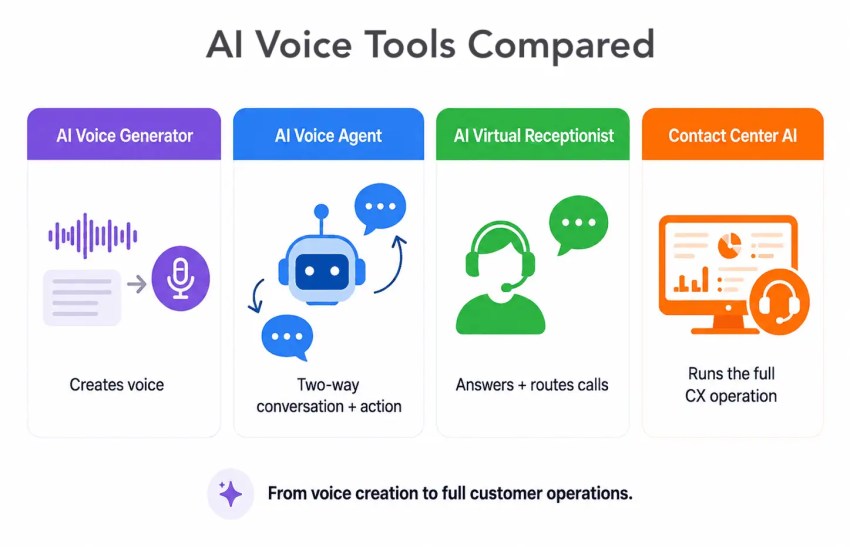
In other words, the question is not only, “Does this tool sound human?” The better question is, “What can it help the customer do?” For CX teams, the most valuable AI voice tools are the ones that reduce friction, speed up resolution, and connect voice interactions to the rest of the customer experience.
Types of AI Voice Tool for CX
AI voice generators and AI voice tools for CX are often grouped together, but they are not the same thing. An AI voice generator can create realistic speech, clone a voice, dub content, or produce polished audio for IVR prompts, training videos, and support content. Those use cases can be valuable, but they do not automatically improve the customer experience on their own.
For CX teams, the bigger question is what the tool can do after the customer starts talking. Can it understand intent? Route the caller correctly? Answer a routine question? Book an appointment? Escalate to a live agent? Summarize the interaction? Update the right system?
That is the difference between tools that generate speech and tools that supports the customer journey. This guide focuses on AI voice tools that can improve real CX workflows, while still recognizing where AI voice generators fit into the broader category.
Here’s how these tools compare:
| Category | What it does | Best for |
|---|---|---|
| AI voice generator | Creates synthetic speech, clones voices, dubs content, and controls pacing, tone, accent, or language. | IVR prompts, training voiceovers, support content, onboarding videos, multilingual content |
| AI voice agent | Uses speech recognition, NLU, dialogue management, and tool calling to hold conversations and take actions. | Automated call handling, lead qualification, appointment setting, order status, routine support |
| AI virtual receptionists | Answers calls, captures intent, routes callers, schedules appointments, collects lead details, and escalates to humans. | Missed-call recovery, after-hours answering, SMB customer handling |
| Contact center AI | Connects AI voice capabilities to routing, analytics, workforce tools, QA, agent assist, CRM logging, and omnichannel workflows. | Enterprise CX, high-volume support, agent performance, operational reporting |
The boundaries are not always crisp and clean; sometimes a tool overlaps. For example, here’s how I’d categorize Nextiva’s XBert:
| Category | Does Nextiva XBert fit? | Why |
|---|---|---|
| AI voice generator | No | It uses AI voice, but it’s not mainly for generating standalone audio. |
| AI voice agent | Partly | It can converse, understand intent, and handle customer interactions. |
| AI virtual receptionist | Yes — best fit | It answers calls, books appointments, qualifies leads, routes callers, and follows up. |
| Contact center AI / CX platform | Partly / adjacent | It connects to broader CX and communications workflows, but XBert itself is best described as an AI receptionist. |
AI tool for voice gives you TTS audio, a voice agent gives you the conversation, and a CX platform gives you the workflow. Most teams need at least two of these layers working together.
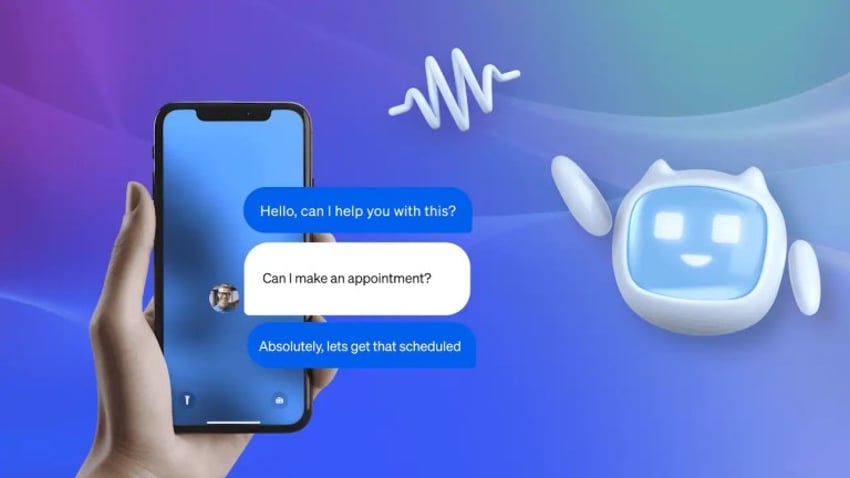
Which AI voice use cases actually move CX metrics?
Not every AI voice use case justifies the investment. The strongest CX use cases are the ones that reduce friction, speed up response times, improve resolution, or help teams scale without sacrificing consistency.
Here are the AI voice applications most likely to move key customer experience metrics.
| Use case | What it improves | CX metrics affected |
|---|---|---|
| AI receptionist | Captures intent, answers after-hours calls, routes customers, and prevents missed opportunities | Missed calls, response time, lead capture, booking rate |
| Conversational IVR | Replaces rigid phone menus with natural-language call routing and self-service | Abandonment rate, transfer rate, containment rate, CSAT |
| AI voice agents | Handles routine customer requests, appointment setting, intake, reminders, and basic support | Resolution rate, cost per contact, average handle time, no-show rate |
| Agent assist | Gives agents real-time prompts, summaries, and next-best actions during customer calls | First-contact resolution, QA scores, handle time, agent productivity |
| Call summaries and transcription | Turns calls into searchable records and reduces manual after-call work | After-call work, documentation quality, follow-up speed |
| Voice analytics | Analyzes sentiment, intent, call drivers, escalation patterns, and coaching opportunities | Sentiment, compliance, escalation trends, coaching effectiveness |
| AI voiceover and multilingual content | Creates consistent training, onboarding, IVR, and support content across languages | Training completion, content production time, localization speed |
What CX Teams Should Look for in an AI Voice Tool
Here’s what CX teams should look for when comparing AI voice tools. Voice quality matters, but it should not be the only test. A tool can sound polished in a demo and still fail when a customer interrupts, changes their mind, asks for a live agent, or needs the conversation logged in your CRM.
The best AI voice tools for CX should be evaluated on two levels: how natural the interaction feels and how well the tool supports the customer journey.
The practical evaluation script
Most teams audition AI voice tools the wrong way. They type a clean sentence into a demo box, listen through good speakers, and judge the tool by how human it sounds. That tells you very little about how it will perform in a real support, sales, or service scenario.
Instead, build a short test script that includes:
- A greeting and simple policy explanation
- A confirmation code, phone number, address, or appointment time
- A common customer request, such as rescheduling an appointment or checking an order status
- An escalation request, such as “I’d like to speak with a manager”
- One emotional moment, such as “I understand this is frustrating”
- One interruption mid-sentence
- One correction, such as “Actually, that’s spelled differently”
- One out-of-scope question the tool should not try to answer
Then evaluate whether the tool can understand intent, pronounce details clearly, respond naturally, complete the task, stay composed under changes, route the caller correctly, log the interaction, and hand off to a human when needed. Play the test through a phone line, not studio headphones.
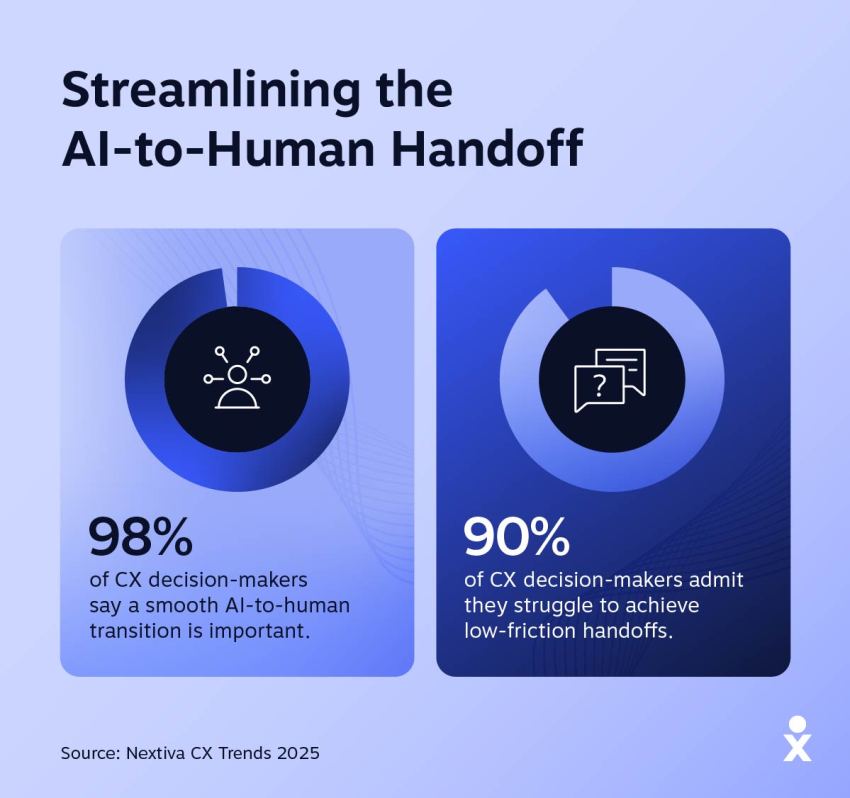
That first interaction matters. Gartner predicts that by 2028, at least 70% of customers will use a conversational AI interface to start their customer service journey. Your AI voice tool needs to hold up in those first seconds.
What guardrails do you need for customer-facing AI voice?
Customer-facing AI voice tools need more than a natural-sounding voice. They also need clear rules for when AI is used, what it is allowed to say, how it escalates, and how customer data is handled.
At a minimum, I’d look for:
- Disclosure controls: Customers should know when they are interacting with AI.
- Consent for cloned voices: Do not clone or use a person’s voice without documented permission.
- Approved scripts and workflows: Keep sensitive or regulated conversations tightly controlled.
- Human escalation: Give customers a clear path to a live agent or staff member.
- Data retention policies: Understand how recordings, transcripts, voice samples, and customer data are stored or deleted.
- Monitoring and QA: Review AI-handled interactions for accuracy, tone, compliance, and customer friction.
- Escalation fallback logic: The tool should know when to stop improvising and escalate.
The CX scorecard
When comparing tools, score each one against these criteria:
| Criterion | Why it matters |
|---|---|
| Naturalness and intelligibility on phone audio | Studio quality does not matter if the voice degrades over a cell connection. |
| Intent detection | The tool should understand why the customer is calling, not just read a script. |
| Routing and escalation | Customer-facing tools need clear paths to the right person, department, or live agent. |
| Task completion | The tool should be able to complete useful actions, such as booking, intake, qualification, reminders, or status checks. |
| Pronunciation, pacing, and tone controls | These matter for names, numbers, policies, emotional moments, and brand consistency. |
| Multilingual capability | This is critical if you serve multiple regions or customer groups. |
| Integrations and APIs | The tool needs to connect with your CRM, help desk, phone system, calendar, and/or contact center workflows. |
| Monitoring, logging, and summaries | Teams need visibility into what happened, what was resolved, and what needs follow-up. |
| Security, data retention, and licensing | Especially important for regulated industries and customer-facing voice interactions. |
| Compliance and disclosure controls | AI voice tools need clear rules around consent, synthetic voice use, recordings, and sensitive data. |
Keep in mind: Don’t only ask whether the tool sounds human. Ask whether it can help the customer get something done.
The Best AI Voice Tools for CX
Here’s how the top AI voice tools stack up for CX use cases.
1. Nextiva XBert — best for SMB customer experience

Nextiva XBert is an AI receptionist/employee built for small- and mid-sized businesses that need enterprise-quality customer coverage without an IT team or implementation budget to match. Unlike the frustrating menus of legacy IVR, XBert is a conversational AI agent that greets customers naturally, answers questions, and handles complex workflows like scheduling appointments or sending confirmation messages (across voice, text, and chat).
It requires no coding or complex automation workflows and can be up and running in minutes, complete with custom greetings and voice settings, making it one of the fastest tools on this list to go from signup to live calls. Nextiva XBert starts at $99 per month for up to 100 interactions, then $0.99 per additional interaction. A 30-day money-back guarantee reduces the commitment risk, plus you can try the #1 AI Receptionist free for 14 days.
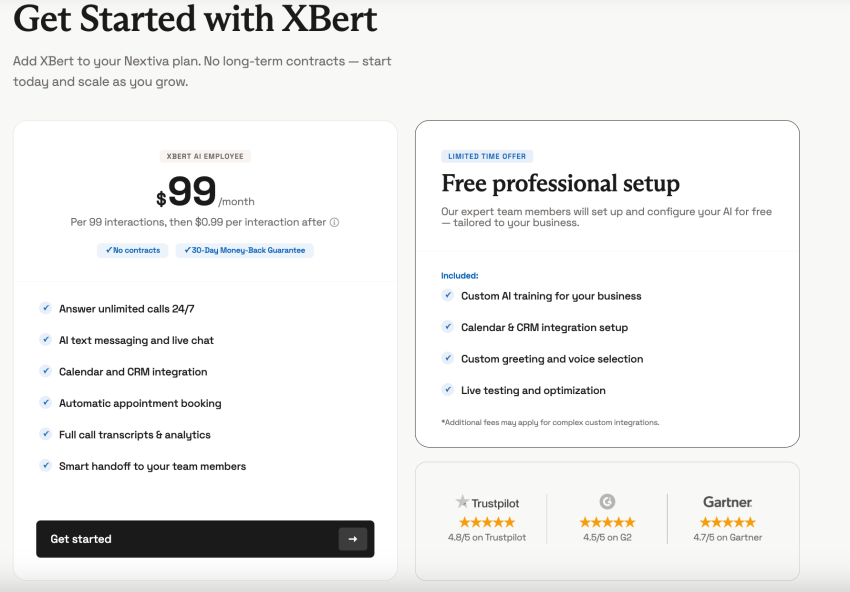
Why it stands out for CX
XBert books appointments with real-time calendar integration, captures leads into your CRM, answers FAQs from your knowledge base, and routes calls to the right person with full context. When a conversation needs a human, XBert transfers it to a human agent with a summary of everything that happened, so customers never have to repeat themselves. For small teams where every missed call is a missed sale, and where hiring a dedicated receptionist isn’t viable, XBert functions as an always-on frontline AI employee.
Here’s what I’ve seen happen in pilots: A team invests weeks evaluating voice generators, picks one with beautiful output, then realizes that the software can’t schedule an appointment or log the interaction. That’s the moment where XBert’s value becomes obvious. It doesn’t compete with ElevenLabs on voice realism. It competes on whether the customer’s problem actually gets solved.
What to watch
- Best fit for teams that want an all-in-one CX platform, not a highly specialized voice AI layer. XBert is strong for call handling, chat, bookings, and issue resolution, but teams with very bespoke automation needs may want to validate depth carefully.
- While Nextiva itself is well established (powering over a million users and billions of interactions annually), XBert’s AI capabilities are still maturing relative to dedicated voice AI specialists on this list.
- Nextiva’s support team is highly praised, but some users note friction in the initial onboarding experience, particularly around set-up forms and account configuration.
Hear why XBert AI is the best AI receptionist
XBert AI receptionist handles customer questions, captures leads, and books appointments. Try it free for 14 days.
2. Retell AI — best for AI-native voice agents
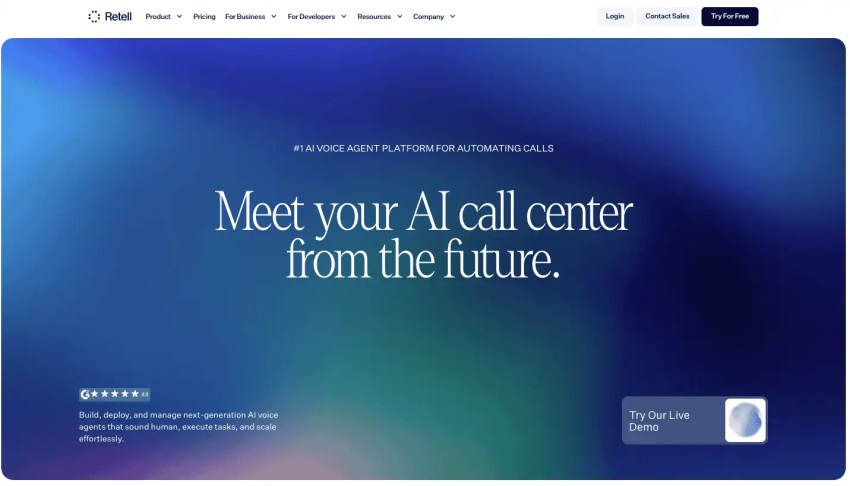
Retell AI is an AI-native voice infrastructure platform built specifically for real phone workflows, rather than a legacy IVR system with AI layered on top. It is designed for low-latency voice agents that can handle multi-turn conversations, support a wide range of languages, and operate across inbound and outbound use cases such as support, lead qualification, appointment booking, and after-hours coverage.
Why it stands out for CX
Retell’s main appeal is control. It gives engineering teams a lot of flexibility across the stack, including real-time voice streaming, webhook-based call routing, dynamic prompt injection, and deployment at scale. It also gives technical teams flexibility around telephony, routing, and integrations, which makes it a strong fit for teams that want more control than a typical no-code AI receptionist provides.
What to watch
- Retell is better suited for developers than non-technical business users, so setup and ongoing iteration usually require engineering help.
- Pricing often depends on the model, voice engine, and telephony setup, which can make forecasting more complex at higher volumes.
- Smaller tiers may rely more on self-serve channels, which can be fine for developers but less ideal for teams that want hands-on support.
3. PolyAI — best for enterprise conversational voice AI
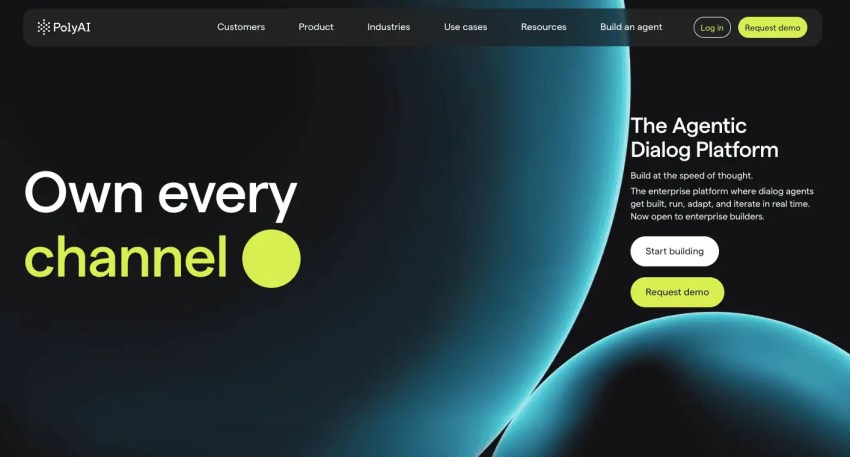
PolyAI is an enterprise voice AI platform built for high-volume inbound contact centers. It is especially strong in industries like banking, healthcare, travel, hospitality, insurance, energy, and retail, where natural conversation quality, reliability, and operational control matter most.
Why it stands out for CX
PolyAI’s biggest advantage is conversational realism. It positions its strength around natural, lifelike conversations, including handling interruptions and topic changes. Its Agent Studio also gives enterprise teams tools to test flows, adjust tone and lexicons, and monitor performance through analytics and observability, which makes it a good fit for regulated or process-heavy environments.
What to watch
- PolyAI uses custom enterprise pricing and is typically best suited to large-scale deployments.
- It is not a self-serve platform in the way some developer-first tools are, so teams that want to build and iterate entirely in-house may find it limiting.
- It can lose track of details in longer exchanges, especially when a conversation extends beyond five or six back-and-forth turns.
4. Decagon — best for omnichannel customer support AI with voice escalation
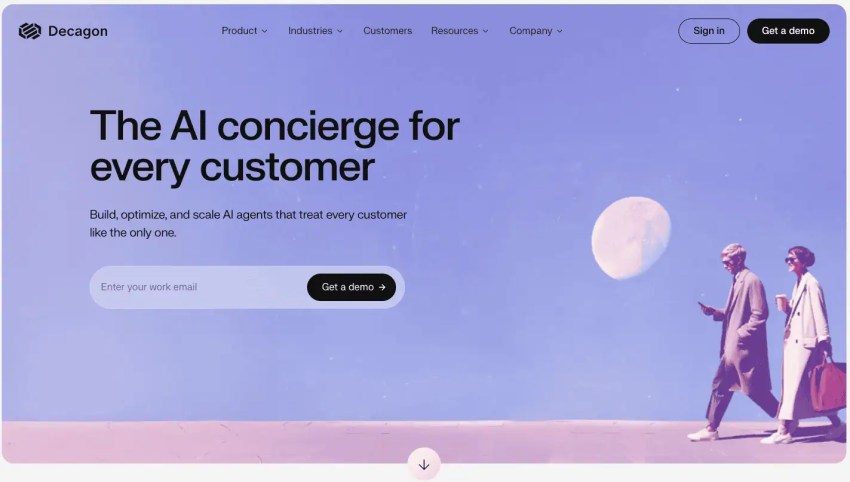
Decagon is an autonomous support agent platform built to resolve customer issues end to end across voice, chat, email, and SMS. Rather than acting like a simple chatbot, it is designed to take real actions inside support workflows, which makes it more useful for CX teams that want AI to do more than answer questions.
Why it stands out for CX
Decagon’s strength is its ability to combine reasoning, workflow execution, and system integration. Its core workflow engine, Agent Operating Procedures (AOPs), let teams define support logic in a structured way, enabling non-technical CX operators to build agent behavior, while Watchtower gives leaders visibility into agent performance and failure points. In practice, that means the platform can help with tasks like issuing a discount, triggering a reshipment, or updating records without bouncing the customer between systems.
What to watch
- Decagon is generally positioned for mid-market and enterprise teams, so it may be too expensive for smaller support operations.
- Advanced workflows and integrations may require technical resources, especially during setup.
- Like many newer AI agent platforms, some features may still be evolving (as G2 reviewers note), so it is worth validating roadmap fit before committing.
5. Replicant — best for high-volume contact center automation
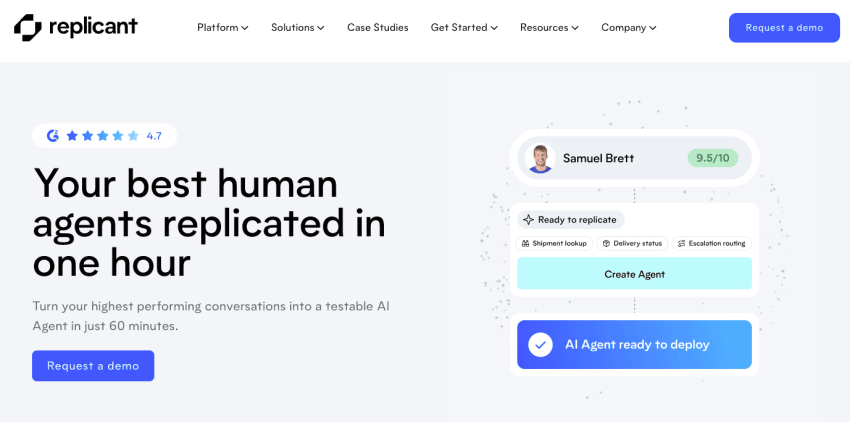
Replicant is an enterprise voice AI agents platform built to automate high-volume, repetitive inbound calls. It focuses on resolving common customer-service interactions end to end, and it is often deployed for Tier 1 support across voice and messaging.
Why it stands out for CX
Replicant’s strength is resolution, not just deflection. It understands multiple intents in a single sentence—such as “I need to change my flight and add a bag”—and maintains context if a customer interrupts or changes subject mid-call. For high-volume contact centers in insurance, healthcare, retail, and travel, where the bulk of call volume is repetitive and transactional, Replicant is built to absorb that load and free human agents for complex or sensitive calls that require judgment.
What to watch
- Pricing is not publicly transparent, so forecasting can be harder before sales discussions.
- It is strongest for repetitive, high-volume call types rather than freeform problem solving.
- The vendor-led model can speed deployment, but it may limit how quickly teams iterate on their own.
6. Five9 IVA — best for contact center voice self-service
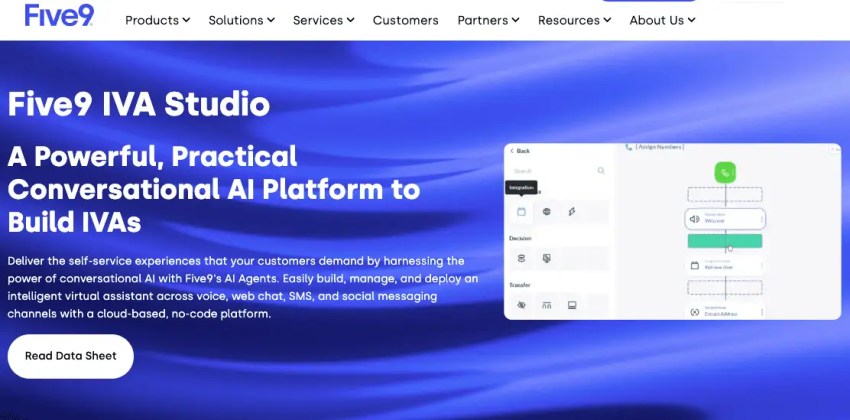
Using Five9’s no-code IVA Studio, teams can build and deploy conversational virtual agents across voice, chat, SMS, and social messaging. Five9 says the platform supports self-service automation across voice and digital channels, with context passed to live agents when escalation is needed.
Why it stands out for CX
Five9’s biggest advantage is integration depth. Because IVA is native to the Five9 platform, CX teams can pair self-service with routing, analytics, and workforce tools inside one ecosystem, which helps preserve context during handoffs.
What to watch
- IVA is not a separate standalone product; it is part of Five9’s broader platform, so the value is highest if you are already using or planning to use Five9.
- Pricing is not publicly transparent, and third-party reviews note a 50-seat minimum, which makes Five9 a better fit for mid-market and enterprise teams.
- It’s a better fit for organizations with enough admin capacity to configure flows, prompts, and integrations well.
7. NICE CXone — best for enterprise CCaaS AI
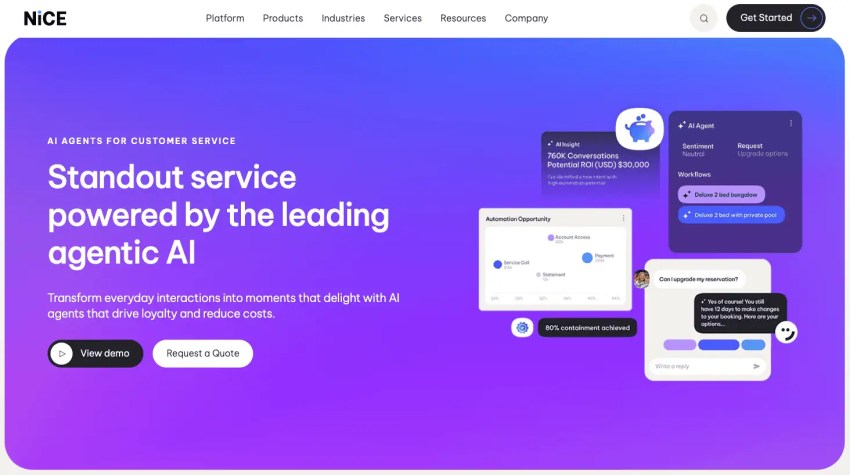
NICE CXone is a cloud-native CCaaS platform that unifies omnichannel routing, AI voice assistant and bots, real-time agent assist, workforce optimization, and analytics in one architecture. It captures intent, sentiment, behavior, and outcomes across interactions, and its Enlighten AI layer powers capabilities like sentiment analysis, routing, summaries, and agent guidance across the platform.
Why it stands out for CX
CXone’s main strength is integration depth: it brings routing, workforce tools, analytics, and AI into a single system, which is valuable for large contact centers that need consistency across channels and teams. NICE also positions CXone as an enterprise platform built to help organizations move from manual engagement to AI-driven service at scale.
What to watch
- Complex pricing and packaging can make costs harder to forecast, especially when AI, routing, and workforce tools are bundled differently.
- Implementation can be involved, so larger deployments may need a capable partner or internal admin support.
- It can be more platform than many smaller teams need, so ROI is strongest when you actually use the breadth of the suite.
8. Hume — best for emotionally intelligent voice AI
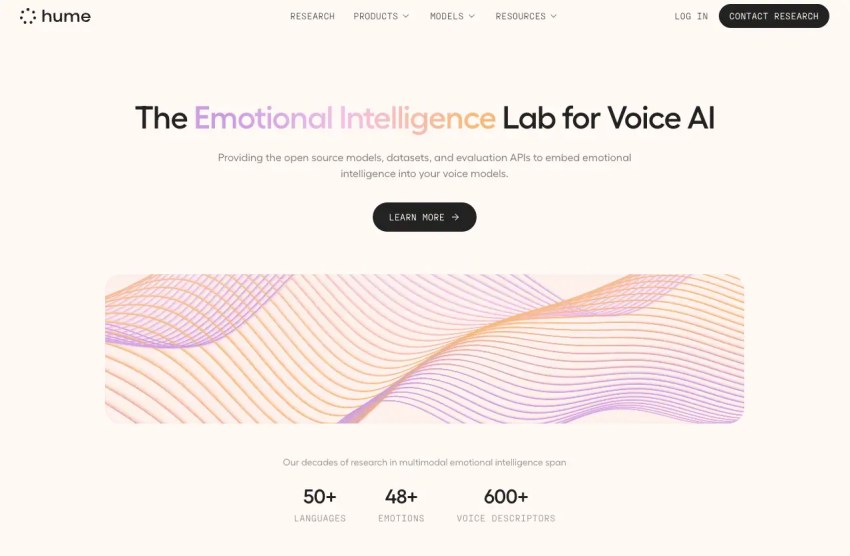
Hume is an AI voice platform built around emotional intelligence. Its Empathic Voice Interface (EVI) produces natural-sounding speech that detects and mirrors vocal emotion with real-time accuracy, making it distinctly different from every other tool on this list. In empathetic support scenarios, where a frustrated customer calls in or a patient needs reassurance, that emotional awareness can change the outcome.
Why it stands out for CX
Most AI voice tools are optimized for resolution speed. Hume is optimized for how the voice interaction feels. For CX teams operating in healthcare, mental health, financial services, or any high-stakes support context where customer emotion directly affects outcomes, that distinction is meaningful. A voice agent that can detect frustration and respond with a calibrated shift in tone can help improve CSAT in ways that faster response times alone cannot.
What to watch
- EVI is not a plug-and-play tool for a CX manager wanting to set up voice flows independently. Integration requires engineering resources, and non-technical teams will need dedicated developer support to build and maintain it.
- Reviewers on Product Hunt have flagged weaker performance in non-English languages, which is a meaningful constraint for teams serving diverse or global customer bases.
- Hume is a strong demo, but teams should test it against real production call scenarios — accent variation, noisy environments, edge-case emotional inputs — before going live at scale.
9. ElevenLabs — best for realistic voice agents and multilingual speech
Note: ElevenLabs is primarily a voice generator, but it can also be used in CX voice workflows, so we’ve included it on this list.
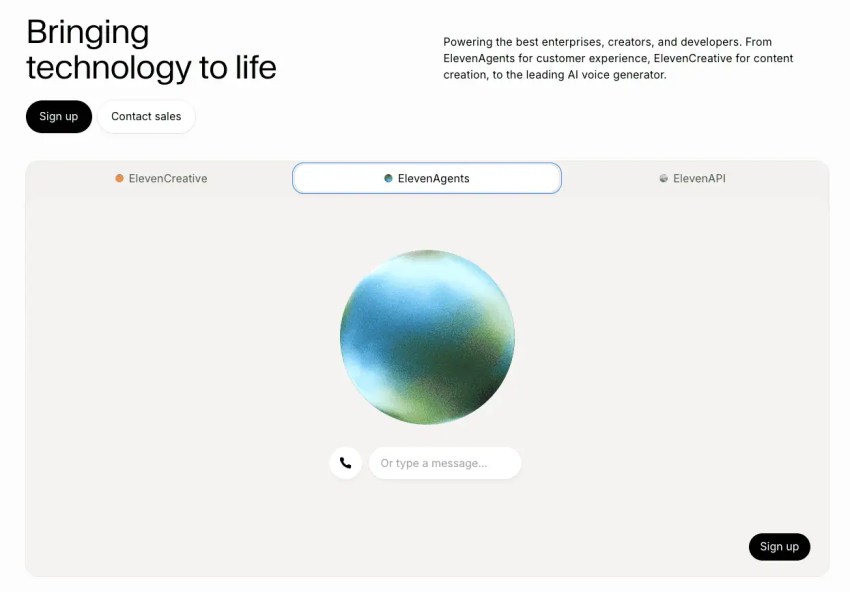
Where many platforms produce audio that sounds competent but clearly synthetic, ElevenLabs produces voices that are genuinely difficult to distinguish from human speech — with natural cadence, expressive range, and emotional nuance built in. In fact, one reviewer on Product Hunt called it “the gold standard,” even despite its imperfections, and noted that “no other TTS provider comes close to this level of quality.” It is also a strong option for multilingual use cases, which makes it useful for CX teams serving diverse audiences.
Why it stands out for CX
For teams that care about brand voice, ElevenLabs gives unusually strong control over how spoken audio feels across use cases and languages. That makes it useful for healthcare reminders (calm tone), sales outreach (confident voice), or support callbacks (neutral sound), and other customer-facing touchpoints where voice quality matters.
What to watch
- Users on Trustpilot report credits being deducted on glitchy or failed outputs, so cost modeling matters at scale.
- Even with stability parameters configured, one reviewer noted “subtle variations in energy, pacing, or emotional tone between calls,” which is worth monitoring in high-volume, customer-facing deployments.
- ElevenLabs’ AI voice cloning capabilities are powerful enough that careless deployment creates real brand and legal risk. Teams should establish clear consent policies, access controls, and audit trails before going live.
Recommended Shortlist by Use Case
Here’s how I’d narrow the list based on what your CX team actually needs.
| Use case | Consider |
|---|---|
| SMB AI receptionist | Nextiva XBert |
| AI voice agents that resolve requests | Retell AI, PolyAI, Replicant |
| Contact center voice self-service | Five9 IVA |
| Enterprise CCaaS AI | NICE CXone Enlighten AI |
| Omnichannel support AI with voice escalation | Decagon |
| Realistic speech and multilingual voice infrastructure | ElevenLabs |
If you need an AI receptionist for SMB customer experience
Start with Nextiva XBert. It’s built for small and midsize businesses that need better customer coverage without hiring a full reception or contact center team.
XBert can answer calls, capture intent, route customers, book appointments, collect lead details, and keep conversations moving across phone, text, and chat. That makes it a strong fit for service-based businesses where a missed call can quickly become a missed customer.
If you need AI voice agents that can resolve customer requests
Retell AI is best for teams that want flexible, programmable voice agents. Among the alternatives to Retell AI, PolyAI is better for enterprise teams that need natural, conversational AI across complex customer journeys. Replicant is strongest when the main goal is automating high-volume, repetitive contact center calls. Both are alternatives to Retell AI.
Use these tools when the goal is not just to answer the phone, but to resolve common customer requests without routing every interaction to a live agent.
If you need contact center voice self-service
Five9 IVA is a good fit for contact centers that want customers to complete common tasks through voice self-service, such as order status, appointment changes, account questions, basic troubleshooting, or routing requests.
It makes the most sense if your team already runs, or plans to run, a broader Five9 contact center environment.
If you need enterprise CCaaS AI
NICE CXone is best suited for enterprise contact centers that need AI across the full CCaaS stack, including routing, analytics, workforce optimization, quality management, voice automation, and agent performance.
Choose this path if you need AI built into a large-scale contact center operation, not just a standalone voice agent.
If you need AI customer support agents with voice escalation
Decagon is a strong fit for teams that want AI support agents across chat, email, SMS, and voice. It works especially well when voice is one part of a larger support journey rather than the only channel.
Use it when customers may start in chat, email, or self-service but need to escalate into voice without losing context.
If you need realistic AI speech, multilingual voice, or flexible voice infrastructure
ElevenLabs is strongest when voice quality itself matters: realistic speech, multilingual support, branded voice experiences, IVR prompts, support content, or embedded voice experiences.
For CX, I would not evaluate ElevenLabs only as a voice generator. Its value is strongest when the voice layer connects cleanly to real workflows, systems, and customer-facing use cases.

How Should CX Teams Run an AI Voice Pilot?
Gartner projects that by 2029, agentic AI will autonomously resolve 80% of common customer service issues without human intervention. But CX teams do not get there by replacing the whole phone journey at once. They get there by starting with one controlled use case, measuring the outcome, and expanding only after the workflow holds up.
Phase one: Pick one high-volume, low-risk journey
Start with a call type that is common, repetitive, and easy to define. Good candidates include:
- Business hours and location questions
- Appointment scheduling
- Order status updates
- Basic account verification
- Simple lead intake
Keep the scope narrow so quality, routing, and escalation issues surface early. You want to find the weak spots before the AI voice tool is handling 20 different call types.
Phase two: Test escalation and reporting
Next, define what happens when the AI cannot complete the task. This includes:
- Warm transfer rules: When should the AI hand off mid-conversation?
- Callback workflows: What happens when a live agent is unavailable?
- Transcript and summary storage: Where are conversations reviewed, logged, and used for coaching?
This is where many teams realize that a beautiful AI voice is not enough. If routing, logging, and handoff are broken, the customer experience still fails.
Phase three: Expand channels, languages, and workflows
Once the first journey works, test whether the AI voice tool can support more realistic customer behavior. For example:
- Can it maintain context when a customer calls and then follows up by text?
- Does translation quality hold up with real customer phrasing, accents, and noise?
- Can the tool sync with your CRM, calendar, help desk, or contact center platform?
- Are summaries accurate enough for agents to trust?
The goal of a pilot is not to replace your team. It is to give agents more room to focus on the interactions that actually need a human. A successful pilot should prove that your AI voice tool and your CX platform are working together, not just sitting next to each other.

For Well-Rounded CX, You Can’t Go Wrong With Nextiva’s XBert
Remember the loop from the intro with a great demo and a beautiful voice, but then weeks spent realizing it can’t route a call? That gap between sounding human and solving the problem is where most CX teams stall.
ElevenLabs is the top pick when voice quality and cloning matter most. But voice quality alone won’t answer a customer’s scheduling question or hand off to a live agent when things get complex. That’s the gap Nextiva fills.
XBert answers the call, captures intent, routes correctly, and follows up across phone, text, and chat. Routine calls get handled consistently, and your team steps in only for exceptions. The difference between a cool audio demo and a real CX upgrade isn’t the voice. It’s the system behind it.
One fitness studio franchise owner saw leads jump 40% in a single week after switching to XBert: “We used to miss 10–15 calls a day. Now every single call gets answered.” See how businesses like yours are using XBert.
See XBert in action. Book a free demo and find out how many calls your business is missing.
XBert AI receptionist never misses a call, text or chat.
Greet customers, book appointments, and capture leads while you run your business. See why it’s the best AI receptionist.
FAQs About the Best AI Voice Tools
Here are a few questions people often ask when evaluating the best AI voice tools.
No, an AI voice generator is not the same as an AI voice tool for CX, though it can be one type of AI voice tool. An AI voice generator creates realistic speech from text. An AI voice tool for CX does more than generate audio: it helps businesses answer calls, understand customer intent, route conversations, automate routine requests, support agents, and improve the overall customer journey.
The best AI voice generator for contact centers depends on your priority and which key features you require. ElevenLabs leads in voice cloning and expressiveness. Nextiva XBert is the strongest AI-powered option for end-to-end call handling, routing, and appointment booking. Most contact centers need AI tools that combine voice generation with workflow automation. So the best AI voice agent really depends on your business needs.
No. AI tools handle high-volume tasks like scheduling and FAQ responses, freeing real human agents for interactions requiring human speech and empathy. A Gartner survey found that only 20% of CX leaders report AI-driven headcount reductions, while 55% maintain stable staffing. By 2029, Gartner projects that AI will resolve 80% of common service issues. AI-powered automation supports agents instead of replacing them.
An AI voice tool is the broader category. It can include AI voice generators, voice agents, AI receptionists, conversational IVR, speech analytics, and contact center AI platforms.
An AI voice generator creates audio from text using text-to-speech technology. These tools are useful for voiceover, IVR prompts, training content, multilingual support materials, and branded audio.
An AI voice agent goes further. It can understand what a customer is saying, manage a conversation, take actions, route the caller, escalate to a human, or complete tasks like booking an appointment or checking an order status.
For example, ElevenLabs is often used for realistic AI speech and AI voice generation, while Nextiva XBert functions more like an AI receptionist that can handle customer interactions.
Test through phone lines, not desktop speakers. Build a script with a greeting, confirmation code, escalation request, and one emotional sentence. Evaluate natural inflection, pacing, and composure under interruptions. Use transcription to verify accuracy.
The best AI voice tools depend on the use case. For CX teams, strong options include Nextiva XBert for SMB AI receptionist and customer call handling, Replicant for high-volume contact center automation, Five9 IVA for contact center voice self-service, or ElevenLabs for realistic AI speech.