
 Productivity
  Blog
Blog  Business Communication
  Customer Experience
  Leadership
  Marketing & Sales
  Nextiva News
  VoIP
VoIP 

Your phone rings, but no one is free to pick up. The caller waits and then hangs up. That unanswered call is a customer call you may never get back.
According to Nextiva’s customer patience benchmark, 54% of callers quit after a short hold, and most never call back. That silence has a price.
Hiring a front-desk receptionist has a price, too. So business owners ask a fair question: When does an AI receptionist pay for itself? It’s not a comparison of $99 per month vs. salary. The real return comes in the form of revenue, which you were unintentionally losing earlier. The ROI of an AI receptionist, relative to the new revenue it generates, is exceptionally high.
In this guide, you’ll see how to calculate the real ROI of an AI receptionist step by step.
What Is the ROI of an AI Receptionist?
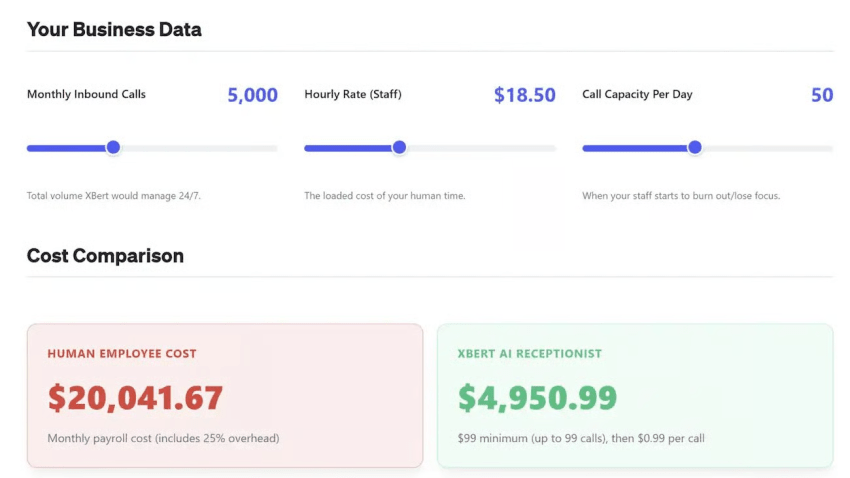
The ROI of an AI receptionist is the value it creates minus its operating costs, measured over time. For example, if you get 100 monthly inbound calls, you’ll save $3,800.01 per month with an AI receptionist when compared with the cost of human labor (at $3,900 per month with 25% overhead).
Use the AI receptionist ROI calculator to input the number of inbound calls you get in a month and the hourly rate you pay your staff. The payback period is the close cousin of annual savings from using an AI receptionist: how many months pass before the value created (revenue captured plus labor saved) covers the cost of the AI receptionist, its setup, and its integrations.
Use our AI receptionist ROI calculator.
See how much your business could save with the XBert® AI Receptionist ROI Calculator. Just enter your call volume and staffing costs to find out how quickly an AI assistant can pay for itself and start freeing up your time.
That question matters more in 2026 than it did even a year ago. The United States has 36.2 million small businesses, and most of them still answer the phone the traditional way. While doing so, they lose revenue from missed calls and after-hours calls from people who knocked on their door but couldn’t get in.
An AI receptionist helps you open that door, even when you’re not physically present to unlock it, by answering calls on your behalf just like you would. For many businesses, these incoming calls add up to real missed revenue, especially the after-hours and peak-hours volume that no one is staffed to handle.
Remember, when answering the question of “What is the ROI of an AI receptionist?”, you need to look beyond face value. It’s not a simple swap of a $99 subscription for a $40,000 salary. The fuller picture has three parts: the labor you no longer pay for, the revenue you stop bleeding from missed and slowly answered calls, and the staff hours you free up for work that grows the business.
Seen that way, the financial impact of an AI receptionist shows up as both cost savings and additional revenue, not just as a line on your phone bill. Once you get these right, the ROI math starts to look more like an insurance policy rather than a price tag.
AI Receptionist Cost Comparison: AI vs. Live Staff
Start with the part everyone understands: payroll. The median receptionist earns $17.90 an hour, or about $37,230 a year, according to the Bureau of Labor Statistics. That figure is the floor, not the real cost. BLS compensation data show benefits add roughly 30% on top of wages for private industry workers before you count recruiting, training, software, and the desk itself.
The usual alternative, a live answering service, trades one problem for another. These services bill by the minute, so your cost climbs exactly when your call volume spikes and you can least predict it. A human virtual receptionist can cost $200 to $3,000 a month, depending on coverage. The more your business grows, the more the per-minute model punishes you.
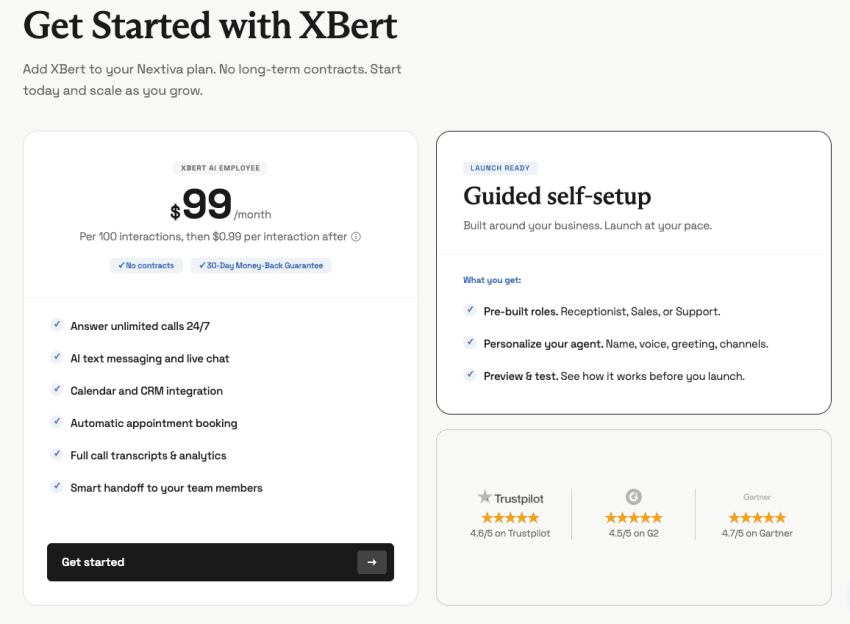
A flat-rate AI receptionist breaks that pattern. Nextiva XBert starts at $99 per month for 100 interactions, then $0.99 per interaction after that, with no contract and a 30-day money-back guarantee.
| Cost factor | Human receptionist | Legacy answering service | XBert AI |
|---|---|---|---|
| Pricing model | Salary plus benefits | Per minute or per call | Flat $99 per month, then $0.99 each |
| Typical cost | $50,000 to $70,000 per year | $200 to $3,000 per month | $99 per month for 100 interactions |
| After-hours coverage | Extra cost or none | Often extra | Included, 24/7 |
| Simultaneous calls | One at a time | Limited by staff | Unlimited |
But this is the shorter half of the story. The larger half is what happens to the calls nobody answers at all. That gap is the real weakness of traditional staffing models.
The Hidden Costs of Missed Calls and Slow Callbacks
Below is an overview of the real cost of missed calls and slow callbacks. Industry data tells a consistent story.
What missed calls actually cost
A missed call is not a neutral event. It’s a customer walking next door. Contractor In Charge pegs the industry-average miss rate at 27%, rising to 62% for small and midsize businesses during business hours and higher during peak season.
And the misses aren’t evenly spread. They cluster exactly where the money is: for example, on weekends. When callers reach voicemail, it doesn’t rescue those phone calls. It buries them. Nextiva’s benchmark found that 54% of callers abandon the call after only a few minutes on hold, and 28% walk away from the brand for good after one bad experience.
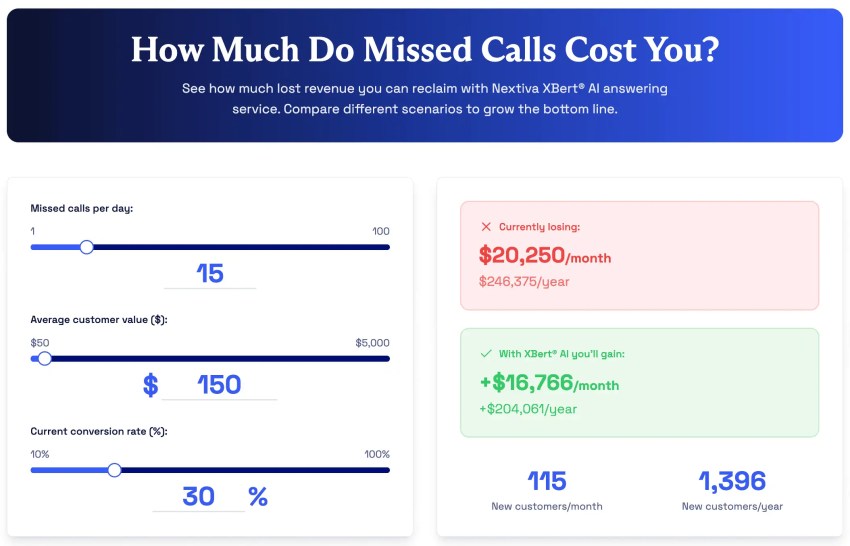
The financial impact adds up fast. Nextiva’s own missed-call analysis (<—click here to calculate) walks through a typical case: a $200 average order, a 15% close rate, and 20 missed calls a day leave $18,000 on the table every month, or nearly $180,000 a year.
Why speed-to-lead multiplies the loss
Answering the call is only half the job. Answering it fast is the other half, and that’s where the ROI quietly compounds. The foundational study here is old but unbeaten: Researchers at MIT and InsideSales found that contacting a lead within five minutes rather than 30 made it 21 times more likely to qualify.
When your existing receptionist is busy, you might miss a lead capture. The caller would likely try another service provider after being on hold.
There’s also a hidden cost that you should account for. Missed calls and slow speed-to-lead have their place when calculating the real ROI. Marketing costs spent to encourage a potential client to call often go unaccounted for. When you consider marketing spend (as cost per lead), you get the real cost of a missed call.
How to Calculate Your Break-Even Point
The formula is simpler than it looks. You’re comparing two numbers: what the AI costs and what it recovers. Work through these steps in order:
- Monthly cost: Start with the subscription. For XBert, that’s $99 plus $0.99 per conversation beyond the first 100 calls per month. That runs to a few hundred dollars a month at most, with no setup fees, no integration fees, no hidden fees, and no long-term contracts or annual contracts. The pricing details stay predictable, and you can cancel anytime.
- Missed opportunities: Multiply your monthly call volume by your miss rate. If you take 300 calls and miss 30%, that’s 90 missed calls. Pinning down how many calls you take each month is the first real step in measuring ROI.
- Real leads: Estimate how many of those misses were buyers, not wrong numbers. Be conservative here.
- Value of a win: Use your average sale, or better, your customer lifetime value. The bigger the opportunity cost of a lost customer call, the faster the math turns in your favor.
- Recovered revenue: Multiply real leads by your close rate by the value of a win.
- Payback point: You break even when the recovered revenue plus saved labor pass your total cost.
Two factors decide how fast that clock runs: call volume and ticket size. A high-volume business with high-value jobs hits payback almost immediately. Picture a home-services company taking 300 calls a month and missing 90. If even 10 of those were jobs worth $400 each, that’s $4,000 recovered against a bill of around $100. The subscription pays for itself in the first saved job, with the rest of the month as profit.
However, not every business pays back quickly. If your phones are quiet, run the numbers before you buy. Nextiva’s 30-day money-back guarantee exists for exactly that reason, so you can measure your payback before you commit.
Implementation and the hidden time savings
A tool only pays back once it’s actually running, so setup speed matters. Here, the contrast is stark. Onboarding a human receptionist takes one to two weeks of hiring and training. An AI receptionist service can go live within 24 to 48 hours, and a straightforward XBert setup runs in minutes with assisted onboarding included at no extra charge.
Deeper deployments, like a clinic wiring AI into its electronic health record, take longer, usually two to four weeks. Either way, it works with your existing phone system, so you’re upgrading call handling without ripping out your phone system.
The catch is that an AI receptionist only earns its keep when it connects to the rest of your stack.
A voice agent that books an appointment but cannot write it back to your calendar or CRM just creates a copy of the work. Nextiva XBert syncs with Google Calendar and Outlook, connects to CRMs, and offers an out-of-the-box Epic integration for healthcare, so a booking made on the phone lands in the system your team already uses.
That seamless integration is what makes the AI front desk feel like part of your operation, increasing operational efficiency and trimming operational costs by keeping call data in one place.
Then comes the part most ROI math ignores: the hours your staff gets back. For most front offices, there’s plenty else to do. The recovered time goes to the people standing in front of you, giving them a more valuable experience. It helps build loyalty.
AI doesn’t replace the receptionist; it hands back the part of the job that builds loyalty.
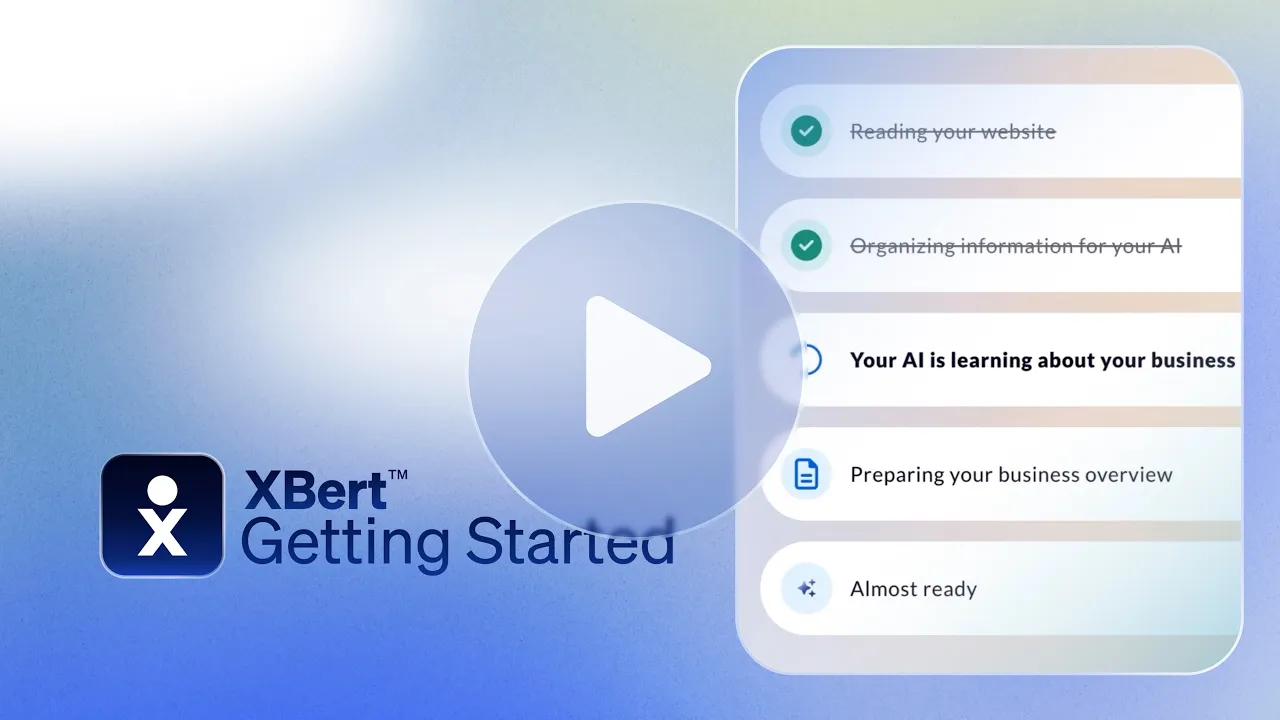
Try the best AI answering service free for 14 days
XBert AI answers questions and captures leads. Add your 24/7 answering service in minutes.
What’s the ROI of an AI Receptionist Service in Different Sectors?
The payback math is real everywhere, but it lands differently by industry. The variables that move it — call volume, ticket size, after-hours demand, and compliance stakes — are not the same for a dentist and a plumber.
Here’s how the return takes shape across four common verticals. The pattern holds whether you run one office or multiple locations.
Healthcare and dental practices
Few industries leak more revenue through the phone than healthcare. No-show rates average about 23.5%, and the misses cost an estimated $150 billion a year. The fix is not outlandish. It’s responding to after-hours appointment requests and sending reminders, which is exactly what an AI receptionist does around the clock. For a clinic, that means fewer dropped patient calls, with automated reminders and appointment confirmations going out without staff lifting a finger.
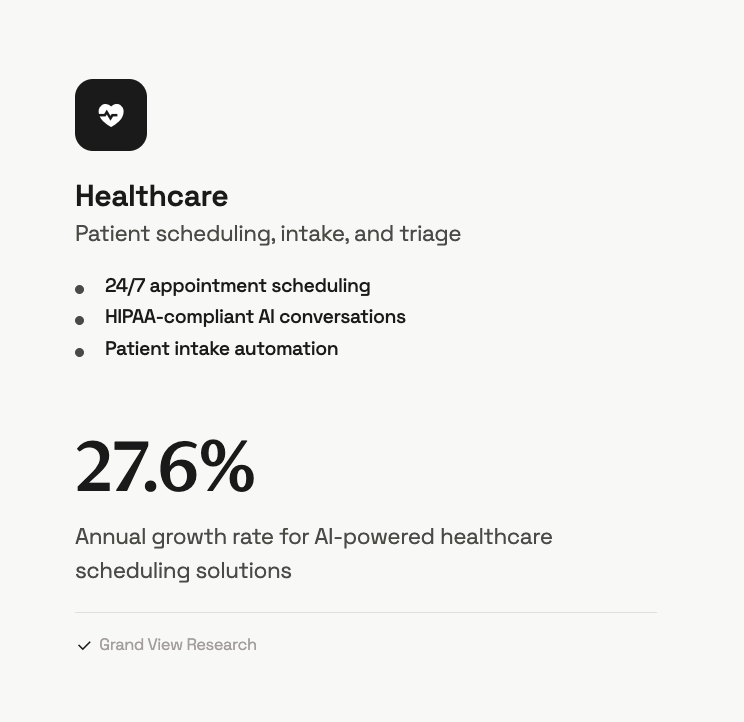
Compliance is the gate that comes before ROI for any clinic, and it’s non-negotiable. An AI vendor handling patient information has to sign a Business Associate Agreement.
Nextiva’s healthcare platform is HIPAA-ready with a signed BAA, SOC 2 certified, and end-to-end encrypted, with Epic integration syncing appointments and records in real time. It also keeps call transcripts of every interaction, since AI receptionists log, transcribe, and analyze caller data automatically for a deep understanding of why people call, and many can detect and switch languages mid-call for multilingual support.
Real estate brokerages
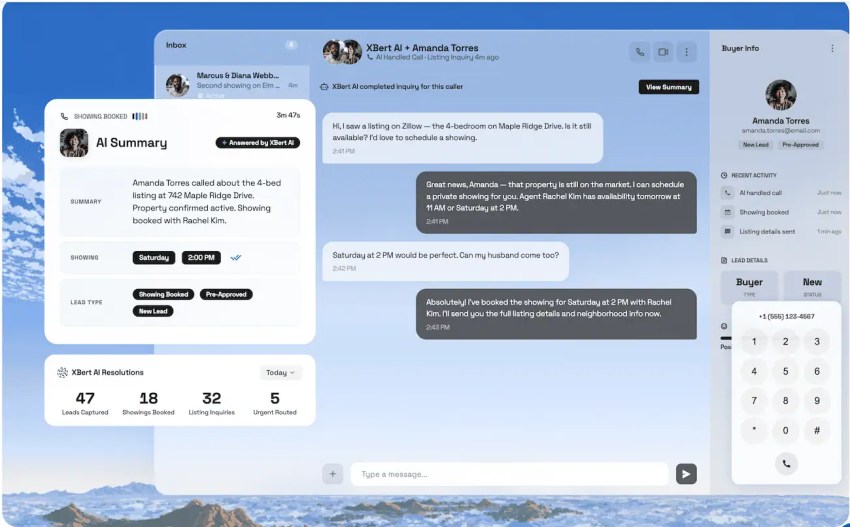
Real estate is a speed game, and most agents are losing it. With response times being hours, the agent who answers first usually wins the client.
An AI receptionist for real estate closes that gap by qualifying the inbound lead in the moment, then transferring a hot prospect straight to the agent’s cell. Being able to handle calls in the moment and answer more calls during busy periods is how agents turn speed into signed clients.
Law firms
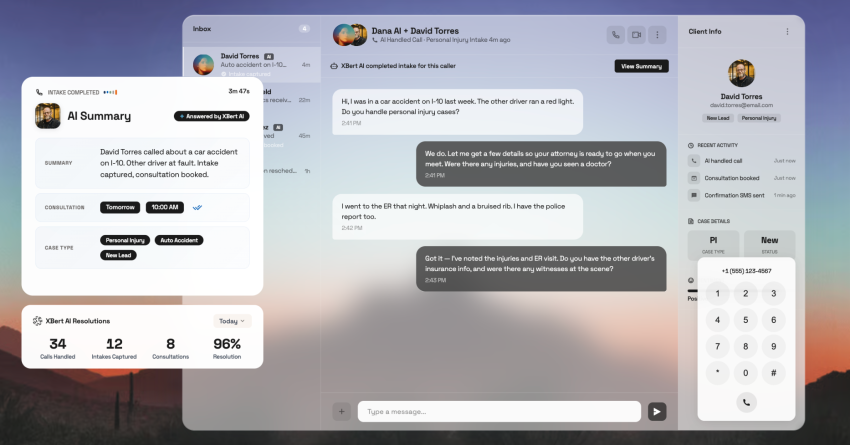
For attorneys, every interrupted hour is a billing problem, and every missed intake call is a lost case. Legacy legal answering services charge by the minute, from $0.85 to $1.75, which punishes high call volume.
A flat-rate AI receptionist screens new matters from routine questions, captures client intake after hours, and routes urgent calls to a person, all without the meter running. The math favors firms with high case value and unpredictable inbound flow.
Home services
Home services are where after-hours coverage pays for itself the fastest. With up to 40% of calls arriving outside business hours and emergencies that cannot wait until morning, a missed call is a lost job. The smart configuration keeps humans in the loop for the cases that need them. The AI covers the gaps; the people handle the calls that matter most.
Picture a plumbing company slammed at peak times. Instead of busy signals, callers reach an AI that books the job and sends SMS follow-ups, a real-world example of capture beating voicemail, with message-taking when a human is needed.
When an AI Answering Service Isn’t Worth It
A guide that only sells you the upside isn’t worth trusting, so here’s the other side. An AI receptionist is the wrong call in a few situations, and naming them is the fastest way to find out whether it is right for you:
- Low volume: If your phones are quiet, the recovered-revenue math is thin, and a 30-day trial will show you that faster than any sales pitch. In the real world, a quick trial settles it.
- Sensitive and high-empathy calls: A grieving family or a complex clinical question needs a person, not a voice agent, which is why the strongest deployments keep humans on the escalation path.
- Integrations: The payback clock doesn’t start when you subscribe; it starts when the AI actually writes back to your calendar, CRM, or EHR. Buy the tool before you have the integration, and you’ve bought a feature, not a result. The strongest setups still route to human agents when service delivery needs a personal touch.
Treat these as guardrails. They tell you where an AI receptionist fits and where a human still earns the chair.
The Real Math Behind AI Receptionist ROI
The cost of doing nothing — the missed calls, the slow callbacks, and the after-hours silence — is the number that should anchor the decision, and for most businesses with high-value calls, it dwarfs the subscription.
An AI receptionist earns its return by closing that gap: It answers every call, captures the lead while it’s still warm, and hands your team back the hours that build loyalty. The payoff is improved client satisfaction, a better client experience, and the staff efficiency that comes from a calmer front desk.
Nextiva XBert was built for that job. At $99 a month, backed by free assisted setup, real integrations, and a 30-day money-back guarantee, it lets you test your own payback with almost no risk.
The question was never whether AI is cheaper than a salary. It’s how much revenue you’re willing to keep losing to a phone nobody answers.
Run your numbers in Nextiva’s AI Receptionist ROI Calculator and find out exactly how fast that silence pays you back. 👇
Use our AI receptionist ROI calculator.
See how much your business could save with the XBert® AI Receptionist ROI Calculator. Just enter your call volume and staffing costs to find out how quickly an AI assistant can pay for itself and start freeing up your time.
Frequently Asked Questions
Most flat-rate AI receptionists fall between $99 and $300 a month. Nextiva XBert starts at $99 for 100 interactions, and then $0.99 each after that, with no contract. Compared with legacy answering services that bill by the minute, the flat rate keeps your cost predictable even when call volume spikes.
For most small businesses, it lands in the 30-to-90-day range, and high-volume or high-ticket businesses often break even in the first month. Nextiva’s 30-day money-back guarantee lets you measure your own number before you commit.
For the call-answering slice of the job, yes, and at a fraction of the cost. For the relationship slice, no. The best setups treat AI as an augmentation: It handles routine and after-hours calls so your team can focus on in-person service, complex cases, and conversations that need empathy. For routine questions, the AI answers instantly and can respond to questions around the clock while front desk teams focus on the human moments.
Focus on leakage. Multiply your call volume by your miss rate, estimate how many of those misses were real buyers, and then multiply by your close rate and the value of a customer. Compare the revenue you recover against the subscription cost. When recovered revenue plus saved labor pass the cost, you’ve hit payback.
They can be, as long as the vendor signs a Business Associate Agreement and secures the data. Nextiva’s healthcare platform is HIPAA-ready with a signed BAA and SOC 2 certification, with end-to-end encryption and an out-of-the-box Epic integration.
A basic AI receptionist can go live within 24 to 48 hours, and a simple XBert setup takes minutes with assisted onboarding included. Deployments that integrate with an electronic health record or a complex CRM usually take two to four weeks, compared with the one to two weeks it takes just to hire and train a person.