

 Business Communication
  Blog
Blog  Customer Experience
  Leadership
  Marketing & Sales
  Nextiva News
  Productivity
  VoIP
VoIP 

When it comes to talking, sending messages, and taking video calls, everyone has their own favorite platform. Whether it’s an establishment looking for a more reliable business communications solution or the average person looking for a simple change, determining which option is best or most favored can be challenging.
Some people hate the green bubble; others don’t mind it. Some like an easier email-to-video call integration, and others might prefer a more complex version. This led us to wonder which video and messaging platforms are the most preferred worldwide.
So we dug into the most popular video and messaging platforms in each country across major players like iMessage, WhatsApp, Google Messages, Google Meet, Zoom, and Microsoft Teams, based on search demand data for each platform across 100 countries, to find out which one across video and messaging is heavily favored around the world.
Insights and trends on messaging use and adoption, plus takeaways for businesses, is found below.
The Most Popular Messaging Platforms by Country
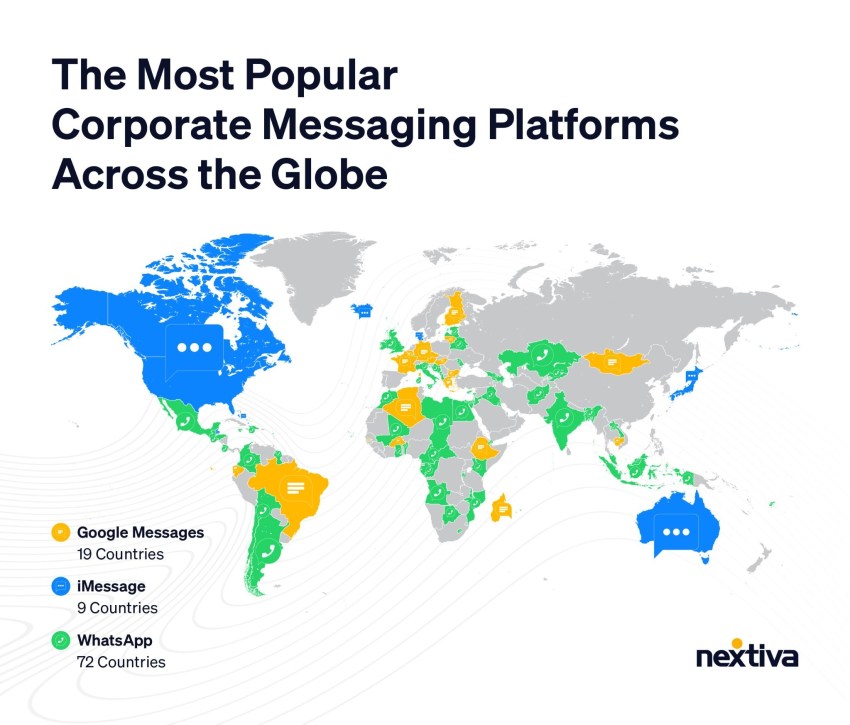
Of the 100 countries listed, WhatsApp emerged as the #1 most preferred messaging platform globally.
While Apple and iMessage have won over in a few key areas, 72% of the countries listed prefer WhatsApp, as the platform is actively changing many people’s minds about their go-to SMS platform for personal use.
Over 3 billion people worldwide love WhatsApp and use it often, because it’s easy to add features users really want. The platform allows people to communicate easily with anybody on any operating system with minimal issues.
Features like the recent Group Message History allow new group chat members to see up to 100 previous messages when they join—solving the “What did I miss?” feeling that iMessage and Android users occasionally experience when joining a group chat.
The Most Popular Video Platforms by Country
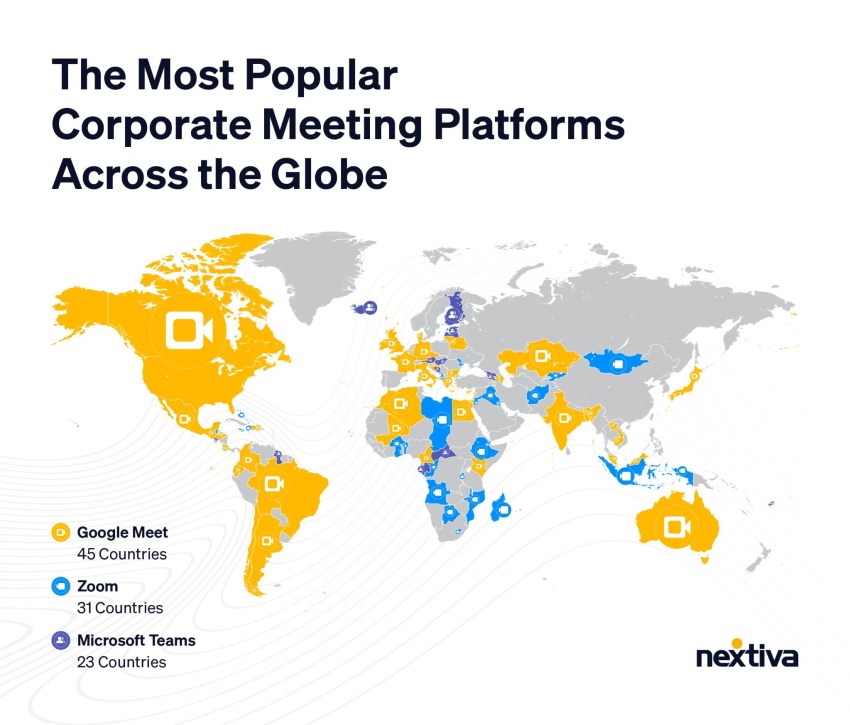
When it comes to meeting face-to-face virtually, Google Meet ranks as the most preferred platform worldwide.
Nearly half of the 100 countries listed prefer Google Meet to heavy hitters like Microsoft Teams and Zoom, with a combined search demand of over 11 million queries for the platform. Millions of people globally use Google products for a multitude of tasks, whether it’s to search the internet, receive emails, send messages, or even take video calls, so it’s no surprise that Meet is many people’s go-to.

The Most Popular Messaging Platforms by State
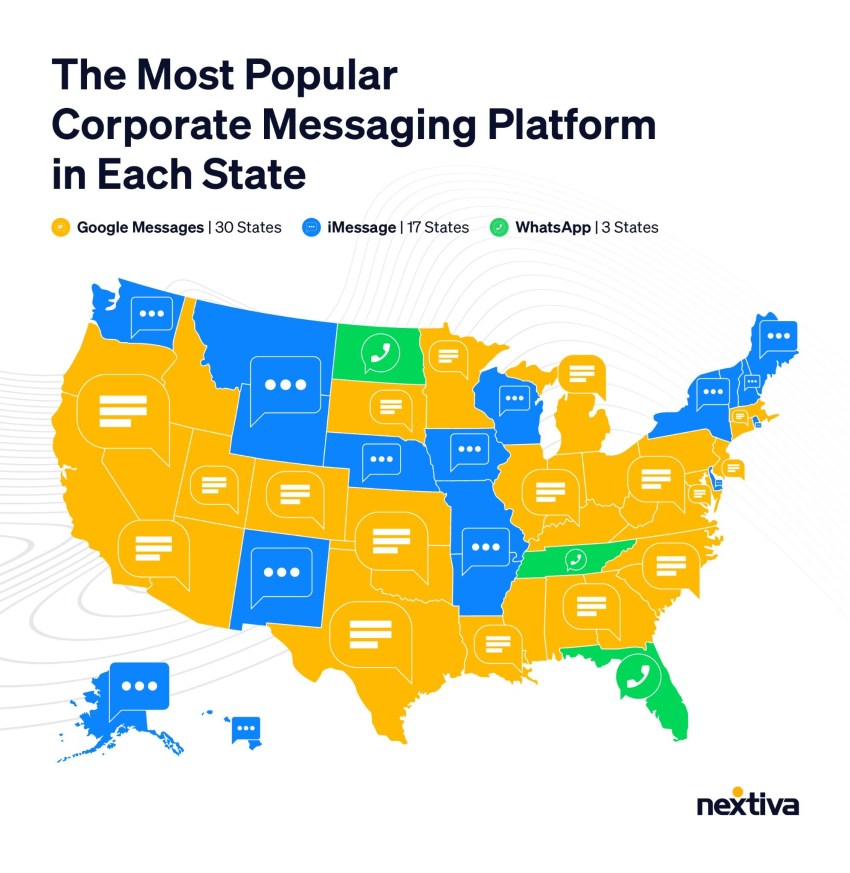
Google Messages leads the pack as the #1 most preferred communication platform in the U.S. among consumers
We studied the top conferencing platforms used in the United States. Most Americans know that the U.S. has been heavily dominated by Apple and iOS, but we’ve seen a recent shift in the platforms that people are leaning towards, with Google Messages taking top spot in the U.S.
With 60% of the country showing recent online interest in the platform, it seems that, in an iPhone- and iMessage-dominant country like the U.S., there’s decent demand for Android- and Google-based communication tools as users look for better ways to bridge the “green bubble” gap.
Around 61% of U.S. phone users have an iPhone, but Android adoption has been creeping up, at around 39%. This signals that there’s a massive demand for Android- and Google-based communication tools amongst users looking for better ways to keep the green bubble alive.
The Most Popular Video Platforms by State
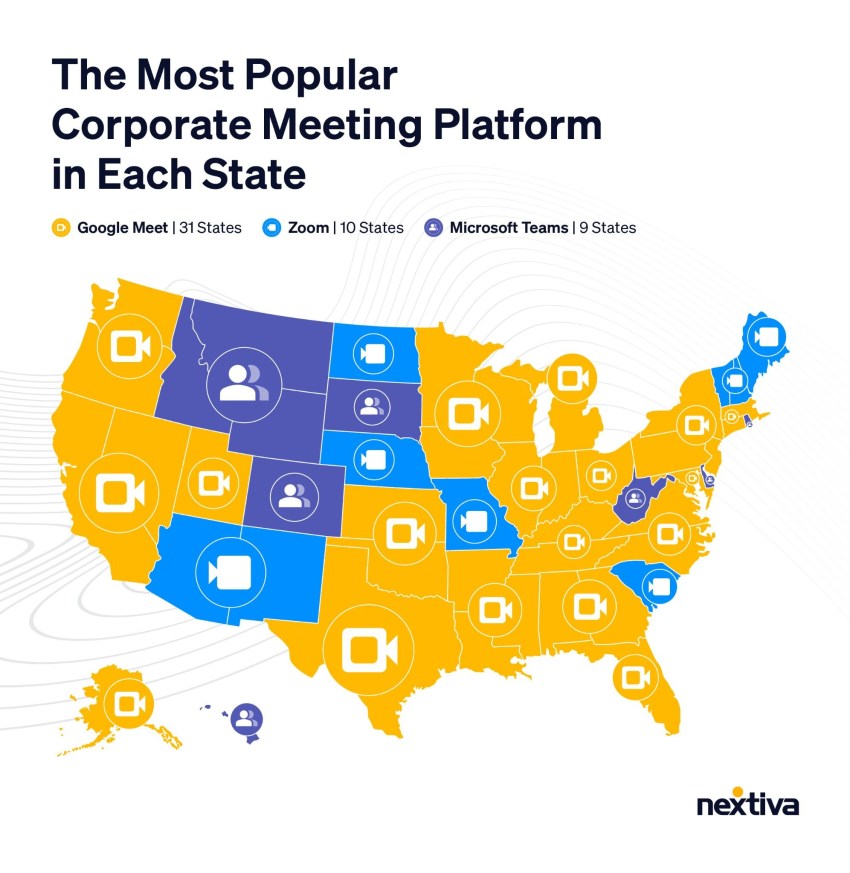
When it comes to meeting face-to-face virtually, Google Meet is the most preferred platform nationwide.
Of the 50 states, 31 prefer Google Meet over players like Microsoft Teams and Zoom.
It looks as if many Americans like the simplicity and ease of integration that Google Meet provides, and that makes sense. Something that may be misunderstood and lost in translation between emails can be solved easily by a simple click—switching from Gmail to Google Meet through a calendar invite in a matter of seconds, which the other platforms can’t do.

2026 Messaging Trends & Consumer Habits
In 2026, messaging is less about one winning app and more about context: region, device ecosystem, age, trust, and whether the message comes from a friend, creator, chatbot, or business.
Consumers use multiple messaging applications to converse with friends, family, workplaces, and businesses.
- There are 5.83 billion unique mobile users worldwide, equal to 70.4% of the global population. Mobile messaging remains one of the most widely used communication layers on Earth.
- There are 6.12 billion internet users worldwide, with global internet penetration at 73.8%. Messaging still has room to grow because close to 2.2 billion people remain offline.
- Social media user identities reached 5.79 billion worldwide, equal to 69.9% of the global population. Many social platforms now act as messaging platforms, not just feeds.
- 96.7% of adult internet users use at least one social network or messaging platform each month. Messaging behavior now touches almost every connected consumer.
- The average active social media user visits 6.5 different social platforms each month. Consumers do not live in one inbox; they move across channels based on who they talk to and why.
- 54% of online adults use WhatsApp each month, compared with 38.4% who use Messenger. That helps explain why WhatsApp dominates messaging interest in many countries.
- WhatsApp is the world’s favorite social platform, named by 17.4% of global social media users ages 16 and older. Instagram ranks second at 16.4%.
- The typical WhatsApp Android user spends 59 minutes per day in the app. That puts WhatsApp closer to a daily habit than a simple texting utility.
- The typical WhatsApp Android user opens the app more than 20 times per day. That level of frequency makes messaging one of the most reflexive consumer behaviors.
- WhatsApp has more than 3 billion monthly users. At that scale, it has become a global standard for consumer communication.
- WhatsApp’s Updates tab reaches up to 1.5 billion users daily. Meta has added channel subscriptions, promoted channels, and Status ads there while keeping personal chats separate from ads
- 90% of UK online adults used WhatsApp in 2025, while 58% used Facebook Messenger. WhatsApp is the clear messaging leader in the UK.
- 74% of UK online adults accessed WhatsApp daily in May 2025, up from 64% in May 2024. Facebook Messenger’s daily reach fell from 30% to 23% during the same period.
- UK smartphone users use an average of 41 apps per month. WhatsApp was used by 92% of UK adult smartphone users in May 2025, underscoring how crowded the messaging app landscape has become.
- 98% of U.S. adults own a cellphone, and 91% own a smartphone. Mobile messaging has near-universal reach in the U.S.
- 16% of U.S. adults are smartphone-only internet users, which means they own a smartphone but do not subscribe to home broadband. For these consumers, messaging may be the main way they reach businesses and services.
- Americans exchanged nearly 2.2 trillion SMS and MMS messages in 2024, up by nearly 42 billion messages from the year before. Traditional texting remains a major channel in the U.S. despite the rise of app-based messaging.
- 32% of U.S. adults use WhatsApp, up from 23% in 2021. WhatsApp is no longer just an international messaging app in the U.S.; it has become part of the mainstream social mix.
- 55% of U.S. teens use Snapchat, and 46% use it daily. Visual, short-form, and friend-first messaging still matter for younger consumers.
- 24% of U.S. teens use WhatsApp, up from 17% in 2022. WhatsApp’s U.S. growth extends to younger users, not just adults with international contacts.
- 36% of U.S. teens use at least one major social platform almost constantly. Messaging platforms now compete in an always-on media environment.
- 64% of U.S. teens use AI chatbots, and about 3 in 10 use them daily. Consumers may expect faster, more conversational help as chatbot behavior becomes normal.
- 72% of U.S. teens have used AI companions at least once, and more than half use them at least a few times per month. Messaging behavior is expanding beyond human-to-human conversations.
- The top five text scam types accounted for about half of all text fraud reports to the FTC in 2024. Consumers have more reason to question unknown senders, especially when messages ask them to click a link or take urgent action.
- Consumers reported $470 million in losses from scams that started with text messages in 2024, more than five times the amount reported in 2020. This makes trust, identity, and message quality essential for business texting.
Sources: DataReportal, TechCrunch, AP News, Ofcom, Pew Research Center, CTIA, Common Sense Media, FTC
5 Practical Takeaways for Businesses
Consumers do not use one messaging channel for every conversation. They text family, DM friends, follow creators, message businesses, join community chats, and now talk to AI assistants.
That creates a sizable opportunity for businesses to stand out and deliver memorable customer experiences via prompt, personal, and consistent replies, no matter where the conversation starts.
1. Meet customers on the messaging channels they already use
Messaging preferences vary by market, age, and context. Some customers prefer SMS. Others expect WhatsApp, Facebook Messenger, Instagram, web chat, or social DMs.
A unified messaging platform like Nextiva helps businesses manage conversations across WhatsApp, Facebook Messenger, Instagram, X, Viber, LINE, and more, all from one shared interface. Instead of asking customers to switch channels, teams can meet them where they already are.
2. Keep conversation history connected across channels
Customers do not think in channels. They remember the issue, the last reply, and whether the business understood them. When messages, calls, emails, chats, and social DMs live in separate tools, agents lose context and customers repeat themselves.
The NEXT Platform connects channels, conversations, customer records, and workflows in one place. That gives teams a clearer view of the customer relationship across voice, SMS, chat, email, social, and more.
3. Support fast responses across chat, SMS, email, and social
Messaging has trained consumers to expect quick replies. Businesses need more than a shared inbox; they need routing, scripting, automation, and channel coverage that help teams respond with speed and consistency.
Nextiva’s Journey Orchestration software brings together live chat, SMS, inbound and outbound messaging, email, social messaging, agent scripting, chatbots, and conversation history. That helps service teams handle digital conversations without creating a fragmented customer experience.
4. Use AI for routine messages and human agents for complex issues
Consumer comfort with AI chat has grown, but customers still expect humans when issues require judgment, empathy, or deeper problem-solving. The strongest setup uses AI to handle repetitive questions while giving agents the context they need for more complex conversations.
Nextiva AI Chat can support customers across websites, Facebook, WhatsApp, and other channels. For broader service operations, Nextiva Contact Center supports AI-powered virtual agents, chatbots, workflow automation, and omnichannel customer conversations.
5. Turn messaging data into better customer experiences
Messaging should not sit apart from the rest of the customer journey. Every conversation can reveal what customers need, where they get stuck, and which channels perform best.
Nextiva Analytics helps businesses track conversations across voice, SMS, chat, email, social media, reviews, video, WhatsApp, Instagram, Facebook, and more. That gives teams a better way to measure response quality, customer sentiment, queue performance, conversion trends, and service outcomes.
The communications platform people search for is only part of the story. The platform they open every day is where communication habits form. Businesses that unify messaging, automate routine work, and preserve context across every interaction can meet customers where they already are without adding more complexity for their teams.
Survey Methodology
To uncover the communication preferences of every country and U.S. state, we’ve analyzed search demand data for platforms—including WhatsApp, iMessage, Google Messages, Zoom, Google Meet, and Microsoft Teams—and ranked these metrics to identify the primary virtual meeting and messaging tool favored in each country and U.S. state.