

 Customer Experience
  Blog
Blog  Business Communication
  Leadership
  Marketing & Sales
  Nextiva News
  Productivity
  VoIP
VoIP 

Customer experience ROI measures the financial return from a specific customer experience investment relative to its cost. Calculate it by subtracting the investment’s total cost from its attributable financial benefits, dividing the result by that cost, and multiplying by 100. Use a consistent timeframe and avoid counting the same benefit twice.
The difficult part is identifying which results the initiative actually caused. Higher satisfaction, fewer repeat contacts, and stronger retention can support the business case, but they need a defensible connection to financial outcomes.
This guide explains what belongs in your CX ROI model, how to measure results, and how to present the evidence to finance.
What Is the ROI of Customer Experience?
The ROI of customer experience compares the financial benefits attributable to a CX initiative with the cost of delivering it. It helps determine whether an investment creates enough value to justify its expense.
Measure a defined initiative, such as improving onboarding, reducing repeat support contacts, or connecting customer conversations across channels. A focused scope makes it easier to establish costs, compare outcomes, and identify what changed.
Financial benefits may include:
- Additional profit contribution from retained customers or increased sales.
- Lower operating expenses, such as reduced overtime or outsourcing.
- Avoided costs that finance accepts and can document.
Customer satisfaction, effort, and loyalty measures help explain performance. These measures do not represent financial returns on their own.
Why Is Customer Experience ROI Important?
Customer experience ROI helps leaders prioritize improvements, allocate budgets, and assess whether a program is delivering financial value. It connects customer-facing work with outcomes the business already measures.
In Nextiva’s 2025 CX research, conducted by Dimensional Research among more than 1,000 CX leaders, 47% said the ability to track the revenue impact of CX investments contributed to leadership’s favorable view of CX.
Customer research also shows why experience deserves attention. In PwC’s 2025 Customer Experience Survey, 29% of consumers said they stopped using or buying from a brand because of poor customer experience.
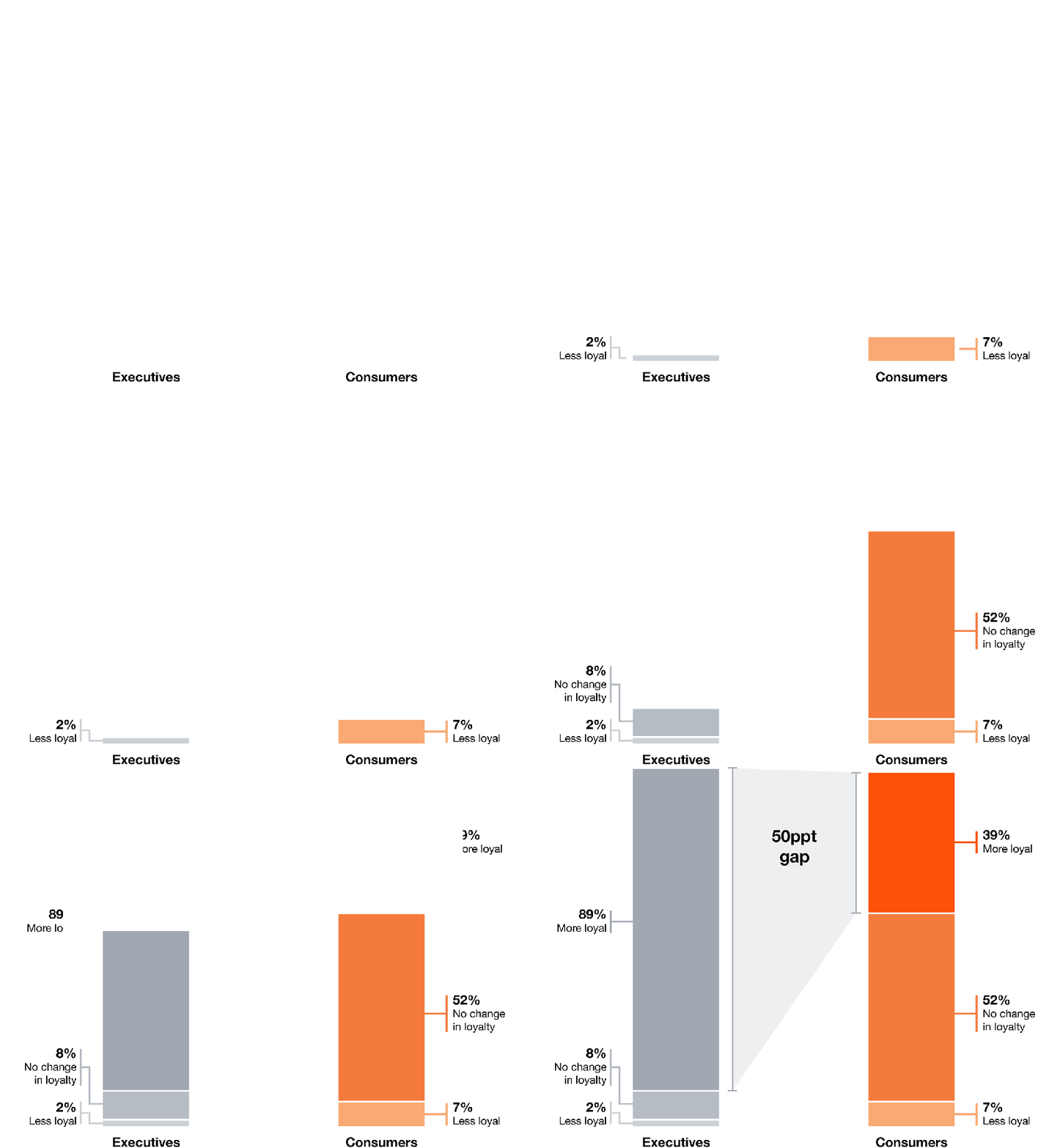
These findings support investigating CX improvements. They do not establish the return your business will achieve. Depending on the initiative, potential benefits include:
- Faster revenue growth: Delivering exceptional experiences encourages customers to spend more and choose your business over competitors.
- Improves lifetime value: Happy customers are more likely to continue buying from you and engage with your brand over the long term.
- Increases retention: A great CX keeps customers loyal, reducing churn and strengthening relationships for lasting success.
- Strengthens brand loyalty: Positive interactions enhance brand trust, boosting long-term engagement and advocacy.
- Lowers costs: An efficient CX strategy reduces operational bottlenecks and streamlines customer support.
- Improves employee morale: Engaged employees feel a greater sense of purpose when they see the tangible results of their efforts.
- Drives innovation: Insights from CX feedback fuel updates to products, services, and processes, ensuring your business adapts to market needs.
How Customer Experience Impacts Sales
Customer experience improvements may influence conversion, repeat purchases, and customer recommendations. Track those changes alongside pricing, marketing activity, and product changes before attributing the results to CX.
- Improving conversion rates: Personalized, seamless experiences encourage confidence and drive purchase decisions.
- Boosting upselling and cross-selling: Trust in a brand makes customers more open to additional recommendations.
- Encouraging positive reviews: Happy customers advocate for your brand, increasing sales through word-of-mouth marketing.
Nextiva explains how customer experience can support business growth.
Why Is It Difficult To Prove CX ROI?
CX ROI is difficult to prove because customer outcomes have several influences, and financial benefits may appear after the initial investment. A change in retention or sales does not automatically show that a CX initiative caused it.
Common challenges include:
- Attribution: Pricing, promotions, product changes, and seasonality can affect the same outcomes.
- Disconnected data: Support interactions, purchases, and customer records may sit in different systems.
- Timing: Implementation costs may arrive before retention or revenue benefits.
- Benefit overlap: Retention, lifetime value, and repeat purchases can describe overlapping gains.
- Unrealized savings: Time saved does not reduce spending unless it changes staffing, overtime, outsourcing, or another expense.
Define a baseline and comparison method before launch. Record assumptions and separate observed results from estimates.
How To Calculate Customer Experience ROI
Use this formula for a defined measurement period:
CX ROI (%) = [(Attributable financial benefits − Total initiative cost) ÷ Total initiative cost] × 100
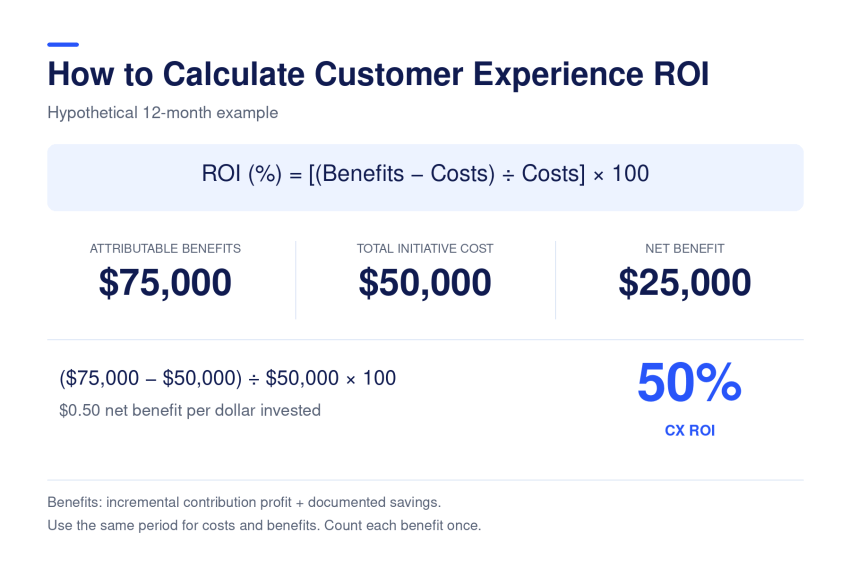
Financial benefits should represent incremental profit or documented savings attributable to the initiative. Costs should include implementation and ongoing expenses over the same period.
What belongs in the calculation?
| Component | What to include |
|---|---|
| Retention benefits | Incremental contribution profit from customers retained because of the initiative |
| Sales benefits | Incremental contribution profit from attributable conversion, repeat-purchase, or expansion gains |
| Operating savings | Documented reductions in spending, such as overtime, outsourcing, or retired software |
| Implementation costs | Setup, integration, migration, consulting, and internal project work |
| Ongoing costs | Subscriptions, usage charges, maintenance, administration, and training |
Contribution profit is revenue minus the variable costs associated with delivering those sales. Agree on the margin and costing method with finance.
Report capacity released separately when employee time savings do not reduce spending. Do not count the same retained-customer value again as lifetime-value growth.
Customer experience ROI example
The following is a hypothetical 12-month example, not a Nextiva pricing estimate or customer result.
A business invests $50,000 in improving its support workflow:
| Cost | Amount |
|---|---|
| Software and usage | $24,000 |
| Implementation and integration | $10,000 |
| Training and internal project work | $8,000 |
| Ongoing administration | $8,000 |
| Total cost | $50,000 |
Its evaluation identifies $75,000 in attributable benefits:
| Benefit | Amount |
|---|---|
| Contribution profit from improved retention | $40,000 |
| Contribution profit from additional sales | $15,000 |
| Documented operating savings | $20,000 |
| Total benefits | $75,000 |
CX ROI = [($75,000 − $50,000) ÷ $50,000] × 100 = 50%
The initiative produces $25,000 in net benefit: $0.50 above the investment cost for each dollar invested.
This result depends on the attribution and cost assumptions being valid. Show those assumptions alongside the calculation.
How To Measure Customer Experience ROI
Despite its challenges, measuring customer experience ROI is essential for any successful CX program. A structured approach ensures businesses can quantify the financial impact of CX initiatives, optimize efforts, justify investments, and align strategies with overarching goals. Follow these steps to measure CX ROI effectively.
1. Define your CX goals and objectives
Start with a specific operational change and the financial outcome you expect it to influence.
For example, reducing repeat support contacts might lower outsourced service costs. Improving onboarding might increase retained-customer contribution profit. An increase in CSAT can help explain the result, but it should not be the only success criterion.
Pinpoint the metrics that align with these objectives and determine which business outcomes you hope to influence.
For example, assess how poor customer experience impacts customer retention or the lifetime value of your clients. By identifying where the biggest opportunities for CX improvement exist, you can focus resources where they’ll have the most impact. Clear goals ensure that your ROI analysis meets customer and organizational needs.
2. Connect CX metrics with financial outcomes
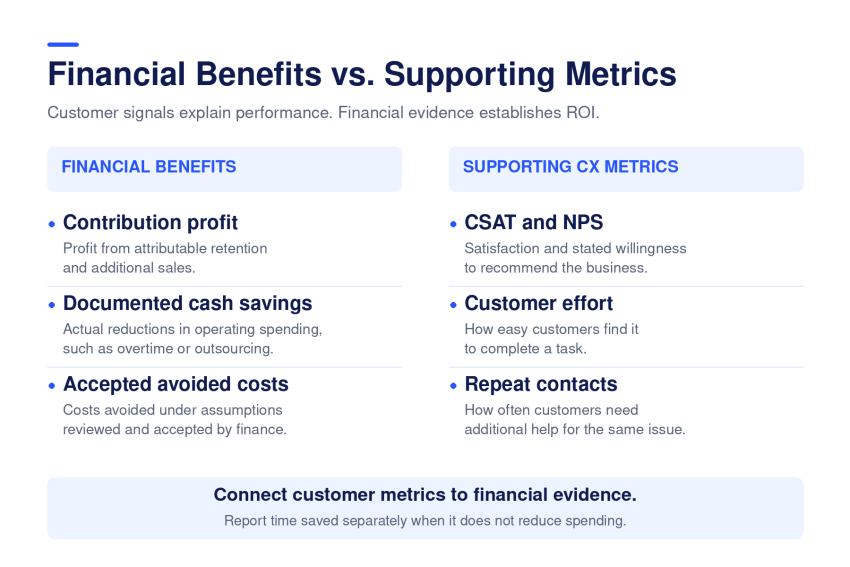
Use customer experience metrics to understand what changed, then connect those changes to financial evidence.
| Metric | What it helps assess | Financial evidence to examine |
|---|---|---|
| Customer retention or churn | Whether customers stay longer | Attributable retained-customer contribution profit |
| Conversion rate | Whether more qualified prospects buy | Incremental contribution profit after accounting for acquisition costs |
| Repeat-purchase rate | Whether customers return | Additional contribution profit within the measurement period |
| Repeat contacts and cost per resolved issue | Whether support becomes more efficient | Changes in actual service expenses |
| CSAT and customer effort | How customers assess an interaction | Links with repeat contacts, retention, or purchasing behavior |
| Net Promoter Score | Customers’ stated likelihood of recommending the business | Actual referrals and their financial contribution |
Customer lifetime value can support longer-term analysis, but you must define whether your model measures revenue or profit. Do not add lifetime-value gains to retention benefits when they represent the same customers and cash flows.
Track operational and financial results separately, and then explain how they are connected.
3. Validate results against a baseline
Compare performance before and after the initiative, using consistent definitions and measurement periods. Where practical, use a comparable group that has not received the change.
Account for seasonality, pricing changes, promotions, and differences in customer mix. If a comparison group is unavailable, explain that limitation and use conservative attribution assumptions.
Evaluate retention and growth according to the initiative’s purpose. Neither should automatically take priority over the other.
4. Present the business case to finance
Summarize the proposal in a format finance can review:
- The customer problem and initiative scope.
- Baseline performance and the comparison method.
- Implementation and ongoing costs.
- Expected benefits, with their data sources.
- Conservative, expected, and optimistic scenarios.
- The measurement period and review dates.
- An owner for each assumption and metric.
Distinguish forecast ROI from measured ROI. For longer-term projects, work with finance on cash-flow timing, payback, and whether discounted analysis is appropriate.

Common Mistakes When Measuring Customer Experience ROI
- Counting revenue as profit: Apply an agreed margin before treating additional sales as a financial benefit.
- Double-counting benefits: Retention, repeat purchases, and lifetime value may overlap.
- Treating satisfaction as ROI: CSAT and NPS provide useful signals but need a connection to financial outcomes.
- Calling all time savings cash savings: Report released capacity separately unless spending falls or an agreed cost is avoided.
- Ignoring full costs: Include integration, training, administration, usage, and maintenance.
- Overstating attribution: Account for other changes that could explain the result.
- Missing employee and journey effects: Check whether an improvement removes work or simply shifts it to another team or channel.
Use consistent definitions and document exclusions so reviewers can understand how the result was produced.
Connect Your CX Data With the Nextiva NEXT Platform
A credible ROI model needs visibility into customer interactions and the outcomes that follow. When conversations and records sit in separate tools, connecting those events becomes harder.
The Nextiva NEXT Platform brings supported communication channels, conversation history, and customer records into a shared environment. Use that connected view to investigate repeat contacts, handoffs, and opportunities to improve service.
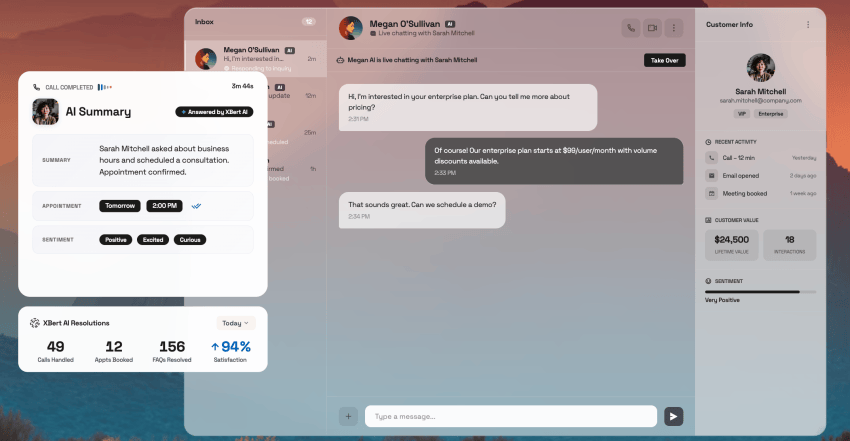
Explore the Nextiva NEXT Platform and ask for a demonstration using your customer journey. Confirm the channels, integrations, and reporting available for your proposed configuration, then connect those operational measures with your finance data to evaluate ROI.
Build Amazing Customer Experiences
Transform your customer journey and acquire, retain, and grow your customers.
Net Promoter, Net Promoter Score, and NPS are trademarks of NICE Satmetrix, Inc., Bain & Company, Inc., and Fred Reichheld.
Customer Experience ROI FAQs
Customer experience ROI compares the attributable financial benefits of a CX initiative with its total cost. It is typically expressed as a percentage over a defined measurement period.
Subtract total initiative cost from attributable financial benefits, divide the result by total cost, and multiply by 100. Use incremental profit and documented savings, with costs and benefits measured consistently.
There is no universal benchmark. A positive ROI means the modeled benefits exceed costs, but an investment must also meet the business’s requirements for timing, risk, and return.
No. They measure aspects of customer perception and stated recommendation intent. Use them alongside operational and financial data to assess whether an initiative creates measurable value.
It depends on the initiative. Operating-cost changes may appear sooner than retention benefits. Define the review period before launch and account for implementation and adoption time.
Yes, but attribution is less certain. Compare against a consistent baseline, account for other influences, and disclose assumptions rather than assigning every improvement to CX.