

 VoIP
VoIP  Blog
Blog  Business Communication
  Customer Experience
  Leadership
  Marketing & Sales
  Nextiva News
  Productivity

Not every local business has the capital to go with Podium when they’re just beginning. While Podium offers review management, text messages, and webchat in a single unified inbox, it can also catch business owners by surprise when the bill arrives. At present, Podium doesn’t list pricing on its website, but third-party sources indicate it costs between $500 and $800 per month with add-ons, usage fees, and per-location prices.
Even if the cost can be justified later, it’s a bet for a local business owner who’s just begun. Moreover, even at that price, it doesn’t include a full business phone system. If any of this encourages you to look for a Podium alternative, this guide compares eight providers that fit different business needs. Pick the one that fits your purpose and, most importantly, your pockets.
Why Businesses Switch From Podium
Podium’s pricing is a bit too much for a local business striving to grow and be sustainable. On top of that, the AI reply module is a separate $ 99-per-month add-on. But it doesn’t end there. Costs seem to increase further with the 10DLC carrier compliance fee and the cost of each phone number beyond the plan limits.
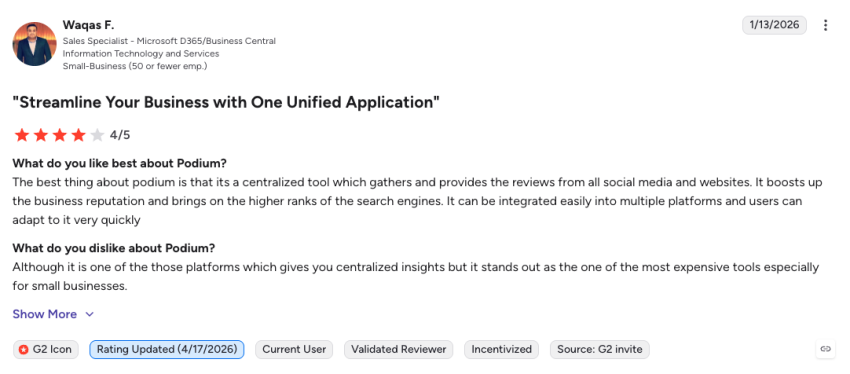
Kevin C, a real estate broker and longtime Podium customer, gives the fairest version of this warning in his video review: “It’s not the cheapest software out there.” Weigh the expense against what you genuinely expect it to return. He likes the product but still tells you to do the math first.
Podium also needs to make the transition to another product a bit easier. Some users report auto-renewal even after trying to cancel.
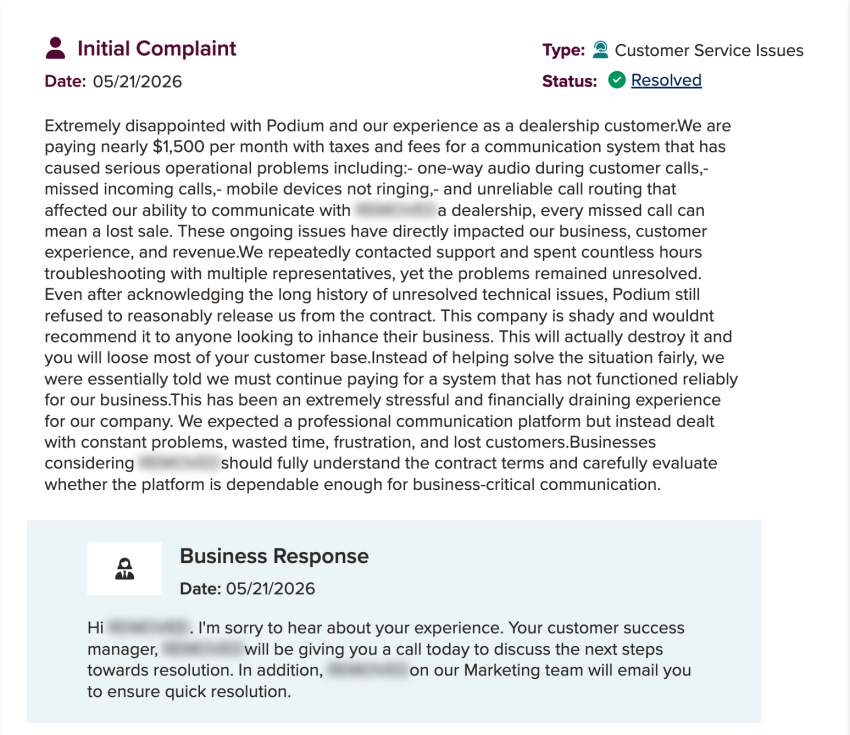
Underneath all of it sits a structural issue: Podium centers on texting, webchat, and reviews. Voice was never the point, so businesses bolt on a separate phone service and end up managing parallel systems. This splits customer interactions across tools and slows response times.
Top Podium Competitors for Local Businesses
Managing communications all day long isn’t the core of a local business, especially in retail, dealership, or service-based operations. Your communication system needs to support this fact, providing a single, omnichannel interface to streamline customer communication and engagement. This way, you don’t spread your focus among systems and can concentrate on what really brings you business.
Nextiva offers a unified solution for your communications if you’re a local business. It handles it all at a fraction of the cost that Podium charges for its services.
1. Nextiva: best all-in-one calling, SMS, and AI receptionist
Podium consolidates everything except the channel local businesses depend on most: the phone. It charges $30 per seat to fix that. In comparison, Nextiva charges $15 per user per month for a core plan.
In addition, it comes with social media and review management capabilities built into the same workspace, so your online reputation lives next to your calls and texts. For a single-location business, it’s a small business phone service and a messaging tool in one invoice at a fraction of Podium’s entry price.
The piece Podium can’t match is XBert, Nextiva’s AI receptionist. It’s an AI-powered add-on that costs $99 per month. XBert answers calls, texts, and web chats around the clock, books appointments on your synced calendar, and handles up to 100 resolutions before a $0.99 per-interaction overage kicks in. It keeps your front desk available 24/7 so you don’t miss a call after business hours.
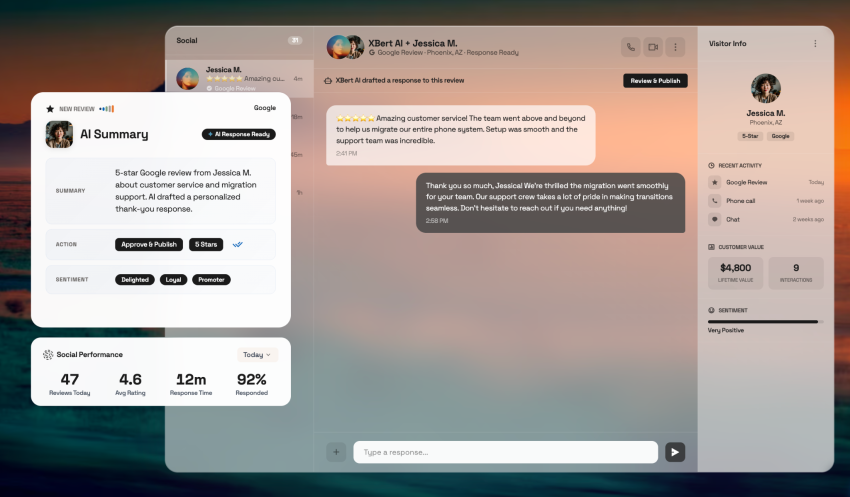
Below are the key features that make Nextiva a strong, cost-effective alternative to Podium:
- Calls and texts included from $15 per user: Nextiva’s Core plan bundles phone calls, business SMS, video meetings, and team chat. Podium starts around $399 per month and still bills phone seats separately at $30 per user for the first four seats.
- Review management built into the base plan: The Core plan includes review management that pulls Google Business, Yelp, and TripAdvisor customer reviews into a single dashboard with real-time notifications, so the core Podium use case comes standard rather than as a premium tier.
- An AI receptionist, not just AI review replies: XBert answers calls, texts, and chats 24/7 and books appointments for $99 per month with 100 resolutions included. It also captures lead details and triggers follow-ups and workflows in your CRM. Podium’s $99 AI Employee add-on centers on automating review responses, not answering your phone.
- Pricing you can review before a sales call: Nextiva publishes its rates. Podium’s pricing page routes every plan through a sales conversation.
- Webchat widgets and a chatbot for your site: Live chat and an AI chatbot are available as Core plan add-ons and are included on higher tiers, so website visitors get instant answers instead of bouncing.
- Carrier-grade reliability: The network runs on eight points of presence with proven uptime, which matters once voice becomes a channel you depend on.
- Proven at a serious scale: Hyundai used Nextiva’s review software across 968 dealerships and reported a 98% improvement in customer response time and an 11% lift in positive reviews.
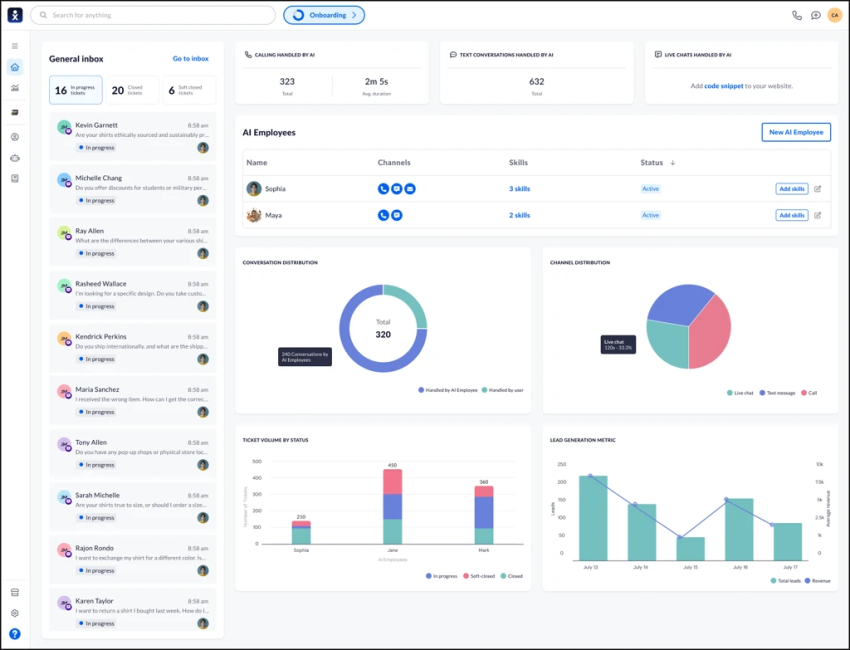
2. Birdeye: best for multi-location businesses
Birdeye is an AI-driven marketing platform that manages listings, review generation, surveys, social media, and customer messaging from a single dashboard. Pricing is where small operators should slow down. Based on third-party sources, Birdeye costs between $299 and $449 per location per month, billed annually.
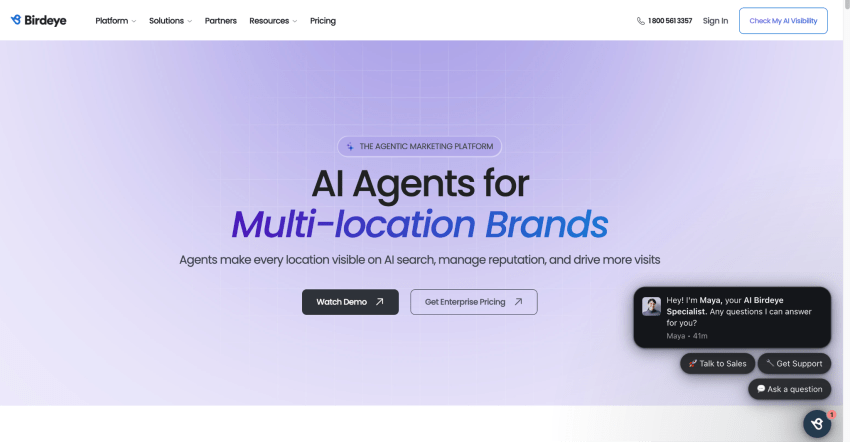
The pricing seems a bit high if you’re a single-location owner and don’t need the full toolkit. The marketing automation and benchmarking features make more sense for multi-location brands, comparing performance across storefronts. There’s also a pattern worth noting. The product earns strong marks from active users on G2, but Birdeye’s Trustpilot page has very different reviews about what happens at the end of the contract. For example, a reviewer reported, “It took over 6 weeks to try to cancel my subscription.”
Product experience and contract experience are two different lifecycle stages. Read reviews on both before you sign anything annual, with Birdeye or anyone else.
3. Broadly: best for home services and local businesses
Broadly builds for HVAC companies, plumbers, automotive shops, and similar local service providers. Its strength is simplicity: quick onboarding, clean review request templates, client texting, web chat, and a mobile app that a field crew will actually open. Customers give it a 4.8-star rating on Capterra across 336 reviews.
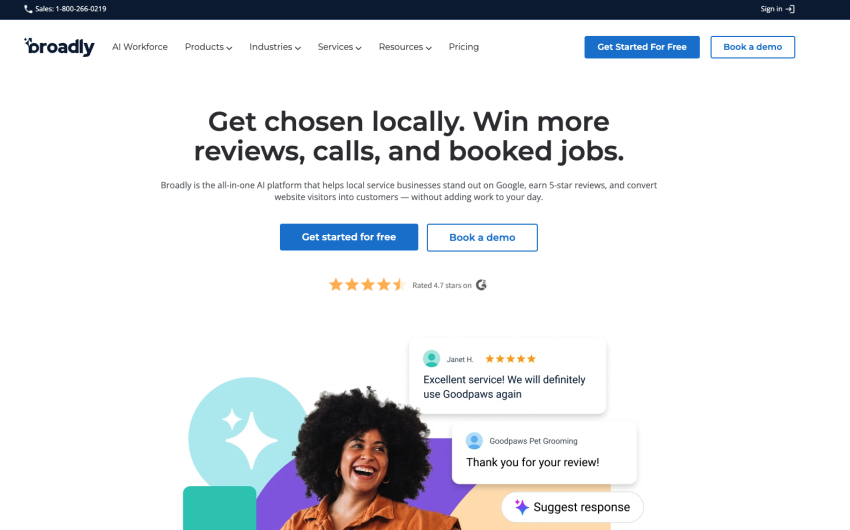
Current pricing data extracted from Broadly’s page shows bundles at $799 per month.
There are two things to check before buying:
- Reporting is lighter than what enterprise platforms offer.
- Voice is an afterthought. Even the $999 Premium bundle caps calling at 300 voice minutes a month.
A busy service business can burn through that in a week.
4. NiceJob: best for simple, automated review generation
NiceJob answers one question well: How do you get customers who promise a review to actually leave one? It connects to your job management apps and sends automated review invites when work wraps, with smart routing that nudges happy customers to public review sites and unhappy ones to private feedback channels.

The pricing is the friendliest on this list. The Reviews plan costs $75 per month, with no contracts and no credit card required for the 14-day trial; the Pro plan is $125 per month.
Know what you’re buying, though. Practitioner reviews aggregated across G2 and Capterra indicate that reporting metrics and analytics are fairly basic. Moreover, NiceJob doesn’t support team chat, phone routing, or broader customer support channels.
It’s a deliberate point solution. If reviews are the whole job, that’s a feature.
5. GatherUp: best for deep reputation and feedback management
GatherUp goes a layer deeper than review counts. Alongside third-party reviews, it collects first-party feedback and Net Promoter Score data through custom surveys, so you learn what customers think before it shows up as a public one-star review. It suits teams that treat reviews as customer experience data, not just an online presence play.
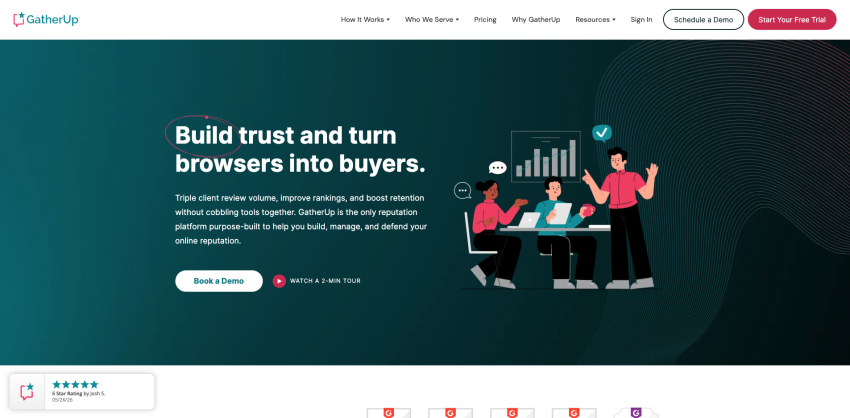
Pricing stays SMB-friendly: $99 per month for a single location, dropping to $60 per location for two to 10 locations. Capterra users rate it 4.6 stars.
The trade-off is focus: GatherUp measures and manages sentiment; it doesn’t run day-to-day two-way texting or front-office communication.
6. Grade.us: best for agencies and white-label management
Grade.us isn’t really for business owners at all. It’s for the marketing agencies that manage their clients’ reputations on their behalf. Every plan includes basic white labeling. Multi-location plans run $60 per location per month, and agency plans are available upon request.
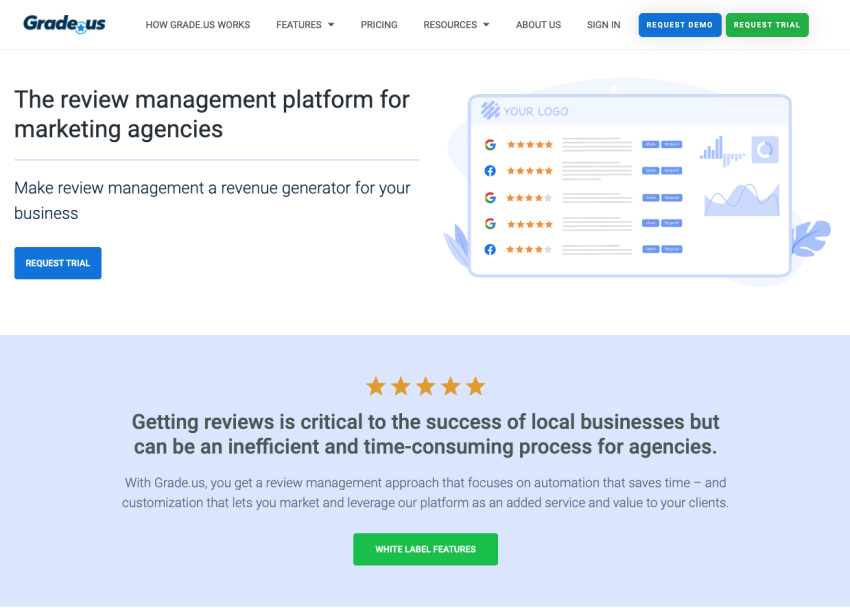
Pricing seems high for some users. A smaller team would take the biggest blow when scaling to multiple clients. G2 reviewers also note limitations with customization options.
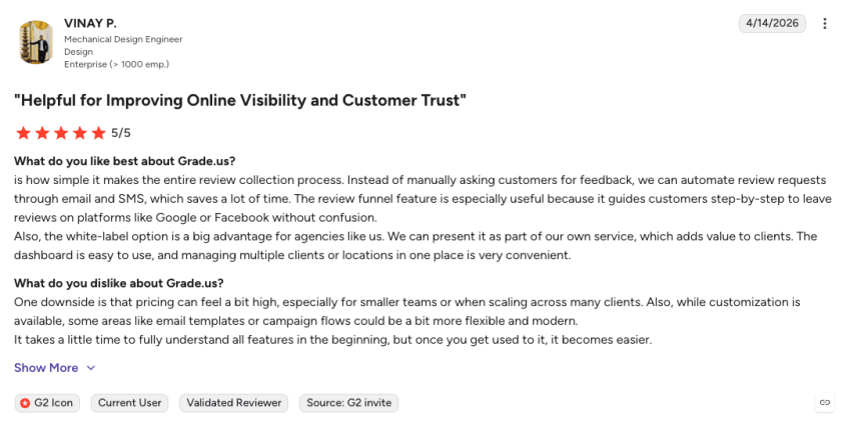
If you’re a single-location owner reading this, skip it; if you sell reputation management as a service, it’s a purpose-built option.
7. Reputation: best for enterprise reputation management
Reputation, formerly Reputation.com, serves the other end of the market: multi-brand organizations with hundreds of locations, compliance requirements, and a need for sentiment analytics and social listening at scale. It’s strongest in regulated, multi-location industries like healthcare and the automotive sector.
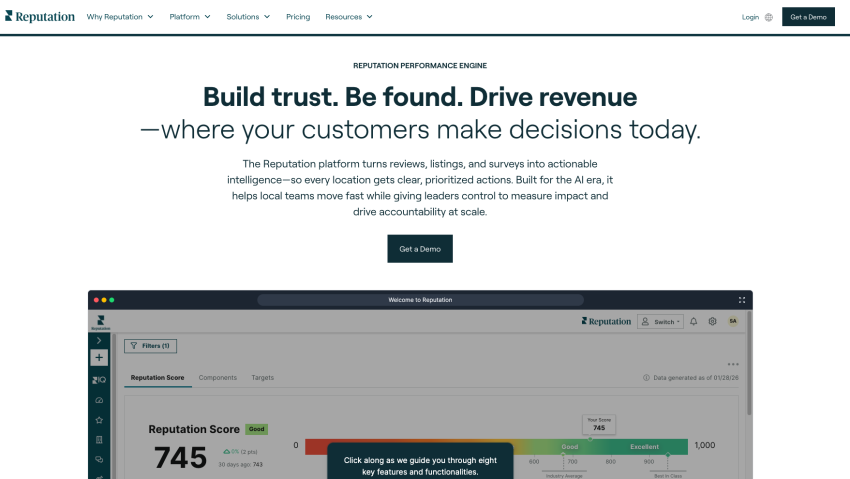
G2 buyers score it 4.5 stars across a smaller, enterprise-skewed review base.
Don’t expect a price tag, as the company publishes no tiers. The prices are likely to be high with enterprise-scale implementation. Factor in long implementation cycles and a steep learning curve. It’s a fit for a 400-location brand, but prohibitive for a three-location one.
8. Yext: best for local SEO and directory listings
Yext does one structural job better than anyone else: syncing your business name, address, phone number, and hours across search engines, maps, and directories from a single dashboard. SMB packages run $199 to $999 per location per year, billed annually.
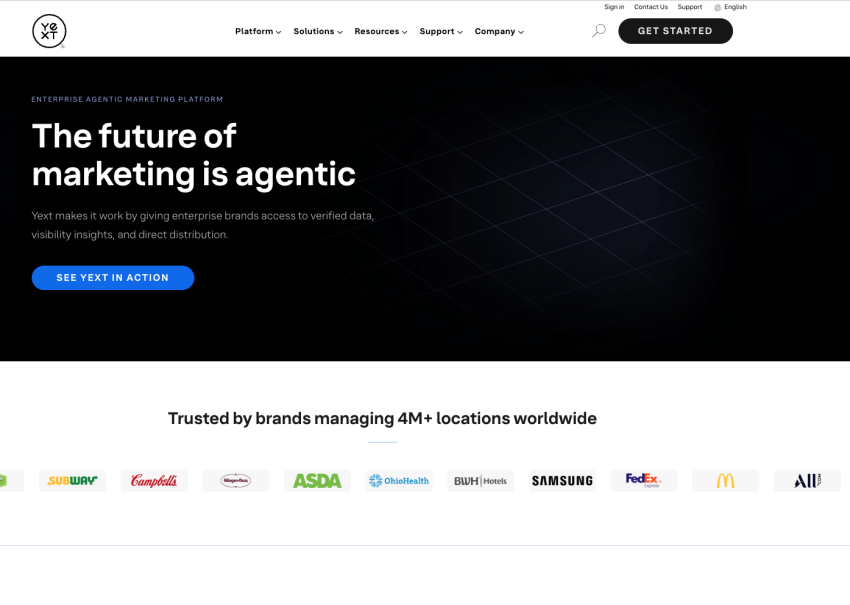
The practitioner community is split on who should pay for it. One local SEO consultant calls Yext “ludicrously expensive” for most small businesses while acknowledging that it makes sense for franchises managing constant address and phone changes at scale.
Translation for this list: Yext is a legitimate pick for multi-location brands drowning in listing updates. It’s not a Podium replacement because messaging and review responses are secondary features behind the listings engine.
How to Choose the Right Podium Alternative
Begin with one diagnostic question: Where do your customers actually reach you? If the answer includes the phone, every messaging-only platform on this list carries a hidden second bill. You’ll still need the separate phone service, plus the staff time to monitor two inboxes. A unified platform such as Nextiva removes this line item entirely, and its contact center solutions extend the same consolidation to teams handling higher volume across channels.
Next, read the contract before trying the demo. Favor transparent monthly pricing over opaque annual quotes, and get any cancellation terms in writing.
Then, weigh the criterion most 2026 buyers still skip: AI features that answer customers, not just AI that drafts review replies. Buying a customer communications platform in 2026 without AI agents that can answer the phone means shopping again in two years.
Here’s a quick summary of your choices:
- Calls, texts, and reviews on one bill: Nextiva
- Reviews only, lowest cost: NiceJob
- Dozens of locations under one dashboard: Birdeye
- Customer feedback and NPS depth: GatherUp
- Agency managing client reputations: Grade.us
- Enterprise scale or heavy listings management: Reputation or Yext
Stop Paying Twice to Talk to Your Customers
Every platform in this guide can outdo Podium at something. NiceJob collects reviews for a fifth of the price. Birdeye scales across locations. Yext keeps a franchise’s listings straight. What none of the point solutions fix is the bill behind the bill: the separate phone system, the unanswered after-hours calls, the customer data split across six or seven tools that CX teams already juggle.
This is the real reason the renewal invoice you get from Podium feels heavy. You’re not just paying Podium’s price. You’re paying for everything Podium doesn’t do.
Nextiva collapses the stack: calls, texts, online reviews, and a 24/7 AI receptionist on one platform, with published pricing you can review before a sales call.
Explore Nextiva’s small business phone service and turn the next missed call into a booked customer.
Get the best business phone service for less.
Simplify team communication with the top-rated phone system for small businesses. A powerful phone service with voice, SMS, and video conferencing built in.
Frequently Asked Questions About Podium Alternatives
Podium is an interaction platform built around text messaging, webchat, and review generation; it doesn’t publish pricing, and user-reported quotes start at around $399 per month for Core. Nextiva is a unified communications platform that combines phone calling, SMS, video, team collaboration, and review management, plus messaging apps like WhatsApp on higher tiers. It starts at $15 per user per month, with the XBert AI receptionist available at $99 per month.
There are several. NiceJob at $75 per month with no contracts attached is the budget pick if review generation is your only need. If you want both messaging and a phone system, Nextiva’s $15 per user entry point undercuts Podium’s reported $399 floor by a wide margin, even after adding AI.
Birdeye is the best alternative in this situation. Its per-location model, listings management, and survey tools are suitable for brands that run dozens of storefronts from one dashboard, with reported tiers starting at $299 per location per month. Budget carefully, since costs multiply by location and contracts are annual.
Yes, this is its core market. Broadly provides businesses such as HVAC, plumbing, and auto repair operators with easy client texting, review requests, and scheduling with minimal setup. Expect simpler analytics than enterprise tools, and note that even its top bundle includes only limited voice minutes.
An AI receptionist is the most direct route. Nextiva’s XBert answers calls, texts, and web chats 24/7, books appointments on synced calendars like Google Calendar and Calendly, and starts at $99 per month for 100 resolutions.