
 Customer Experience
  Blog
Blog  Business Communication
  Leadership
  Marketing & Sales
  Nextiva News
  Productivity
  VoIP
VoIP 

I’ve gone beyond the standard fare of contact center trends articles you’ve surely scrolled past. Instead of rounding up basics like “AI this” and “put customers first,” I’ve reached out to industry analysts, contact center vendors, and frequent contributors and influencers within the market.
You won’t want to miss these, especially if you run a contact center or a customer service team.
Yes, artificial intelligence (AI) and automation remain high priorities. But the conversation has shifted, and rightly so.
Leaders are no longer asking whether to adopt AI, but how to implement it responsibly to optimize outcomes, protect agents, and deliver consistent value across increasingly complex customer interactions.
Based on the perspectives shared by analysts, vendors, and practitioners across the contact center industry, here are 10 customer experience (CX) trends that will not only shape how contact center and call center teams are preparing for the year ahead, but also perhaps the next decade as we get used to new technology.
Customer experience is driving much of the contact center activity in 2026, so the focus is on CX rather than technology for technology’s sake.
- Premium CX channels emerge as a differentiator
- Automation grows up — and metrics must follow
- CX maturity shifts from containment to recovery
- Clean data becomes the foundation for effective AI
- AI reshapes staffing — and raises burnout risks
- Omnichannel expectations continue to rise
- Phone systems begin encroaching on the contact center
- Governance and trust become CX differentiators
- Intent becomes context, not just routing
- AI augments (not replaces) the human layer
1. Premium CX Channels Emerge as a Differentiator
Speed and access to humans are becoming increasingly valuable in an impatient market.
Martin Taylor, co-founder and Deputy CEO at Content Guru, predicts a rise in tiered CX models, where frictionless automation handles everyday inquiries while fast, human-led service becomes a premium offering. Drawing parallels with the airline industry, he notes that just as travelers pay for priority boarding or upgrades, customers will increasingly pay for immediacy, empathy, and expertise.
This model reframes how organizations think about self-service and escalation. Instead of treating automation purely as a cost-reduction tool, businesses can use AI-powered routing, interactive voice response (IVR), and self-service options to create clearly defined service tiers. Routine questions are resolved quickly, while time-sensitive or emotionally charged customer issues are routed to live agents without friction.
Taylor notes that this approach allows brands to move beyond simple budget-versus-luxury positioning. Enabled by AI working alongside human agents, organizations can serve a wider range of customer needs, improve customer satisfaction, and generate new value while still maintaining strong operational efficiency. In an automation-first world, empathy and human connection are becoming premium features.
2. Automation Grows Up — and Metrics Must Follow
For years, contact center automation focused on reducing call volume, shrinking wait times, and deflecting inquiries through self-service and chatbots. In 2026 and beyond, those basics will become table stakes.
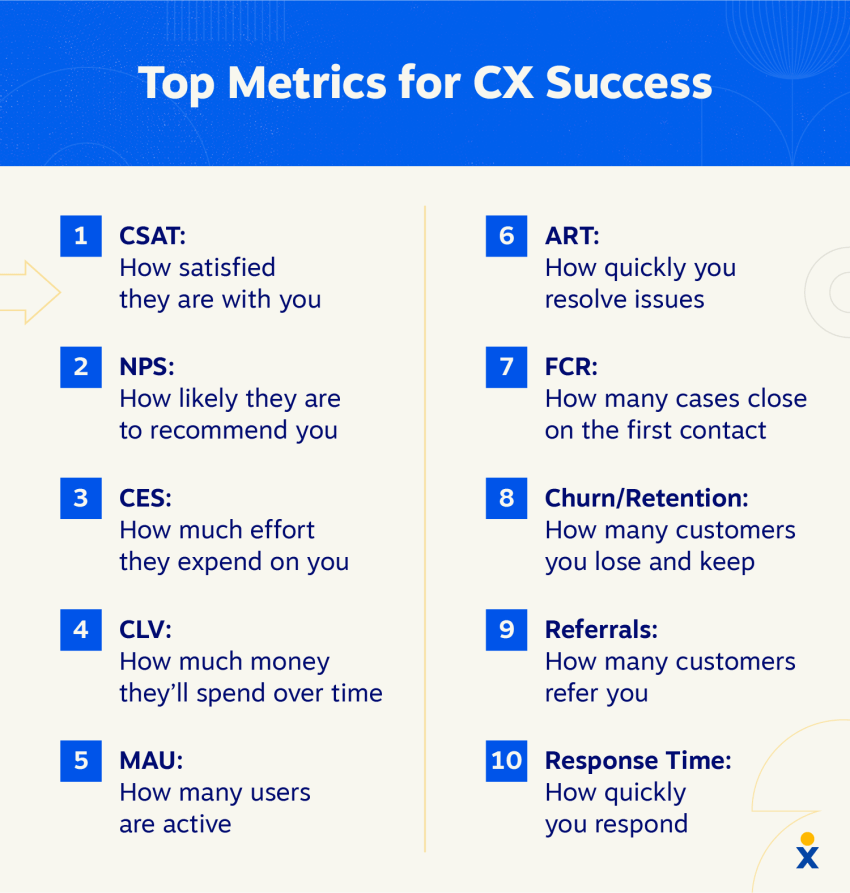
As Blair Pleasant, President and Principal Analyst at COMMfusion, notes, traditional metrics like handle time become less meaningful when AI agents handle straightforward requests and human agents take on more complex issues.
Measuring AI success requires new benchmarks, including:
- Containment quality
- Handoff efficiency
- AI assistance utilization
- Outcome-based measurements that reflect real customer value
That said, Brent Kelly, Principal Analyst at Omdia, makes an important counterpoint. Average handle time (AHT) still matters — particularly as a customer satisfaction indicator. If a bot or AI-powered system technically resolves an issue but forces customers to endure long phone calls or drawn-out messaging sessions, the business hasn’t gained anything.
In practice, this means call center leaders won’t abandon legacy KPIs. Instead, they’ll expand them. Dashboards will blend AHT, first-call resolution, resolution rates, and quality assurance scores with AI-specific measurements. The goal isn’t to optimize a single number, but to understand how automation and humans work together to serve customers in real time.
3. CX Maturity Shifts From Containment to Recovery
By 2026, CX maturity will be defined less by avoiding mistakes and more by how well organizations recover when AI gets things wrong.
Mefteh Werghemmi, co-founder at Heedify, explains that the focus will shift away from how often automation successfully contains interactions and toward whether it escalates at the right moment — and how painful it is for customers to recover when it doesn’t. In this model, escalation accuracy and recovery efforts become stronger indicators of CX health than containment alone.
Edon Abdulovski, Technology Architect at Infosys, builds on this by highlighting how recovery changes routing and workflows. Intent alone is no longer sufficient. Systems must consider confidence, risk, past outcomes, and the cost of being wrong before deciding whether to continue automation or involve human agents.
This recovery-first mindset has a direct impact on customer relationships. Poor recovery increases frustration, drives customer churn, and damages trust. Mature contact center platforms will focus less on being right every time and more on recovering gracefully when they aren’t.

4. Clean Data Becomes the Foundation for Effective AI
As organizations deploy more advanced conversational AI, many are discovering that AI performance depends less on models and more on content readiness.
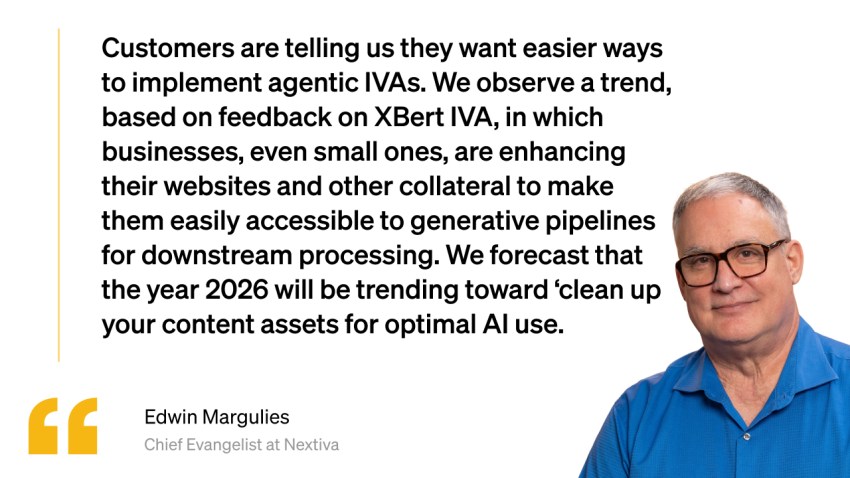
Firsthand feedback gathered throughout 2025 shows that organizations implementing agentic IVAs show a consistent pattern: businesses are actively enhancing websites, documentation, policies, and knowledge base content to make them accessible to generative AI pipelines.
What starts as preparation for customer-facing self-service options often extends into internal intelligence assets such as procedures and best practices.
This focus on data hygiene supports better customer interactions, improves answer accuracy, and reduces unnecessary escalations. In the future, AI success will depend as much on content governance as on AI technologies themselves. Clean content helps streamline workflows, reduce call volume, and improve customer satisfaction at scale.
5. AI Reshapes Staffing — and Raises Burnout Risks
As AI takes over more repetitive tasks, the work left for agents becomes more demanding.
Ty Stephens, Director of Channel Sales at Five9, notes that as automation handles simpler interactions, agents increasingly face back-to-back complex calls. These are often emotionally charged, high-stakes conversations that require empathy and problem-solving.
As a result, contact center leaders are rethinking staffing, schedules, and recovery time. Introducing health breaks, smarter forecasting, and better workforce management practices are becoming essential to prevent burnout. In 2026, improving agent productivity won’t be about pushing agents harder, but about protecting agent performance over time.

6. Omnichannel Expectations Continue to Rise
Customer expectations for flexibility across communication channels continue to increase.
Over the last decade, talking with clients and vendors, it has become clear that customers expect seamless transitions between phone calls, SMS, social media, chat, and app-based messaging, with context preserved in real time. If they’re getting it from one company, they expect it from every other company.
Repeating information or restarting conversations is no longer acceptable.
To meet these expectations, organizations are investing in cloud-based contact center platforms that unify IVR, digital channels, and CRM data into a true omnichannel experience. When done well, omnichannel strategies reduce wait times, improve customer satisfaction, and support long-term retention while increasing operational efficiency.


7. Phone Systems Begin Encroaching on the Contact Center
Another notable shift is the growing overlap between phone systems and the contact center. This is great news for vendors that provide not just a phone system and a contact center in their portfolio, but an integrated system that connects the two, streamlining the experience for contact center agents and back-office specialists.
Edwin Margulies, Chief Evangelist at Nextiva, observes that many organizations are moving smaller teams off of full contact center platforms and onto modern phone systems enhanced with AI. These systems increasingly include features such as IVR, basic analytics, and automation.
While the true cost benefits are still debated, customers value the flexibility and simplicity. This trend is forcing providers across the contact center industry to clearly articulate what differentiates full contact center platforms from basic call handling.

8. Governance and Trust Become CX Differentiators
As AI adoption accelerates, trust is becoming a defining CX factor. Buyers are scrutinizing AI security, governance, and compliance following high-profile chatbot failures like Air Canada, which was forced to pay $650.88 after its chatbot exposed a customer to misinformation.
Confidence in AI tools now directly impacts customer trust, customer satisfaction, and long-term retention.
At the same time, Thomas Randall, CX Industry Analyst at Info-Tech Research Group, notes that adoption will remain uneven. With only a minority of organizations having a corporate-wide AI strategy, advanced agentic AI deployments will require stronger professional services and clearer guardrails to ensure responsible use.

9. Intent Becomes Context, Not Just Routing
Traditional intent detection has long driven routing decisions. That model is changing.
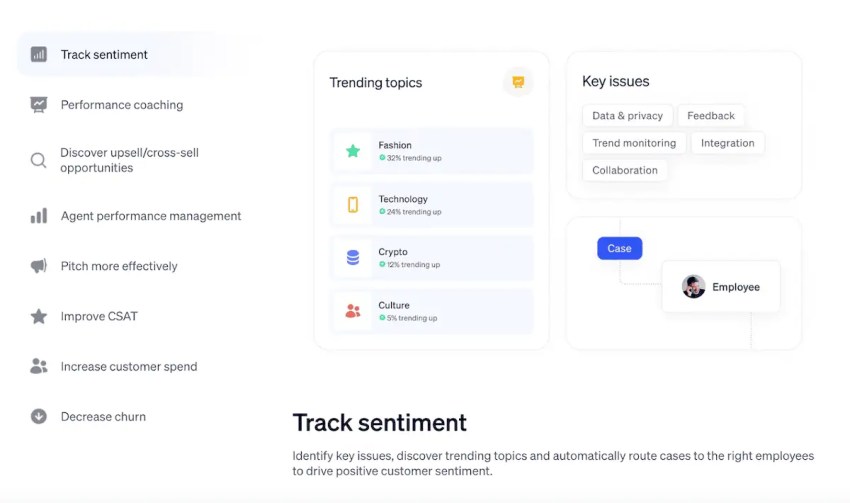
Two interactions with the same intent may require very different handling. Modern contact center platforms evaluate intent alongside confidence, risk, sentiment analysis, and recovery cost before deciding what happens next.
This approach improves resolution rates, protects customer satisfaction, and ensures human agents are involved when automation alone would introduce risk. In 2026 and beyond, context-aware routing will be a hallmark of CX maturity.
10. AI Augments (Not Replaces) the Human Layer
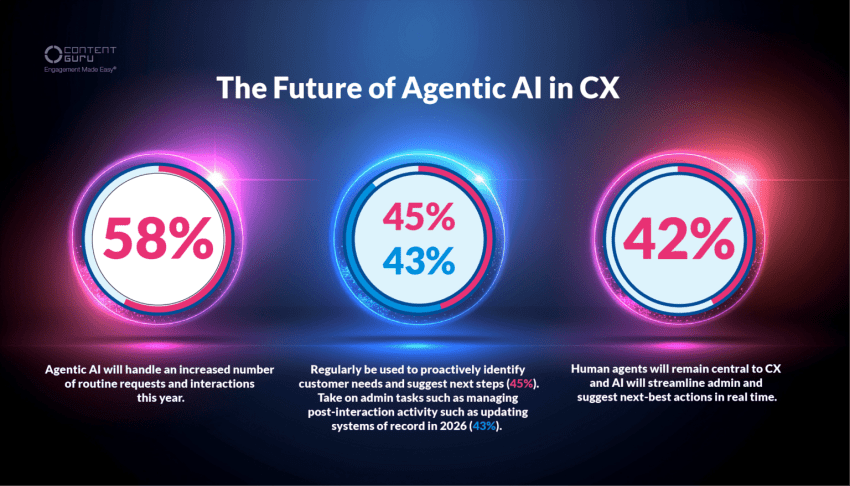
Despite rapid advancements, contributors consistently expect AI to augment, not replace, people. AI-powered systems increasingly act as agent assist, virtual assistants, and decision-support layers. Combined with real-time guidance, robust knowledge base integration, and sentiment-aware prompts, AI helps streamline workflows and empower agents to deliver higher-quality outcomes.
This hybrid model supports better agent performance, reduces handle time for complex interactions, and ensures that empathy remains central to the customer experience.


The 2026 Forecast: CX Maturity Over Novelty
The forecast for 2026 is clear: the most successful contact center and call center teams will focus less on hype and more on maturity. They will balance automation with empathy, design self-service that escalates gracefully, measure outcomes using the right KPIs, and build trust through governance and transparency.
Together, these CX trends point to a future where AI enables better decisions, stronger recovery, and more resilient CX operations. We’re talking about genuine intelligence rather than just speed and self-service.
If you’re exploring these shifts in more detail, Nextiva has a dedicated resource center with topics including risk and security in the age of AI, an AI success kit for CX leaders, and budgeting strategies for 2026.
Want to get ahead of the curve this year? Check out the new Nextiva resource center.
Visit the New Nextiva Resource Center
Our collection of guides, reports, ebooks, and videos will help you drive better customer experiences and stay current on the latest trends and best practices.